
Blog
Haze Indoor Air Quality: The Operator's Playbook
When the API climbs past 100, the fresh air intake that keeps your CO2 in check is also the fastest route for outdoor particulate into the office. Here is how Malaysian facility teams manage filtration, outdoor air, building pressure and occupant communication through a haze episode.
 Tan Kok XinEnergy Monitoring & Analytics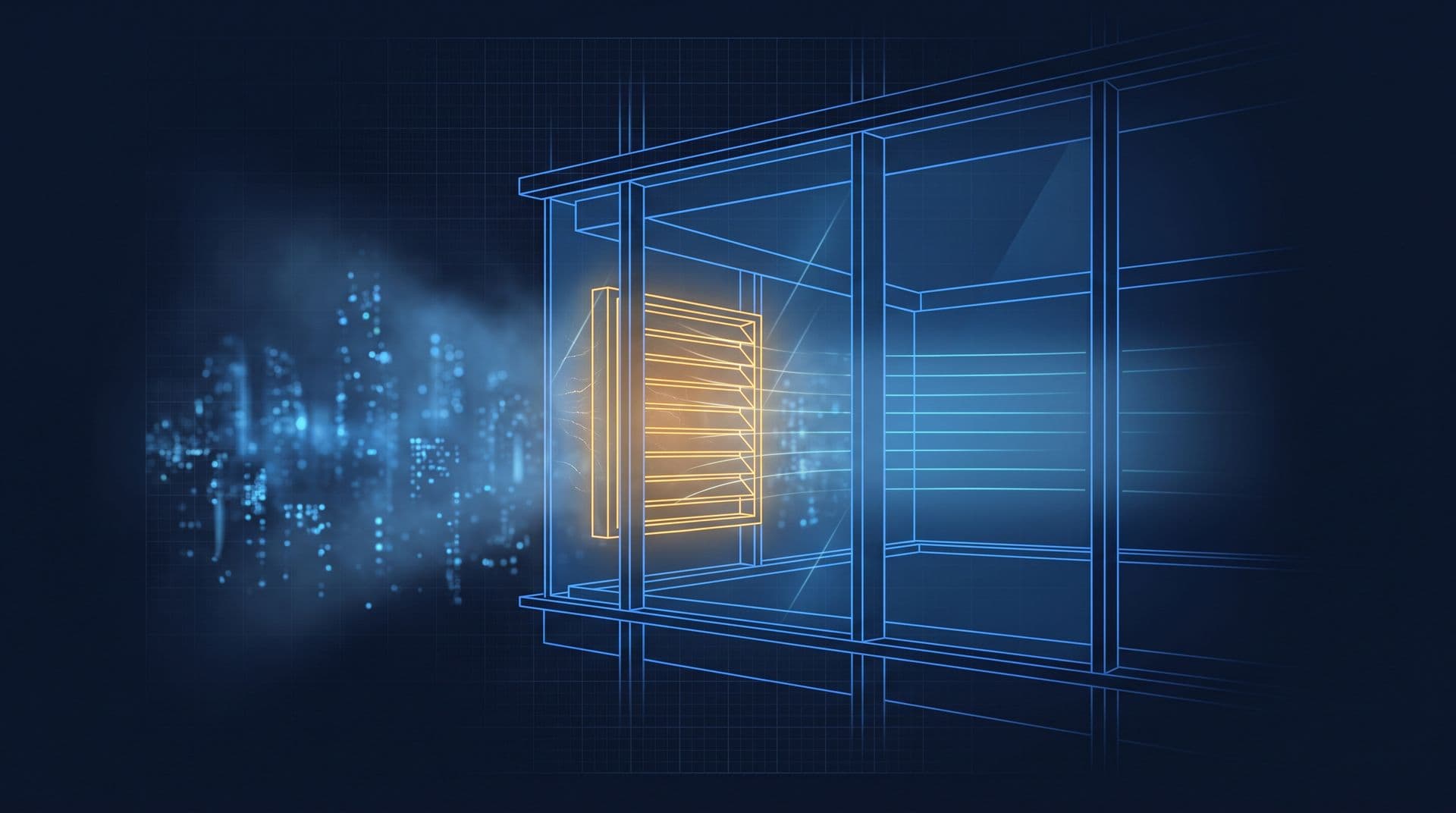
An API reading of 150 over Shah Alam does not stay outside. Within an hour or two the same particulate is in the lobby, the open plan floor and the meeting rooms, delivered through the fresh air intake you are obliged to keep running. Haze indoor air quality is a mechanical problem before it becomes a health complaint: the outdoor air that holds CO2 below the 1,000 ppm inadequate ventilation indicator in the Industry Code of Practice on Indoor Air Quality 2010 is travelling down the same duct that carries respirable dust to your occupants.
Most Malaysian commercial buildings are sealed and ACMV served, which helps. It does not make them airtight, and it certainly does not make them filtered to a standard that was chosen with haze in mind. The filter bank in a typical AHU was specified to protect the cooling coil from lint and coarse dust, not to strip fine smoke particles out of transboundary haze. Knowing that distinction is the difference between a haze plan that works and one that consists of an email telling staff to drink more water.
In short
- Outdoor haze particulate reaches the lobby and open-plan floor within an hour or two through the fresh air intake a building is obliged to keep running.
- Filter grade decides how much of that particulate actually gets stopped, so check what grade is installed before assuming the AHU is protecting the space.
- Closing the fresh air damper during haze is not free: it trades outdoor particulate for rising indoor CO2, on top of the added filter cost.
- Monitor against the indoor PM10 limit, not against the outdoor API reading, since the two do not track each other exactly.
Where the haze actually gets in
Three routes, in rough order of volume.
The outdoor air intake is the big one. Every AHU pulling in code minimum fresh air, roughly 5 cfm per person plus 0.06 cfm per square foot for offices under ASHRAE 62.1, is pulling in whatever the atmosphere is offering that day. During a haze episode that is a continuous, mechanically assisted dose.
Infiltration is the second. Lift lobbies, car park stair pressurisation, loading bays, main entrance doors cycling every few seconds at lunchtime, and gaps around service penetrations. Infiltration is driven by pressure difference, which means it is something you can influence rather than something you simply accept.
Internal re-suspension is the quiet third. Particulate that has settled on carpet, ceiling void surfaces and return air plenums during the first days of an episode gets stirred back into the air by foot traffic and by the return path itself. This is why indoor readings often stay elevated for a day or two after the outdoor API has come down.
Filter grade in practical terms
Filters are rated by how much of a given particle size they capture. Under the older MERV scale, the pre-filters common in Malaysian AHUs sit around MERV 7 to MERV 8. They do a competent job on coarse dust and almost nothing useful on the fine fraction that dominates haze. Moving to MERV 13, or the ISO 16890 ePM1 classes, captures a far larger share of fine particles and is the grade most often discussed for smoke events.
That upgrade is not free, and the cost is not only the filter price.
A higher grade filter has a higher initial pressure drop, and it loads faster in dirty air. On a constant speed fan, higher resistance means less airflow, so you can quietly lose the ventilation rate you were relying on to control CO2. On a VSD driven fan, the drive compensates and you pay in kW instead. Either way, the change shows up on your electricity bill and in the relationship between ventilation and energy that we covered in indoor air quality and energy use in Malaysian buildings.
Three practical checks before anyone orders a pallet of high grade filters:
- Does the housing take the depth? A deep pleat MERV 13 in a frame designed for a 50 mm panel will not seat properly.
- Is the frame sealing? Air takes the easy path. A filter bank with 10 mm of bypass around the gasket delivers close to unfiltered air regardless of what the label says.
- Is there a differential pressure gauge across the bank? Without one, filter changes happen on a calendar rather than on actual loading, which during haze season is the wrong trigger entirely.
If a full grade change is not feasible mid episode, a realistic interim step is shortening the replacement interval on the existing grade and confirming that every bank is sealed and correctly seated.
Should you close the fresh air damper during haze?
Reduce it, do not close it. Cutting outdoor air to the minimum that still holds CO2 below 1,000 ppm is a defensible temporary measure during a severe episode: you are limiting the particulate load while keeping the ventilation performance indicator in the ICOP satisfied. Closing the damper entirely trades a particulate problem for a stale air problem, and CO2 in a densely occupied floor climbs faster than most operators expect.
Two conditions make this work. First, you need to actually know the CO2 level, floor by floor, rather than assuming the design occupancy still applies in a hybrid working office. Second, you need enough supply to keep the building positively pressurised.
Positive pressure is the setting nobody checks
A building that exhausts more than it supplies goes negative, and a negative building sucks unfiltered haze in through every door seal, lift shaft and cable penetration it has. Toilet exhausts, kitchen hoods, car park fans and smoke spill systems all run continuously or on schedule, and if you have trimmed outdoor air without trimming exhaust, you have engineered a leak.
During a haze episode, walk the building at peak occupancy. Doors that swing shut on their own and a slight outward draught at the main entrance are the cheap field test. Loading bay roller shutters left open for convenience will defeat everything upstream of them.
Monitor against the PM10 limit, not against the API
The API tells you about outdoor air. Your obligation as an employer is about the air inside. ICOP IAQ 2010, approved in August 2010 under OSHA 1994, sets an acceptable limit of 0.15 mg/m3 for respirable particulates (PM10), alongside limits including 10 ppm carbon monoxide, 0.1 ppm formaldehyde and 3 ppm TVOC, and comfort ranges of 23 to 26 C and 40 to 70% relative humidity. Formal assessments are carried out by trained, competent assessors, and the full obligation set is laid out in our ICOP IAQ 2010 compliance guide.
The number worth watching during haze is the ratio of your indoor reading to the outdoor reading at the same moment. A low ratio tells you the filtration and pressurisation strategy is working. A ratio drifting towards 1 tells you air is bypassing your filters, and it tells you that before anyone complains about a smoky smell.
Continuous monitoring is what makes that ratio visible. CobiNeural tracks CO2, temperature, humidity and related IAQ sensors alongside energy, water and chilled water, with WhatsApp and email alerts when a floor drifts out of range, and dashboards and reports you can put in front of management or an assessor. It runs standalone or as an overlay on an existing BMS, PLC or SCADA, so a haze response does not wait on a controls upgrade.
Tell occupants what you are doing
Silence during a haze episode gets filled with speculation and personal air purifiers under desks. A short, factual notice works better: what the indoor readings are, what the ICOP limits are, what you have changed in the ACMV system, and what staff should do. Keep windows and balcony doors closed. Reschedule outdoor maintenance and any work at loading bays. Give staff who must work outdoors properly fitted respirators, not surgical masks. Point occupants with asthma or other respiratory conditions to occupational health rather than making a judgement for them. Publish the current DOE reading from apims.doe.gov.my next to your own indoor number so people can see the gap your building is closing.
Haze season is predictable enough to prepare for and long enough to be expensive if you improvise. Filters ordered in advance, dampers with known minimum positions, a pressurisation check and live indoor readings will carry a building through an episode with far fewer complaints than a reactive scramble.
If you want indoor readings and alerts in place before the next episode, request a demo and we will walk through what monitoring your building already supports. Employer obligations under OSHA 1994 and the ICOP are published at dosh.gov.my.
FAQ
Frequently asked questions
Ask us about this topic
Something in this article you want to dig into — or a situation in your own building it doesn't quite cover? Send us your question. We don't run public comments; the team replies to you directly by email.