Blog
Bikeshedding: Why the Meeting Debates the Lobby Thermostat
Parkinson's committee approved the £10 million reactor in 2.5 minutes and debated the £350 bicycle shed for 45. Your tenant-comfort meeting does the same with the lobby setpoint and the chiller retrofit.
 Tan Kok XinThe Essay Series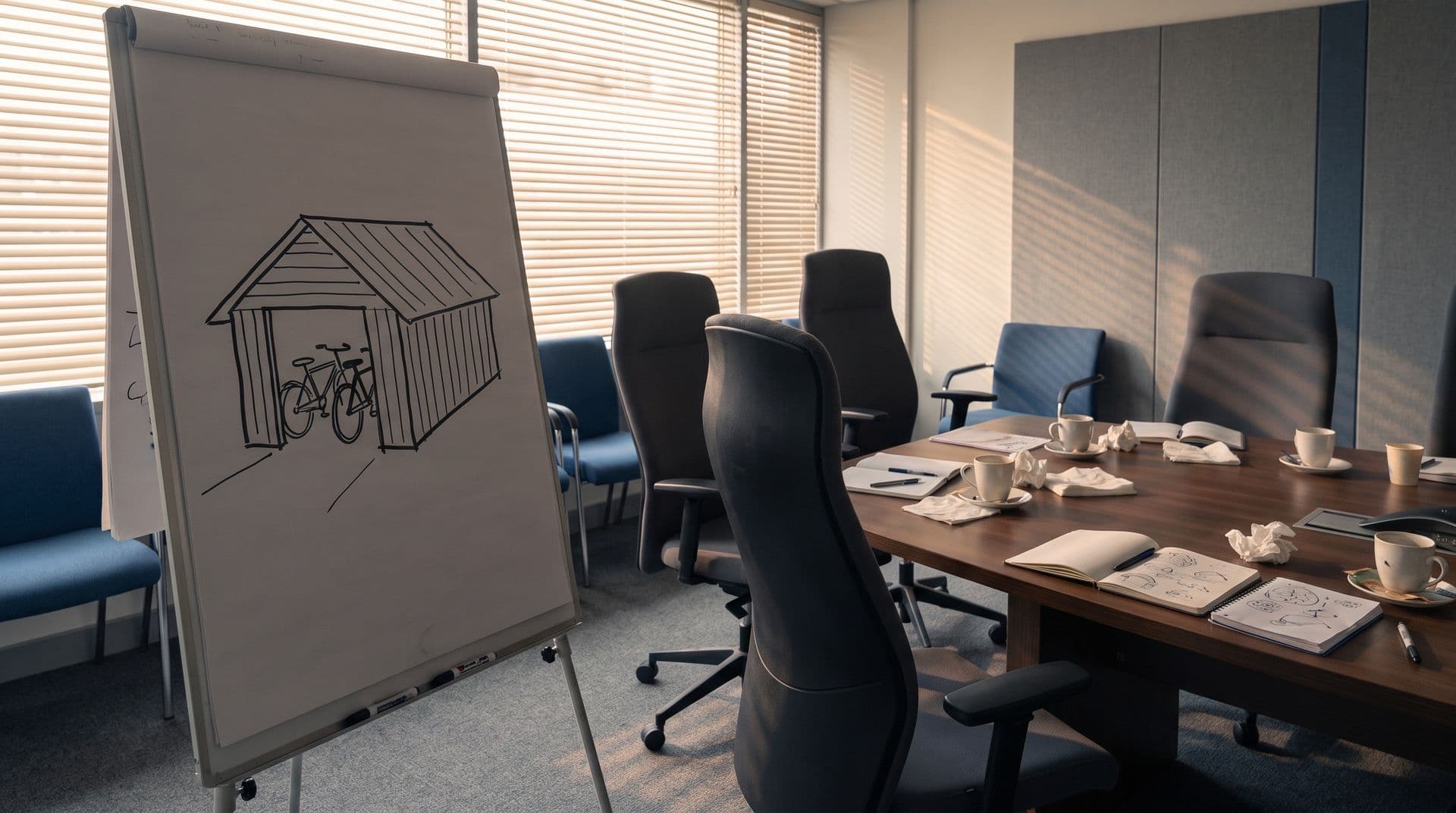
A finance committee sits down with three items on the agenda. Item one: a contract for a £10 million atomic reactor. Approved in two and a half minutes. Item two: a £350 bicycle shed for the staff. Forty-five minutes of debate, much of it about roofing materials. Item three: £21 a year for committee refreshments. That one runs an hour and fifteen minutes.
The committee is fictional. It comes from C. Northcote Parkinson's 1957 satire Parkinson's Law, and engineers now call the pattern bikeshedding. The rule is simple: the smaller the sum on the table, the longer the meeting spends on it. Parkinson put it plainly: "The time spent on any item of the agenda will be in inverse proportion to the sum involved."
Why does it happen? Not stupidity. A reactor is so big and so technical that nobody in the room can really judge it. So everyone quietly assumes somebody else checked the details.
A bike shed, though? Everyone can picture a bike shed. Everyone has an opinion. So the discussion goes on.
The name came much later. In 1999, FreeBSD developer Poul-Henning Kamp wrote a now-famous mailing-list email titled "A bike shed (any colour will do) on greener grass...". The paint colour is his addition, by the way; Parkinson's committee argued about roofing. Kamp's point was the same.
A power plant, Kamp wrote, "is so vast, so expensive and so complicated that people cannot grasp it". A bike shed? Anyone can build one over a weekend "and still have time to watch the game on TV".
Bikeshedding in the plant room
If you sit in building meetings, you have seen this before.
The tenant-comfort meeting spends forty minutes on the lobby setpoint, then approves the chiller-plant retrofit in four. The board debates what colour the solar carport should be, and nobody asks about the escalation clause in the PPA. The energy committee argues for half an hour about which widget goes top-left on the dashboard.
Malaysia is having a national version right now. This month the Deputy Prime Minister ordered every government office to set its air-conditioning no lower than 24°C. The whole country is debating the thermostat, and fair enough, it is a real saving. But look at the number nobody debates.
Under the RP4 tariff, medium-voltage demand charges run RM89.27 to RM97.06 per kW per month. A building that peaks at 1,000 kW pays roughly RM90,000 a month for that peak alone. The peak comes from a single worst 30-minute interval, so one careless Monday morning start-up can cost five figures. That line on the bill gets the reactor treatment: two and a half minutes, approved, next item.
The fix is translation, not smarter people
Attention flows to whatever the room can picture. Everyone can picture a lobby. Almost nobody can picture a kilowatt of chilled-water plant, a delta-T, or a COP curve. So the big decisions stay hard to read, and the meeting drifts back to the shed.
The fix is not hiring smarter directors. It is translation. Put the chiller retrofit on the table as ringgit per month, the PPA clause as ringgit per year, and the setpoint as ringgit per degree.
When the big item is as easy to picture as the small one, the forty minutes land where the money is. That is the reporting job we built CobiNeural for: it turns meter data into EECA- and ISO 50001-aligned numbers a committee can actually argue about.
One caution: trusting the experts on the reactor was not foolish. Boards should not have to master chiller thermodynamics. The problem is trusting without checking. Approve because someone showed you a number you could test, not because the item was unreadable.
Where the bike shed metaphor breaks
To be fair, the lobby setpoint is not really a bike shed. Parkinson's shed cost £350, once. Air-conditioning is about 57% of a Malaysian office building's electricity. Each degree of setpoint is worth roughly 7% of cooling energy, so a careful setpoint debate is real money.
There is also comfort. "Too cold" and "too hot" are the top two office complaints in IFMA surveys, and comfort feeds straight into lease renewals. The shed never complained or moved out; tenants do. Even the widget argument matters a little, because whatever sits top-left shapes what the committee pays attention to next quarter.
So the skill is not banning small debates. It is knowing which is which. Some small debates are a stand-in for a big number nobody can read. Others are the actual business.
If your meetings give the lobby forty minutes and the chiller four, the problem is probably not the people. It is that only one of those items comes in a language everyone speaks. Request a demo and we will show you your building's reactor-scale numbers, in ringgit. They are worth at least two and a half minutes of the agenda.
FAQ
Frequently asked questions
Ask us about this topic
Something in this article you want to dig into — or a situation in your own building it doesn't quite cover? Send us your question. We don't run public comments; the team replies to you directly by email.