Blog
Shopping Mall Energy Management in Malaysia: A Guide
Half a mall's electricity runs through the chiller plant, and one festive Saturday half-hour sets the RP4 demand charge. A practical guide for Malaysian mall operators: load split, tenant billing, the measure stack, BEI benchmarks and EECA.
 Tan Kok XinIndustry Guides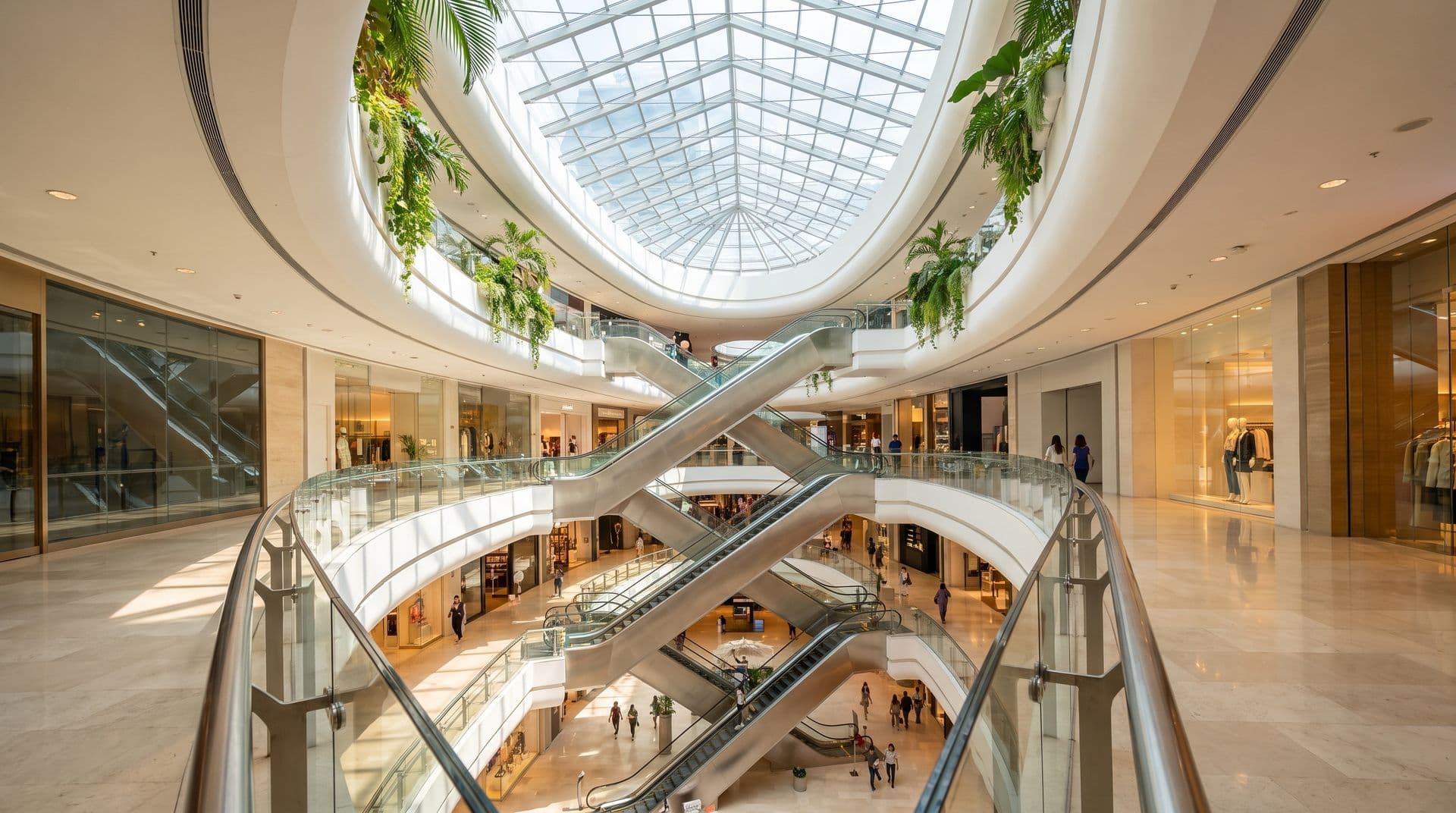
In December 2024, the Malaysia Shopping Malls Association (PPK) warned that the July 2025 tariff restructure could add roughly RM5 million a year in electricity cost for a 500,000 sq ft mall, on top of an ICPT surcharge that had already climbed from 2 sen to 16 sen/kWh. That was a pre-implementation estimate, not a measured outcome, but the direction was correct: energy sits among a mall's largest operating costs, and RP4 changed how that cost is calculated. Shopping mall energy management in Malaysia now hinges on three questions. What is your chiller plant drawing? What does your 30-minute peak hit on a festive Saturday? And how cleanly can you separate common-area load from tenant load?
In short
- The July 2025 tariff restructure could add roughly RM5 million a year in electricity cost for a large 500,000 sq ft mall, on top of existing surcharges.
- Common area and tenant load need separate accounting, since a mall's operator typically only controls one of the two directly.
- A mall's maximum demand is often set by a single Saturday afternoon, not by an average weekday.
- Fair tenant billing without spreadsheet disputes depends on metering the split between common area and tenant load at the source.
What shopping mall energy management means in Malaysia
For a Malaysian mall, energy management means controlling one dominant load (the chiller plant, typically around half of total consumption), one dominant tariff exposure (the RP4 capacity and network charges set by a single 30-minute peak each month), and one recurring commercial argument (how common-area electricity gets allocated to tenants). Get those three right and the rest (lighting schedules, escalator drives, carpark fans) is refinement. Get them wrong and no amount of LED retrofitting will show up on the TNB bill.
Malls are also the inverse of offices. An office empties on Saturday; a mall fills up. That single fact shapes everything below, from when your maximum demand lands to whether the new time-of-use structure works for or against you.
Where does a mall's electricity actually go?
About half of it goes through one room. A site investigation of a large Malaysian shopping mall found its water-cooled chiller plant (three 1,245 TR machines) consumed 10,737 MWh a year, roughly 51% of the building's total electricity. Broader studies of malls in subtropical climates put HVAC at 40.1–50.7% of consumption, lighting at 22.1–29%, electrical equipment at 16.6–32.9%, and lifts and escalators at only 2.2–5.3%.
The ranking tells you where to spend engineering effort. A 5% improvement in chiller plant efficiency moves the whole bill more than a 30% improvement in escalator energy. Escalators and lighting are still worth doing, and we cover them later, but they come after the plant room, not before.
Common area vs tenant load: who pays for what?
The landlord's meter feeds two very different loads. Common-area load is everything the mall runs to stay open: the chiller plant, common-area AHUs, escalators and lifts, corridor and facade lighting, carpark ventilation. Tenant load is what happens behind each shopfront: display lighting, POS equipment, kitchen gear, and in many fit-outs, chilled water drawn from the landlord's plant and measured through BTU meters.
The split matters because the incentives differ. Tenants pay for what their sub-meters record, so their waste is self-correcting. Common-area load is the landlord's problem alone, and it is where an oversized chiller stage running for a half-empty Tuesday morning quietly burns money nobody is individually accountable for. If you cannot see the two loads separately, you cannot manage either.
The mall load curve: weekdays, weekends, festive seasons
A typical Malaysian mall trades 10am to 10pm, seven days a week. Footfall peaks on weekends and spikes during festive seasons: Raya, Chinese New Year, Deepavali, Christmas, and the school holidays. The load curve follows the crowd. Chillers stage up through late morning, AHUs run hardest through the mid-afternoon retail peak, and the heaviest half-hours of the month land on a festive-season Saturday or Sunday afternoon when every chiller, AHU and escalator bank is running at once.
That is the opposite of an office tower, and under RP4 it cuts both ways.
Maximum demand under RP4: one Saturday afternoon sets the month's bill
Under RP4 (in force since 1 July 2025), the old single Maximum Demand charge became two line items: a capacity charge of RM89.27/kW and a network charge of RM97.06/kW for medium-voltage general commercial connections, RM186.33 per kW in total. Both apply to the same figure: the highest 30-minute average demand recorded in the billing month. One busy half-hour, say 3.00pm on the Saturday before Raya, sets the demand charge for all thirty days. A 500 kW festive spike above your normal peak costs about RM93,000 that month whether it lasted thirty minutes or all week. The mechanics are covered in our RP4 maximum demand explainer.
The energy side of the tariff is kinder to malls. Under the RP4 time-of-use structure, peak energy pricing applies 2pm to 10pm on weekdays only; nights, weekends and public holidays are off-peak. A mall's busiest trading days, Saturday and Sunday, fall entirely in off-peak hours. Weekend-heavy load, the very thing that makes mall demand management hard, works in your favour on the kWh rate. Whether a ToU switch pencils out for your account is a separate calculation on your own interval data.
The operational conclusion: you cannot schedule away weekend footfall, but you can stop stacking loads. Stagger chiller stage-ups, pre-cool before the crowd arrives, and hold non-essential loads (storage AHUs, facade lighting tests, workshop equipment) out of the peak window.
How do you bill tenants fairly without spreadsheet wars?
Tenant allocation is its own discipline, and we have written a full guide to tenant electricity billing in Malaysia covering the mechanics and the legal boundaries, so one paragraph here. The short version for malls: sub-meter every lot including BTU meters on chilled water, apportion common-area cost by a published, auditable formula rather than an inherited spreadsheet, and generate statements from the meter data automatically. CobiNeural's Billing & Tariffs module does exactly this: tariff plans, tenant cost allocation, and invoices from the same meters that drive the energy dashboards, which removes the monthly argument about whose numbers are right.
Savings beyond the chiller: escalators, lighting, carpark ventilation
The chiller plant still comes first. Sunway Pyramid's plant retrofit, eight centrifugal chillers serving about 4 million sq ft of retail, achieved 0.75 kW/TR or better and cut energy costs by around RM3 million a year for seven consecutive years, beating its 30% reduction target and avoiding roughly 6,400 tCO2 annually. If you do not know your own plant's kW/TR, measuring it is the first job in the plant room.
Then work down the stack:
- Occupancy-driven AHU and lighting schedules. A mall open 10am–10pm does not need every AHU at full airflow from 8am, and back-of-house zones do not need trading-hours settings at all. Schedule to occupancy, not to the clock on the wall.
- Escalator drives. Malls run banks of escalators 12+ hours a day, mostly carrying nobody. VVVF drives with a standby crawl mode, slowing to about 20% of rated speed when sensors detect no passengers, cut escalator energy by up to about 30% versus continuous running.
- Demand-controlled carpark ventilation. Multi-level mall carparks often run jet fans and exhaust at full power around the clock. CO sensors modulating the fans replace that with on-demand operation, a measure Cobler has already delivered at a residential carpark and one that transfers directly to mall basements.
How does your mall compare? BEI benchmarks and EECA obligations
Malaysian malls typically run a Building Energy Intensity of 220–300 kWh/m²/year, against the much wider 100–450 kWh/m²/year range for Malaysian commercial buildings generally. Even a strong performer sits high: GBI-certified Melawati Mall achieved about 337 kWh/m²/year, presented as impressive for an enclosed city mall. So do not benchmark your mall against the 250 kWh/m²/year figure people quote for offices; a 12-hour, 7-day building with a cinema and F&B belt plays in a different league.
On regulation, one distinction matters. EECA's building energy labelling initially applies to office buildings of 8,000 m² GFA and above, so malls are not in the first labelling wave. But the Act's energy-consumer provisions catch any installation using 21,600 GJ over 12 months (about 6 GWh, roughly RM2.4 million a year in electricity), and a large regional mall clears that easily. That means appointing a Registered Energy Manager, running an energy management system, periodic audits, and reports to Suruhanjaya Tenaga. The Act came into force on 1 January 2025, so that clock is already running.
What Seremban Prima did
Seremban Prima Mall is a seven-storey mall with about 320,000 sq ft of lettable space, anchored by Parkson with a cinema and F&B floors. Its chiller plant and AHUs used to run at fixed output regardless of who was in the building. Cobler retrofitted the plant and air side with demand-based staging and put CobiNeural on top for monitoring, so the plant now stages to actual load and the operations team can see, half-hour by half-hour, what the building is drawing and why. The full write-up is in the Seremban Prima case study.
Where to start: meter the split first
Before buying a single VSD, establish visibility. Sub-meter the chiller plant, the common-area risers and the tenant feeds so you know the split; log demand in 30-minute intervals so you can see exactly which half-hour set last month's RM186.33/kW charge; then work the list in order: plant staging, AHU and lighting schedules, escalator drives, carpark ventilation. Every step after the metering is a decision you can verify instead of a guess.
For how a chiller plant fits together end to end, see our free course Cooling Fundamentals.
CobiNeural does the visibility layer for malls out of the box: real-time demand with a Max Demand KPI, tenant billing from the same meters, EECA-format reporting, and alerts to WhatsApp when a festive Saturday starts creeping toward a new monthly peak. Request a demo and we will walk through it on your own mall's load profile.
FAQ
Frequently asked questions
Ask us about this topic
Something in this article you want to dig into — or a situation in your own building it doesn't quite cover? Send us your question. We don't run public comments; the team replies to you directly by email.