
Blog
Chesterton's Fence and the Mystery Setpoint
Every plant room polices fences it never built: the 6°C lock, the untouchable schedule, the 2014 override. Chesterton's fence explains why — and trend data is how you take one down safely.
 Tan Kok XinThe Essay Series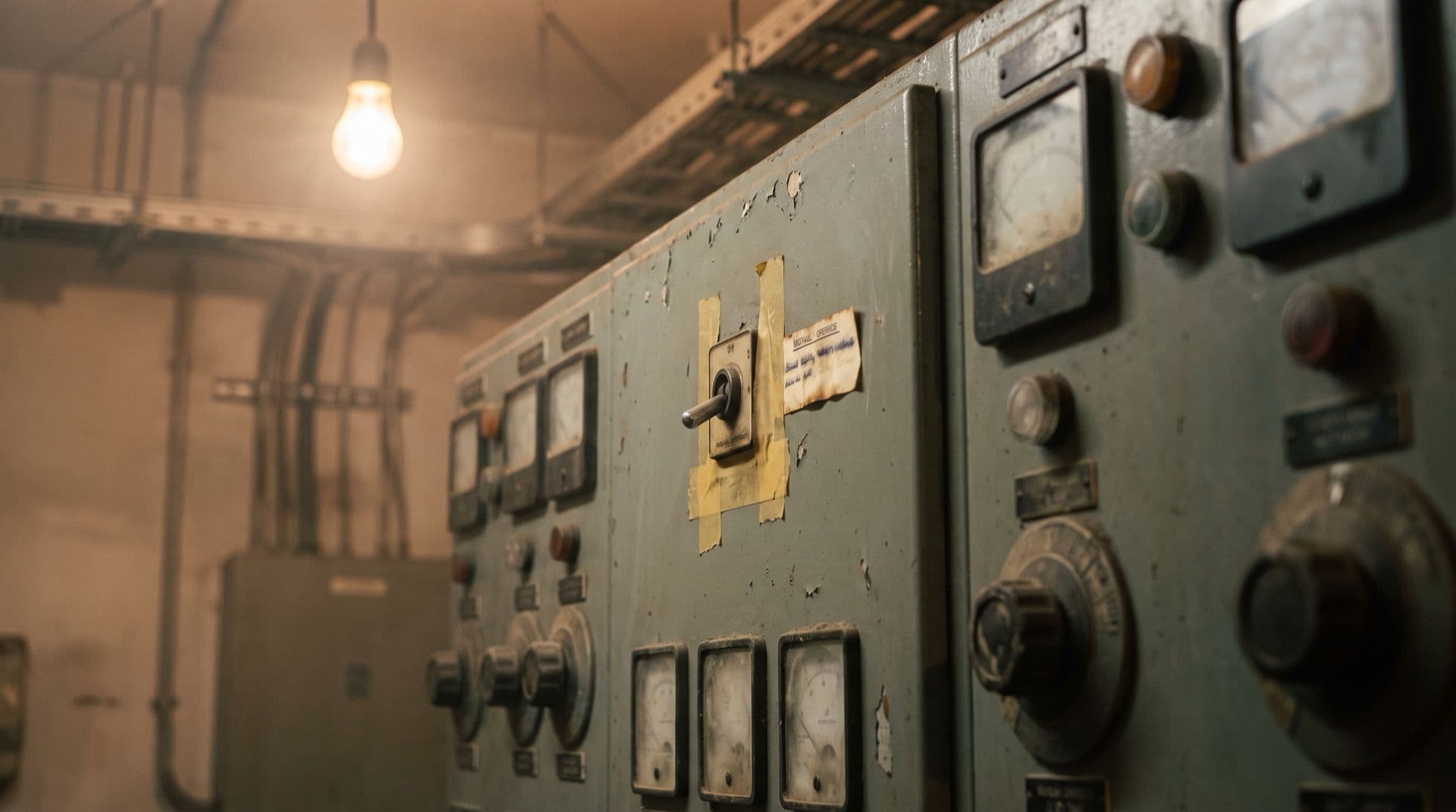
Every plant room in Malaysia has at least one fence. The chiller locked at 6°C supply since commissioning, and nobody remembers why 6 and not 7. The AHU with "JANGAN TUTUP" taped over the isolator in fading marker. The manual override a contractor wired in around the BMS in 2014, two renovations ago. The time schedule nobody dares touch, because the last person who changed it took the server room down. G.K. Chesterton never stood in a chiller plant, but he named this situation almost a century ago, and the principle we now call Chesterton's fence is the most useful, and most misread, idea a facilities team can carry through the plant room door.
The feeling it names is specific: every facilities team spends its days policing fences it did not build.
In short
- Every Malaysian plant room has at least one "mystery fence": a setpoint, override or locked value nobody remembers the reason for.
- Chesterton's fence says do not remove a rule until you understand why it was put there, and plant rooms are full of rules nobody wrote down.
- An unexplained setpoint left standing out of caution still bills you every month it stays in place.
- Trending a value before changing it, watching what it actually does, is safer than either blindly removing it or leaving it alone forever.
What is Chesterton's fence, exactly?
The principle comes from Chesterton's 1929 book The Thing: Why I Am a Catholic, in a chapter called "The Drift from Domesticity". Here is the passage in full, because the paraphrase everyone knows loses the best part:
"In the matter of reforming things, as distinct from deforming them, there is one plain and simple principle; a principle which will probably be called a paradox. There exists in such a case a certain institution or law; let us say, for the sake of simplicity, a fence or gate erected across a road. The more modern type of reformer goes gaily up to it and says, 'I don't see the use of this; let us clear it away.' To which the more intelligent type of reformer will do well to answer: 'If you don't see the use of it, I certainly won't let you clear it away. Go away and think. Then, when you can come back and tell me that you do see the use of it, I may allow you to destroy it.'"
Two things are routinely missed. First, the attribution. The famous one-liner, "don't ever take a fence down until you know the reason why it was put up," is not Chesterton's wording at all. According to the American Chesterton Society, Bartlett's traces that compression to John F. Kennedy's notebook in 1945, and it is regularly misattributed to Robert Frost besides. Second, and more important, the intelligent reformer permits the demolition. "Then... I may allow you to destroy it." Chesterton's fence is a sequencing rule, not a defence of the status quo: understand first, then remove. It authorises change; it just refuses to let ignorance do the removing.
Facilities teams tend to hear only the first half. The result is a plant room where every fence stands forever.
Why plant rooms breed mystery fences
Chesterton assumed the fence-builder's reason could be recovered by going away and thinking. Plant rooms are harder, for three structural reasons.
Institutional memory is literally licensed to individuals. Under Malaysia's Electricity Regulations 1994, an installation must be operated by a Suruhanjaya Tenaga-certified competent person, and a chargeman's certification requires at least three years' experience controlling live equipment. The competency attaches to the person, and so does the operating knowledge that came with it. When the chargeman retires, the reason for the 6°C lock walks out the door with him.
The records lie. NIST estimated that inadequate information interoperability costs the US capital-facilities industry $15.8 billion a year, with $10.6 billion borne by owners and operators, and the largest share incurred during operations and maintenance: information that is lost, unverifiable, or expensively re-created. Anyone who has compared an as-built drawing to an actual riser knows this number in their bones.
And the alarm system trains people to build fences. EEMUA 191, the de facto alarm-management benchmark, says an operator can properly handle about one alarm every ten minutes; plants measuring for the first time typically run five to twenty times over. Flooded operators stop investigating and start overriding. That override was never a decision anyone made. It is sediment: a commissioning shortcut here, a temporary workaround there, each layer outliving its author.
A standing fence bills you hourly
Here the plant room departs from Chesterton's country road. His fence costs nothing to leave standing while you think. A locked setpoint or an always-on AHU sends an invoice every hour.
The 13 most common faults in US commercial buildings, including schedule overrides, stuck dampers and simultaneous heating and cooling, waste an estimated $3.3 billion a year. PNNL found that fixing common controls problems and deploying advanced controls could cut US commercial building energy use by roughly 29% on average. Field surveys have found more than 90% of packaged AC units running with at least one fault.
In Malaysia the bill is sharper still. Under TNB's RP4 tariff, capacity and network charges total RM89.27/kW per month on General tariffs and RM97.06/kW on ToU, billed on the month's single highest 30-minute demand interval. One forgotten override that lets equipment stack up during one bad half hour sets your demand charge for the month; we walked through the mechanics in our RP4 maximum demand explainer. The status quo is not neutral. Waiting to understand a fence has a running cost, which means understanding has a deadline.
Go away and trend
So the method has to change. Chesterton's remedy was reflection, because he assumed the reason lived in someone's head or some record. In a building, the head has retired and the record lies. "Go away and think" becomes "go away and trend."
The engineering version of the intelligent reformer looks like this. Overlay monitoring on the existing BMS, PLC or SCADA rather than ripping anything out; you don't demolish the fence-keeper to study the fence (this is what a BMS overlay means in practice). Watch what the override actually protects, across seasons, shifts and load conditions. Correlate the 6°C lock against real cooling load and see whether it ever earns its keep. Simulate removal before you attempt it. Change one thing. Then measure and verify the result rather than declaring victory.
The evidence says this works. LBNL's Smart Energy Analytics Campaign, covering 104 organisations and more than 6,500 buildings, documented median energy savings of 9% from fault detection and diagnostics, with a two-year simple payback. That figure is essentially the market price of asking fences why they exist.
This is, in the interest of honesty, the workflow we built CobiNeural around: Insights→Energy trends the demand profile and Max Demand KPI behind the locked schedule, Insights→Equipment watches the motor the override has been babying, Alerts tells you when the fence's supposed hazard actually appears, and Plan & Verify runs the M&V afterwards. But the method matters more than the tool. Any team that trends before it touches is already the intelligent reformer.
Where the metaphor breaks down
Four honest limits, because the parable is not scripture.
First, Chesterton assumes a builder with a reason. Plant-room fences are often accidents: a factory default nobody chose, a workaround that outlived its problem. Sometimes diligent inquiry ends in "there is no reason," and the principle must not become a ratchet that preserves accidents.
Second, his recovery method presumes the reason is recoverable by thought. When the knowledge retired and the drawings lie, thinking alone cannot answer. The parable ends exactly where the engineering begins.
Third, as above: his fence is free to leave standing, yours is not. "Wait until you understand" cannot be an indefinite policy when the meter is running.
Fourth, the inverse limit. Trend data has a horizon. If the fence guards a rare catastrophe, the server-room interlock that trips once in five years, two clean months of trends prove nothing about the tail event. Safety interlocks need design review and simulation, not just observation. Data-driven confidence can curdle into the same arrogance Chesterton mocked; the modern reformer now walks up gaily waving a dashboard.
No fences without names
Read the intelligent reformer's reply once more, this time as a facilities policy: nothing gets removed by someone who cannot explain it, and nothing gets to stand unexplained either. Every override gets an owner, a written reason, and a trend behind it. The goal was never a plant room with no fences. It is a plant room with no mystery fences.
If your site has a setpoint nobody can explain, that is usually where we start: overlay the monitoring, trend the fence for a few weeks, and see what it is actually protecting. Request a demo and bring your strangest override with you.
FAQ
Frequently asked questions
Ask us about this topic
Something in this article you want to dig into — or a situation in your own building it doesn't quite cover? Send us your question. We don't run public comments; the team replies to you directly by email.