
Blog
TNB ToU Tariff: Peak Hours, the 6-Month Rule & Who Saves
TNB ToU under RP4: peak is 2pm-10pm weekdays only; nights, weekends and 15 public holidays are off-peak. What the myTNB 6-month warning means, the off-peak maximum demand exemption, and how to model a switch with 30-minute interval data.
 Tan Kok XinTNB Bills & Tariffs
Since 1 July 2025, every non-domestic TNB customer has had a genuine choice: stay on the General tariff or opt into the TNB ToU tariff. Under RP4, Time of Use is no longer a niche rider. The peak window shrank to 2pm–10pm on weekdays, weekends and 15 public holidays became fully off-peak, and the part most guides skip: maximum demand recorded during off-peak hours is not charged at all on ToU. That last rule can be worth more than the energy discount. Here is the decision method, with Medium Voltage numbers throughout.
In short
- Since 1 July 2025, every non-domestic TNB customer can choose between the General tariff and Time of Use (ToU); the right answer depends on when your load actually runs, not on total kWh.
- On MV and HV ToU, maximum demand recorded during the off-peak period is not charged, which changes the arithmetic in ToU's favour for many sites.
- The peak window is now 2pm to 10pm on weekdays; weekends and 15 public holidays are fully off-peak.
- Model the switch against your own interval data before committing, since a 6-month minimum lock-in makes a wrong guess expensive.
Who should switch to the TNB ToU tariff? The short answer
Switch if a large share of your consumption, and especially your highest 30-minute demand, falls outside 2pm–10pm on weekdays. Stay on General if your load peaks squarely inside office hours.
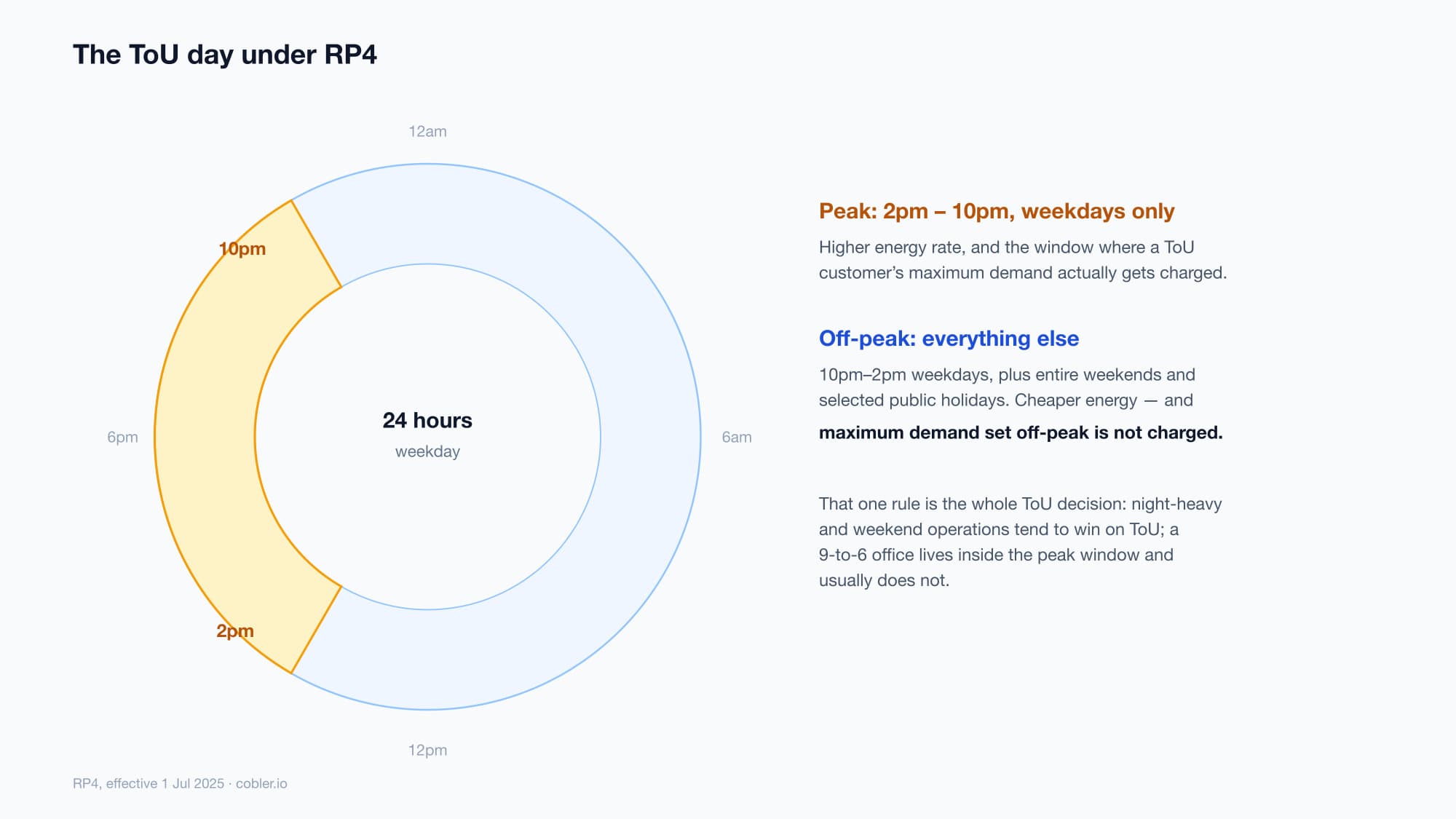
The whole ToU day at a glance. The off-peak rule on maximum demand is what decides the switch for most sites.
Likely yes: factories running night shifts or weekend production, cold storage, facilities with flat 24/7 load, any plant whose highest demand occurs at night or on Saturdays. These sites collect the off-peak energy discount on most of their kWh and get their off-peak maximum demand ignored for billing. >Probably no: offices, malls and 9-to-6 single-shift operations whose consumption and maximum demand both land inside 2pm–10pm weekdays. ToU would charge them a higher energy rate and a higher RM/kW rate on essentially the same numbers. >Either way: model it first. TNB's own guidance is to "check your usage pattern and your ability to shift your consumption to the designated Off-Peak period before opting for ToU" (TNB tariff page). That means interval data, not monthly bill totals.
Seeing a 6-month minimum warning in myTNB?
That warning comes from the legacy Enhanced ToU (ETOU) scheme, which carried a minimum 6-month stay. For the RP4 ToU introduced on 1 July 2025, TNB's published guidance is RM10 stamp duty each way with no general lock-in. The myTNB application flow states the binding conditions for your account class, so treat what it shows for your account as final, and plan to stay at least one full bill cycle so you have a real ToU bill to judge against.
What RP4 changed about the Time of Use tariff
RP4 collapsed ToU into two periods and made off-peak three-quarters of the week. The RP4 schedule took effect on 1 July 2025 and runs to 31 December 2027 (Suruhanjaya Tenaga). The new windows, from TNB's official tariff page:
- Peak: 2:00pm–10:00pm, Monday to Friday — 40 hours a week.
- Off-peak: everything else — 10pm–2pm on weekdays, plus all of Saturday, Sunday and 15 designated public holidays (including CNY, Hari Raya, Merdeka, Deepavali and Christmas). That is 128 of 168 hours each week, before holidays are even counted.
Compare that with the pre-RP4 structure: commercial and industrial ETOU ran three periods with peak stretching across 8am–10pm, and plain off-peak riders only covered 10pm–8am. Be careful with older guides still showing B, C1, C2 and E1–E3 tables; those categories no longer exist. RP4 replaced them with Low, Medium and High Voltage classes, each with a General and a ToU option.
Two RP4 basics to keep straight: every bill now itemises five components (Energy, Capacity, Network, Retail and AFA), and AFA, the monthly fuel adjustment that replaced ICPT, is published monthly by the Energy Commission. The comparison below sticks to the components where General and ToU actually differ: energy and demand.
ToU vs General: the two levers that decide it
The switch pays off through two independent levers: the energy-rate spread and the off-peak maximum demand exemption. The second one is routinely underestimated. Medium Voltage figures below are from the published RP4 schedule (rate table).
Lever 1: the energy spread
- MV General: 29.83 sen/kWh, flat, around the clock.
- MV ToU: 31.32 sen/kWh peak, 27.23 sen/kWh off-peak.
So ToU costs 1.49 sen/kWh more for peak consumption and 2.60 sen/kWh less off-peak. The break-even sits at roughly 36% off-peak consumption: above that share, the energy component of your bill goes down on ToU. Since off-peak covers 76% of the week's hours, many sites clear 36% from overnight base load alone, but a building that idles hard at night may not.
Worked example on 500,000 kWh/month at 60% off-peak:
- General: 500,000 × 29.83 sen = RM149,150
- ToU: (200,000 × 31.32 sen) + (300,000 × 27.23 sen) = RM62,640 + RM81,690 = RM144,330
Energy saving: about RM4,820/month, from the split alone.
Lever 2: off-peak maximum demand is not charged
Under RP4, the old MD charge became Capacity + Network, billed per kW of your highest 30-minute average demand: RM89.27/kW on MV General, RM97.06/kW on MV ToU (the mechanics are explained in our RP4 maximum demand explainer). At first glance ToU looks 8.7% worse. But TNB's tariff page states it plainly: for MV and HV ToU customers, "Maximum Demand which occurs during Off-Peak period will not be charged" (TNB).
General bills your anytime maximum. ToU bills only your 2pm–10pm weekday maximum. A factory whose absolute peak is a 1,000 kW night-shift start-up, but which never exceeds 800 kW during the peak window, pays:
- General: 1,000 kW × RM89.27 = RM89,270/month
- ToU: 800 kW × RM97.06 = RM77,648/month
That is RM11,622 a month, about RM139,000 a year, without shifting a single kWh. For night- and weekend-heavy operations, this lever alone can decide the switch.
One scope note: Low Voltage non-domestic accounts have no per-kW demand charge at all under RP4 (capacity and network are charged per kWh), so for LV businesses the decision is purely Lever 1.
How do you model the switch with interval data?
Recompute both tariffs from your 30-minute profile over several representative months. Monthly bill totals cannot answer this question. The procedure:
- Pull your 30-minute interval data: from your smart meter (via TNB), CT metering, or your own sub-metering. At least 3 months; 6 is better.
- Tag every interval as peak (weekday 2pm–10pm, excluding the 15 gazetted holidays) or off-peak.
- Split the kWh and price them: peak × 31.32 sen, off-peak × 27.23 sen; versus everything × 29.83 sen for General.
- Find two demand numbers per month: the highest 30-minute demand overall (General's billing basis) and the highest inside the peak window only (ToU's basis). Multiply by RM89.27 and RM97.06 respectively.
- Sum each tariff's energy + demand and compare, month by month.
- Stress-test with your worst month: a high-production month, or one where a breakdown forced daytime catch-up runs. One afternoon spike sets the ToU demand charge for the whole month, so an annual average that ignores variance will mislead you.
What breaks the naive estimate: guessing your off-peak share from operating hours ("two shifts, so 50%") instead of measured kWh; forgetting that a single 30-minute excursion into the peak window sets your ToU MD for the month; and using stale pre-RP4 rate tables. TNB's online tariff calculator is a reasonable first pass, but it cannot see your interval profile.
If pulling and profiling interval data sounds like the hard part, that's what an energy monitoring platform automates. CobiNeural records 30-minute (and finer) demand per site and per feeder, and its Billing & Tariffs module prices the same consumption under multiple tariff plans, so the General-vs-ToU comparison is a report, not a spreadsheet project.
Which load-shifting strategies change the answer?
Anything you can move out of 2pm–10pm weekdays improves the ToU case twice: cheaper kWh and a lower billable MD.
For factories:
- Schedule batch processes and other energy-dense steps to finish before 2pm or start after 10pm.
- Stagger compressor and chiller loading so their combined draw doesn't stack inside the peak window; sequence big motor starts for off-peak.
- Weekend production is now fully off-peak; for some plants that alone rebalances the ratio.
For commercial buildings:
- Pre-cool before 2pm and let thermal mass ride through the afternoon.
- Ice or chilled-water thermal storage charges at 27.23 sen and displaces 31.32 sen tonnage.
- Use BMS scheduling to push non-critical loads (pumping, EV charging, water heating) off-peak.
Be honest about limits: a building's comfort load peaks at 3pm because Malaysia's sun does, and no schedule moves that. Where the residual afternoon peak is the problem, batteries enter the picture, a separate economics question covered in battery storage for peak shaving.
When does ToU backfire?
When your peak-window numbers are the same as your anytime numbers. Three common cases:
- Process locked into 2pm–10pm. Single-shift operations whose heaviest draw is mid-afternoon pay the 1.49 sen peak premium on most of their kWh.
- Low weekend and night utilisation. If the site is dark outside office hours, the off-peak discount has little to apply to, and you may sit below the ~36% break-even.
- Peak-window MD equals anytime MD. If your monthly maximum always lands between 2pm and 10pm anyway, the off-peak exemption is worth zero: you simply pay RM7.79/kW more (RM97.06 vs RM89.27) on the same demand. At 2,000 kW that's RM15,580/month for nothing.
None of these are guesses to make from memory; they fall straight out of the interval-data model above.
How to apply, and how to verify the decision
Application is open to all registered TNB customers, costs RM10 in stamp duty, and has no lock-in. Under RP4 the scheme is no longer smart-meter-only: CT-metered and RMR-metered customers qualify too. Apply at a Kedai Tenaga, by email, or through the myTNB app. Processing takes about 5 working days with a compatible meter, up to 2 months if a meter change is needed; switching back to General costs another RM10, though TNB recommends staying at least one full bill cycle before judging (application details).
If you want to see this on your own bill, our free maximum demand calculator estimates the charge from your kW and tariff. For the full mechanics of a TNB bill, see our free course Understanding Your Electricity Bill.
Because there's no lock-in, the real risk isn't the switch — it's switching blind and never checking. Verify the decision the same way you made it: track your peak-window kWh share and peak-window MD against the model, every month. In CobiNeural this is continuous: Insights → Energy watches the Max Demand KPI against the 2pm–10pm window, Billing & Tariffs re-prices each month under both tariffs to show the actual RM delta, and Alerts flags a demand excursion into the peak window over WhatsApp before it becomes next month's demand charge.
FAQ
Frequently asked questions
Ask us about this topic
Something in this article you want to dig into — or a situation in your own building it doesn't quite cover? Send us your question. We don't run public comments; the team replies to you directly by email.