Blog
EV Charger Load Management for Malaysian Buildings
Ten 22 kW AC chargers stacking inside one 30-minute peak interval can add over RM21,000 a month in RP4 demand charges. How building operators manage EV charger load before it hits the meter.
 Tan Kok XinTNB Bills & Tariffs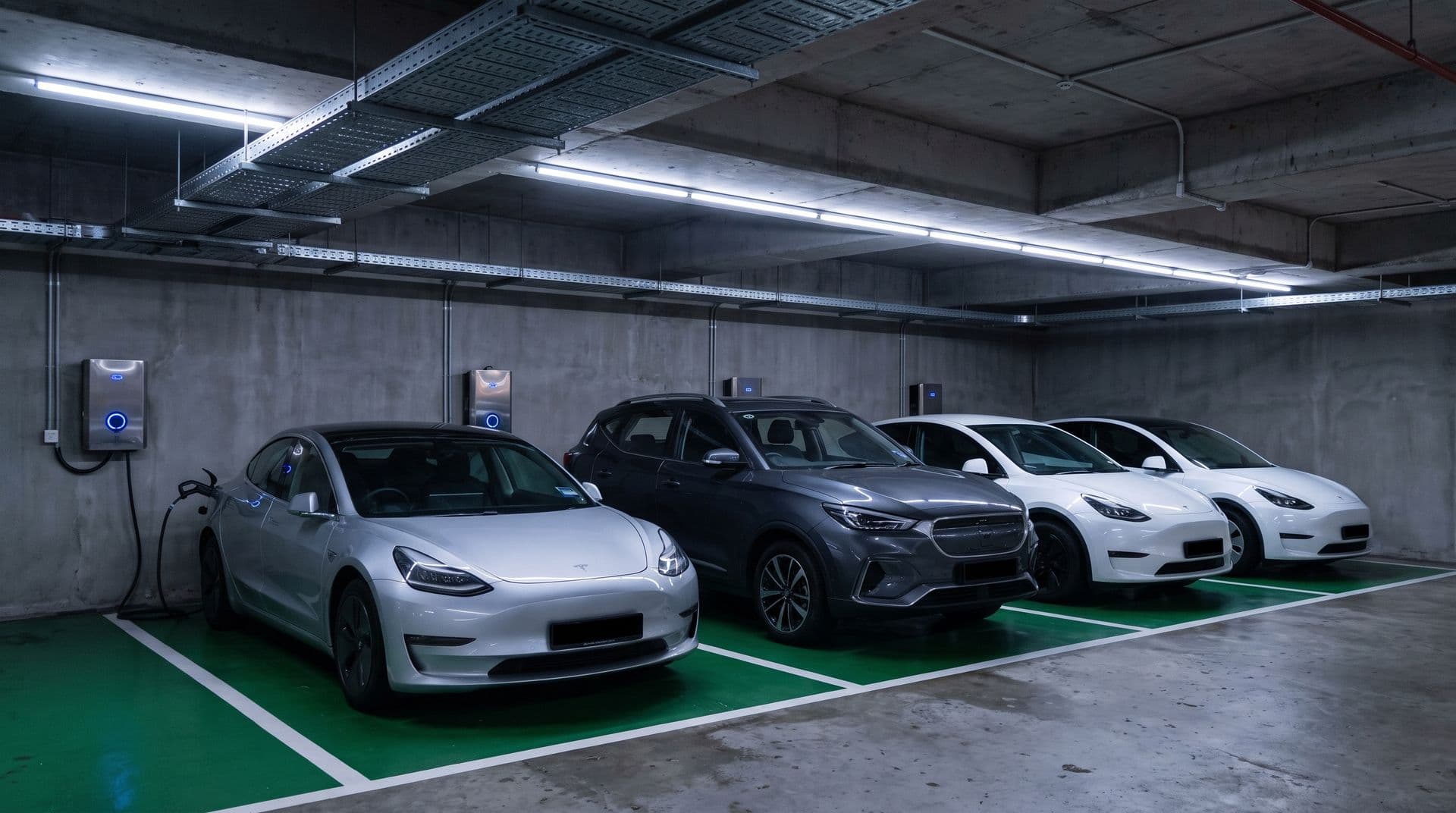
Malaysia missed its 10,000-charger target for 2025, so the plan was revised. In December 2025 the Energy Commission put the new goal at 8,000 AC chargers by around Q3 2026. Most of those will sit inside buildings, not on highways (paultan.org). PLANMalaysia's GPP EVCB guidelines already ask every new multi-storey development to reserve at least 2% of parking bays for EV charging (paultan.org).
The installer's brochure stops at the wallbox. The operator's problem starts at the meter, and EV charger load management is the piece nobody quotes for. One 22 kW AC charger is a bigger load than most chiller pumps. Under TNB's RP4 tariff, every kW of peak-hour maximum demand costs RM89.27 to RM97.06 per month. Manage the load first, before the first bay is painted green.
In short
- EV charger demand is easy to manage because charging is flexible in time, unlike most building loads.
- Size the load management, staggering, scheduling or capping chargers, before you size the charger count, since ten chargers running together can add a large new peak to your maximum demand.
- Overnight charging is usually the cheapest kW to serve, since it falls outside the daytime tariff and demand-sensitive window.
- Live demand data lets a charge controller share the building's actual headroom instead of working off a fixed, conservative cap.
Short answer: size the load management before you size the chargers
Ten 22 kW AC chargers running together add 220 kW. If that stack lands on the building's 30-minute peak between 2pm and 10pm, it adds roughly RM19,600 to RM21,400 to the bill. Every month, under RP4.
The same ten chargers, managed, can cost close to nothing in demand charges. Cap the fleet during peak hours. Shift the bulk of charging to after 10pm on a ToU tariff, and the kW charge on that energy disappears. The chargers are identical. The control strategy is the whole difference.
Why is the EV push reaching your car park now?
Because policy, planning rules and registrations are all pointing at buildings.
EV registrations more than doubled to 44,813 units in 2025. The growth carried into 2026: March alone saw 4,717 registrations, up 58.5% year on year (SoyaCincau). Public charging has not kept pace: as of April 2026 Malaysia had 5,619 public bays, about one charger per 15 EVs (iMoney). Whether the revised 8,000 AC target will actually be met by Q3 2026 is unconfirmed as of July 2026. Only 3,721 AC units were counted in April 2026, far off the required pace, and official statements have framed the target in slightly different ways.
On the planning side, GPP EVCB sets the 2% EV-bay minimum for new multi-storey residential and commercial developments. It allows AC bays (up to 22 kW) on any indoor parking level and restricts DC chargers to the ground and first two upper floors. Note that planning guidelines are not binding law, and for existing buildings the guideline only says numbers should follow demand (VCC Law).
Strata buildings face an extra layer. Malaysia has no "right to charge" law. An accessory-parcel car park covers only the plot itself. Charger cabling therefore crosses common property, which needs JMB or MC approval under the Strata Management Act 2013. ST has said it is discussing private AC chargers at designated condo bays, but that is an intention, not an enacted rule. KPKT's draft circular for strata EV charging proposed banning chargers in basements and at individual bays. As of July 2026 it has not been confirmed as final. Treat it as proposed, not law.
Either way, the JMB or facilities manager ends up owning the electrical consequences.
What do ten chargers do to your maximum demand?
RP4 replaced the old single MD charge with two per-kW charges, Capacity plus Network, billed on the highest 30-minute average demand of the month. For medium-voltage commercial accounts that totals RM89.27/kW on the General tariff and RM97.06/kW on ToU (myTNB). On ToU, only demand set during the 2pm-10pm weekday peak counts.
Here is the uncontrolled case, step by step:
- One 22 kW AC charger at full rate draws about 32 A three-phase.
- Ten charging in the same 30-minute interval: 220 kW.
- That interval coincides with the building peak, inside 2pm-10pm.
- ToU: 220 kW x RM97.06 = RM21,353 per month.
- General: 220 kW x RM89.27 = RM19,639 per month.
- Over a year: roughly RM236,000 to RM256,000 in demand charges alone.
And the managed case:
- Dynamic load balancing caps the fleet at 44 kW during peak hours.
- ToU exposure: 44 kW x RM97.06 = RM4,271 per month.
- Schedule most charging after 10pm instead, and the kW charge on that load is zero.
The mechanics are the same ones covered in how to cut TNB maximum demand charges. To test your own numbers, use the maximum demand calculator.
How does EV charger load management work? Three methods
Static per-bay limits. Set each charger to a fixed cap, say 7.4 kW instead of 22 kW. Simple and cheap, and it works with basic hardware. The downside: the cap applies at 3am too, when the building has spare capacity, so cars charge slower than they need to.
Dynamic load balancing. The charger fleet reads live building demand and throttles itself to keep total site load under a setpoint. Chargers speed up when the chillers wind down. This needs a load-management controller and a live feed of building demand, but it protects the MD figure without starving the bays.
Charge scheduling. Hold or slow charging during the 2pm-10pm window and release it after 10pm. For office and residential car parks this is often painless, because most cars sit for 8 to 12 hours anyway.
Most real installations combine the second and third: balance dynamically during the day, then open the taps at night.
Why is overnight charging the cheapest kW you will ever serve?
On medium-voltage ToU, maximum demand set during off-peak hours is not charged at all. Off-peak energy costs 27.23 sen/kWh against 31.32 sen/kWh at peak, per the same myTNB tariff pages. Nights, weekends and public holidays are all off-peak.
So a full overnight charge on ToU pays only the energy, with zero Capacity and Network charge on those kW. A 60 kWh charge costs about RM16 in energy. For a building weighing whether ToU suits its profile, EV load is a strong point in favour; see should you switch to TNB's ToU tariff.
Who pays for the electricity?
Not the building, if you set it up properly. Each charging bay should be submetered so consumption can be billed to the resident, tenant or driver who used it.
Licensing matters here. Under ST's EVCS framework, third-party chargers open to the public, consumers or employees count as "public EVCS" and must be licensed. Owner-operated chargers for own use are exempt. Licences follow the meter: several chargers behind one EV meter need one licence, and separately metered chargers need separate licences (Lowyat.NET). Every charger must also sit on a dedicated final circuit installed by an ST-registered Competent Person.
The allocation logic is the same as any tenant recharging exercise: meter the load, apply the tariff, issue the bill. The process is covered in tenant electricity billing in Malaysia.
Where does live demand data fit in?
Every strategy above depends on one input: knowing the building's demand right now, not on next month's bill. CobiNeural tracks a live Max Demand KPI against your RP4 tariff. It sends WhatsApp or email alerts while the 30-minute interval is still open, so the fleet can be throttled before the peak is set, not explained after. Its Billing & Tariffs module handles per-bay cost allocation, and it deploys as an overlay on the BMS and metering you already have.
For the full mechanics of a TNB bill, see our free course Understanding Your Electricity Bill.
The chargers are coming, through GPP EVCB bays in new builds and resident requests in existing ones. The buildings that come out ahead will be the ones that treated the car park as a controllable load from day one. Want to see what your charger stack would do to your MD profile? Request a demo and we will walk through it with your own interval data.
FAQ
Frequently asked questions
Ask us about this topic
Something in this article you want to dig into — or a situation in your own building it doesn't quite cover? Send us your question. We don't run public comments; the team replies to you directly by email.