
Blog
How to Cut TNB Maximum Demand Charges
Maximum demand is the quiet line item inflating Malaysian electricity bills. Under TNB's RP4 tariff, cutting TNB maximum demand charges is now worth roughly RM89-RM97 per kW, every month.
 Tan Kok XinTNB Bills & Tariffs
Cutting TNB maximum demand charges starts with one fact most operators miss: you are billed for a single half-hour, not for the month's total consumption. Maximum demand (MD) is the highest average power your site draws in any 30-minute interval during the billing month, measured in kW. One badly timed overlap of chillers, air compressors and a production line restarting after lunch can set a peak you then pay for across all 30 days. Trim that peak and the saving repeats every month, automatically.
The stakes rose sharply on 1 July 2025, when TNB moved to the Regulatory Period 4 (RP4) tariff structure for 2025-2027. The old single Maximum Demand charge in RM/kW is gone. Demand is now billed through two separate per-kW components, and for a typical commercial or industrial site the combined figure lands near RM89-RM97 per kW per month (TNB tariff schedule).
In short
- Maximum demand (MD) is your highest 30-minute average kW in the billing month, not your total kWh.
- Under RP4, MD is billed through two per-kW charges (Capacity + Network) totalling about RM89-RM97/kW.
- Staggering equipment startups alone was worth about RM17,854 a month in the worked example below.
- The four practical levers are: real-time visibility, staggered startups, shifting load off the ToU peak window, and catching anomalies before they set a new peak.
How TNB maximum demand charges work under the RP4 tariff
Under RP4, the bill has five components instead of the old three: Energy (sen/kWh), Capacity Charge (RM/kW), Network Charge (RM/kW), Retail Charge (RM/month), and the Automatic Fuel Adjustment (AFA), which replaces the old ICPT. Both demand-related charges are levied per kW of your monthly peak demand:
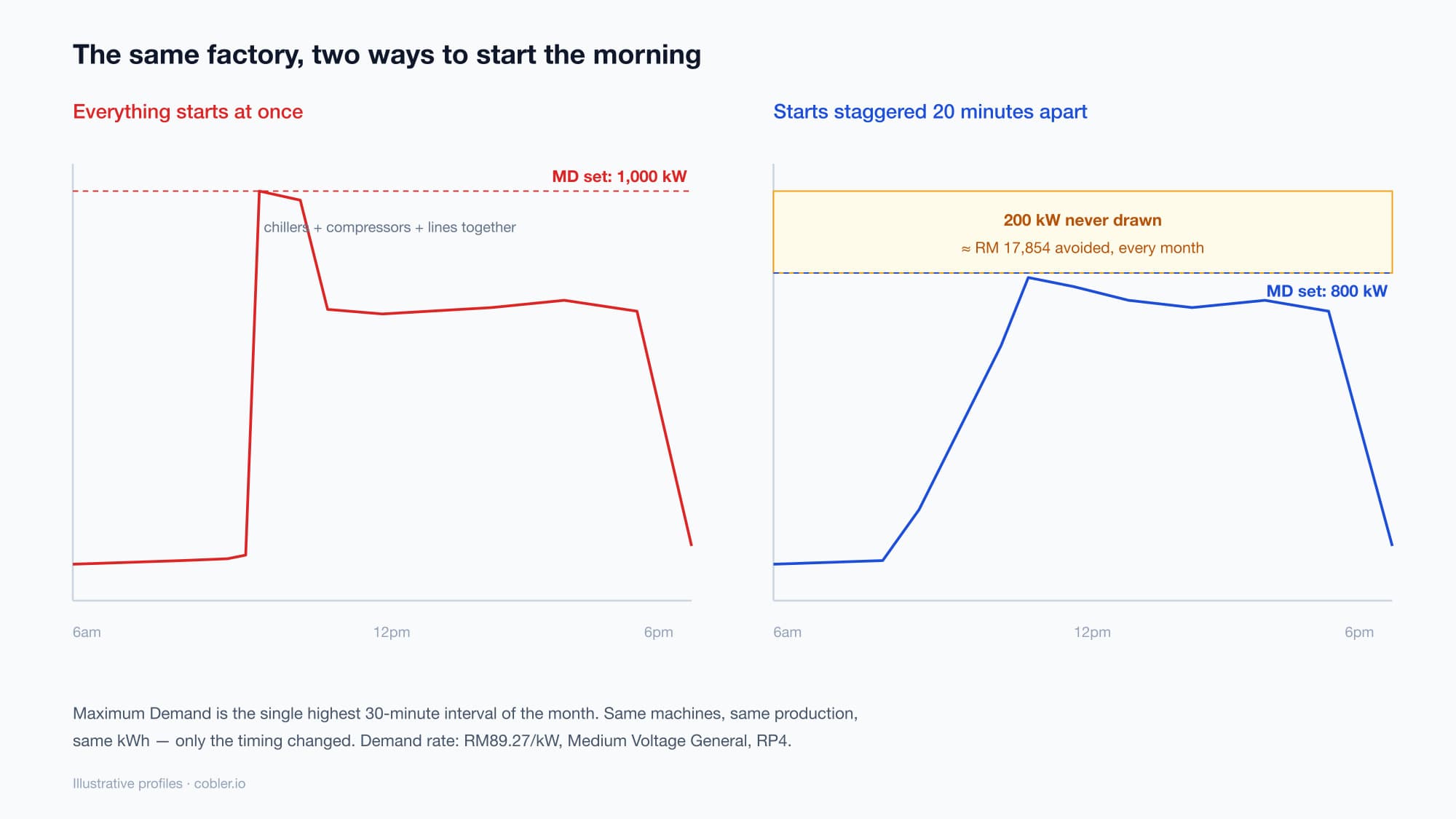
Same machines, same kWh. Staggering the morning starts is worth about RM17,854 every month at RP4 Medium Voltage General rates.
- Capacity Charge — RM29.43/kW on Medium Voltage General and RM30.19/kW on Medium Voltage Time-of-Use (ToU).
- Network Charge — RM59.84/kW (General) and RM66.87/kW (ToU).
If your older bills or supply documents use the pre-RP4 letters: Medium Voltage General replaced C1 (commercial) and E1 (industrial), and Medium Voltage ToU replaced C2 and E2. The full old-to-new mapping is in our guide to TNB tariff categories under RP4.
Add them and every kW of monthly peak costs roughly RM89.27/kW on Medium Voltage General and RM97.06/kW on Medium Voltage ToU (TNB). That is the number that matters. Shave 50 kW off your monthly peak on a ToU tariff and you avoid about RM4,850 a month, or roughly RM58,000 a year, with zero change to how much energy you actually consume.
The ToU peak window also changed. Under RP4 the peak period runs 2:00pm to 10:00pm on weekdays. Everything else is off-peak: 10:00pm to 2:00pm on weekdays, plus all weekends and public holidays. If you are still planning load shifts around an 8am-10pm window, your schedule is built on the previous tariff and is costing you money.
What actually sets your peak
MD is about coincidence, not volume. Two plants that consume identical kWh can have very different MD bills if one staggers its loads and the other starts everything at once. The recurring culprits in Malaysian facilities:
- Simultaneous HVAC startup. Chiller plants pulling full load the moment the building opens, often stacked on top of the previous night's residual cooling.
- Compressor cycling. Air compressors and refrigeration units that all kick in within the same half-hour.
- Production ramp-up after breaks. Lines restarting together after lunch, prayer breaks or shift changes, frequently landing inside the 2pm-10pm peak window.
- Hidden anomalies. A failing motor drawing excess current, or a stuck damper forcing a chiller to overwork, can quietly push a new monthly peak that no one notices until the bill arrives.
For a step-by-step breakdown of how the half-hour interval is measured and charged, see our guide on how to calculate maximum demand.
How to cut TNB maximum demand charges
You cannot manage a peak you only see on next month's bill. Reducing MD comes down to four moves, in order of effort:
1. See demand in real time, at equipment level
The direct answer: you reduce MD by knowing which assets coincide to create the peak, then breaking that coincidence. A monthly TNB bill shows the peak number but never the cause. Equipment-level monitoring shows the exact half-hour and the exact loads stacked inside it.
CobiNeural tracks demand continuously through its Insights → Energy module, where the Max Demand KPI sits alongside consumption, power factor and EUI at both location and equipment level. When several assets overlap to form a peak, you see the contributing loads rather than a single site-wide figure. This is the same sub-metering visibility that exposes other hidden waste; the principle is covered in how sub-metering finds the problems in your building.
2. Stagger startups and sequence large loads
The direct answer: spread the switch-on of high-draw equipment across several half-hour intervals so they never all land in the same one. Soft-starting chillers, sequencing compressors, and delaying non-critical loads by 15-30 minutes can flatten a sharp morning peak without affecting output. CobiNeural's Actions module triggers these sequences automatically, and when it overlays an existing BMS, PLC or SCADA system it can enforce the staging through controls you already own. See automation for how the overlay works.
3. Shift flexible load out of the 2pm-10pm peak window
The direct answer: on a ToU tariff, move what you can to off-peak hours, where demand charges and energy rates are both lower. Battery thermal storage, ice storage, and rescheduling batch processes to before 2pm or after 10pm all reduce the peak that falls inside the costed window. Battery storage can also discharge during peak to cap demand; whether it pays depends on your load shape, which we examine in BESS for peak shaving in Malaysia.
4. Catch anomalies before they set a new peak
The direct answer: alert on abnormal demand the moment it happens, not at month-end. CobiNeural's Alerts module sends WhatsApp or email notifications when demand approaches or exceeds a threshold, so a stuck valve or a failing motor gets fixed before it locks in a higher MD for the whole billing cycle.
What the saving is worth
Because demand charges recur monthly, MD reduction compounds. Consider a mid-sized plant on the Medium Voltage ToU tariff peaking at 1,200 kW. Its monthly demand charge is about 1,200 x RM97.06 = RM116,472. Cutting the peak by 8 percent through staggered startups and load shifting brings it to roughly 1,104 kW, saving close to RM9,300 a month, or about RM112,000 a year, before any change to energy consumption.
For sites pursuing EECA compliance or ISO 50001 certification, MD data also feeds directly into energy performance reporting, so the monitoring you install to cut demand charges does double duty for your regulatory obligations.
Every kW you shave off your monthly peak is a recurring saving, not a one-off. That is what makes MD the single most valuable line item to attack on a Malaysian commercial bill.
If you want to see this on your own bill, our free maximum demand calculator estimates the charge from your kW and tariff. For the full mechanics of a TNB bill, see our free course Understanding Your Electricity Bill.
If you want to see which loads are setting your peak and what cutting them is worth, book a demo and we will walk through your own demand profile.
FAQ
Frequently asked questions
Ask us about this topic
Something in this article you want to dig into — or a situation in your own building it doesn't quite cover? Send us your question. We don't run public comments; the team replies to you directly by email.