
Blog
How to Calculate Maximum Demand (MD): A Malaysian Guide
Maximum demand drives some of the largest charges on a Malaysian commercial bill, and TNB changed how it is billed in July 2025. Here is how MD is measured, charged, and reduced.
 Tan Kok XinTNB Bills & Tariffs
On a Malaysian commercial or industrial bill, the charges tied to your maximum demand are among the largest single line items you pay TNB, and since 1 July 2025 they have changed shape entirely. This guide explains what maximum demand is, how it is calculated, why the arithmetic trips almost everyone who meets it, how the new tariff charges it, and how to bring it down.
In short
- Maximum demand is your highest 30-minute average kW in the billing month, read from the meter, not calculated from your kWh total.
- Since 1 July 2025, RP4 unbundled the old single MD charge into separate Capacity and Network charges.
- The half-hour meter reading needs one conversion step before it becomes the kW figure TNB bills, which is where most people miscalculate it.
- Seeing demand build in real time, before month-end, is what lets you act on a peak instead of only discovering it on the bill.
What maximum demand is
Maximum demand (MD) is the highest electrical power your site draws, measured in kilowatts (kW), averaged over a fixed interval, taken as the single highest interval in the billing month. TNB measures it in 30-minute intervals. It is not how much energy you used over the month (that is kWh); it is how hard you pushed the grid at your worst moment.
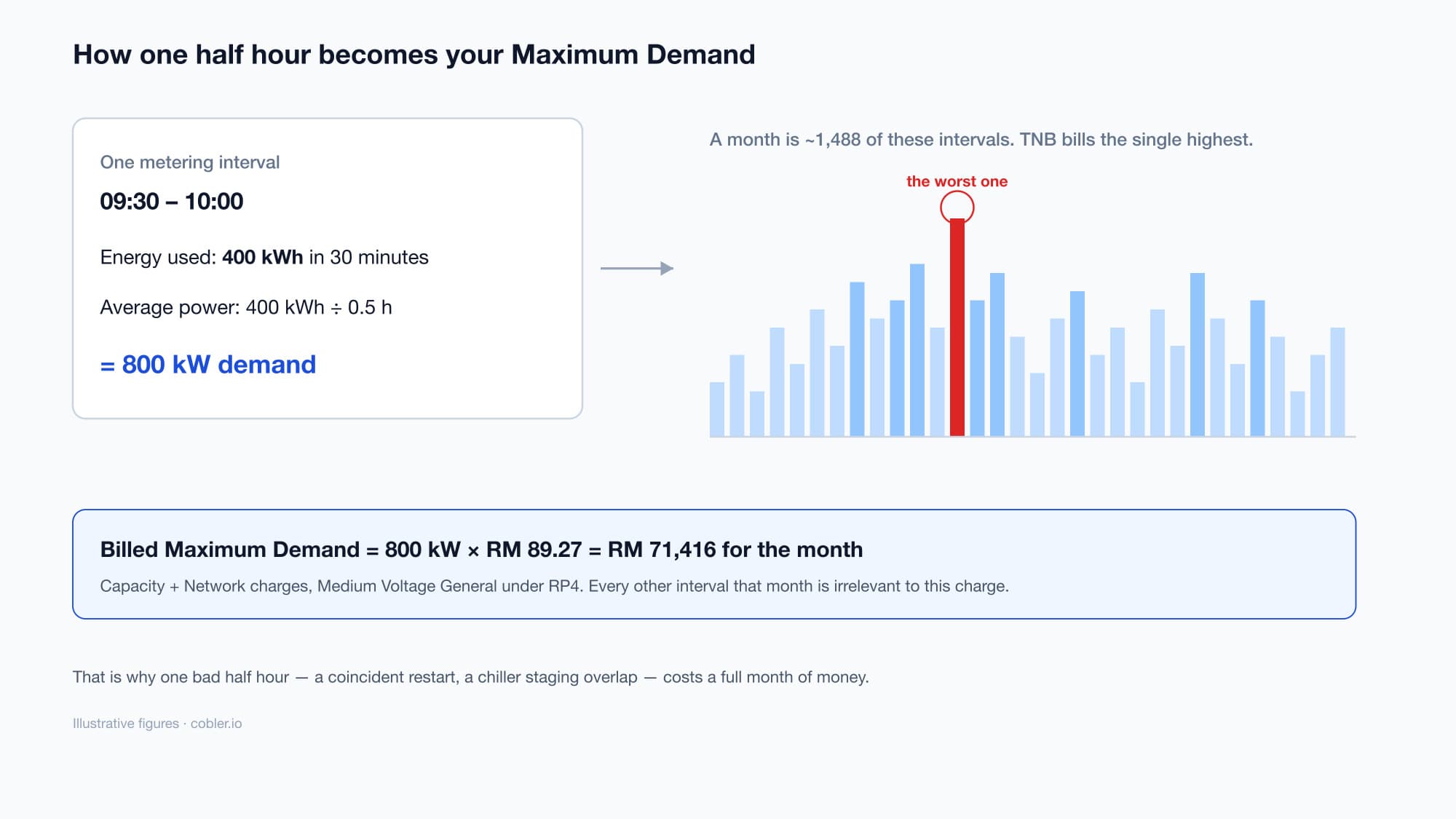
One interval of energy, doubled into kW. Out of roughly 1,488 intervals a month, only the highest one is billed.
That single worst half-hour sets your demand charges for the entire month, which is why a brief, badly-timed coincidence of loads can cost you far more than steady, well-managed consumption.
What changed in July 2025: the MD charge was unbundled
The old tariff had a single Maximum Demand charge in ringgit per kW. Under the RP4 tariff structure (Regulatory Period 4, effective 1 July 2025 to 31 December 2027), that single charge has been split into two separate per-kW charges:
- Capacity Charge (RM per kW of monthly maximum demand)
- Network Charge (RM per kW of monthly maximum demand)
Your bill now has five components instead of the old structure: Energy (sen/kWh), Capacity (RM/kW), Network (RM/kW), Retail (fixed RM/month), and the Automatic Fuel Adjustment (AFA), a monthly fuel and forex adjustment that replaces the old ICPT surcharge/rebate.
The practical effect: your peak 30-minute interval now drives two line items, not one. Managing maximum demand matters more under RP4 than it ever did before.
How maximum demand is calculated
Keep three units straight: energy is kWh, power is kW, and maximum demand is reported in kW. Over any interval:
MD (kW) = energy used in the interval (kWh) ÷ interval length (hours)
Worked example, straight from a meter reading every 30 minutes:
- 8:00 — meter reads 18,200 kWh
- 8:30 — meter reads 18,500 kWh → 300 kWh used in 0.5 h → MD = 300 ÷ 0.5 = 600 kW
- 9:00 — meter reads 19,000 kWh → 500 kWh used in 0.5 h → MD = 500 ÷ 0.5 = 1,000 kW
TNB records the highest 30-minute reading each day, keeps the daily peak, and bills the single highest interval of the whole month as your maximum demand.
Why do you multiply the half-hour reading by 2?
Because kW is a per-hour rate, and the meter only gave you half an hour's worth of energy. Dividing by half an hour is the same as multiplying by 2, and this one line of arithmetic causes more confusion than anything else on a Malaysian bill. The instinct says: half an hour, so surely you halve the number. The instinct is wrong, and here is the cleanest way to see it.
Think of driving. If you covered 40 km in 30 minutes, nobody hesitates to say you averaged 80 km/h. You double the distance, because speed is measured per hour and you only drove for half of one. Maximum demand is the identical calculation with different units: your meter clocked 300 kWh in a half-hour block, so your average power was 300 ÷ 0.5 = 600 kW. Same doubling, same reason. Energy is the odometer, power is the speedometer, and kW means "kWh per hour" in exactly the way km/h means kilometres per hour.
The confusion exists because kWh and kW look like siblings, so the per-hour instinct that works effortlessly on the road evaporates in front of an electricity bill. But the ×2 was never a fudge factor or a penalty. It is pure unit conversion, and it follows the window length: a utility that metered 15-minute intervals would multiply by 4, and one that metered full hours would multiply by 1 and nobody would ever ask the question.
Why maximum demand confuses everyone
The ×2 is only the first trap. Maximum demand behaves unlike anything else you are billed for, in four specific ways:
- It is a maximum of averages, not an instantaneous peak. A 400 kW compressor that runs for 6 minutes inside a block contributes only 400 × 0.1 = 40 kWh, an 80 kW bump to that block's average. Meanwhile a modest 250 kW held for the full 30 minutes bills at 250 kW. Operators routinely blame their brief spikes; the meter actually punishes sustained draw.
- The windows are fixed clock blocks, not rolling. The meter averages 8:00–8:30, then 8:30–9:00, and so on. A surge that straddles a boundary splits its energy across two blocks and can halve its apparent MD, so the same operation can cost different amounts depending on when it starts.
- One half-hour sets a month's charge. Every other line on the bill is a sum; MD is a maximum. Twenty-nine careful days are erased by one bad 9 a.m. coincidence of chillers, and "using less overall" does nothing to undo it.
- On Time-of-Use, only peak-window blocks count. Under RP4 ToU, chargeable MD is taken from the weekday 2:00 pm–10:00 pm window, so an identical spike at 7 a.m. sets nothing.
Once you internalise those four, MD stops being mysterious and starts being manageable: it is a game about when and how long, not just how much.
Who pays demand charges
Capacity and Network charges on a per-kW demand basis apply to Commercial and Industrial consumers taking supply at Medium Voltage: 6.6 kV, 11 kV and 33 kV. Low-voltage residential and small LV users are billed differently and do not face a per-kW demand charge in the same way.
What maximum demand costs under RP4
The demand charges are billed per kW of your monthly maximum demand. Under the RP4 schedule:
- General tariff (C1 commercial / E1 industrial): Capacity RM 29.43/kW + Network RM 59.84/kW = RM 89.27/kW per month
- Time-of-Use tariff (C2 commercial / E2 industrial): Capacity RM 30.19/kW + Network RM 66.87/kW = RM 97.06/kW per month
So a site that peaks at 1,000 kW pays roughly RM 89,270 (General) to RM 97,060 (Time-of-Use) in demand charges every month, before a single kWh of energy is counted. Note how much higher the per-kW figure is than the old MD charge (which sat around RM 30/kW): TNB lowered the energy rate to roughly 29–31 sen/kWh to offset it, which shifts the reward toward operators who flatten their peaks rather than simply use less in total.
Time-of-Use windows under RP4
If you are on a Time-of-Use tariff, when you run matters:
- Peak: 2:00 pm – 10:00 pm, weekdays
- Off-peak: 10:00 pm – 2:00 pm weekdays, plus all weekends and public holidays
This is a change from the old peak window: the high-cost band is now the afternoon and evening, which is exactly when most commercial cooling and production loads are heaviest.
How to reduce your maximum demand
You cannot manage what you cannot see. Without sub-interval metering you only learn your MD from the monthly bill, after it is set, and with no idea which loads caused it. With proper monitoring you can work backwards from the peak interval to the equipment that drove it. Practical tactics:
- Shift heavy, flexible loads to off-peak (after 10pm or onto weekends), where Time-of-Use energy is cheapest and you avoid stacking the afternoon peak.
- Stagger start-ups. Bring chillers and large motors on in sequence, ahead of the 2pm peak window, rather than letting everything spike together.
- Cap simultaneous large loads. Train operators not to start more than one or two big loads inside any single 30-minute block.
- Find your real peak, daily, weekly and monthly, with interval metering, then rebalance the schedule around it.
- Use demand limiting / load shedding on non-critical equipment so a brief coincidence never sets a month-long charge.
See your demand as it builds
CobiNeural records demand at 30-minute and finer resolution, surfaces the maximum demand for each period, and flags the coincident loads behind every peak, so you can act before a spike is locked into next month's Capacity and Network charges. For the wider cost-reduction playbook, see cutting TNB maximum demand charges, and for the full story of what your meter measures and why, the Electricity Fundamentals course builds it from first principles. Book a demo to see your own load profile.
If you want to see this on your own bill, our free maximum demand calculator estimates the charge from your kW and tariff. For the full mechanics of a TNB bill, see our free course Understanding Your Electricity Bill.
Tariff figures reflect TNB's RP4 schedule effective 1 July 2025; confirm current rates against the official TNB tariff schedule.
FAQ
Frequently asked questions
Ask us about this topic
Something in this article you want to dig into — or a situation in your own building it doesn't quite cover? Send us your question. We don't run public comments; the team replies to you directly by email.