Blog
Electricity Fundamentals: Start Here
The map to our free 15-lesson electricity fundamentals course, from why the light is instant to how your phone charger changes the electricity twice. No science background needed.
 Tan Kok XinElectricity Fundamentals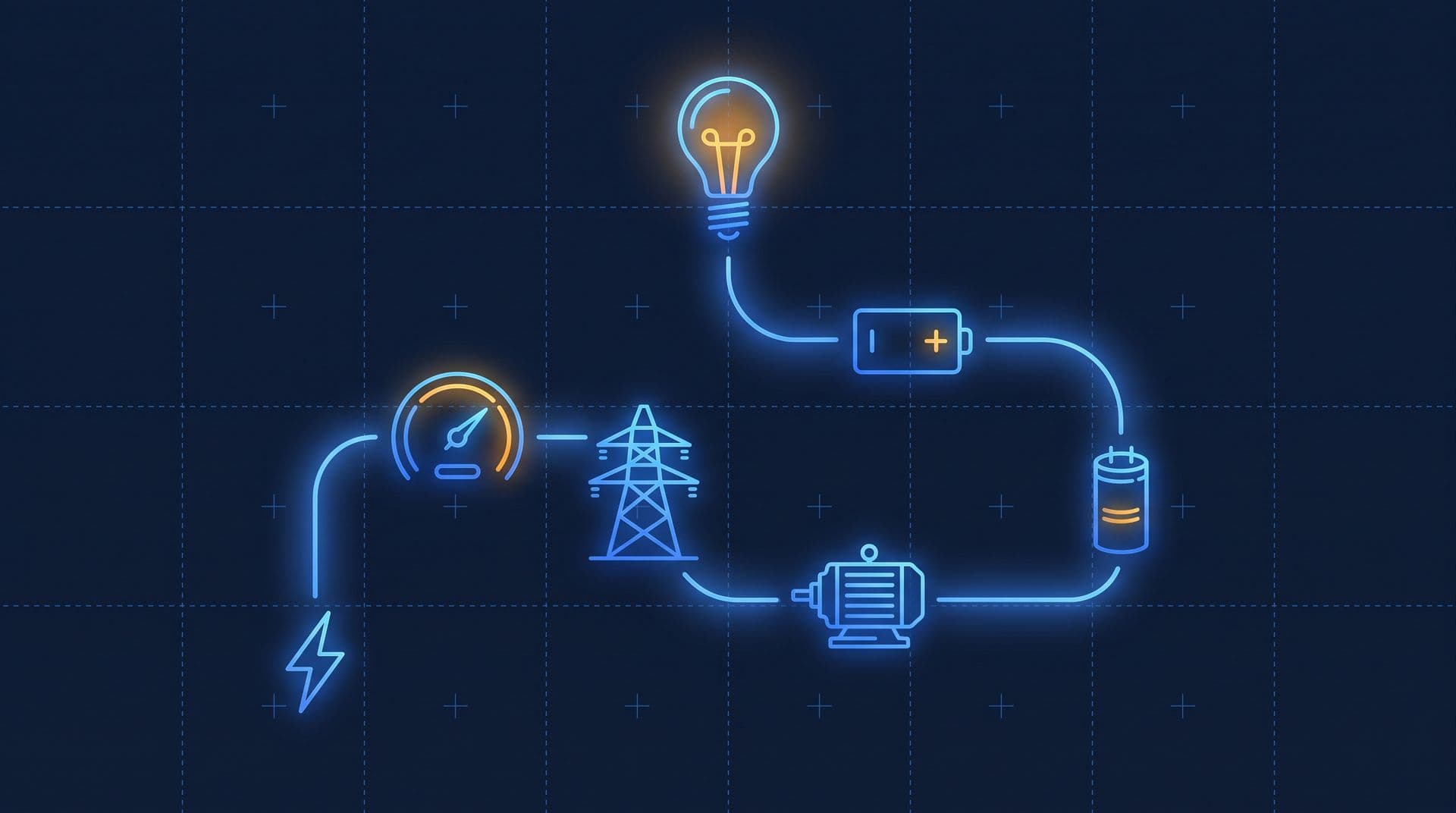
The electrons in a wire crawl along at about a tenth of a millimetre per second, yet the light comes on the moment you press the switch. A bird can sit on an 11,000 V line and fly off unharmed. Your phone has never run on the AC from your wall socket. This free electricity fundamentals course starts from everyday puzzles like these and explains, in plain words, what is really going on.
It has 15 short lessons in four modules, plus optional side readings. You do not need any background in science or engineering. Each lesson opens with a surprise, explains why it happens, and ends with the question the next lesson answers, so the course reads as one story from a light switch to the power station and back.
Who this course is for
- Anyone curious about how the electricity in their home or office actually works.
- Students who want the ideas behind the formulas before the formulas.
- Facility and operations staff who read meters and equipment nameplates and want to understand what the numbers mean.
What you will be able to do by the end
- Explain voltage, current, power and energy, and work out kWh from how long equipment runs.
- Say why a building is wired in parallel, what a breaker stops and what an RCD catches.
- Explain AC, three-phase supply, kW, kVA and power factor without confusing them.
- Trace electricity from a power station, through transformers and the grid, to a kettle in an office pantry.
- Read a motor nameplate and tell its rated output from the electrical input a meter records.
- Recognise shock and fault hazards, and know when to call the electrical competent person.
How the lessons work
Each lesson is built around two to four surprises, each followed by the plain explanation behind it. The same everyday examples come back throughout: a 3 kW kettle on a 230 V socket, a phone charger, a ceiling fan and a light switch. From Part 5 onwards, bigger examples use one fictional 20-storey office tower that we visit throughout the course. Diagrams show what is hard to picture. Any maths or history sits in an optional box near the end of a lesson, so you can skip it.
Every lesson ends with a short recap of what you now understand and two check questions with answers. Read the lessons in order the first time. After that, each one works as a stand-alone reference.
The electricity fundamentals course map
Module A: Foundations
- What Is Electricity, Actually?: you are full of electric charge and never notice it, and the light is instant even though electrons crawl.
- Volts and Amps: why a socket holds 230 V with nothing flowing, and why a 20,000-volt static shock is harmless.
- What Is an Electric Circuit? Series vs Parallel: why one dead bulb used to switch off a whole string of fairy lights, and why a short circuit makes the current bigger.
- Earthing and RCDs: why a bird on a power line is safe, what the earth wire does, and how an RCD catches a leak a breaker would miss.
- Power vs Energy: kW and kWh: how a small standby light can use more energy than a kettle, and why a building's busiest half-hour gets its own number.
Module B: AC and the machines
- AC vs DC: your socket reverses 100 times a second and actually peaks at about 325 V, and high voltage cuts the heat lost in the lines.
- How Generators Make Electricity: a magnet sitting still makes no electricity, and switching on a kettle makes a distant generator harder to turn.
- How Transformers Work: power crosses a gap with no wire, and the hum from a transformer is not at 50 Hz.
- Three-Phase Power Explained: why 230 V and 230 V make 400 V, not 460 V.
- How Electric Motors Work: the spinning part of most motors has no wires connected to it, and an 11 kW motor uses more than 11 kW.
- kW, kVA and kVAR: The Power Triangle: why a motor draws more current than its kW suggests, and why reactive power goes back and forth without being used up.
Module C: From the grid to your gadgets
- How the Malaysia Electricity Grid Reaches Your Plug: the electricity boiling your kettle was made less than a second ago, and it passes through four or five transformers on the way.
- Rectifiers and Inverters: your phone charger changes the electricity twice, and an "inverter" air conditioner hides both conversions inside.
- How Batteries Store Energy: a flat battery holds as many electrons as a full one, and the office tower's server room never notices a power cut.
Module D: Finish
- Capstone: Read a Building's Electrical Story: five worked tasks in the office tower, from tracing the electricity to the pantry kettle to knowing what you may do yourself and what needs a competent person.
Optional side readings
These tell the fuller story behind a surprise in the course. The lessons link to each one at the point where it fits. You do not need them to finish the course.
- Why 50 Hz? The Accident Behind the Grid Frequency
- The War of the Currents: Edison, Tesla and Why AC Won
- Joules vs kWh: Why Energy Has Two Names
- Why Is Power Measured in Watts? Blame the Steam Engine
- Reactive Power Is Not Wasted Energy
- Electrical Harmonics: How VFDs Distort Your Power
- Voltage Sags and Swells: Why Your Plant Trips
- Star vs Delta: Two Ways to Wire Three-Phase
- How Electrical Energy Flows: In the Wire or Around It?
- How Solar Panels Make Electricity: No Spinning Needed
- Why Blackouts Happen (and Restarting a Grid Is Hard)
Going further (for engineering students)
These use more mathematics than the course and are written for readers who want the theory behind it.
- Why Engineers Use Imaginary Numbers for Real Power
- Fourier Analysis: Why Every Wave Is a Sum of Sines
- Why Engineers Learn Laplace Transforms
- PID Control: From Watt's Governor to Your Chiller
- Maxwell's Equations, Decoded
- From Transistor to CPU: How Switches Learned to Count
- The ARM Story: The Little Chip That Won
- From Schematic to Board: How PCBs Are Made
What about the money?
This course explains electricity itself and leaves prices out. What your kWh, maximum demand and power factor cost, and how to read a TNB bill line by line, is the subject of our Understanding Your Electricity Bill course. It builds on the ideas taught here.
What to take next
- Understanding Your Electricity Bill turns the kW and kWh from this course into the charges on a bill. Start here.
- Building Electrical Fundamentals follows the power through a building's own equipment: switchboards, breakers, cables and earthing systems. Start with MSB, SSB and DB: Your Building's Electrical Tree.
- Cooling Fundamentals and Building Automation and BMS Fundamentals cover the systems that use most of a commercial building's electricity. See all courses on the Learn page.
Where Cobler comes in
The numbers in this course, such as kW, kWh, maximum demand and power factor, exist in your building right now. Cobler builds CobiNeural, a platform that shows a facility team those numbers live across the whole site. To see how your building uses electricity, talk to us.
Ready to begin? Start with Part 1: What Is Electricity, Actually?
FAQ
Frequently asked questions
Ask us about this topic
Something in this article you want to dig into — or a situation in your own building it doesn't quite cover? Send us your question. We don't run public comments; the team replies to you directly by email.