Blog
How Generators Make Electricity: Spin Meets Wire
Move a magnet past a coil of wire and current flows. That one trick, discovered by Faraday in 1831, is how every kilowatt-hour Malaysia burns gets made, and why the grid runs on a sine wave.
 Tan Kok XinElectricity Fundamentals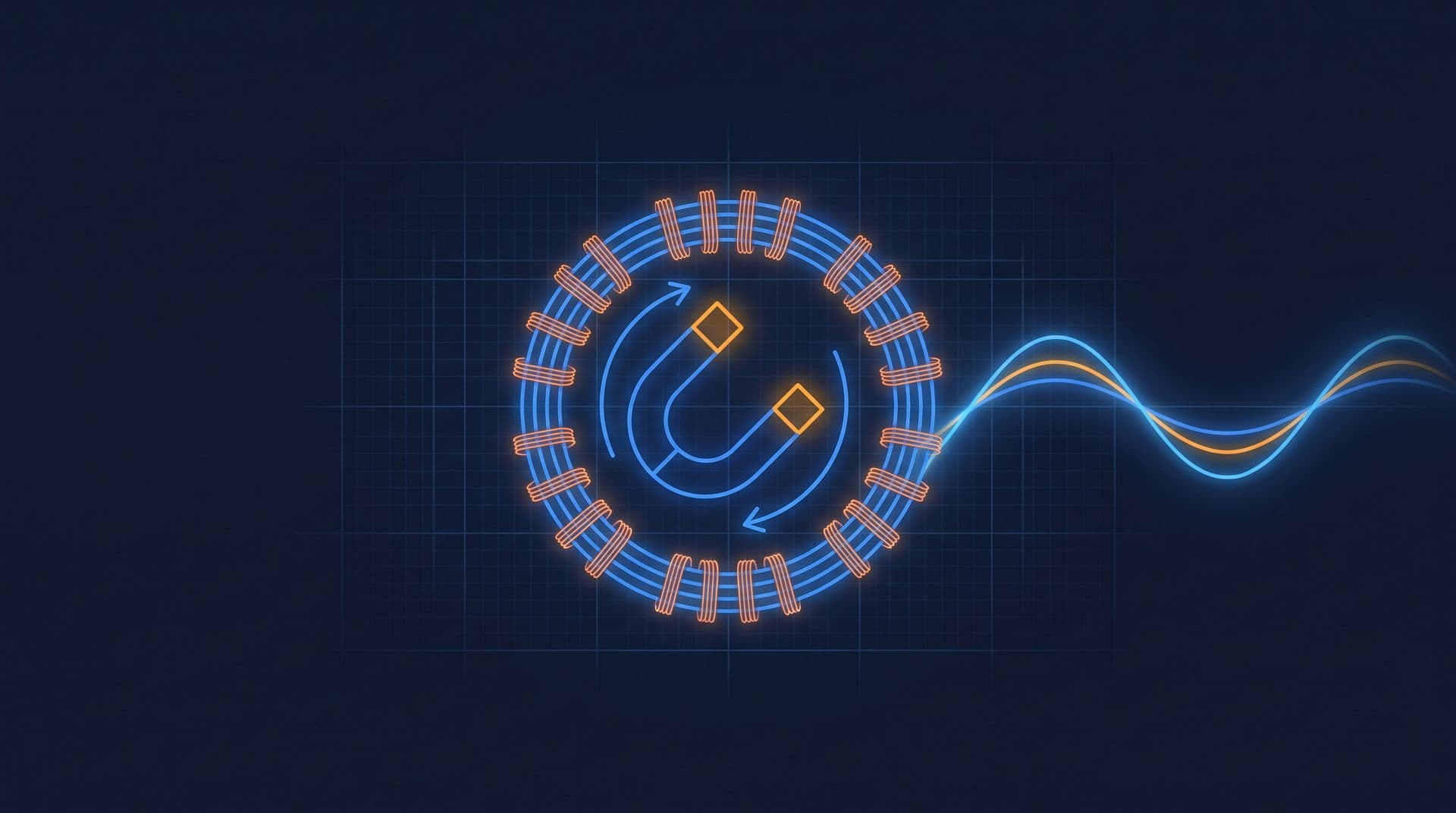
Part 7 of 15 in Cobler's Electricity Fundamentals course. New here? Start with the course map.
Tape the strongest magnet you can find to a coil of wire and you will get no electricity at all. Wave a weak magnet quickly past the same coil and a current flows. Part 6 ended with the question "Where does AC come from in the first place?", and the answer starts with that difference.
How generators make electricity: a magnet sitting still makes none
In What Is Electricity, Actually? (Part 1) we saw that moving charges create a magnetic field around a wire. The link also works the other way. A magnetic field that is changing can push charges along a wire and create a current. This effect is called electromagnetic induction.
Michael Faraday showed it in 1831 with two separate coils of wire wound on opposite sides of an iron ring. He connected one coil to a battery, and the other to a needle that would twitch if any current flowed (Wikipedia). When he connected the battery, the needle twitched. While the battery stayed connected, the needle stayed still, even though the first coil was now carrying a steady current and making a steady magnetic field. When he disconnected the battery, the needle twitched the other way. Current flowed only while the magnetic field was changing: growing when the battery was connected, and collapsing when it was disconnected.
That explains the taped magnet. Its magnetism through the coil is strong but never changes, so it pushes no current. The voltage produced depends on how fast the magnetism through the coil is changing, not on how strong the magnet is. More turns of wire in the coil also help, because each turn adds its own small push.
You may have seen this with a wind-up torch. Crank it faster and the bulb glows brighter. Stop cranking and it goes dark, because the magnet inside has stopped moving and the magnetism in the coil is no longer changing.
Spin the magnet and AC comes out on its own
One twitch of a needle is not a power supply. To get a continuous supply, the magnetism through the coil has to keep changing, and the simplest way to do that is to rotate something. So a generator spins a magnet inside a ring of coils, or spins coils inside a magnetic field. From the coil's point of view, the magnetism passing through it never stops changing.
Follow the magnet through one full turn, with a coil fixed just above it:
- The magnet's north pole points straight at the coil. The magnetism through the coil is at its strongest, but for an instant it is not changing, so the voltage is zero.
- A quarter turn later the magnet is side-on to the coil. The magnetism through the coil is passing through zero and changing fastest, so the voltage is at its highest.
- Another quarter turn and the south pole points at the coil. The magnetism is strongest again, now in the opposite direction, and for an instant the voltage is zero again.
- At the next side-on position the magnetism is changing fastest the other way, so the voltage reaches its highest value in the opposite direction.
Then the cycle repeats. The voltage rises, falls, reverses and returns in a smooth wave, one complete cycle for every turn. That smooth shape is called a sine wave, and it is the AC wave from AC vs DC (Part 6). Nobody has to design the reversals in: the north and south poles take turns passing the coil, so a turning machine naturally produces alternating current.
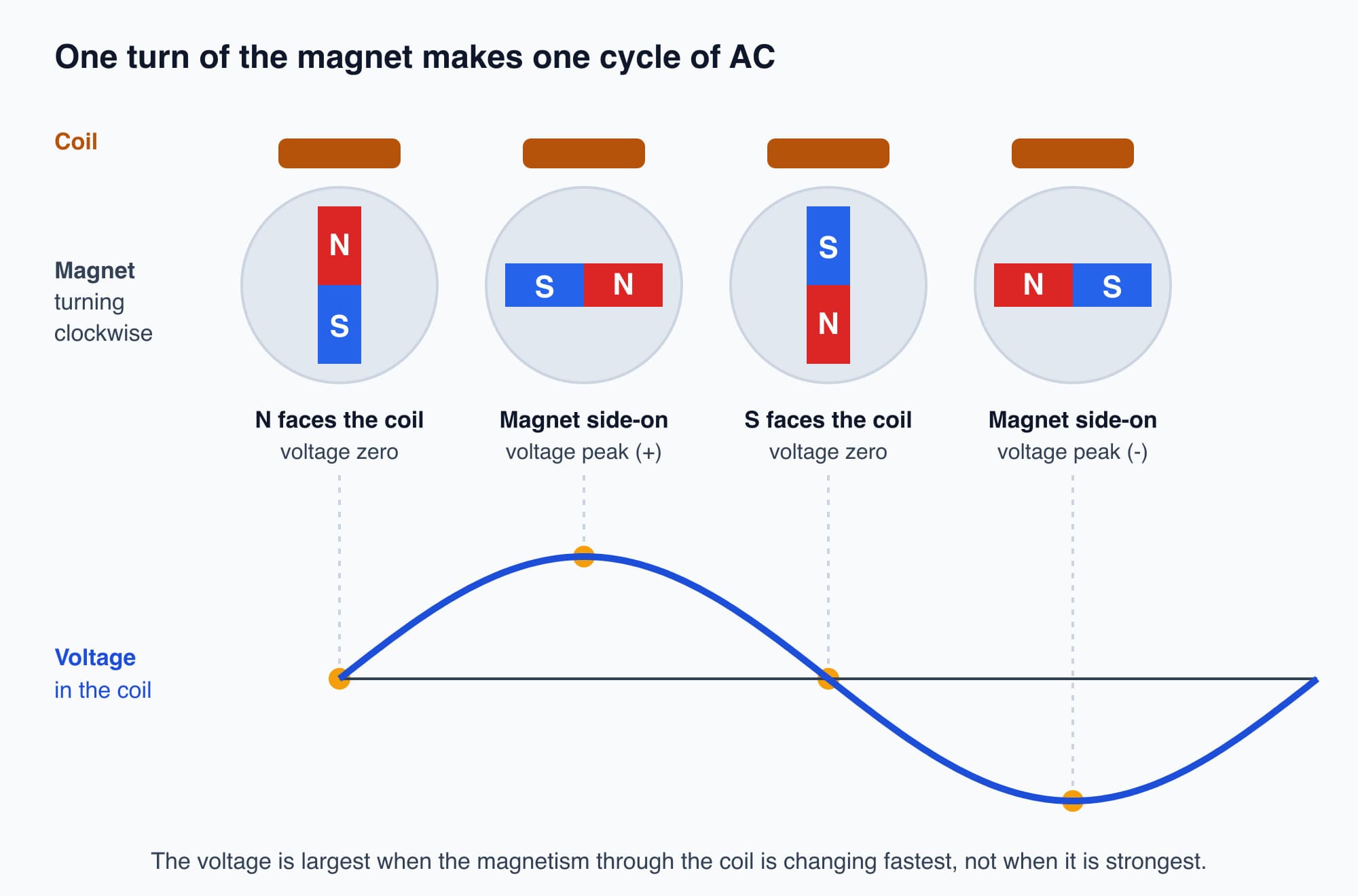
The voltage is zero when a pole faces the coil and highest when the magnet is side-on, because that is when the magnetism through the coil changes fastest.
Switching on a kettle makes a distant generator harder to turn
A generator does not create energy. It converts the energy of its turning shaft into electrical energy, so something has to keep supplying that energy.
Here is how the generator "knows" you switched on a kettle. When current flows in the generator's coils, that current makes its own magnetic field, and that field pushes back against the turning magnet. The more current the grid draws, the harder the push-back, and the harder the shaft is to turn. To keep the speed steady, the engine or turbine must work harder, which means burning more fuel or letting through more steam or water.
What turns the shaft differs from one power station to the next, but the generator on the end is essentially the same machine:
- Coal and gas power stations use heat to make a fast stream of high-pressure steam or hot gas. That stream pushes against a turbine, a set of angled blades on the shaft, and turns it. Coal and gas supply most of Malaysia's electricity (Part 12 gives the shares).
- Hydroelectric stations use falling water to push the turbine blades.
- Wind turbines use moving air.
- A standby generator uses a diesel engine. The office tower has one: a 1,000 kVA set that starts on its own when the mains supply fails and feeds the fire lifts, emergency lighting and other essential equipment. (kVA is a size rating, explained in Part 8.)
Apart from solar panels, which work differently, nearly every kilowatt-hour Malaysia uses starts as something turning.
The push-back also works in reverse. A generator and an electric motor are built from the same parts: magnets, coils, iron and bearings. Turn the shaft and the machine produces electricity; feed electricity in and the machine turns the shaft. In practice each machine is designed and controlled for its main job, but many can work both ways. An electric car uses this when it slows down: the car's controller lets the wheels turn the motor, so it works as a generator and sends current back into the battery. The braking force the driver feels is that push-back. This is called regenerative braking, and How Electric Motors Work (Part 10) covers motors.
All the big generators on the grid turn in step
For a generator with one north pole and one south pole (a two-pole generator), one turn of the shaft makes one cycle of AC. To make 50 cycles a second, it must turn 50 times a second, which is 3,000 revolutions per minute (rpm) (Wikipedia). Large steam and gas-turbine generators are usually built this way. Generators with more poles make more cycles per turn, so they turn more slowly to make the same 50 Hz.
All the large generators on a connected grid, such as Peninsular Malaysia's, turn in step, so that their waves rise and fall together. A generator is brought up to the right speed and matched to the grid's wave before it is connected, and once connected, the grid holds it in step. So the grid's frequency is, in effect, the speed of all of those machines at once.
That makes the frequency a live gauge of supply and demand. When people switch on more than the power stations are producing for, the extra push-back slows every generator slightly, and the frequency dips just below 50 Hz. Automatic controls then add fuel, steam or water to bring it back. When generation runs ahead of demand, the frequency rises slightly instead.
Why 50 and not some other number? Malaysia's supply was built with British and European equipment, and European manufacturers settled on 50 Hz in the early 1890s. American manufacturers settled on 60 Hz at about the same time. Neither number is clearly better, and once a country has built its generators, transformers and motors for one frequency, changing it would mean replacing all of them. Want the full story, including why Japan still runs on both? Read the side reading Why 50 Hz?.
Optional detail: Faraday's law in symbols is ε = −N dΦ/dt. Here ε is the voltage produced in the coil, N is the number of turns of wire, Φ is the magnetic flux (the amount of magnetism passing through the coil), and dΦ/dt means how fast that flux is changing. The minus sign is the push-back described above: the current produced always pushes against the change that caused it. >The speed of any generator is set by rotation speed in rpm = 120 × frequency ÷ number of poles. For a two-pole generator at 50 Hz, 120 × 50 ÷ 2 = 3,000 rpm. Hydroelectric generators often have dozens of poles; one with 40 poles turns at 150 rpm to make the same 50 Hz.
What you now understand
- Electricity is made by changing magnetism through a coil, not by magnetism itself; faster change gives more voltage.
- Rotation keeps the magnetism changing, and a turning magnet naturally produces AC, one cycle per turn for a two-pole machine.
- The energy comes from whatever turns the shaft: drawing more current makes the shaft harder to turn, so more fuel, steam or water is needed.
- The grid's generators turn in step, so the frequency shows whether supply matches demand; 50 Hz itself was a historical choice.
Check your understanding
- A strong magnet is taped to a coil of wire and left there. Does the coil produce electricity? Why or why not? No. Current is produced only while the magnetism through the coil is changing. A magnet that does not move gives a steady magnetic field, so no voltage is produced, however strong the magnet is.
- Why does a power station burn more fuel when people use more electricity? A generator converts the energy of its turning shaft into electrical energy. When more current is drawn, the current in the coils pushes back harder against the turning magnet, so the shaft is harder to turn. To keep turning at the same speed, the turbine needs more steam or gas, which means more fuel.
What comes next
Faraday's iron ring had a second surprise in it: his two coils passed electricity from one to the other with no moving parts and no wire between them. That arrangement is the transformer. A power station makes electricity at thousands of volts. How does it become 230 V? The next part, How Transformers Work, explains.
This is Part 7 of 15 in Cobler's Electricity Fundamentals course. Previous: AC vs DC: Why the Grid Alternates and Your Phone Does Not. Next: How Transformers Work: The Grid's Quiet Machine.
Cobler builds CobiNeural, a platform that shows a facility team its building's energy, water and indoor air data as live numbers across the whole site. To see how your building performs, talk to us.
FAQ
Frequently asked questions
Ask us about this topic
Something in this article you want to dig into — or a situation in your own building it doesn't quite cover? Send us your question. We don't run public comments; the team replies to you directly by email.