Blog
AC vs DC: Why the Grid Alternates and Your Phone Does Not
AC reverses direction 100 times a second so it can be transformed to high voltage and travel far; DC flows one way and runs the electronics inside every device. Here is why the grid picked one and your phone the other.
 Tan Kok XinElectricity Fundamentals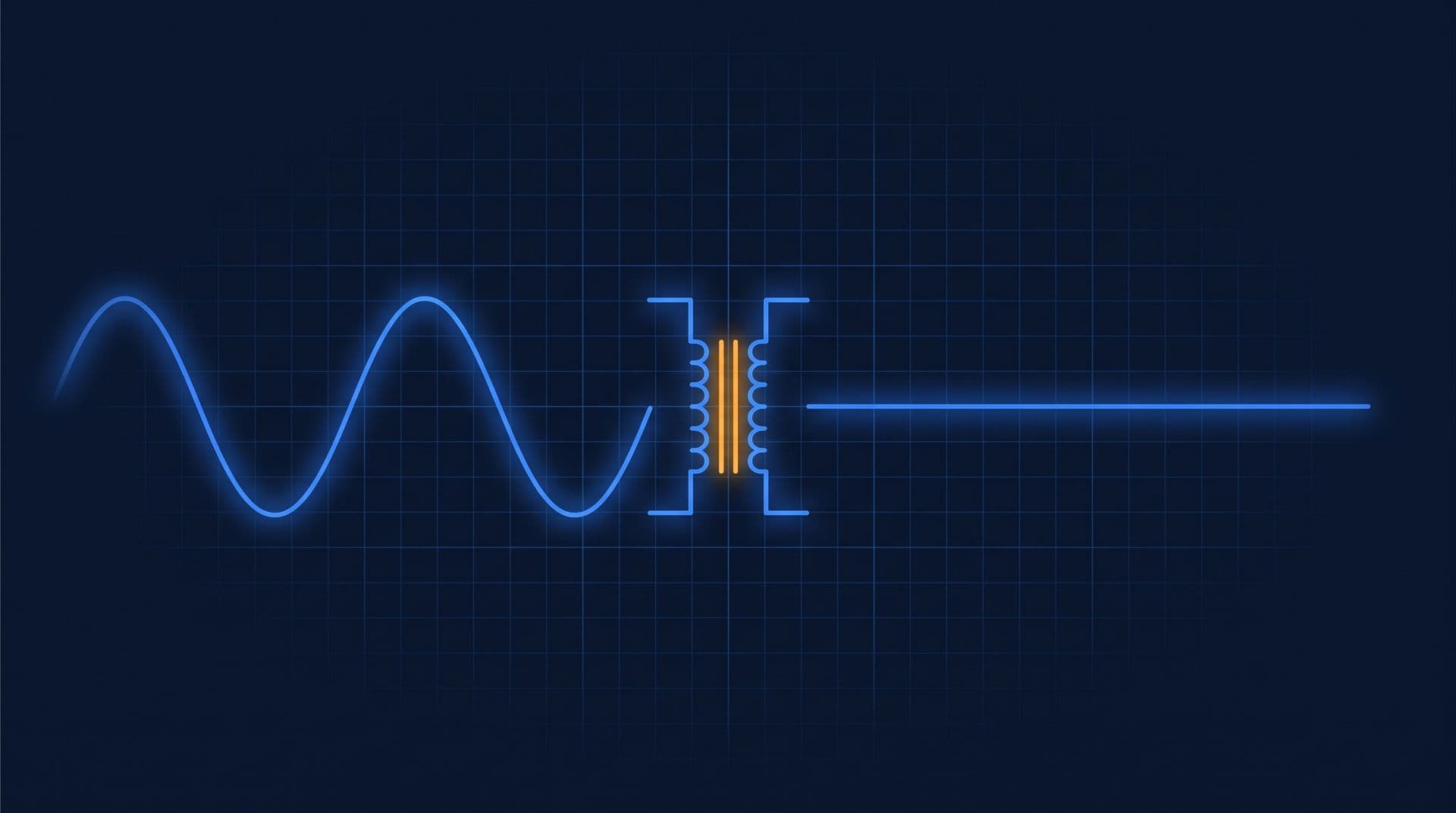
Part 6 of 15 in Cobler's Electricity Fundamentals course. New here? Start with the course map.
The electricity in your wall socket does not flow in one direction. It reverses 100 times every second, while the electricity from your phone's battery flows one way only. Part 5 ended with the question "The supply in your wall is AC. Why does it go back and forth?", and this part answers it.
AC vs DC: one flows one way, the other keeps reversing
In What Is Electricity, Actually? (Part 1) we saw that a current is charge flowing around a complete circuit, and in Volts and Amps (Part 2) we saw that voltage is the push that drives it. The two kinds of supply differ in the direction of that push.
With direct current (DC), the push is always in the same direction, so the current always flows the same way around the circuit. A battery is the everyday example. Its plus and minus terminals never swap, so the current always leaves from one terminal and returns to the other. A power bank charging your phone is DC on both sides, which is why there is no charger brick between them: nothing needs converting.
With alternating current (AC), the push keeps reversing. For a moment one terminal of the wall socket pushes, then the push fades to zero and builds up in the opposite direction, then it reverses again, over and over. The electrons in the wires drift a little one way, then a little the other way.
In Malaysia the grid does this at 50 hertz (Hz). One hertz means one complete cycle per second, so 50 Hz means 50 full cycles every second. Each cycle has two reversals (forward to backward, then backward to forward), so the current reverses direction 100 times a second. One cycle takes 1/50 of a second, which is 20 milliseconds (ms). The next part explains where the 50 comes from.
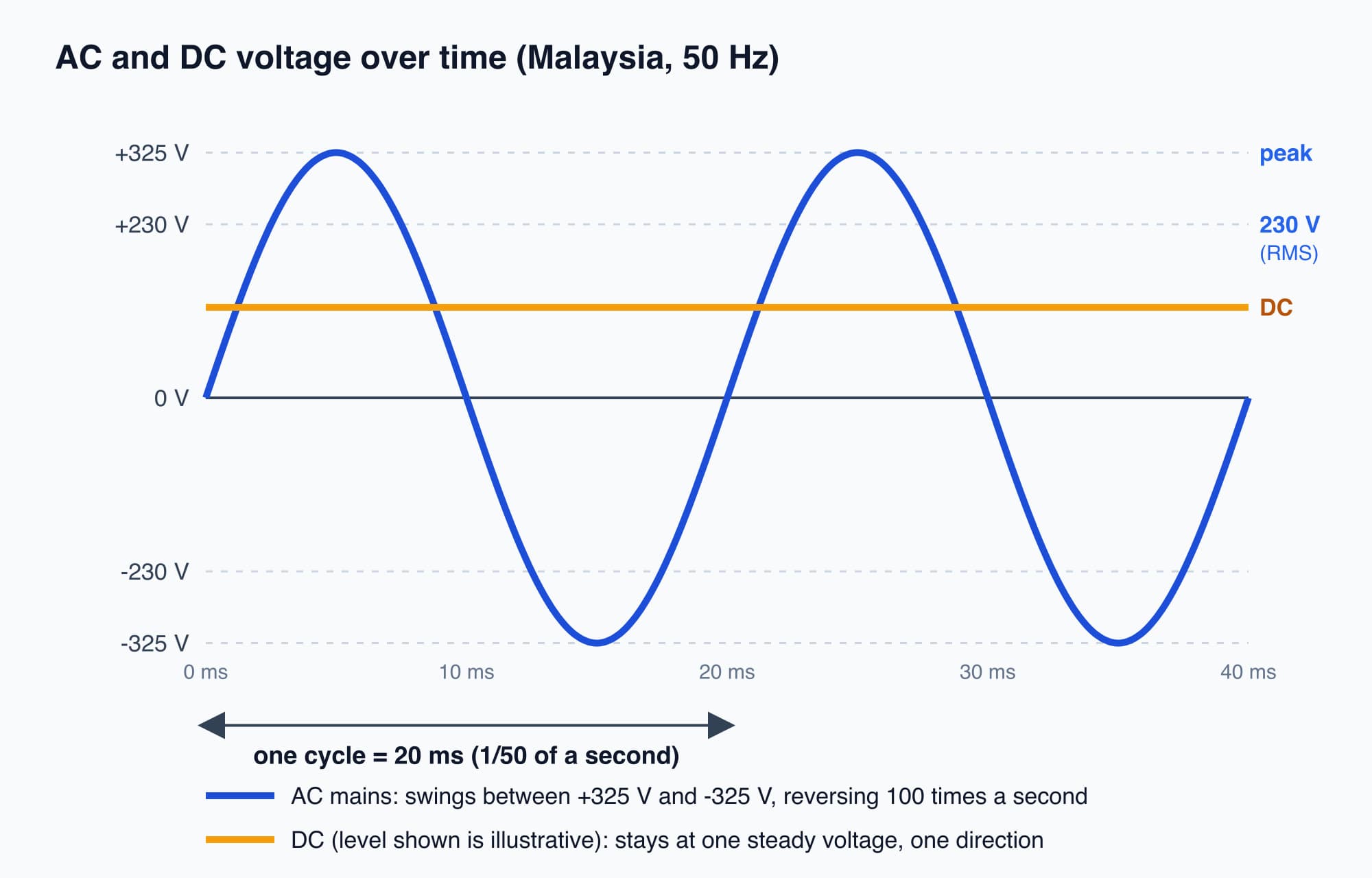
AC mains voltage rises and falls in a smooth wave, completing one cycle every 20 ms, while DC stays at one steady level.
If the current only rocks back and forth, how does a kettle get hot? A heating element warms up whichever way the current flows through it: the current pushes charge through the element's resistance in one direction, then in the other, and both directions heat the wire. So energy is delivered all through the cycle, except for the brief instants when the voltage passes through zero, even though each electron only rocks back and forth a tiny distance.
A 230 V socket actually reaches about 325 V
The standard TNB (Tenaga Nasional Berhad) low-voltage supply is 230 V single-phase and 400 V three-phase (National Grid Malaysia). Single-phase 230 V is what reaches an ordinary wall socket. Three-phase 400 V is used for larger equipment, and Three-Phase Power Explained (Part 9) explains it.
But an AC voltage is always rising and falling, so which number is "230"? It is the effective value: an AC supply of 230 V heats a kettle element exactly as much as a steady 230 V DC supply would. That is why it is the useful number to quote.
The wave itself goes higher. For a smooth mains wave, 230 V effective means the voltage peaks at about 325 V in each direction, 100 times every second (once forward and once backward in each of the 50 cycles). Every appliance you own is built to expect this.
Sending power at 230 V across the country would need 43,000 amps
Now for the main question: why does the grid use AC at all? The answer starts with a problem every power line has.
Every wire has some resistance, so some energy is lost as heat whenever current flows through it. In Part 2 we saw that power in watts equals volts times amps. The heat lost in a wire follows a different rule: it equals the current, times the current again, times the wire's resistance. Engineers write this as I²R, where I is the current and R is the resistance.
Because the current is multiplied by itself, the loss rises very fast with current. Double the current and the loss becomes four times larger. Halve the current and you quarter the loss.
This gives a way to cut losses. Since power equals volts times amps, you can send the same power with a higher voltage and a lower current. Raise the voltage four times, and the current needed for the same power falls to a quarter. The loss then falls to one sixteenth (a quarter times a quarter).
Here is a worked example. Suppose a power company wants to send 10 MW (10 megawatts, or 10,000 kW) along a line whose wires have a total resistance of 5 ohms there and back. These figures are illustrative, and we treat the line as a simple two-wire circuit. Real transmission lines are three-phase, which changes the arithmetic slightly but not the pattern.
Sending voltage | Current (power ÷ voltage) | Heat lost in the line (I × I × R) | Share of the 10 MW lost |
|---|---|---|---|
33 kV (33,000 V) | about 303 A | about 459 kW | about 4.6% |
132 kV (132,000 V) | about 76 A | about 29 kW | about 0.29% |
The same line, carrying the same power, wastes about sixteen times less energy at 132 kV than at 33 kV. Both 33 kV and 132 kV are voltages used on the Malaysian grid.
Now try the same 10 MW at the 230 V of a wall socket. The current would have to be about 43,000 A. No practical line could carry that much current over any distance; it would overheat long before it delivered the power. That is why the pylons crossing the country carry 275 kV or 500 kV while your building receives 400/230 V. Substations step the voltage down in stages along the way.
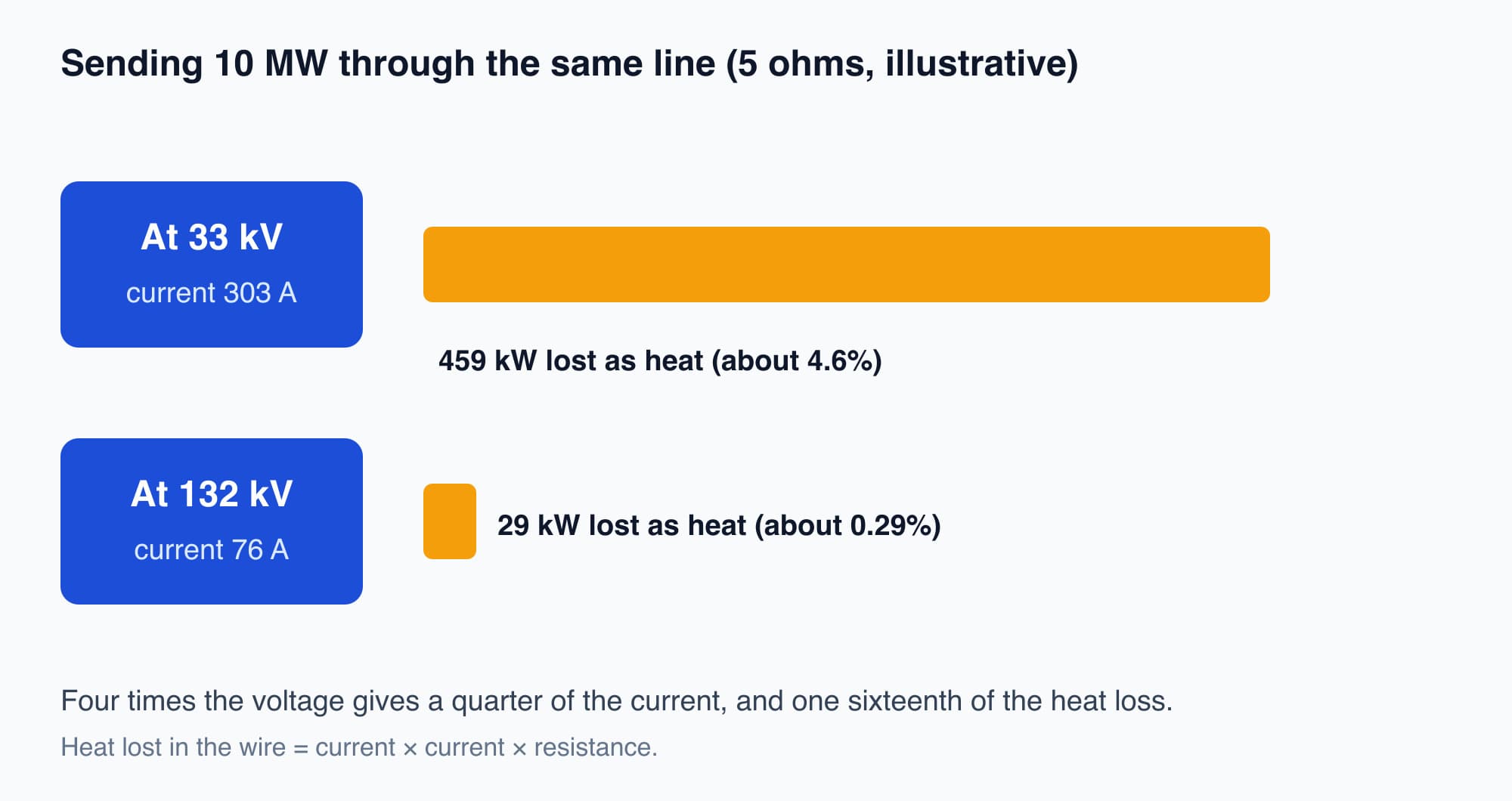
The same power sent at four times the voltage needs a quarter of the current and loses about one sixteenth as much energy as heat.
The machine that changes voltage only works on AC
Sending power at high voltage is only useful if you can raise the voltage for the long journey and lower it again before it reaches people. The machine that does this is the transformer: two coils of wire on an iron core, with no moving parts.
A transformer works only while the magnetism in its core keeps changing. AC changes all the time, so a transformer passes it on. Steady DC makes a steady magnetism, and nothing crosses to the second coil. How Transformers Work (Part 8) explains how.
This is why AC won in the 1880s. At the time, only AC could be changed cheaply to high transmission voltages and back again. Want the full story? The business and personal battle behind that choice is told in the side reading The War of the Currents. You do not need it for the rest of the course.
The grid is AC, yet your phone has never used AC
Electronic chips, LEDs and batteries all work on DC. A chip needs a steady voltage to tell a 1 from a 0, and a battery can only be charged by current pushed into it in one direction. So anything with a chip or a battery needs a device that turns the grid's AC into DC. That device is called a rectifier, and your phone charger contains one. A rooftop solar system needs the reverse: its panels make DC, and an inverter turns that DC into AC for the building's switchboard.
So the grid stays AC for the journey, and the conversion to DC happens at the last moment, inside the equipment that needs it. Rectifiers and Inverters (Part 13) explains how that conversion works, including why a phone charger does it twice.
Optional detail: Engineers call the effective value the RMS value, short for root mean square, the name of the averaging method used to work it out. For a smooth mains wave, the peak is about 1.41 times the RMS value (the square root of 2), so 230 V RMS peaks at about 325 V. >DC has come back for one grid job: moving large amounts of power over very long distances, using high-voltage DC (HVDC) lines. A long AC cable, especially under the sea, uses part of its capacity just charging and discharging itself, and alternating current tends to crowd towards the outer surface of a thick conductor (the skin effect). A DC link avoids both and can join two grids that are not running in step. China's Changji-Guquan link runs at ±1,100 kV over 3,324 km, carrying up to 12 GW (NS Energy). The North Sea Link between Norway and the UK carries 1,400 MW through 720 km of subsea cable (North Sea Link). As a rule of thumb, HVDC becomes the better choice above roughly 600 km of overhead line, or for submarine cables longer than about 50 to 80 km. Inside a building, the supply is AC.
What you now understand
- DC flows one way; AC reverses, 100 times a second on Malaysia's 50 Hz grid, and it still delivers energy because heating works in either direction.
- "230 V" is an effective value: the AC wave heats like 230 V DC, although it peaks at about 325 V.
- Heat lost in a line grows with the current multiplied by itself, so power travels at high voltage and low current.
- Transformers change voltage, and they only work with AC. That is why the grid is AC.
- Electronics and batteries need DC, so the grid stays AC and chargers contain a rectifier that turns AC into DC at the last moment.
Check your understanding
- Your wall socket is labelled 230 V. Why does the voltage actually reach about 325 V? The voltage of an AC supply rises and falls in a wave. 230 V is the effective value, the steady DC voltage that would heat a kettle element by the same amount. The wave has to go higher than that at its peaks to heat the same amount on average; for a smooth mains wave, the peak is about 325 V.
- Why does sending power at a higher voltage waste less energy in the line? For the same power, a higher voltage needs a lower current, because power equals volts times amps. The heat lost in the wire depends on the current multiplied by itself, so a quarter of the current means one sixteenth of the loss. Transformers make it possible to raise the voltage for the journey and lower it again, and transformers only work with AC.
What comes next
The grid stores very little electricity: power stations make it at the moment you use it. Where does AC come from in the first place? The next part, How Generators Make Electricity, starts with a puzzle: the strongest magnet you can find, taped to a coil of wire, makes no electricity at all.
This is Part 6 of 15 in Cobler's Electricity Fundamentals course. Previous: Power vs Energy: The Difference Between kW and kWh. Next: How Generators Make Electricity: Spin Meets Wire.
Cobler builds CobiNeural, a platform that shows a facility team its building's energy, water and indoor air data as live numbers across the whole site. To see how your building performs, talk to us.
FAQ
Frequently asked questions
Ask us about this topic
Something in this article you want to dig into — or a situation in your own building it doesn't quite cover? Send us your question. We don't run public comments; the team replies to you directly by email.