Blog
Rectifiers and Inverters: Electricity's Translators
The grid speaks AC; solar panels, batteries, LEDs and every chip speak DC. Rectifiers and inverters are the translators between them, and a modern building is quietly full of both. Here is how they work.
 Tan Kok XinElectricity Fundamentals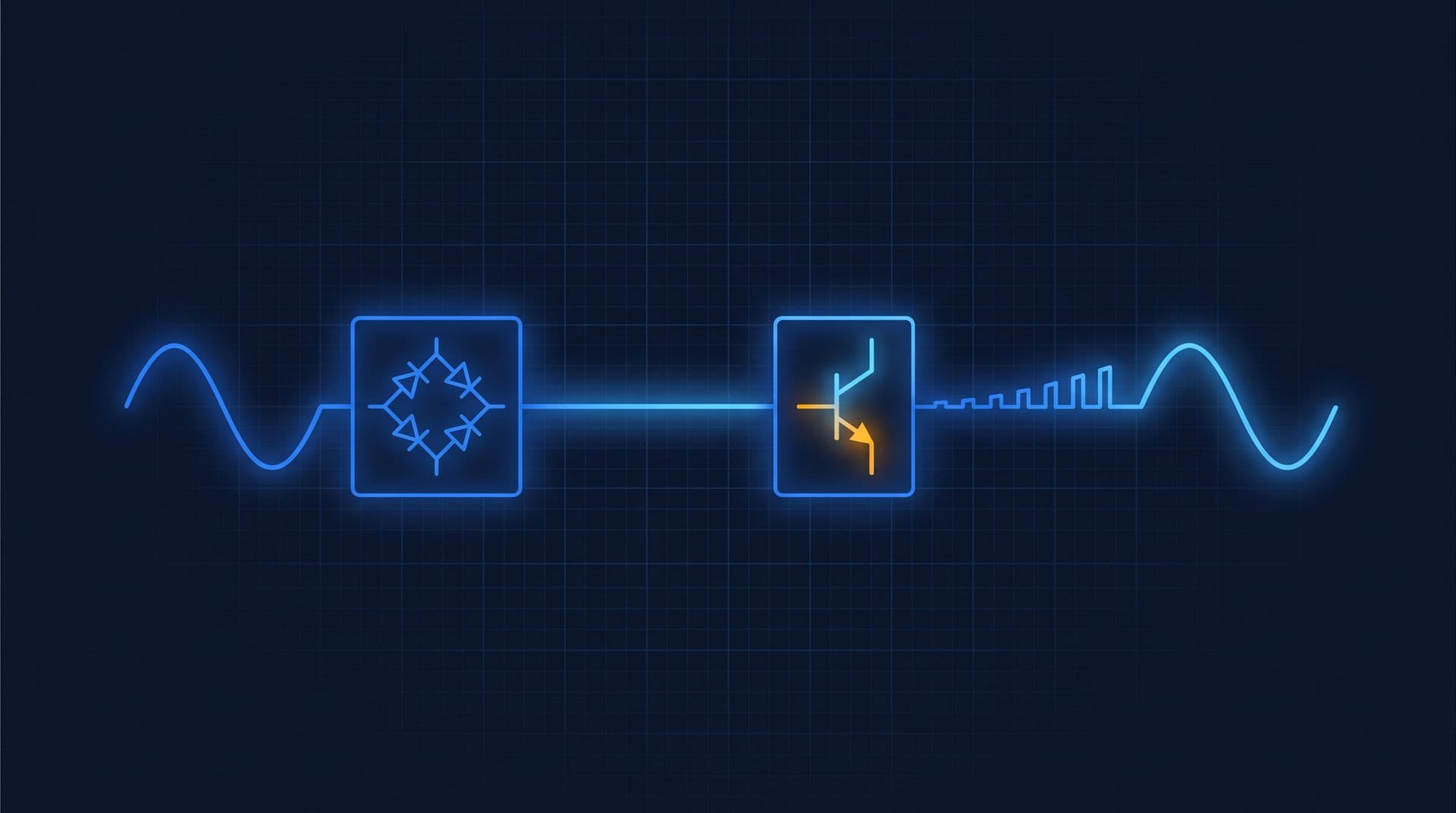
Part 13 of 15 in Cobler's Electricity Fundamentals course. New here? Start with the course map.
Your phone has never run on the AC from your wall socket. Every charge it has ever had came as direct current (DC), usually made inside the small charger plugged into the wall. How the charger does that answers the question Part 12 ended on: phones, LEDs and computers run on DC, so how is the AC from the grid turned into DC?
The equipment that does it is called a rectifier: it turns alternating current (AC) into DC. Its partner, the inverter, turns DC back into AC. Between them, rectifiers and inverters explain a surprising amount of what sits in a building.
How can a part with no moving pieces make current flow one way?
The mains supply is AC. As AC vs DC (Part 6) explained, its push reverses direction many times a second: on Malaysia's 50 Hz supply the current changes direction 100 times a second. A phone battery, an LED lamp and a computer chip all need current that flows one way only.
A rectifier is built around a small electronic part called a diode, which lets current flow through it in one direction and blocks it in the other. A useful comparison is a one-way valve (a check valve) in a water pipe: water can pass one way, but if it tries to flow backwards, the valve closes. The comparison stops working in one respect: a diode has no moving parts, because it is made of specially treated silicon.
Feed AC into a single diode and it passes the forward half of each cycle and blocks the backward half. What comes out flows one way, but half the time there is no current at all. To use the whole wave, rectifiers usually arrange four diodes in a pattern called a bridge. The forward half-cycles go straight through, and the backward half-cycles are steered round so they come out pointing forwards as well.
The result flows one way but is not steady yet: it rises and falls in humps, one for each half-cycle, so a 50 Hz supply gives 100 humps a second. One more part fills in the dips. A capacitor stores a small amount of charge and can release it quickly. It charges up as each hump rises to its peak, then releases its charge into the load as the hump falls away, which keeps the voltage up until the next hump arrives. The output becomes nearly steady DC.
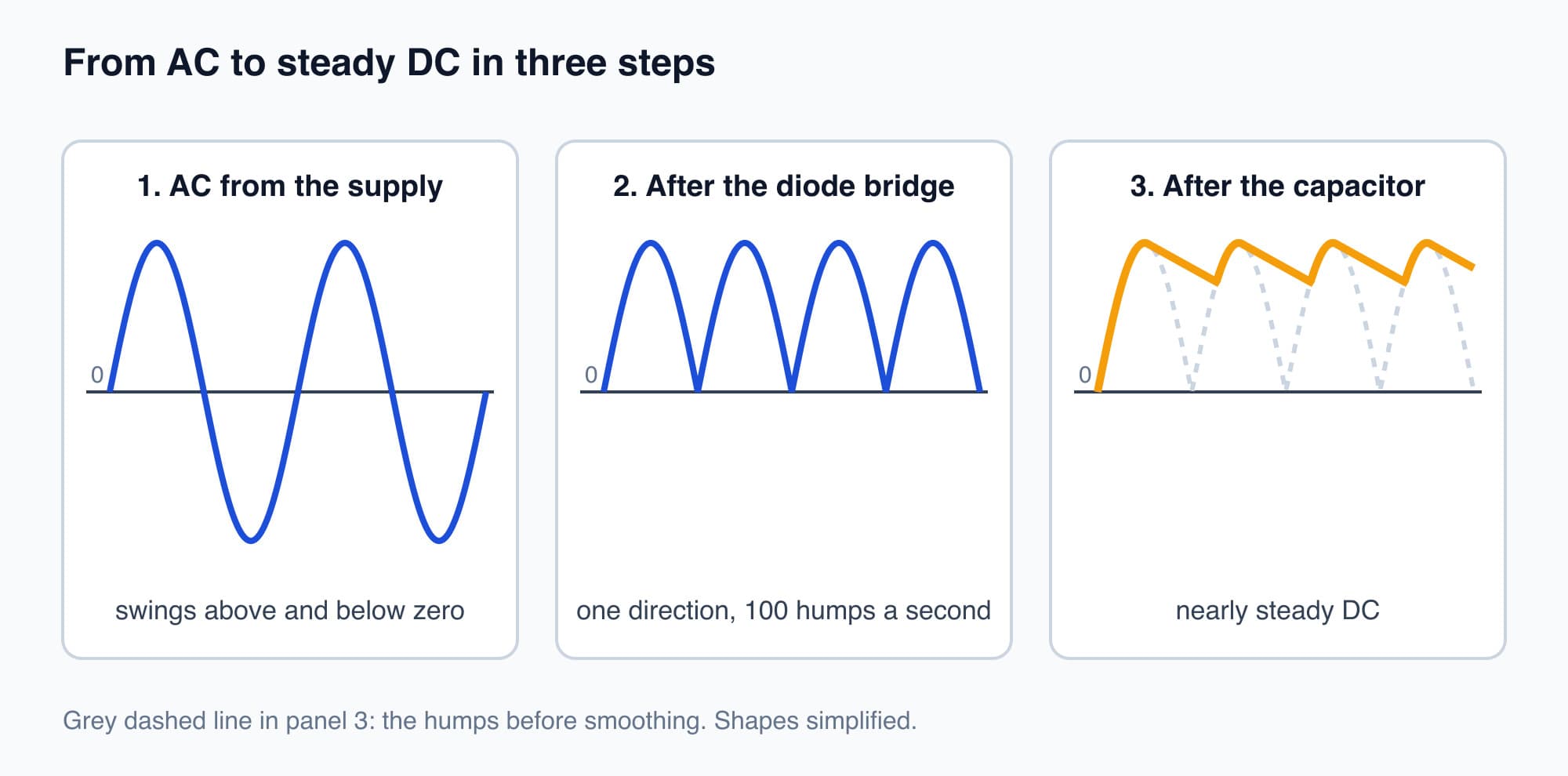
A bridge of diodes turns both halves of the AC wave into humps in one direction, and a capacitor fills the dips to give nearly steady DC.
Your phone charger changes the electricity twice
A phone charger does not stop at the rectifier. The DC from its diode bridge and capacitor is at a few hundred volts, far too much for a phone. So the charger switches that DC on and off tens of thousands of times a second or more, which turns it back into a kind of AC. That fast AC goes through a tiny transformer, which steps the voltage down, and a second rectifier turns the result into the few volts of DC the phone needs.
Why take the long way round? A transformer only works with AC, as How Transformers Work (Part 8) explained. At 50 Hz, a transformer needs a heavy iron core. At the much higher switching frequency, the transformer can be small and light. This is why a modern charger fits in your palm, while older chargers with a 50 Hz transformer inside were heavy blocks.
The fast switching also explains two things you may have noticed. The warmth of a charger is the small share of energy its stages lose as heat. And some chargers, LED drivers and adapters make a faint high-pitched whine: the switching makes small parts inside them, such as coils, vibrate, and when the switching rate is one the human ear can hear, you hear it.
An inverter builds a smooth wave out of on-off switching
Going the other way, from DC to AC, is harder. A DC source such as a solar panel or a battery gives a steady push in one direction. An inverter has to turn that into a push that rises, falls and reverses smoothly 50 times a second, with no spinning parts.
It does this with electronic switches called transistors. A diode cannot be controlled: it only passes or blocks. A transistor can be turned on and off by a small control signal, very quickly. The inverter switches the DC on and off thousands of times a second and changes how long each pulse stays on:
- Where the AC wave it is building should be high, the pulses stay on for longer (wide pulses).
- Where the wave should be low, the pulses are kept short (narrow pulses).
- To make the negative half of the wave, the switches connect the DC source the other way round.
Averaged over a short time, this train of pulses follows the shape of a smooth 50 Hz wave. A filter, which in a motor drive is often the motor's own coils, smooths out the remaining chopping. This method is called pulse-width modulation (PWM), because the width of each pulse is changed to shape the output.
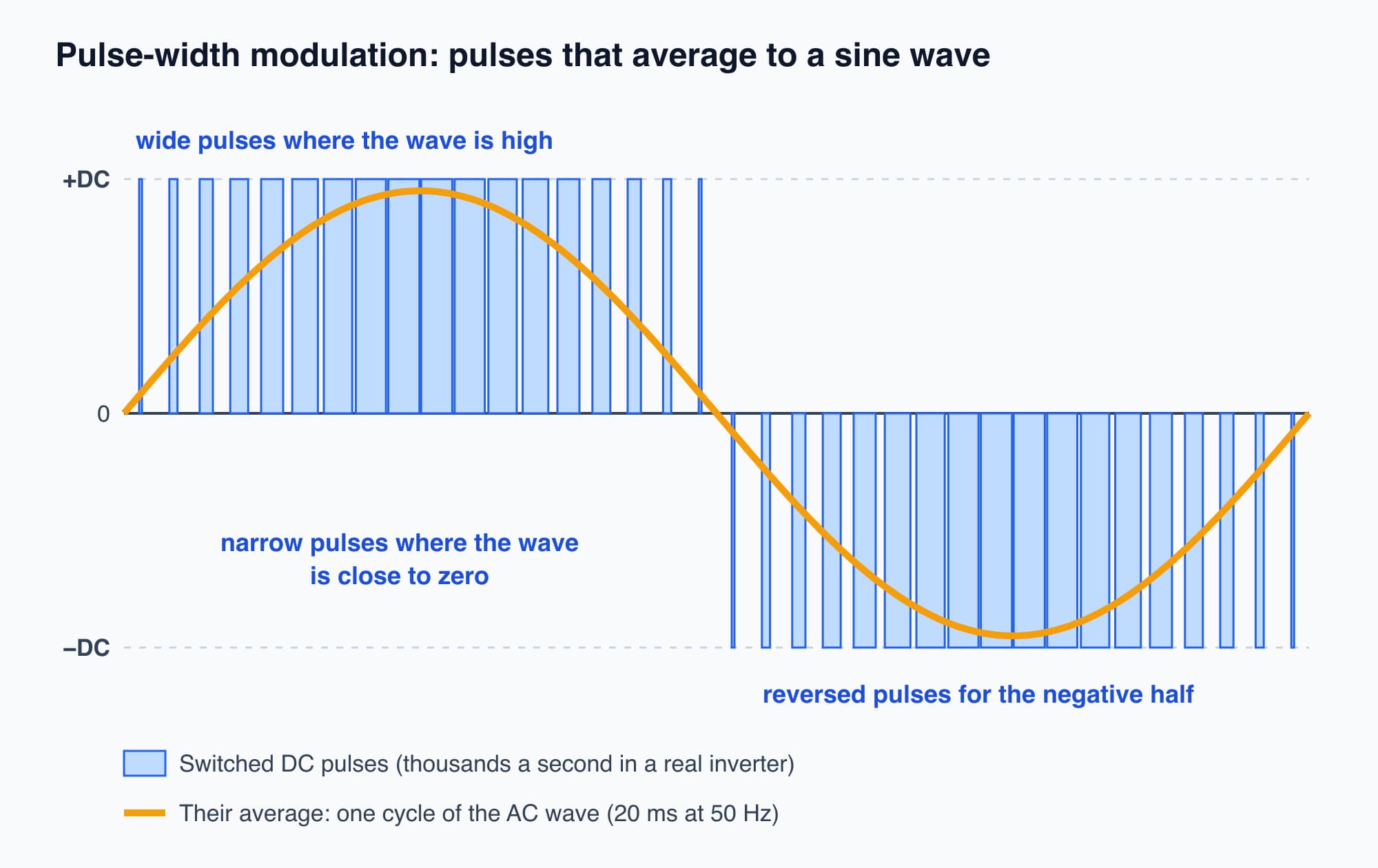
In pulse-width modulation, wide pulses where the wave should be high and narrow pulses where it should be low average out to a smooth AC wave.
A generator (Part 7) makes AC by turning a magnet and coils past each other. An inverter makes AC by switching silicon on and off. The output has the same shape, but the two machines work in completely different ways.
An "inverter" air conditioner hides rectifiers and inverters back to back
A variable frequency drive (VFD), also called a variable speed drive (VSD), controls the speed of a motor. How Electric Motors Work (Part 10) met it as a way to start a motor gently; here is what is inside. It rectifies the incoming AC into DC, then inverts that DC back into AC at whatever frequency the motor needs. A motor's speed follows the speed of its rotating field, and that field turns in step with the supply frequency (1,500 rpm for a four-pole motor at 50 Hz, as Part 10 showed), so a lower frequency makes the motor turn more slowly. The office tower's secondary chilled-water pumps run on drives like this. The word inverter on an air conditioner or fridge label means the compressor is fed through such a drive, so it runs at a varied, steadier speed instead of switching fully on and then fully off. That is usually quieter and usually uses less energy when the unit is not working at full cooling.
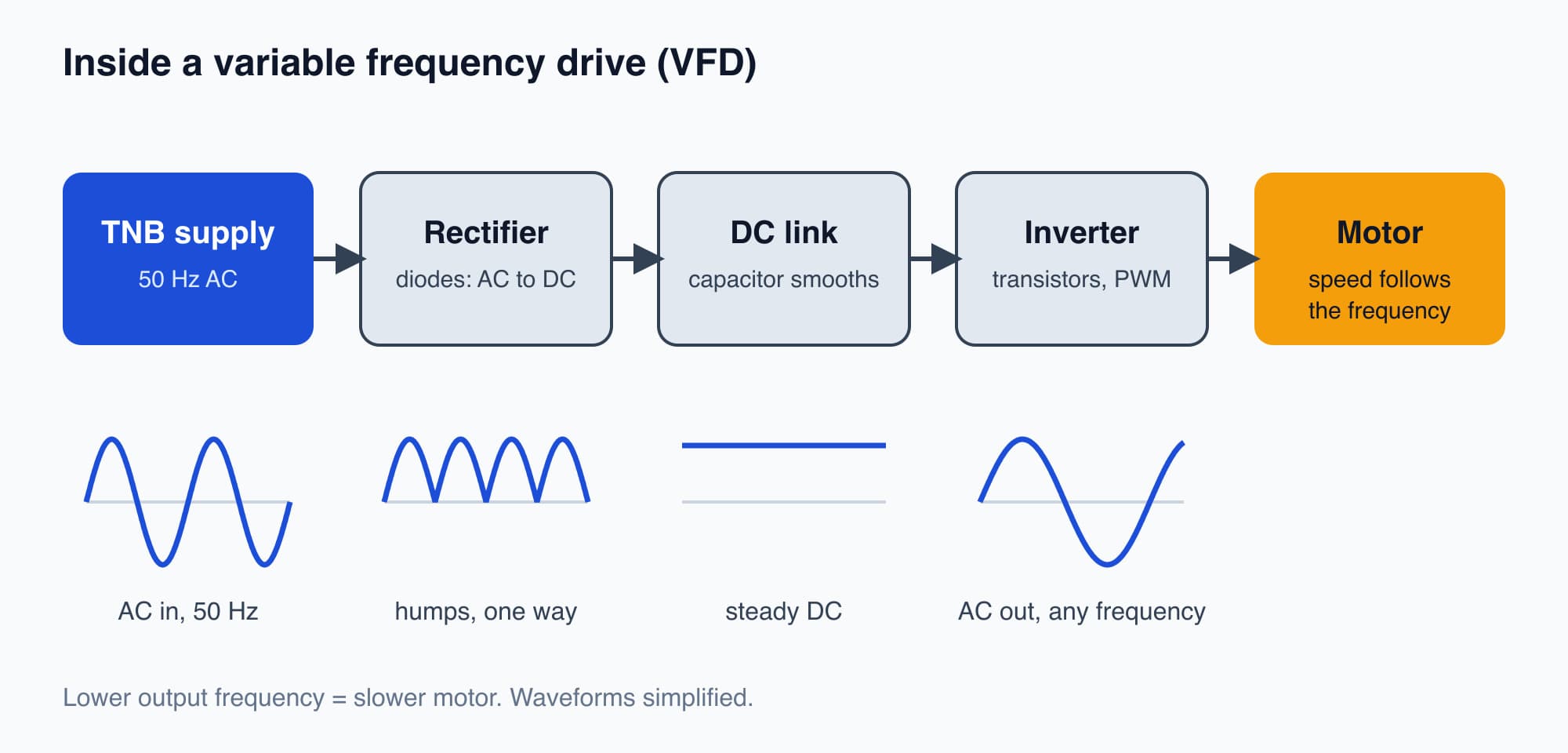
A variable frequency drive contains a rectifier and an inverter back to back, with a DC link between them.
Once you know the pattern, you find rectifiers and inverters all over a building:
- Phone chargers and LED drivers turn 230 V AC into a few volts of DC.
- Solar inverters turn the DC from the panels into AC that is synchronised with the grid.
- UPS (uninterruptible power supply) units and battery systems rectify AC to charge their batteries and invert DC back to AC when the mains fails. How Batteries Store Energy (Part 14) covers these.
- EV chargers: a car battery needs DC. With a slower AC charger, a rectifier inside the car does the conversion. A DC fast charger has a much larger rectifier inside the charging unit itself.
Every conversion loses some energy as heat in the diodes and switches, which is why drives and inverters need heatsinks and fans. Rectifiers also draw current from the supply in short bursts near the top of each wave, because the smoothing capacitor only charges when the supply voltage rises above its own. When a building has many drives, chargers and LED drivers, these bursts change the shape of the current in its wiring. That effect is called harmonics. The side readings Electrical Harmonics and Voltage Sags and Swells cover power quality for readers who look after building equipment.
One safety point follows from the smoothing capacitor. The capacitors in drives, UPS units and inverters can stay charged for some time after the equipment is switched off. Opening them up is work for a competent, qualified person, following the manufacturer's instructions. The general safety rules are in Earthing and RCDs (Part 4).
Optional detail: Inverters depend on power transistors that can switch large currents and high voltages quickly, reliably and cheaply. Switches like that were not available at a practical price for most of the 20th century, so solar inverters, motor drives and compact chargers only became widespread in recent decades. Good solar inverters now convert energy at efficiencies in the high 90s percent, with the best modern units near 99%. The same electronics lets engineers send very large amounts of power over long distances as high-voltage DC. In the 1890s, AC won the choice of grid partly because DC voltage could not be changed easily; the side reading on the war of the currents tells that story.
What you now understand
- A rectifier turns AC into DC: diodes let current through one way only, a bridge of four diodes uses both halves of the wave, and a capacitor smooths the humps.
- A phone charger converts twice, AC to DC and back through a fast-switched tiny transformer to low-voltage DC, which is why it can be small and light.
- An inverter makes AC from DC by switching transistors on and off quickly and varying the pulse widths (PWM).
- A variable frequency drive is a rectifier and an inverter back to back, and the same building blocks sit inside solar inverters, UPS units, battery systems and EV chargers.
Check your understanding
- What does the capacitor do in a rectifier? After the diode bridge, the current flows in one direction but rises and falls in humps. The capacitor charges near the top of each hump and releases charge as the hump falls, filling in the dips so the output is nearly steady DC.
- An inverter has no spinning parts. How does it produce a smooth AC wave? It switches DC on and off thousands of times a second using transistors, making pulses wide where the wave should be high and narrow where it should be low, and reversing the connection for the negative half. Averaged and filtered, the pulses follow the shape of a smooth 50 Hz wave. This is pulse-width modulation.
What comes next
A UPS keeps the office tower's server room running when the mains fails, and your phone lasts all day without a cable. Both depend on a battery, and a flat phone battery holds just as many electrons as a fully charged one. The next part, How Batteries Store Energy, asks: if electronics can turn AC into DC, can we store electricity for later?
Go deeper on video (optional)
This video walks through the inside of a variable frequency drive, the rectifier and inverter back to back described above, in more detail. It is optional: you do not need it for the next part.
"Variable Frequency Drives Explained: VFD Basics" by The Engineering Mindset
This is Part 13 of 15 in Cobler's Electricity Fundamentals course. Previous: How the Malaysia Electricity Grid Reaches Your Plug. Next: How Batteries Store Energy (and Why It Is All DC).
Cobler builds CobiNeural, a platform that shows a facility team its building's energy, water and indoor air data as live numbers across the whole site. To see how your building performs, talk to us.
FAQ
Frequently asked questions
Ask us about this topic
Something in this article you want to dig into — or a situation in your own building it doesn't quite cover? Send us your question. We don't run public comments; the team replies to you directly by email.