Blog
How Batteries Store Energy (and Why It Is All DC)
A battery does not store electricity; it stores chemical potential and manufactures current on demand. Why that is inherently DC, what the two datasheet ratings mean, and where storage pays off in a Malaysian building.
 Tan Kok XinElectricity Fundamentals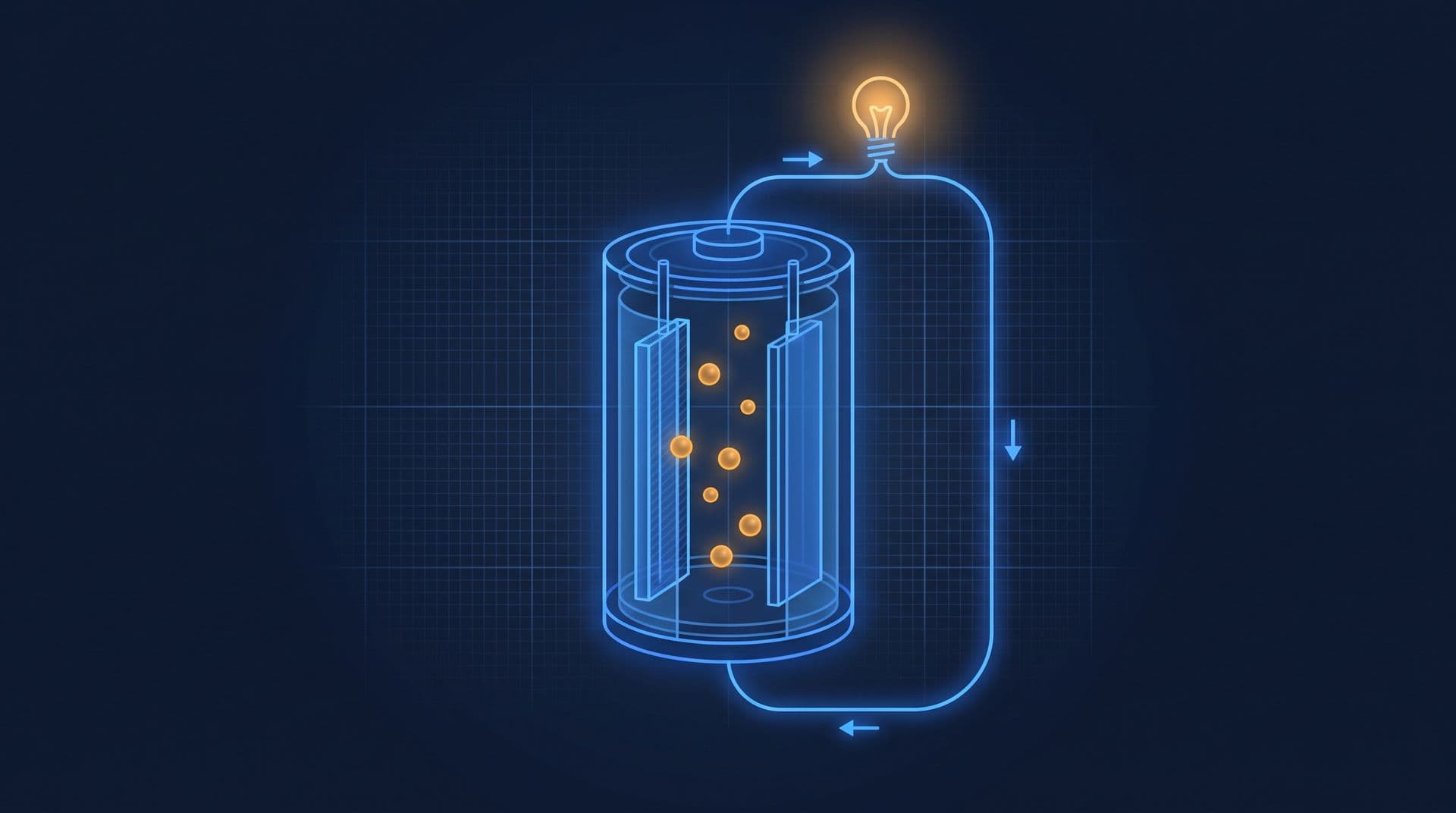
Part 14 of 15 in Cobler's Electricity Fundamentals course. New here? Start with the course map.
A flat phone battery contains just as many electrons as a fully charged one. Charging does not pour electricity into it like water into a tank; it rearranges the chemistry inside, and that is how batteries store energy. It is also the answer to the question Part 13 ended on: if electronics can turn AC into DC, can we store electricity for later? We can, but only by turning it into chemical energy and back.
How batteries store energy without storing electricity
A battery stores energy in chemical form and turns it into electrical energy through a controlled chemical reaction when you connect a load. The basic unit that does this is called a cell. A phone battery has one cell; a large battery system has thousands.
A cell contains two different materials, called electrodes. One gives up electrons easily and the other takes them readily. If the two touched directly, they would react straight away and release their energy as heat, which is of no use to you. So the cell keeps them apart and connects them in only two ways:
- Inside the cell, a layer called the electrolyte lets charged atoms (ions) move between the electrodes, but does not let electrons through.
- Outside the cell, your circuit (the wire, the switch and the device) lets electrons flow from one electrode to the other.
Because electrons cannot cross inside the cell, the reaction can only run when there is a complete circuit outside. Close the switch and electrons leave one electrode, flow through your device and arrive at the other electrode, while ions move across inside the cell to keep the charges balanced. On the way, the electrons deliver energy to your device: light in a torch, or motion in a fan. This is the circuit from What Is Electricity, Actually? (Part 1), with the push coming from a chemical reaction.
Charging runs the reaction backwards. A charger pushes electrons back the other way, the ions move back too, and the chemical arrangement is rebuilt so it can be used again. The number of electrons in the battery never changed; only where they sit, and the chemistry holding them, did.
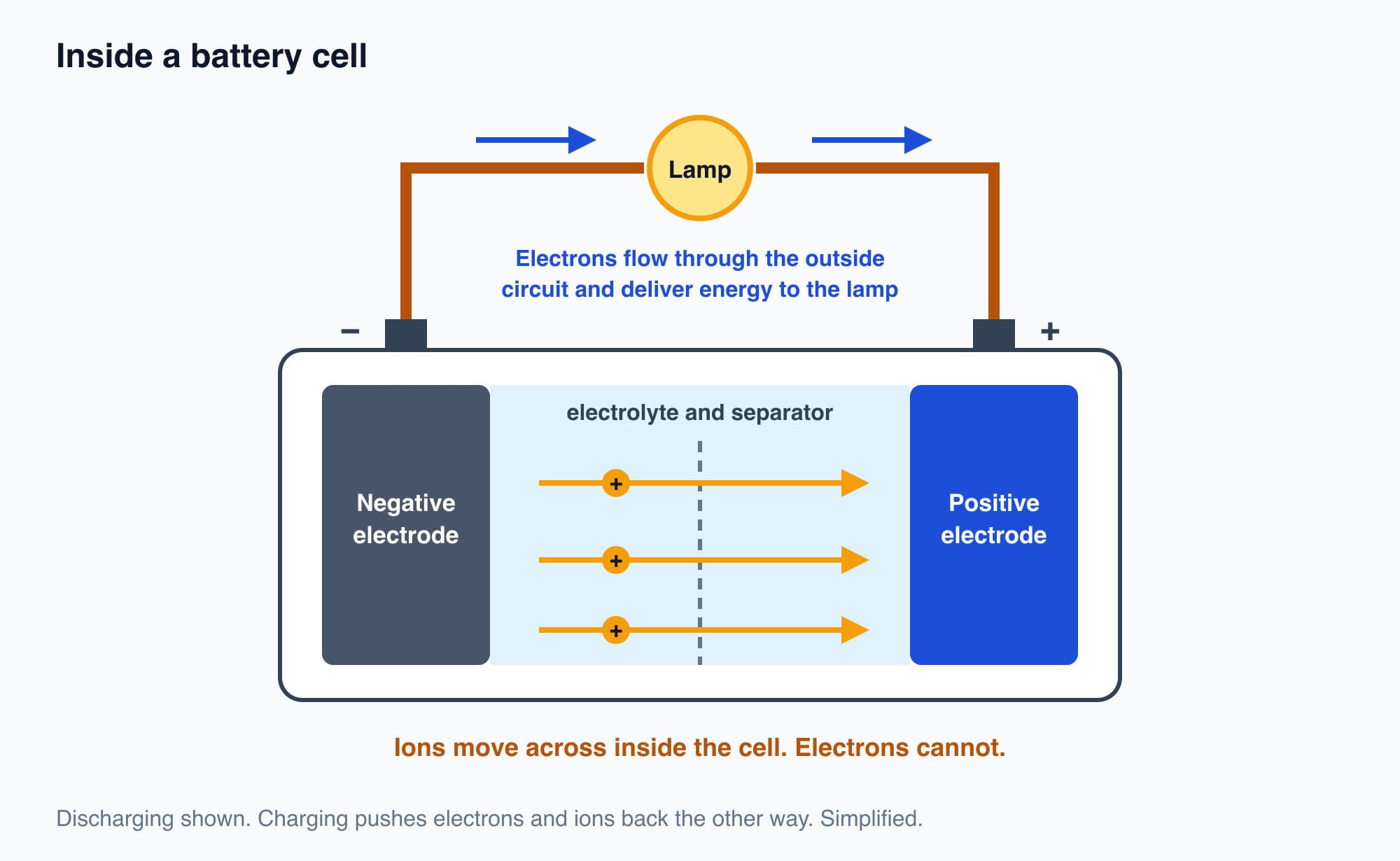
Ions move inside the cell; electrons can only travel through the outside circuit, and deliver energy to the lamp on the way.
Why does a battery only ever give DC?
A battery supplies direct current (DC) because its reaction runs in one direction while it discharges. Electrons leave the negative terminal, pass through your circuit and enter the positive terminal, steadily, for as long as the reaction continues. Nothing in a cell makes that flow reverse 50 times a second.
The TNB (Tenaga Nasional Berhad) grid and most building wiring run on alternating current (AC), as AC vs DC (Part 6) explained. So a battery that connects to a building's AC supply needs the equipment from Part 13 between the two:
- When the battery discharges, an inverter turns its DC into 50 Hz AC.
- When the battery charges, a rectifier turns AC into the DC the cells need.
A large battery energy storage system (BESS) is, electrically, a big DC battery with this conversion equipment between it and the network. Each conversion loses a little energy as heat, so you always get back somewhat less than you put in. The share you get back is called the round-trip efficiency.
Why doesn't the office tower's server room notice a power cut?
The office tower has a UPS (uninterruptible power supply) of 60 kVA for its server room. In an online UPS, the servers run from the UPS's inverter all the time. A rectifier turns the incoming AC into DC, which keeps the battery charged and feeds the inverter. When the mains supply fails, the battery is already connected to the inverter, so it takes over without a break. The servers never see the gap.
The battery only has to last a short while. The tower's standby generator starts when the mains fails, and a transfer switch connects it to the essential supply that feeds the UPS. Once the generator has taken over, the battery can recharge from it. So a UPS battery bridges the gap between the power cut and the generator; it is not meant to run the servers for hours.
The tower has other batteries doing similar quiet jobs. The emergency light fittings each carry their own battery, so the stairwells stay lit in a power cut. And the building's 11 kV switchgear has a battery cabinet that supplies DC to trip the breakers. A breaker that must open when something goes wrong cannot depend on the supply it is protecting, so it gets its own battery.
Want the full story on what happens when a whole grid goes down? The side reading why blackouts happen covers it.
A battery has two sizes: how much, and how fast
Every battery storage system has two separate ratings, and mixing them up is a common mistake:
- Energy capacity, in kilowatt-hours (kWh): how much energy the battery can hold.
- Power rating, in kilowatts (kW): how fast the battery can take energy in or give it out.
These are the two ideas from Power vs Energy (Part 5): kW is a rate and kWh is an amount. Different parts of the design set them, so a battery can hold a lot of energy but deliver it slowly, or hold less but deliver it quickly. Dividing the energy by the power gives the hours it can run at full power. A system rated 400 kWh and 100 kW can supply 100 kW for 400 ÷ 100 = 4 hours.
Both sizes matter for the two common building uses:
- Solar storage. Rooftop panels make most of their electricity around midday, and a battery can hold some of it for the evening. The kWh size decides how much of the evening it covers, and the kW size decides how many appliances it can run at once.
- Peak shaving. The office tower's maximum demand (Part 5) is set on a hot weekday afternoon, at 1,600 kW. A battery that supplies everything above 1,500 kW during those half-hours lowers the maximum demand the meter records. Its kW rating must cover the 100 kW difference, and its kWh must last for as long as demand stays above the target. What that is worth on the bill is covered in the Understanding Your Electricity Bill course, and battery energy storage and peak shaving works through the sizing.
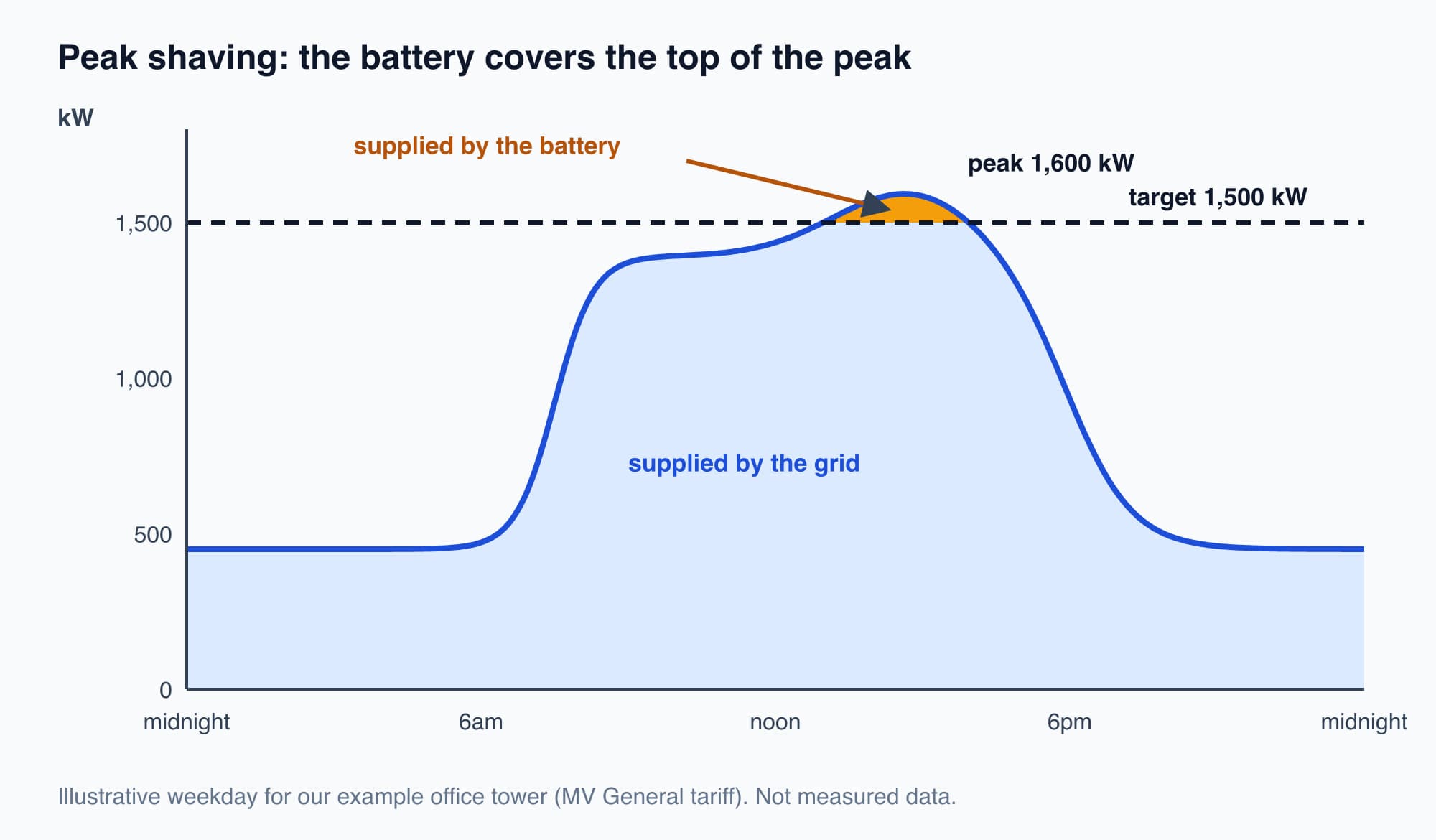
Illustrative only: the battery supplies the part of the afternoon peak above 1,500 kW, so the meter records a lower maximum demand.
Batteries also wear out. Each full charge and discharge is called a cycle, and each cycle wears the cell slightly, so the energy it can hold slowly falls. A battery is usually retired when it holds only 70 to 80 percent of its original capacity. Keeping a lithium-ion battery close to full, especially when it is warm, also wears it. This is why many newer phones offer to stop charging at 80 percent: the battery then spends less time close to full.
Optional detail: Modern lithium-ion grid systems have round-trip efficiencies of roughly 85 to 95 percent; most systems connected through their own inverter are between 88 and 94 percent, and the US National Renewable Energy Laboratory (NREL) uses 85 percent for planning (NREL / sustainability-directory summary). Engineers describe how hard a battery is worked with the C-rate: at 1C it charges or discharges in one hour, and the 400 kWh, 100 kW system above is a 0.25C system. A lithium iron phosphate (LFP) cell, the chemistry most grid systems now use, typically lasts around 6,000 cycles at 80 percent depth of discharge (the share of its capacity used each cycle), and up to 8,000 cycles before its state of health falls to 70 percent if used gently (NextG Power); worked at 2C, it may reach 80 percent health after only 2,000 to 3,000 cycles. In Malaysia, the Energy Commission's MyBeST programme (launched November 2024) plans four grid batteries of 100 MW / 400 MWh each, targeted for 2027 (Energy-Storage.news), and TNB's Santong BESS, also 100 MW / 400 MWh, was launched in May 2026 as the first battery system connected to the national grid (The Star).
What you now understand
- A battery stores chemical energy, not electricity: its electrons can only move from one electrode to the other through your circuit, and charging rebuilds the chemistry.
- Because the reaction runs one way, a battery gives DC, so a battery on an AC supply needs a rectifier to charge and an inverter to discharge.
- A UPS keeps equipment running through a power cut by always feeding it from an inverter, with the battery ready behind it until the generator takes over.
- A battery has two separate sizes, kWh for how much energy and kW for how fast, and every storage job needs both to be right.
Check your understanding
- A battery storage system is rated 400 kWh and 100 kW. What do the two numbers mean, and how long can it run at full power? 400 kWh is how much energy it can hold, and 100 kW is how fast it can deliver that energy. At full power it can run for 400 ÷ 100 = 4 hours.
- Why do many newer phones offer to stop charging at 80 percent? Keeping a lithium-ion battery close to full, especially when it is warm, wears it faster. Stopping at 80 percent means the battery spends less time close to full, so it keeps more of its capacity over the years.
What comes next
You have now followed electricity from the push in a wire to the grid, the motors, the power electronics and the batteries. The last part is a set of worked tasks in the office tower. It asks you to put it all together: can you trace the electricity from the power station to the pantry kettle, and read the numbers on the way? Start with Read a Building's Electrical Story.
This is Part 14 of 15 in Cobler's Electricity Fundamentals course. Previous: Rectifiers and Inverters: Electricity's Translators. Next: Capstone: Read a Building's Electrical Story.
Cobler builds CobiNeural, a platform that shows a facility team its building's energy, water and indoor air data as live numbers across the whole site. To see how your building performs, talk to us.
FAQ
Frequently asked questions
Ask us about this topic
Something in this article you want to dig into — or a situation in your own building it doesn't quite cover? Send us your question. We don't run public comments; the team replies to you directly by email.