Blog
Power vs Energy: The Difference Between kW and kWh
Power (kW) is how fast energy flows; energy (kWh) is how much flowed over time. Why the difference matters, and why your TNB bill charges for both.
 Tan Kok XinElectricity Fundamentals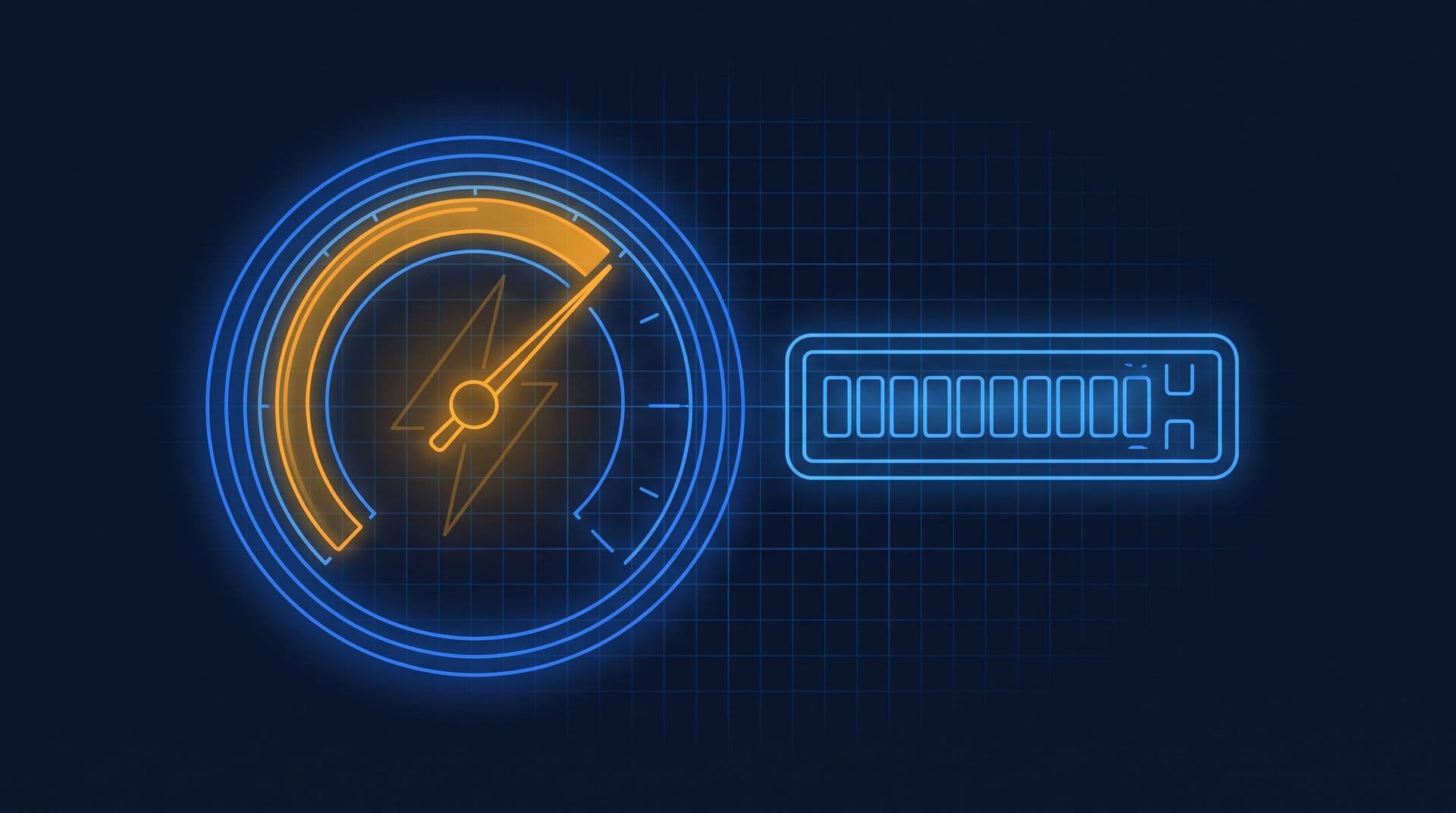
Part 5 of 15 in Cobler's Electricity Fundamentals course. New here? Start with the course map.
A 15 W standby light left on all day uses more than twice as much energy as a 3 kW kettle boiling water for three minutes. Part 4 ended by asking how we measure how much electricity something uses, and this puzzle shows why the answer needs two different numbers. The difference is power vs energy: power is how fast energy is being used at a moment, and energy is how much has been used over a period of time. Power is measured in kilowatts (kW). Energy is measured in kilowatt-hours (kWh).
Power vs energy: why the kettle label says kW but the meter counts kWh
Energy is what lets something do work: heat water, turn a fan, light a room. In Part 1 we saw that the supply delivers energy and an appliance turns it into heat, light or movement, and What Is an Electric Circuit? (Part 3) showed that this needs a complete circuit. The basic scientific unit of energy is the joule.
Power is the rate at which energy is delivered or used. One watt means one joule every second, and one kilowatt (kW) is 1,000 watts. So when our 3 kW kettle is switched on, it uses energy at a rate of 3,000 joules every second. In Volts and Amps (Part 2) we worked that power out from volts × amps.
A joule is a very small amount of energy, so electricity is measured in a larger unit, the kilowatt-hour (kWh). One kWh is the energy used by a 1 kW appliance running for one hour. In everyday terms, 1 kWh runs a 1 kW heater for an hour, or ten 100 W bulbs for an hour.
A car dashboard is a useful comparison. It has two different readings:
- The speedometer shows your rate, for example 90 km/h. It tells you nothing about how far you have travelled.
- The odometer shows your total, for example 40,000 km. It tells you nothing about how fast you are going right now.
You can drive at 90 km/h for one minute or for six hours. The speedometer shows the same number the whole time, while the odometer keeps climbing.
Power is like the speedometer, and energy is like the odometer. The kettle label gives its power, the rate at which it uses energy, the way 90 km/h is a speed. How much energy it uses depends on how long it stays on. Your electricity meter works like an odometer: its main register counts kWh, adding up the energy used since it was installed. (The comparison only illustrates rate versus total; it says nothing else about how electricity works.)
A small standby light can use more energy than a kettle
To work out energy, multiply the power in kilowatts by the time in hours:
kWh = kW × hours
Some examples:
- A 2 kW appliance running for 30 minutes uses 2 kW × 0.5 hours = 1 kWh.
- A 1 kW appliance running for one hour also uses 1 kWh.
- A 100 W bulb (0.1 kW) left on for 10 hours uses 0.1 × 10 = 1 kWh.
These are three different power levels using the same energy, because the lower-power ones ran for longer.
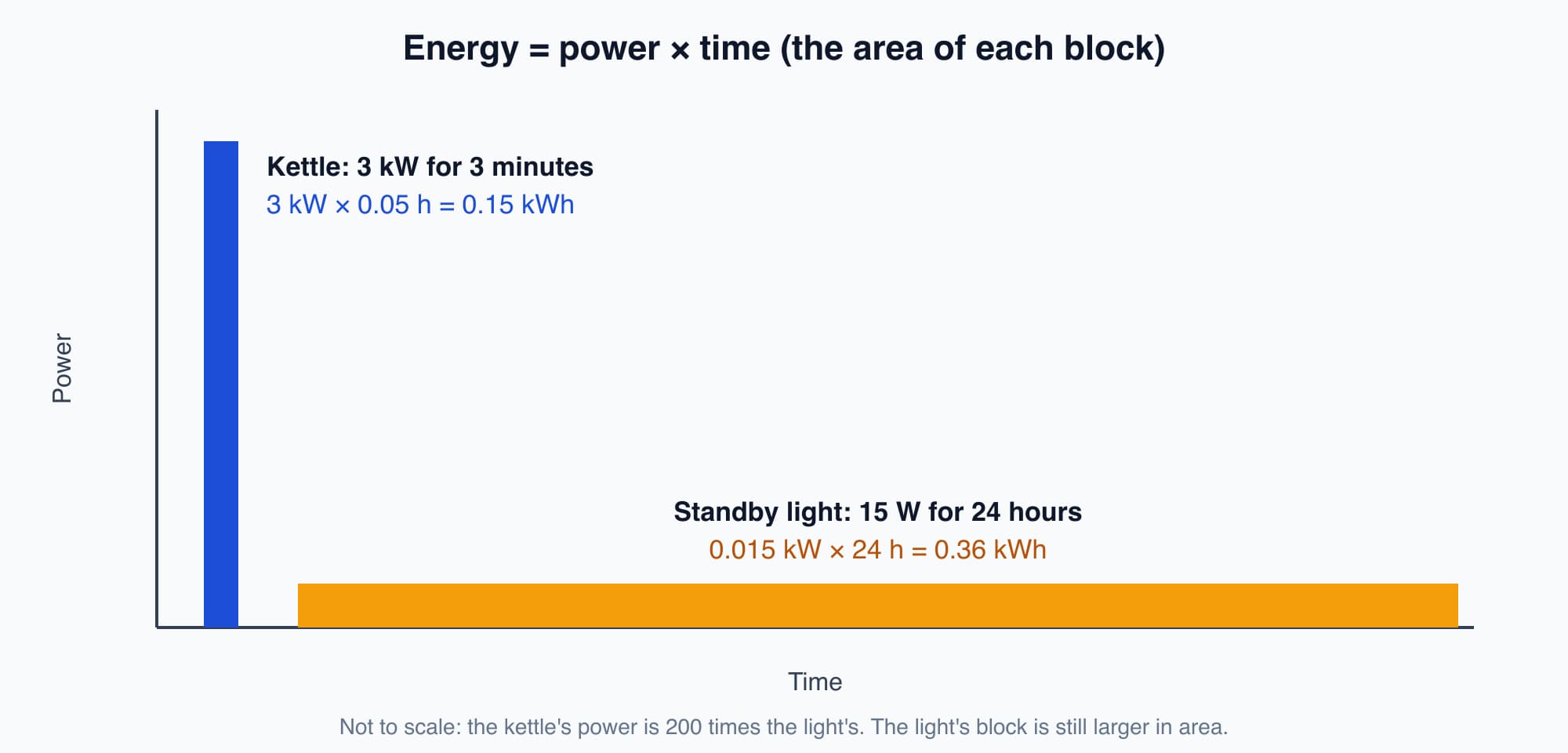
Energy is power multiplied by time: the area of each block. The low, long block holds more energy than the tall, short one.
Now the puzzle from the start of this lesson:
- The 3 kW kettle boiling water for 3 minutes uses 3 kW × 0.05 hours = 0.15 kWh.
- A 15 W standby light left on for a full day uses 0.015 kW × 24 hours = 0.36 kWh.
The standby light draws less than one percent of the kettle's power, but over the day it uses more than twice as much energy. The kettle has a high power for a short time. The light has a low power for a long time.
An electric car works the same way. A 50 kW fast charger can fill its battery in around an hour, while a 7 kW charger at home takes all night. The battery needs the same kWh either way. The power only sets how fast the energy goes in.
Air conditioners show why running time matters in a building. An air conditioner that runs for eight hours a day uses far more energy than a kettle that runs for a few minutes. When you read its label, check which figure is which. Many labels show a cooling capacity, for example 3.5 kW of cooling, and a separate, smaller electrical input power. The input power, multiplied by the running hours, is what adds kWh to the meter.
You may hear people say "kilowatts per hour" when they mean energy use. There is no such unit for consumption. A kilowatt is already a rate, so "kilowatts per hour" is like saying "kilometres per hour, per hour", which describes a change in speed, not a distance. Energy is counted in kilowatt-hours: kilowatts multiplied by hours, not divided by them.
A building's busiest half-hour of the month gets its own number
Homes and shops count their electricity mainly in kWh: the odometer reading. Larger buildings also have a second number recorded, and it comes from the speedometer.
Meet our example office tower: a fictional 20-storey office tower in Kuala Lumpur that we will visit throughout the course. In a typical month it uses 500,000 kWh. Its meter also records its maximum demand (MD): the highest 30-minute average power, in kW, during the month. For the office tower that is 1,600 kW, usually set on a hot weekday afternoon when the air conditioning is working hardest.
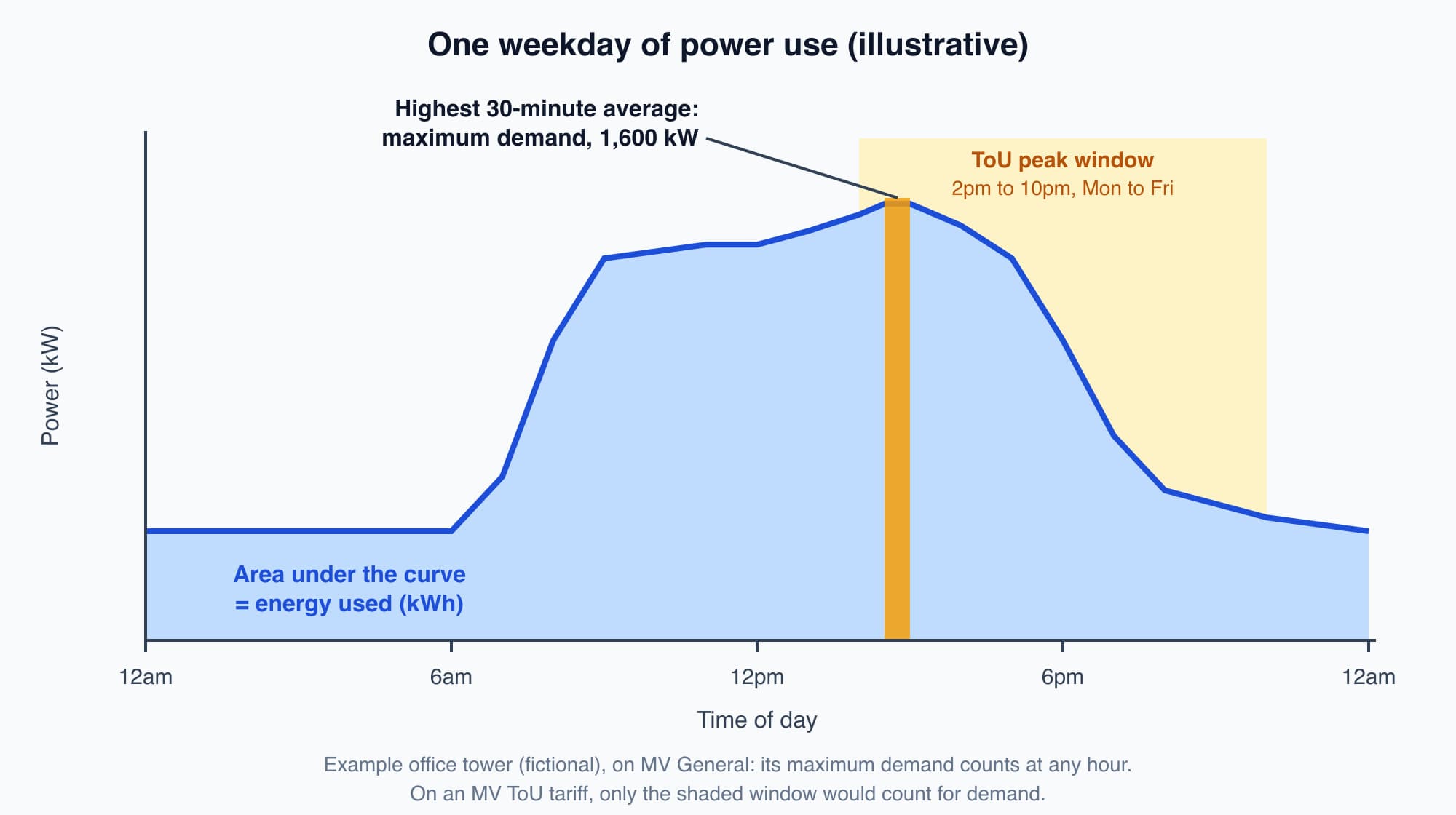
The area under the curve is energy (kWh); the highest half-hour is maximum demand (kW). The shaded window matters only on some tariffs, which the bill course explains.
Maximum demand is not the building's total use. It is set by its single highest half-hour in the month, even if the building reached that level only once. The grid cares about it because cables, transformers and substations must be large enough for the highest power they will ever carry, even if that peak lasts only half an hour. So larger buildings supplied at medium voltage are charged for both numbers: the energy they use in kWh and their maximum demand in kW. Buildings on a low-voltage supply, such as homes and shops, have no per-kW demand charge.
To lower its maximum demand, a building has to lower its peaks, for example by not starting large loads at the same time. The prices for each kWh and each kW are covered in our Understanding Your Electricity Bill course.
Motors and air conditioners also have a third power number, kVA, which is a little larger than their kW. kW, kVA and kVAR: The Power Triangle (Part 11) explains it once alternating current and motors have been covered.
Optional detail: One kWh is 1,000 joules per second for 3,600 seconds, or 3.6 million joules (3.6 megajoules). Want the full story? Joules vs kWh: Why Energy Has Two Names explains why energy has two units, and Why Is Power Measured in Watts? explains where the watt comes from.
What you now understand
- Power (kW) is how fast energy is being used; energy (kWh) is how much has been used. One is a speedometer reading, the other an odometer reading.
- Energy is power multiplied by time, so a low-power device left on for a long time can use more energy than a high-power one used briefly.
- An air conditioner's cooling capacity is not its electrical input; the input power and the running hours set the kWh.
- Larger buildings also have a maximum demand: their highest 30-minute average kW in the month. The grid has to be built for that peak.
Check your understanding
- A 2 kW heater runs for 3 hours. How much energy does it use? Energy = power × time = 2 kW × 3 hours = 6 kWh.
- The office tower uses 500,000 kWh in a month and its maximum demand is 1,600 kW. Why are these two different numbers? The 500,000 kWh is the total energy used over the month, like an odometer reading. The 1,600 kW is a rate: the highest 30-minute average power in the month, like the highest speedometer reading. One busy half-hour sets the maximum demand, however little energy the building uses the rest of the time.
What comes next: AC
So far we have treated the push from the supply as if it were steady. It is not: the push in your wall socket reverses direction 100 times every second. The supply in your wall is AC. Why does it go back and forth? AC vs DC: Why the Grid Alternates and Your Phone Does Not answers that.
This is Part 5 of 15 in Cobler's Electricity Fundamentals course. Previous: Earthing and RCDs: Why Birds Don't Get Shocked. Next: AC vs DC: Why the Grid Alternates and Your Phone Does Not.
Cobler builds CobiNeural, a platform that shows a facility team its building's energy, water and indoor air data as live numbers across the whole site. To see how your building performs, talk to us.
FAQ
Frequently asked questions
Ask us about this topic
Something in this article you want to dig into — or a situation in your own building it doesn't quite cover? Send us your question. We don't run public comments; the team replies to you directly by email.