Blog
What Is an Electric Circuit? Series vs Parallel
Electricity only flows in a complete loop. What an electric circuit is, why your house is wired in parallel, and what actually happens in a short.
 Tan Kok XinElectricity Fundamentals
Part 3 of 15 in Cobler's Electricity Fundamentals course. New here? Start with the course map.
On an old string of fairy lights, one dead bulb could switch off all the others, yet when a lamp fails in your home, every other light stays on. Part 2 ended by asking how the hundreds of things in a building are all connected, and the difference between those two kinds of wiring is the answer. First, though, we need to look at what an electric circuit actually is.
Why a few millimetres of air can switch off an electric circuit
An electric circuit is a closed loop that carries current from a source, through a load that does useful work, and back to the source. Current flows only when there is a continuous conducting path all the way round. Break the loop anywhere and the current stops everywhere in it.
Every circuit has four parts:
- A source provides the push: the 230 V at a socket, or the terminals of a battery.
- A conductor, usually copper wire, carries the current out to the load.
- A load turns electrical energy into something useful: heat in a kettle, movement in a ceiling fan, light in a lamp.
- A return path carries the current back to the source. At a socket, this is the neutral wire from Part 2.
A switch is not one of the four parts. As Part 1 showed, it is a gap in the loop that you can open and close on purpose. When you press a light switch off, two metal contacts inside it move a few millimetres apart. Air at that gap is a good enough insulator to stop the current from a 230 V supply, so the loop is broken and the room goes dark.
A circuit with a break in it is called an open circuit. The break might be an open switch, a blown fuse, a snapped wire or a burnt-out bulb. In each case the path is broken, so no current flows.
One dead bulb used to switch off a whole string of fairy lights
There are two basic ways to connect several loads to one source. The first is series: the loads sit one after another on a single loop.
In a series circuit, the same current flows through every load in turn. This has two consequences:
- One break stops everything. Older strings of fairy lights were wired in series. When one bulb's filament burnt through, the only path was broken, and all the bulbs on the string went dark at once while you hunted for the dead one.
- The loads share the voltage. The 230 V is divided among all the bulbs. Twenty identical bulbs in series on 230 V get about 11.5 V each. Add more bulbs and each one gets less voltage and glows more dimly.
Series wiring still has its uses. A switch is connected in series with the load it controls, so that opening the switch breaks the loop.
A building uses the other way. In a parallel circuit, each load sits on its own branch, and every branch connects across the same two supply wires. Each branch is its own loop from the source, through its load and back. This gives a building two things it needs:
- Full voltage for every load. Every socket and light gets the full 230 V it was designed for, whatever else is running.
- Independence. You can switch a lamp off without affecting the fridge. If one appliance fails, the others keep working.
This is why a building's distribution board (the panel of breakers, often called the DB) feeds a set of parallel circuits.
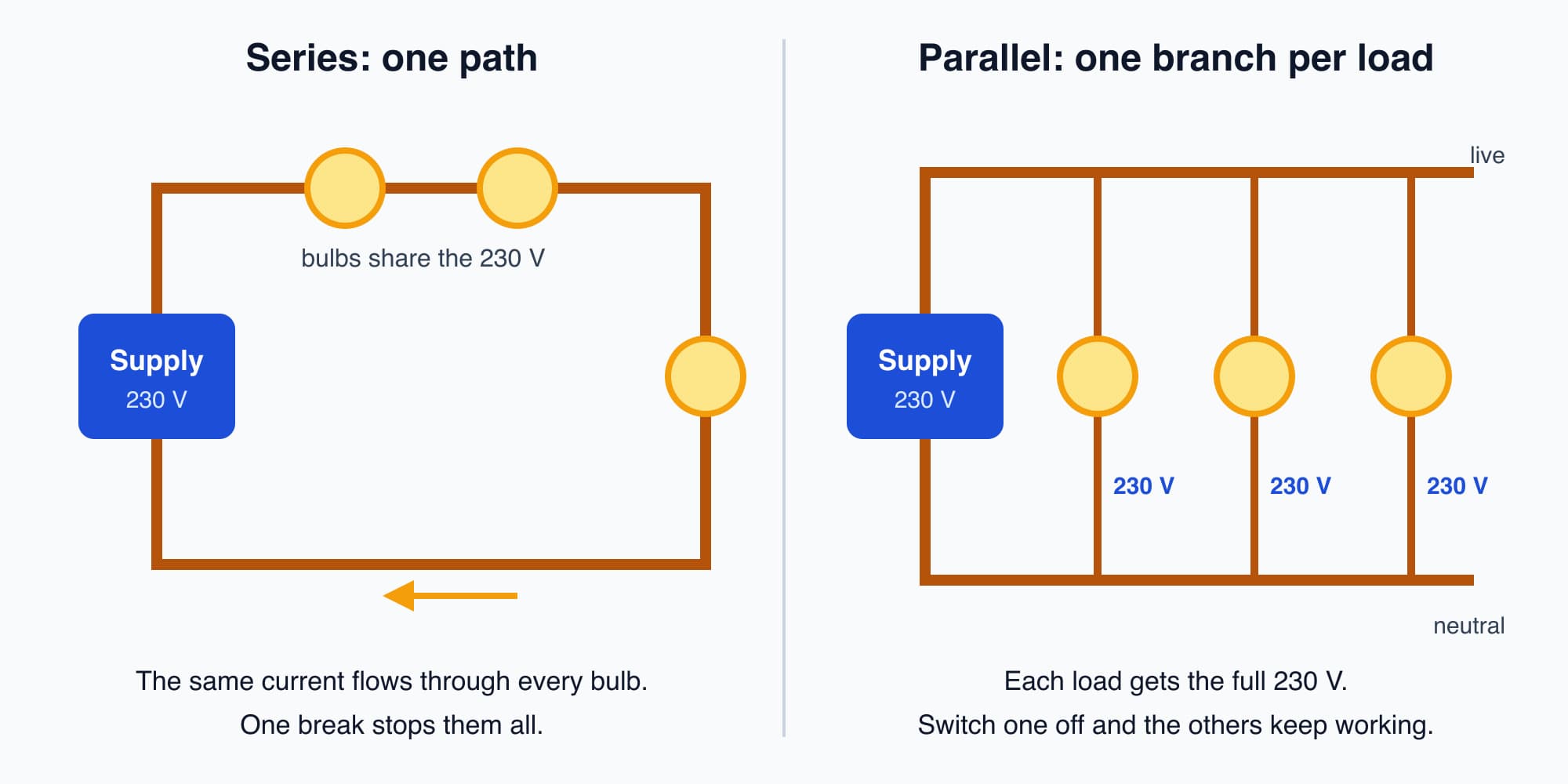
In series, the loads share one path and the voltage. In parallel, each load has its own branch and gets the full 230 V.
Parallel wiring has one cost: the currents add up. Each branch draws its own current, and all of those currents flow together in the wires that feed the branches. If the kettle, the air conditioner and the water heater run at the same time, the cable that feeds them carries all three currents at once.
Breakers and cables are sized for that total. You may have seen the lights go off when someone switched on the kettle while the iron was already running on the same circuit: the two currents together pushed the circuit past its breaker's rating, and the breaker tripped. It is also why a heavy appliance gets its own dedicated circuit instead of sharing one.
A short circuit skips the kettle, and the current gets bigger, not smaller
You might expect that taking the kettle out of the loop would mean less current. The opposite happens. A short circuit is a path that skips the load. It connects the live wire almost directly back to the neutral, or to earth (the protective wire connected to metal casings, which Part 4 explains). You may have seen one: a crack, a blue flash, a smell of hot plastic, and the breaker switching off.
Ohm's law from Part 2 (current = voltage ÷ resistance) explains why:
- Normally, the load's resistance limits the current. The element in a 3 kW kettle keeps the current at about 13 A.
- Now suppose a live wire rubs through its insulation and touches the neutral beside it. The current no longer passes through the kettle. The only resistance left in the loop is that of the wires and the supply itself, which together is often less than one ohm.
- Dividing 230 V by a very small resistance gives a very large current, far more than the cable is built to carry.
A wire that safely carries 13 A turns into a heater at a current like that. Within a fraction of a second the copper gets hot, the insulation begins to char, and the cable itself can start a fire.
A short circuit is the opposite of an open circuit. In an open circuit the path is broken and no current flows. In a short circuit the path has almost no resistance and far too much current flows. Most electrical faults are a form of one or the other.
Stopping a short circuit is the main job of a circuit breaker. The breaker measures the current flowing through it. When it detects a fault current far above its rating, it opens its contacts within a fraction of a second. This turns the dangerous short circuit back into a harmless open circuit before the cable overheats.
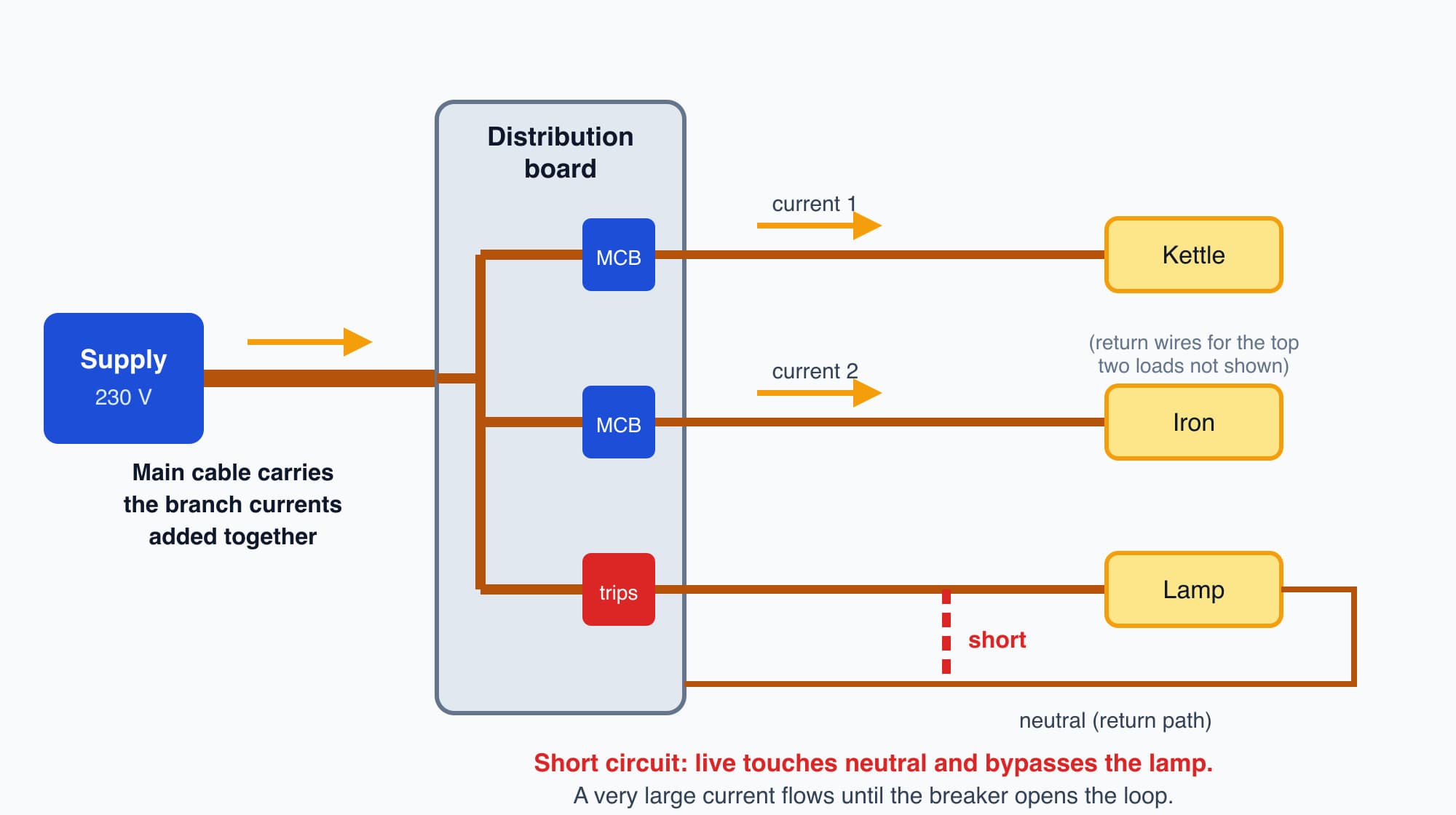
Branch currents add up in the cable feeding the board. A short circuit bypasses the load, and the breaker opens the loop.
A Malaysian plug has its own fuse inside
Malaysia uses the British-style BS 1363 plug, the three-pin Type G plug, adopted locally as MS 589. Many plug types used elsewhere, such as the two-pin plugs common in Europe and the United States, have no fuse, but this one does: a small cartridge fuse inside the plug, typically rated 3 A or 13 A. That fuse is why an appliance can suddenly stop working with nothing visibly broken.
The fuse sits in series with the appliance (see the fairy lights above), so all of the appliance's current flows through it. It is a deliberate weak link: a thin piece of metal inside it melts and opens the loop if the current is too high. It is there to protect the appliance's flexible cable, which is thinner than the fixed wiring in the walls.
This gives layered protection:
- The plug fuse protects the appliance cable. It blows if that one lead or appliance develops a fault.
- The circuit breakers in the distribution board protect the fixed wiring in the walls, and interrupt a full short circuit.
A fault in a table lamp should blow the 3 A fuse in its plug and nothing else, so the rest of the building keeps running. Only a larger fault reaches the breaker at the board.
Optional detail: The largest current that could flow at a given point in a fault is called the prospective fault current. In a building it can range from hundreds to many thousands of amps, depending mainly on how close the point is to the supply transformer and on the length and size of the cables in between. Opening a circuit carrying thousands of amps is hard, so each breaker also has a breaking capacity: the largest fault current it can interrupt safely without its contacts welding shut. For breakers in homes and small buildings, this is commonly 6,000 A or 10,000 A, and it must be higher than the prospective fault current where the breaker is installed.
What you now understand
- A circuit is a complete loop from the source, through a load and back. A switch, a blown fuse or a snapped wire opens the loop, and the current stops everywhere in it.
- Series loads share one path and the voltage, so one break stops them all. Buildings are wired in parallel, so each load gets the full 230 V and works on its own.
- In parallel wiring the branch currents add up, which is why a breaker can trip when too many heavy appliances run at once.
- A short circuit skips the load, so almost nothing limits the current. Breakers protect the fixed wiring, and the plug fuse protects the appliance's own cable.
Check your understanding
- Why is a building wired in parallel and not in series? In parallel, every load has its own branch across the supply, so each one gets the full 230 V and works independently. In series, the loads would share the voltage and one break would stop everything on the loop.
- Why does the current become so large in a short circuit? A short circuit bypasses the load, so the only resistance left is the small resistance of the wires and the supply. From Ohm's law, current = voltage ÷ resistance, so 230 V divided by a very small resistance gives a very large current. A breaker must open the loop before the cable overheats.
What comes next: a leak through a person
There is a third kind of fault. Current can leak to earth through a damaged appliance casing, or through a person, instead of returning along the neutral. That leak can be far too small to trip an ordinary breaker, yet large enough to kill. A breaker stops a short circuit. What stops a small leak through a person? Earthing and RCDs answers that, starting with a bird on a power line.
This is Part 3 of 15 in Cobler's Electricity Fundamentals course. Previous: Volts and Amps: Electrical Pressure and Flow, Explained. Next: Earthing and RCDs: Why Birds Don't Get Shocked.
Cobler builds CobiNeural, a platform that shows a facility team its building's energy, water and indoor air data as live numbers across the whole site. To see how your building performs, talk to us.
FAQ
Frequently asked questions
Ask us about this topic
Something in this article you want to dig into — or a situation in your own building it doesn't quite cover? Send us your question. We don't run public comments; the team replies to you directly by email.