Blog
Volts and Amps: Electrical Pressure and Flow, Explained
Voltage is electrical pressure, current is flow, and multiplying them gives you watts. The two numbers on every appliance label, explained from first principles for Malaysian 230 V supply.
 Tan Kok XinElectricity Fundamentals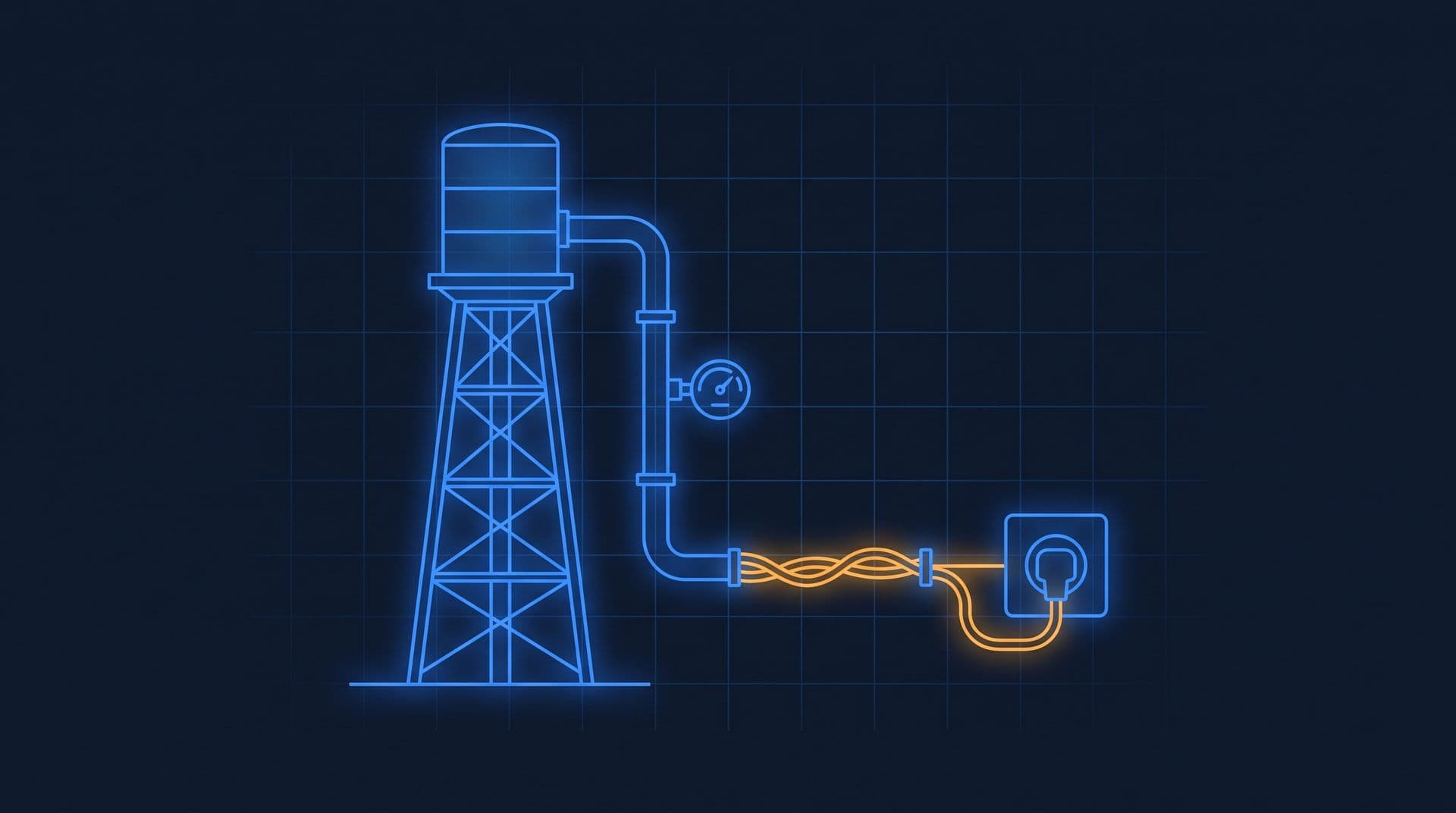
Part 2 of 15 in Cobler's Electricity Fundamentals course. New here? Start with the course map.
The socket on your wall has 230 volts in it right now, even with nothing plugged in, yet no electricity is flowing out of it. Part 1 ended by asking what exactly the push is, and how we measure the push and the flow; the answer is two numbers, volts and amps, and a 3 kW kettle (3,000 watts) on a 230 V socket shows how they work.
A socket holds 230 V with nothing plugged in. Why does nothing flow?
Voltage is the electrical push that the supply provides. Its proper name is potential difference, and it is measured in volts (V).
The word "difference" matters. Voltage is always measured between two points, never at one point. Asking "what is the voltage here?" is like asking "how high is this step?" without saying high compared to what.
A socket shows how this works. Two of its three pins carry the current:
- Live carries the push from the supply.
- Neutral gives the current its path back to the supply.
The third pin, earth, is a safety connection that normally carries no current. Earthing and RCDs (Part 4) explains it.
When we say a Malaysian socket is 230 V, we mean that the voltage between its live and neutral pins is about 230 V. The figure is "nominal", the official design value; the actual voltage varies a little, and you may still see the older "240 V" quoted for the same supply. That push is there all day. Nothing flows, because there is no complete path. When you plug in the kettle and switch it on, the kettle completes the path, and a current flows.
Current is how much electric charge flows past a point in the circuit each second. It is measured in amperes, usually shortened to amps (A).
The garden hose from Part 1 fits here. A useful comparison is:
- Voltage is like the water pressure that the tap provides.
- Current is like the amount of water flowing along the hose each second, in litres per second.
With the tap closed, there is pressure but no flow, just like the socket with nothing plugged in. Open the tap and water flows. How much flows depends on the pressure and on how narrow the hose is. A circuit works the same way: the voltage provides the push, and current flows only when the path is complete.
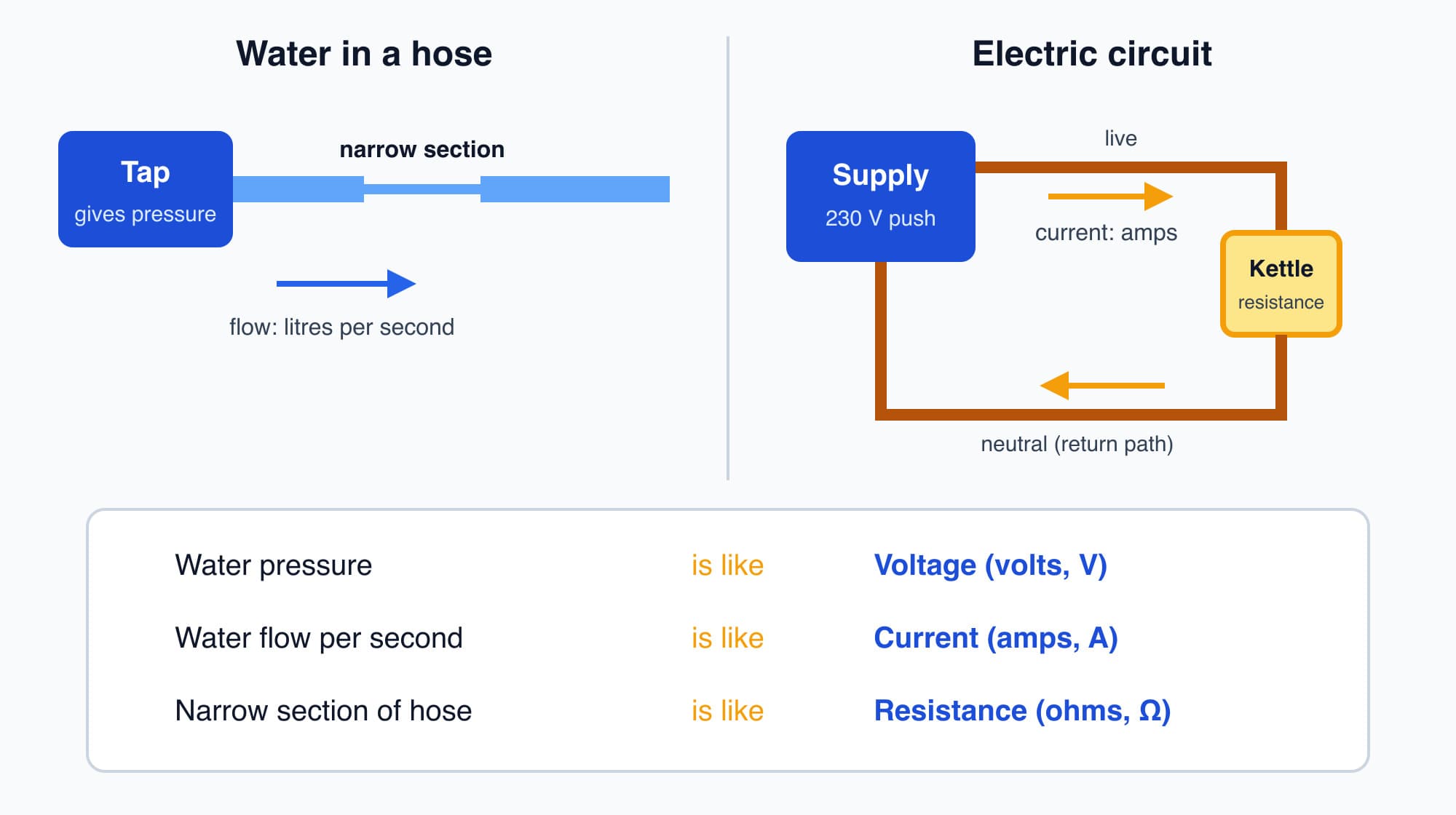
The hose comparison: pressure is like voltage, flow is like current, and a narrow section is like resistance.
The hose has limits. It works best for a steady current in one direction, called direct current (DC), like the current from a battery. Building mains is alternating current (AC): the push goes back and forth 50 times each second, which AC vs DC (Part 6) explains. And water comes out of a hose, but nothing comes out of a wire. Use the hose to picture voltage and current, not as a complete description.
Multiply the volts and amps on a label and you get the power
Turn over a kettle and you will find a small rating label. It shows the voltage the kettle is made for, usually 230 V or a range such as 220 to 240 V, and either its power in watts (W) or its current in amps (A). The two are linked by a simple rule.
Multiplying volts and amps gives power, measured in watts (W). Power is the rate at which an appliance uses energy:
watts = volts × amps, so 1 watt = 1 volt × 1 amp.
For our kettle, 230 V × 13 A = 2,990 W, which is close to 3,000 watts, or 3 kilowatts (3 kW; "kilo" means a thousand). Working the other way, a 3,000 W kettle on 230 V draws 3,000 ÷ 230, or about 13 A.
That is why a label gives both numbers, or gives volts and watts so you can work out the amps. Volts tell you the supply the appliance expects. Amps tell you how much current it draws at that voltage. Together they set its power. How that power adds up into the energy on a bill is the subject of Power vs Energy (Part 5).
A 12-volt kettle would need a cable as thick as your thumb
Resistance is how strongly something opposes the flow of current. It is measured in ohms (Ω). In the hose comparison, resistance is a narrow section of hose: for the same pressure, less water gets through.
Voltage, current and resistance are linked by Ohm's law:
V = I × R
Here V is the voltage in volts, I is the current in amps (I is the standard symbol for current), and R is the resistance in ohms. Rearranged, the current is I = V ÷ R. So a bigger push gives more current, and more resistance gives less current for the same push. For our kettle, 230 V ÷ 13 A gives an element resistance of about 18 ohms. (Ohm's law describes wires and heating elements well. Many electronic devices, such as LED lamps and phone chargers, do not follow it in such a simple way.)
When current flows through a resistance, some electrical energy turns into heat. A kettle element is designed to do this. In a wire, the same heating is wasted energy, and too much of it can melt the insulation and start a fire.
A thin wire has more resistance than a thick wire of the same material and length, so a large current in a thin wire makes more heat. You have probably noticed an extension cord used near its limit, especially one left coiled up, feel warm: the cord is thin for the current it carries, and the warmth is wasted energy.
Now put the two ideas together. Higher voltage delivers the same power with less current. From watts = volts × amps, 3 kW at 230 V needs about 13 A. The same 3 kW at 12 V would need 250 A, and a cable as thick as your thumb to carry it without overheating.
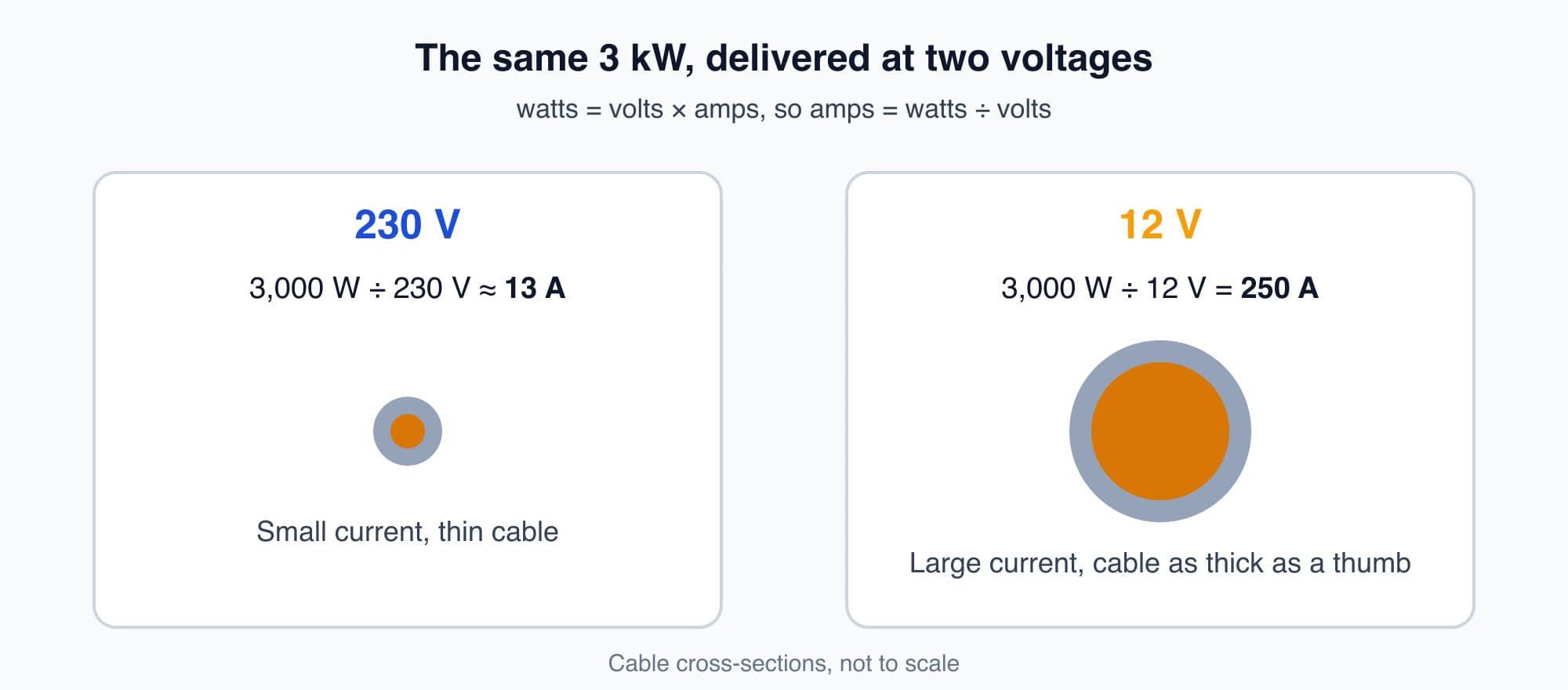
The same 3 kW needs about 13 A at 230 V but 250 A at 12 V, so a lower voltage needs a much thicker cable.
The grid uses the same idea on a much larger scale: it carries electricity across the country at hundreds of thousands of volts to keep the current low, then steps the voltage down before it reaches buildings. AC vs DC (Part 6) explains the heat saved, and How Transformers Work (Part 8) explains the stepping down. Larger buildings also get a three-phase supply, with 400 V between its live wires, which Three-phase power (Part 9) explains.
Heat in cables is also why fuses and circuit breakers are rated in amps. Their job is to cut the circuit before the current gets high enough to overheat the wiring. What Is an Electric Circuit? (Part 3) shows how they do it.
A 20,000-volt static shock is harmless, but 230 V can kill
A static shock from a car door or a nylon carpet can be twenty thousand volts or more, far higher than any socket. It is harmless because there is very little charge behind it: the current lasts a tiny fraction of a second. A car battery is the opposite case. At only 12 volts it cannot push a dangerous current through dry skin, yet it can deliver hundreds of amps through metal. If a spanner falls across its terminals, the spanner can get hot enough to weld itself in place.
What harms a person is current passing through the body. The voltage matters because it drives that current, but the body's resistance and the supply's ability to keep pushing matter too.
It takes very little current through the body to cause serious harm. A current of a fraction of an amp, measured in milliamps (mA, thousandths of an amp), can be fatal. How dangerous a shock is depends on the current, how long it flows and its path through the body (shock physiology reference). Malaysia's 230 V mains is dangerous because it can push a current like that through a person, especially with wet skin, and it keeps pushing. To judge a hazard you need to know both the voltage and how much current can flow. Earthing and RCDs (Part 4) explains how a building protects people from it.
Optional detail: watts = volts × amps holds exactly for heating appliances such as kettles, heaters and water heaters. For motors and much electronic equipment, volts × amps is somewhat larger than the watts actually used; kW, kVA and kVAR: The Power Triangle (Part 11) explains why. Also, because mains voltage alternates, "230 V" is a kind of average: it heats the kettle the same as a steady 230 V would. Part 6 explains this.
What you now understand
- Voltage is the push, and it is always measured between two points. A socket has its 230 V push all the time, but current flows only when something completes the path.
- Current is the flow of charge, counted in amps. Volts × amps gives watts, the rate at which an appliance uses energy.
- Resistance turns some energy into heat. That is why thin wires get warm, why low-voltage power needs thick cables, and why breakers are rated in amps.
- What harms a person is current through the body, not voltage alone.
Check your understanding
- A 3 kW kettle runs on a 230 V supply. About how much current does it draw? Current = power ÷ voltage = 3,000 ÷ 230, which is about 13 A.
- A static shock can be twenty thousand volts and still be harmless. Why can 230 V mains kill? Harm comes from current through the body. A static shock has very little charge behind it, so the current lasts only a tiny fraction of a second. Mains can push a dangerous current, a small fraction of an amp, through a person and keeps pushing for as long as contact lasts.
What comes next: circuits
So far we have followed one kettle on one loop. A building has hundreds of things plugged in at once. How are they all connected? What Is an Electric Circuit? Series vs Parallel answers that, starting with an old string of fairy lights.
This is Part 2 of 15 in Cobler's Electricity Fundamentals course. Previous: What Is Electricity, Actually?. Next: What Is an Electric Circuit? Series vs Parallel.
Cobler builds CobiNeural, a platform that shows a facility team its building's energy, water and indoor air data as live numbers across the whole site. To see how your building performs, talk to us.
FAQ
Frequently asked questions
Ask us about this topic
Something in this article you want to dig into — or a situation in your own building it doesn't quite cover? Send us your question. We don't run public comments; the team replies to you directly by email.