
Blog
What Is Electricity, Actually?
Inside a wire, electrons drift a fraction of a millimetre per second, yet the light comes on instantly. Here is what electricity actually is: free charge, a slow drift, and an energy wave racing along near light speed.
 Tan Kok XinElectricity Fundamentals
Part 1 of 15 in Cobler's Electricity Fundamentals course. New here? Start with the course map.
Your table, the wire in your wall and your own body are all packed with electric charge, and you never feel it. That is the first clue to what electricity is, and this lesson follows it from there to the moment a light comes on. It is Part 1, so you need no science background at all.
What is electricity? You are full of charge and never notice
Everything around you is made of atoms. Each atom has a centre, called the nucleus, with even smaller particles called electrons around it.
Electrons and the nucleus carry electric charge. Charge is a property of matter that lets it push or pull on other charges. Electrons have negative charge and the nucleus has positive charge. In a normal atom the two balance out exactly, which is why you do not notice all that charge. Two simple rules describe how charges behave:
- Opposite charges (positive and negative) attract each other.
- Like charges (two negatives, or two positives) push each other away.
You have probably seen both rules at work. Rub a balloon on your hair and some electrons move from one to the other, so the balloon and your hair end up with opposite charges. Your hair is pulled towards the balloon because opposite charges attract. The strands also spread apart from each other, because they all carry the same charge and push each other away.
The small shock you sometimes get from a car door is the same thing. Charge builds up on you and then jumps across in a spark. In humid outdoor air, a thin layer of moisture on surfaces lets charge leak away, so these shocks are less common. In dry air-conditioned rooms, charge builds up more easily. Charge that builds up and stays in place is called static electricity.
Electricity is the name for everything that charges do, whether they are sitting still or moving. When charge flows from one place to another, that flow is called an electric current. A spark is a very brief current. A building runs on current that keeps flowing steadily, so that is what most of this course is about.
Copper and plastic are both full of electrons. Why does only copper carry a current?
For a current to flow, the charges in a material must be able to move through it.
In copper, some electrons are not held by any one atom. They can move through the metal. Copper contains a very large number of these movable electrons, so current flows through it easily. Materials like this are called conductors.
In rubber, PVC plastic and glass, the electrons are held tightly by their atoms. Very little current can flow through them under normal conditions. These materials are called insulators.
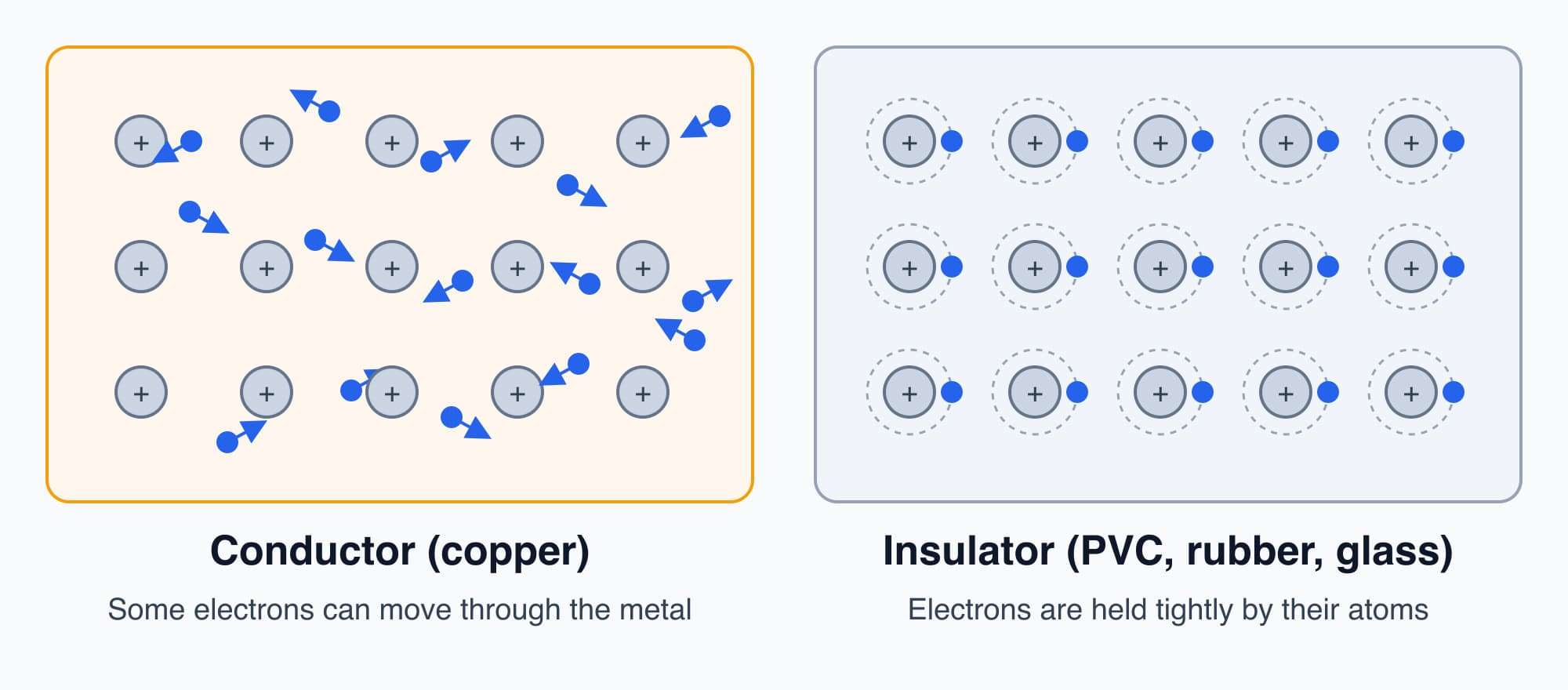
In copper, some electrons can move between atoms. In an insulator, each electron stays with its atom.
This is why a typical building cable has two parts:
- Copper conductors that carry the current.
- Insulation around them, usually PVC, that stops current flowing into nearby objects or people.
It also explains an important safety rule. Your body contains salty water, and salty water conducts too. If you touch a live conductor, current can pass through your body. Wet skin makes this more likely, but dry hands do not make a live wire safe. Intact insulation is what protects you.
Silver actually conducts slightly better than copper, but it costs far more. Copper conducts very well at a practical price and can be drawn into long, flexible wire, so it is the standard choice for building wiring (Copper Development Association). Aluminium is also used, mainly for large cables.
A light switch does not send electricity to the lamp. It closes a gap.
The movable electrons in a copper wire are there all the time, whether the light is on or off. On their own they jiggle around in all directions and go nowhere overall, so there is no current.
To get a current, two things are needed:
- A source that provides the electrical push, such as the building's electricity supply or a battery.
- A complete path, called a circuit, that runs from the source, through the appliance and back to the source.
A light switch works by opening or closing that path. When you switch the light on, you close a gap in the circuit. The push from the supply now acts on the electrons all around the loop, and they start to drift in one direction. That movement of charge is the current. The supply provides the energy, and the bulb turns that energy into light and heat.
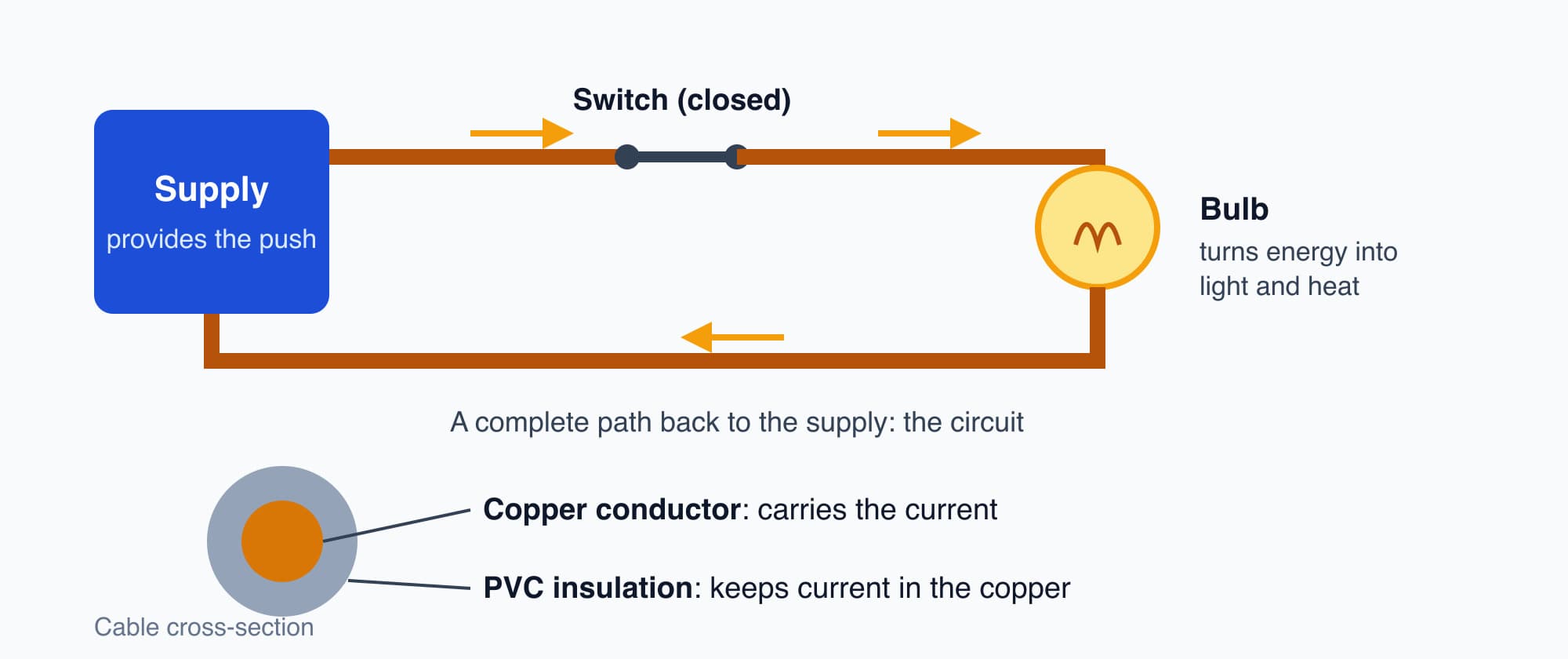
A simple circuit: the supply provides the push, the closed switch completes the path, and the bulb turns energy into light and heat.
One detail about buildings: the mains supply is alternating current (AC). The push reverses direction many times a second, so the electrons drift back and forth rather than travelling one way around the loop. Energy is still delivered to the bulb either way. Part 6 explains AC.
Electrons crawl slower than a snail, so why is the light instant?
The electrons in a wire move surprisingly slowly. Take a copper wire with a cross-section of 1.5 square millimetres (1.5 mm2, a common size for lighting circuits) carrying a steady 2 amperes (amps) in one direction. The electrons' average drift speed is only about 0.1 millimetre per second (drift velocity, Wikipedia). At that speed, it would take about three hours to drift one metre.
So how does the bulb light up the moment you press the switch?
A useful comparison is a garden hose that is already full of water. When you turn on the tap, water comes out of the far end almost at once. It is not the water that just entered at the tap. It is water that was already at the end of the hose. The push travels along the hose much faster than any drop of water.
A wire is similar. It is already full of movable electrons along its whole length. When the switch closes, the push reaches every part of the circuit almost at once, so electrons at the bulb start moving straight away. (Like any comparison, the hose has limits: an electrical circuit needs a complete path back to the supply, and nothing "comes out" of the wire.)
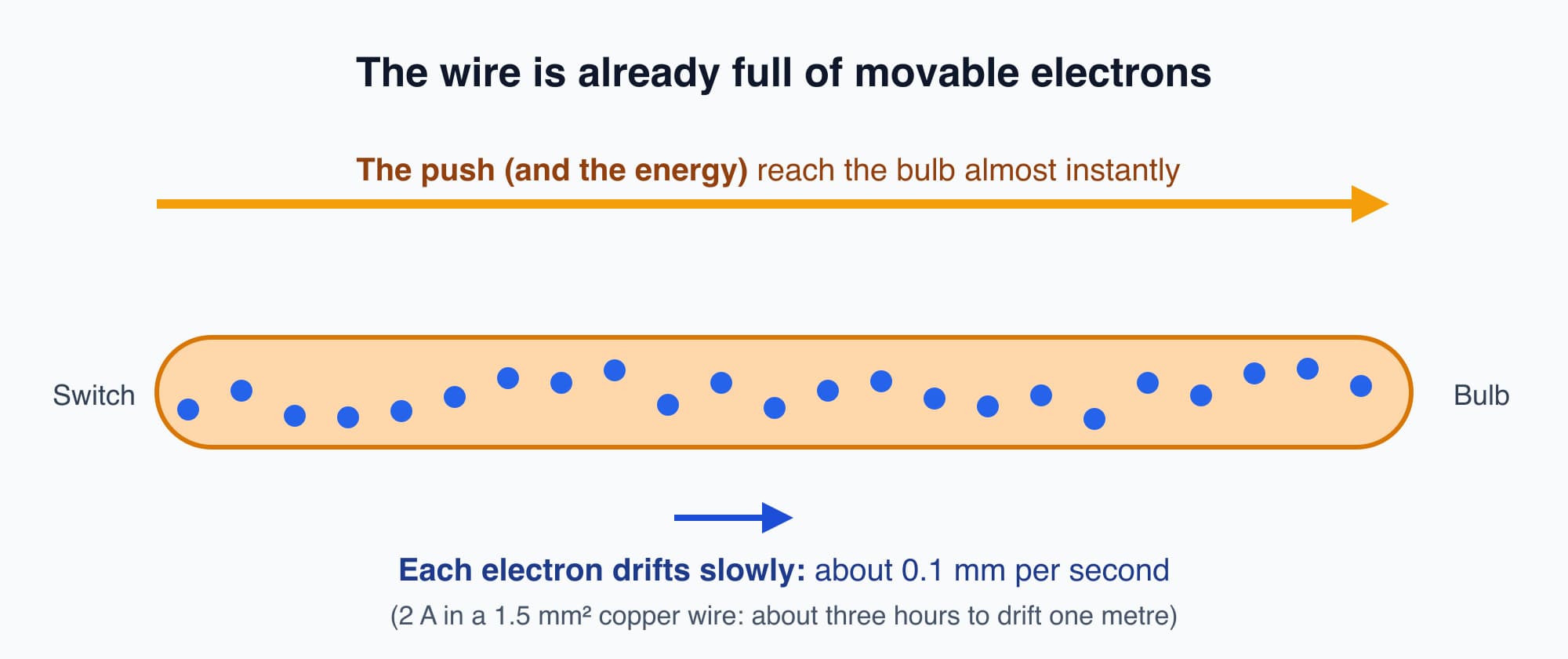
Each electron drifts very slowly, but because the wire is already full of electrons, the push reaches the bulb almost at once.
That leaves one more puzzle. If the electrons barely move, how does the energy get from the supply to the bulb? It travels in the electric and magnetic fields around the wires. The supply sets up an electric field along the circuit, and that field is what pushes the electrons. The moving electrons create a magnetic field around the wire. Together, these fields carry energy through the space around and between the wires and into the bulb. Changes in these fields travel very fast, at a large fraction of the speed of light in a typical cable (speed of electricity, Wikipedia).
Want the full story? Where electrical energy actually flows explains the fields in more detail. It is optional: the rest of the course only needs you to keep two ideas apart. Current is charge flowing around the circuit. Energy is what the supply delivers to the appliance.
Optional detail: Air is normally an insulator, but a strong enough electric field makes it conduct. That is what happens in a static spark. For a small gap in ordinary air, a rough figure is 3 kilovolts per millimetre: about 3,000 volts across a one-millimetre gap (dielectric strength); the exact value depends on conditions and the shape of the gap. Lightning is the same effect on a huge scale, with voltage differences of hundreds of millions of volts across distances of a kilometre or more (NSSL, NOAA; National Weather Service).
What you now understand
- Everything is full of electric charge. You only notice it when positive and negative charges are pulled apart, as with a balloon or a car-door spark.
- A current is charge on the move. It flows easily through copper, whose electrons can move, and hardly at all through insulators such as PVC.
- A current needs a source that pushes and a complete circuit. A switch simply opens or closes a gap in that circuit.
- The electrons drift very slowly, but the push reaches the whole circuit almost at once, and the energy travels in the fields around the wires.
Check your understanding
- Why does a cable have copper inside and insulation outside? Copper has electrons that can move through it, so it carries current. In insulation such as PVC, the electrons are held tightly, so very little current can flow. The insulation keeps current in the copper and away from people.
- If electrons drift only about 0.1 mm per second, why does a light come on almost instantly? The wire is already full of movable electrons. When the switch closes, the push reaches the whole circuit almost at once, so electrons at the bulb start moving straight away. The energy itself is carried quickly by the electric and magnetic fields.
What comes next: the push and the flow
All through this lesson we have talked about a "push" from the supply and a "flow" of charge. Keep the garden hose in mind: the push is like the water pressure from the tap, and the flow is like the amount of water passing along the hose each second. What exactly is the push, and how do we measure the push and the flow? Volts and Amps answers that, starting with the socket on your wall.
Go deeper on video (optional)
The section on why the light is instant said the energy is carried by the electric and magnetic fields around the wires. This video looks more closely at that idea. It is optional: you do not need it for the next part.
"The Biggest Misconception About Electricity" by Veritasium
This is Part 1 of 15 in Cobler's Electricity Fundamentals course. Next: Volts and Amps: Electrical Pressure and Flow, Explained.
Cobler builds CobiNeural, a platform that shows a facility team its building's energy, water and indoor air data as live numbers across the whole site. To see how your building performs, talk to us.
FAQ
Frequently asked questions
Ask us about this topic
Something in this article you want to dig into — or a situation in your own building it doesn't quite cover? Send us your question. We don't run public comments; the team replies to you directly by email.