Blog
Three-Phase Power Explained: Why Factories Get 400 V
A house gets two wires; a factory gets four. Here is why three-phase power delivers constant torque, spins motors for free, and turns 230 V into a 400 V supply.
 Tan Kok XinElectricity Fundamentals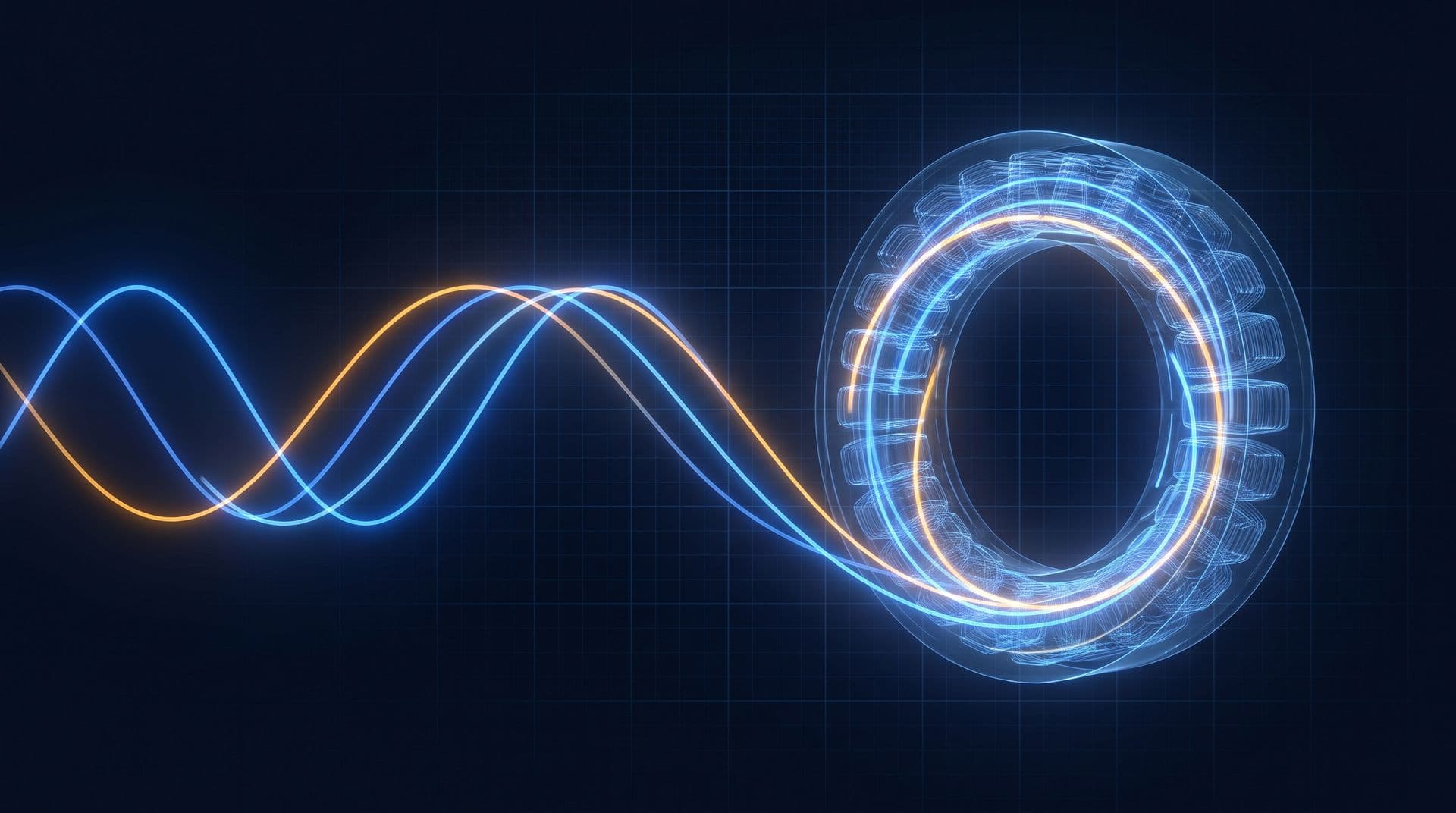
Part 9 of 15 in Cobler's Electricity Fundamentals course. New here? Start with the course map.
In a shoplot, each live wire is 230 V from neutral, but measure between two of the live wires and you get 400 V, not the 460 V you might expect. Part 8 ended with the question "Why do buildings get three live wires instead of one?", and that odd 400 V is part of the answer.
Three-phase power: three waves, a third of a cycle apart
A typical terrace house gets a single-phase supply from TNB: one live conductor and one neutral, at 230 V. The live (also called a phase) carries the alternating voltage. The neutral is the return path to the transformer. A shoplot or a large building like the office tower usually gets three-phase power: three live conductors and a neutral. You can often spot a three-phase supply by a round red industrial socket on the wall, quite different from the flat three-pin socket at home.
Circuits in both also have the green-and-yellow protective earth, which connects the metal casings of equipment designed to be earthed to the building's earthing system so that suitable protection can disconnect a fault, as described in Earthing and RCDs (Part 4).
The three live conductors are usually labelled L1, L2 and L3. Each carries an AC voltage of the same size and the same frequency, 50 Hz. The difference is timing. One cycle at 50 Hz takes 20 milliseconds (ms), as we saw in AC vs DC (Part 6). L2 reaches its peak a third of a cycle (about 6.7 ms) after L1, and L3 peaks a third of a cycle after L2. They come from three sets of windings in the same transformer, and at the power station from three sets of coils in the same generator.
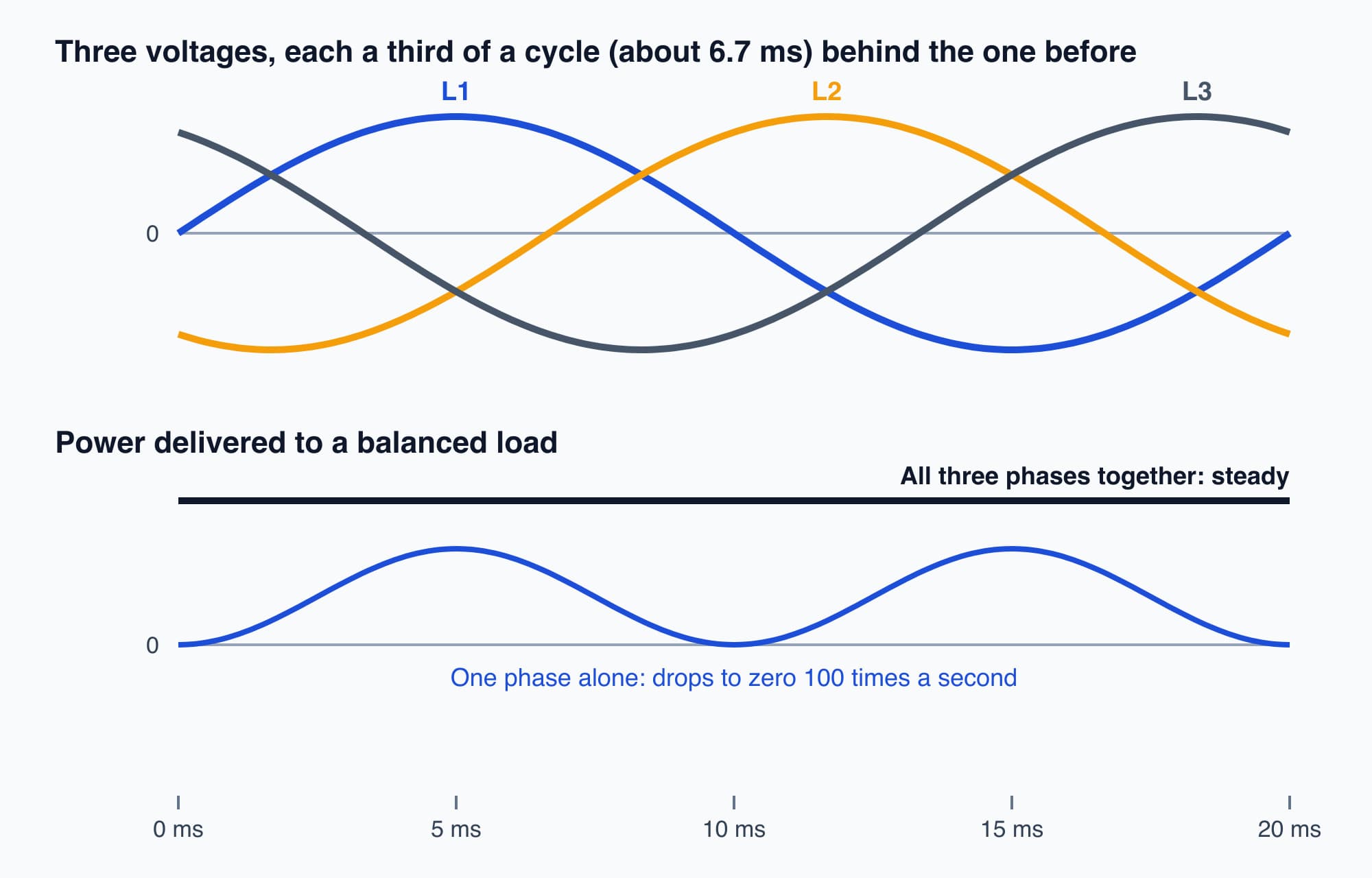
Top: the three phase voltages peak one after another. Bottom: one phase alone delivers power in pulses, but the three together deliver a steady total.
230 V and 230 V make 400 V, not 460 V
Each phase is 230 V measured from that phase to neutral. The nominal voltage between two phases is 400 V.
You might expect 230 + 230 = 460 V. That would only be true if the two phases peaked at the same moment in opposite directions, and they never do: when one is at its peak, the other is a third of a cycle behind. The voltage between them is the difference between two waves that are out of step, and for three evenly spaced phases that difference always works out at about 1.73 times the phase voltage. So 230 × 1.73 gives about 400 V.
This is why Malaysian low-voltage three-phase supply is described as "400/230 V". One supply gives both: 230 V from any phase to neutral for lights and sockets, and 400 V between phases for large equipment. The higher voltage comes from the timing of the three waves, not from a bigger supply.
Single-phase power drops to zero 100 times a second
On a single phase, the power delivered rises and falls with the voltage. On a 50 Hz supply the voltage passes through zero 100 times a second, and each time it does, the power delivered to a simple load like a heater drops to zero too. So single-phase power arrives in pulses, 100 times a second. A kettle does not mind, but a large motor would feel every pulse as an uneven turning force.
Three phases fix this. When one phase is near zero, the other two are delivering power. For a balanced load (one that draws the same current on each phase), the three pulses add up to a total that is constant at every instant, as the lower half of the diagram above shows.
For a motor, constant power means a constant turning force (torque). A large motor on three phases runs smoothly without needing a heavy flywheel to even out the pulses. That is one reason chiller plants, pumps and large fans run on three-phase.
In a balanced supply, the neutral carries no current
Three separate single-phase circuits would need six conductors: a live and a return for each. Three-phase does the same job with far fewer. When the three phase currents are equal, smooth waves, they cancel out at their common connection, so the neutral carries no current, and three conductors can deliver the same power as six. Some three-phase equipment, such as many motors, needs no neutral at all.
In a building, the electrician spreads the single-phase circuits (lights, sockets, small appliances) across L1, L2 and L3, aiming for roughly equal current on each. This is called balancing the load. If most of the load sits on one phase, that phase's cable and transformer winding run hotter, the voltage on that phase drops, and the neutral carries the leftover current. TNB does the same balancing on a larger scale, spreading the houses along a street across the three phases. A three-phase motor is connected to all three phases at once, so it is a balanced load by design.
(Electronic equipment such as computers and LED drivers can still send current through the neutral even when the phases are balanced. The side reading Electrical Harmonics explains why.)
A building needs three-phase when its load is too large for one phase, or when it has large motors. A home's lights and appliances usually fit on a single phase, and its motors, in the fridge compressor, the ceiling fans and the air conditioners, are small single-phase motors. A shoplot with larger air-conditioning units may take a three-phase supply. Our example shoplot, a fictional three-storey shoplot in Petaling Jaya that we will meet again in Part 12, is one of these. Large buildings take three-phase as standard. Installers of EV chargers and solar systems also ask whether a house is single-phase or three-phase, because it affects what they can install.
Safety note: wire colours are changing. In Peninsular Malaysia, ST is introducing the IEC 60445 wire-colour scheme (Suruhanjaya Tenaga Directive 11/2026); Sabah and Sarawak have separate regulatory requirements. The old code used red, yellow and blue for the three phases and black for neutral. The new code uses brown, black and grey for the phases and blue for neutral. ST's table lists green or green-and-yellow for earth in both schemes. Blue and black have swapped roles, so never judge what a wire does, or whether it is safe, from its colour alone. Leave board covers in place: identifying and testing conductors is work for an ST-registered electrical competent person whose certificate covers the work.
Optional detail: Engineers describe a full cycle as 360 degrees, so the three phases are spaced 120 degrees apart. The factor between phase and line voltage is the square root of 3: V_line = √3 × V_phase = 1.732 × 230 ≈ 398 V. These are effective (RMS) voltages; 230/400 V is the standard nominal designation, and actual voltages vary. Older documents use "415/240 V", the legacy description. >Nikola Tesla's basic patents for a polyphase AC motor were granted in May 1888, and George Westinghouse acquired his AC patents that July (IEEE Spectrum). Mikhail Dolivo-Dobrovolsky at the German company AEG then developed a practical three-phase system. In 1891 it was demonstrated by sending power 175 km from Lauffen to Frankfurt at about 15 kV, with an efficiency of about 75% (ETHW milestone).
What you now understand
- Three-phase power is three AC waves of the same size, each a third of a cycle behind the one before.
- Because the waves never peak together, the voltage between two phases is about 1.73 times the phase voltage: 400 V from 230 V phases.
- One phase delivers power in pulses; three balanced phases deliver a steady total, which gives large motors smooth torque.
- Balanced phase currents cancel in the neutral, so three-phase carries more power with fewer conductors, provided the load is spread evenly.
Check your understanding
- Each phase of a supply is 230 V to neutral. Why is the voltage between two phases 400 V and not 460 V? The two phases peak a third of a cycle apart, so their voltages never reach their peaks at the same moment in opposite directions. The difference between them works out to about 1.73 times the phase voltage: 230 × 1.73 ≈ 400 V.
- Why does an electrician spread lights and sockets across L1, L2 and L3? To balance the load. With roughly equal current on each phase, the phase currents largely cancel in the neutral, and no phase's cable or transformer winding runs hotter than the others or suffers a larger voltage drop.
What comes next
Feed three-phase power into three sets of coils spaced around a ring, and something moves without anything touching it. Inside most of the motors in a building, the part that spins has no wires connected to it at all. How does three-phase power turn a motor? The next part, How Electric Motors Work, explains.
Go deeper on video (optional)
This animated video shows the three phase voltages and how they combine, which may help after the first two sections. It is optional: you do not need it for the next part.
"How Three Phase Electricity works: The basics explained" by The Engineering Mindset
This is Part 9 of 15 in Cobler's Electricity Fundamentals course. Previous: How Transformers Work: The Grid's Quiet Machine. Next: How Electric Motors Work (and Run Everything).
Cobler builds CobiNeural, a platform that shows a facility team its building's energy, water and indoor air data as live numbers across the whole site. To see how your building performs, talk to us.
FAQ
Frequently asked questions
Ask us about this topic
Something in this article you want to dig into — or a situation in your own building it doesn't quite cover? Send us your question. We don't run public comments; the team replies to you directly by email.