Blog
Why 50 Hz? The Accident Behind the Grid Frequency
Malaysia runs at 50 Hz, America at 60. Neither is physics. Here is the 1890s corporate accident that set the grid frequency, and why every motor you own still obeys it.
 Tan Kok XinElectricity Fundamentals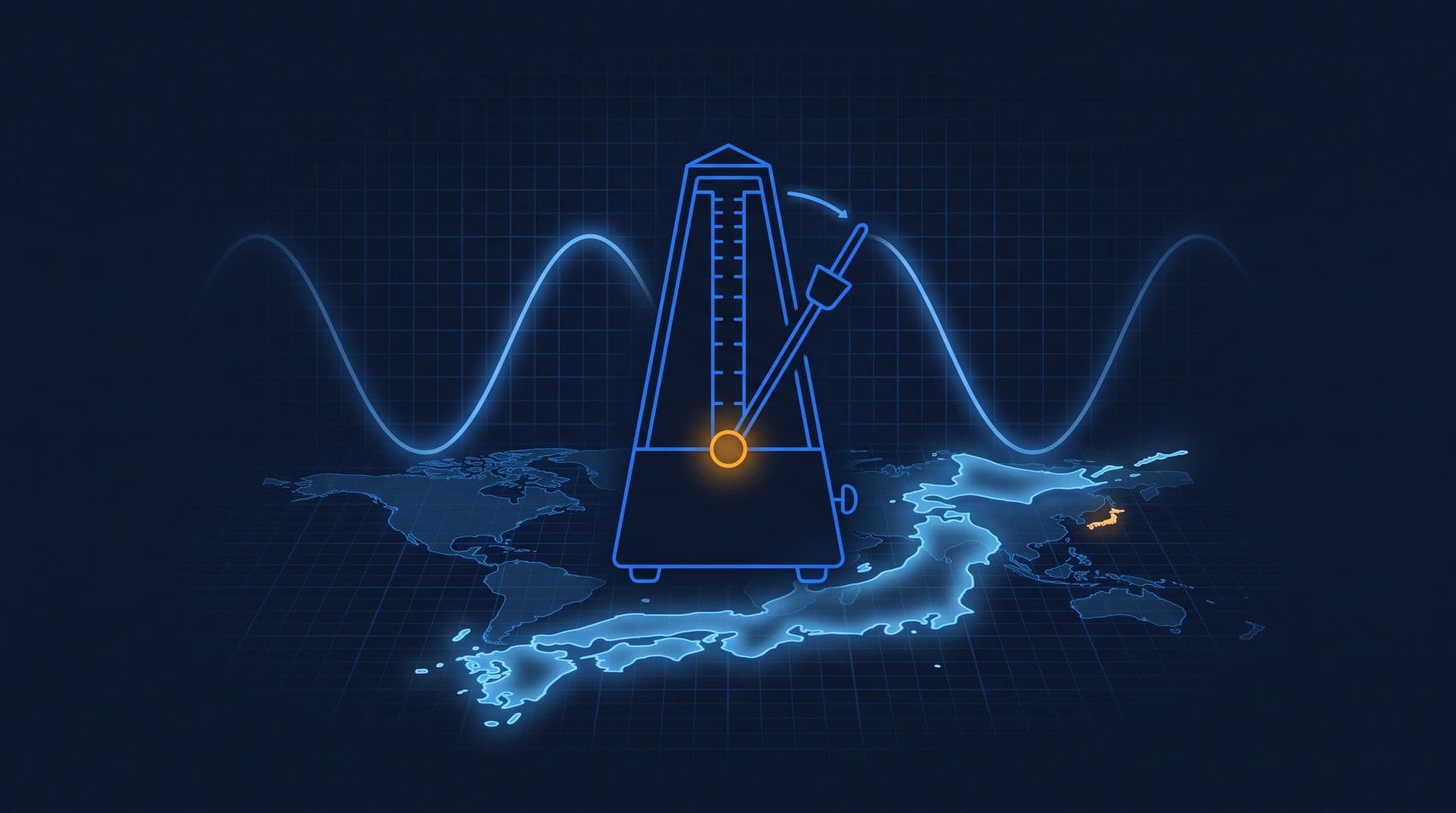
An optional side reading for Cobler's Electricity Fundamentals course. It goes with Part 7. See the course.
Look at the small print on a phone charger or laptop power brick. It usually says something like "100–240 V, 50/60 Hz". The charger is built to work in countries with different supplies. Malaysia's grid runs at 50 Hz; the United States runs at 60 Hz.
Why 50 Hz here and 60 Hz there? Malaysia's grid frequency is 50 Hz because its supply was built with British and European equipment, and European manufacturers settled on 50 Hz in the early 1890s. American manufacturers settled on 60 Hz at about the same time. No law of physics picks either number. In this part we look at how the choice was made, why it cannot be changed now, and why the grid frequency still matters in your building: it sets the speed of your motors, and it tells the grid operator, second by second, whether there is enough power.
What grid frequency means
In AC vs DC (Part 6) we saw that the mains voltage rises and falls in a smooth wave. Frequency is the number of complete waves, or cycles, per second. It is measured in hertz (Hz): one hertz is one cycle per second.
So at 50 Hz, the voltage completes 50 full cycles every second and reverses direction 100 times a second. At 60 Hz it completes 60 cycles and reverses 120 times. The same frequency applies everywhere on a connected grid at the same moment, which is why it is called the grid frequency.
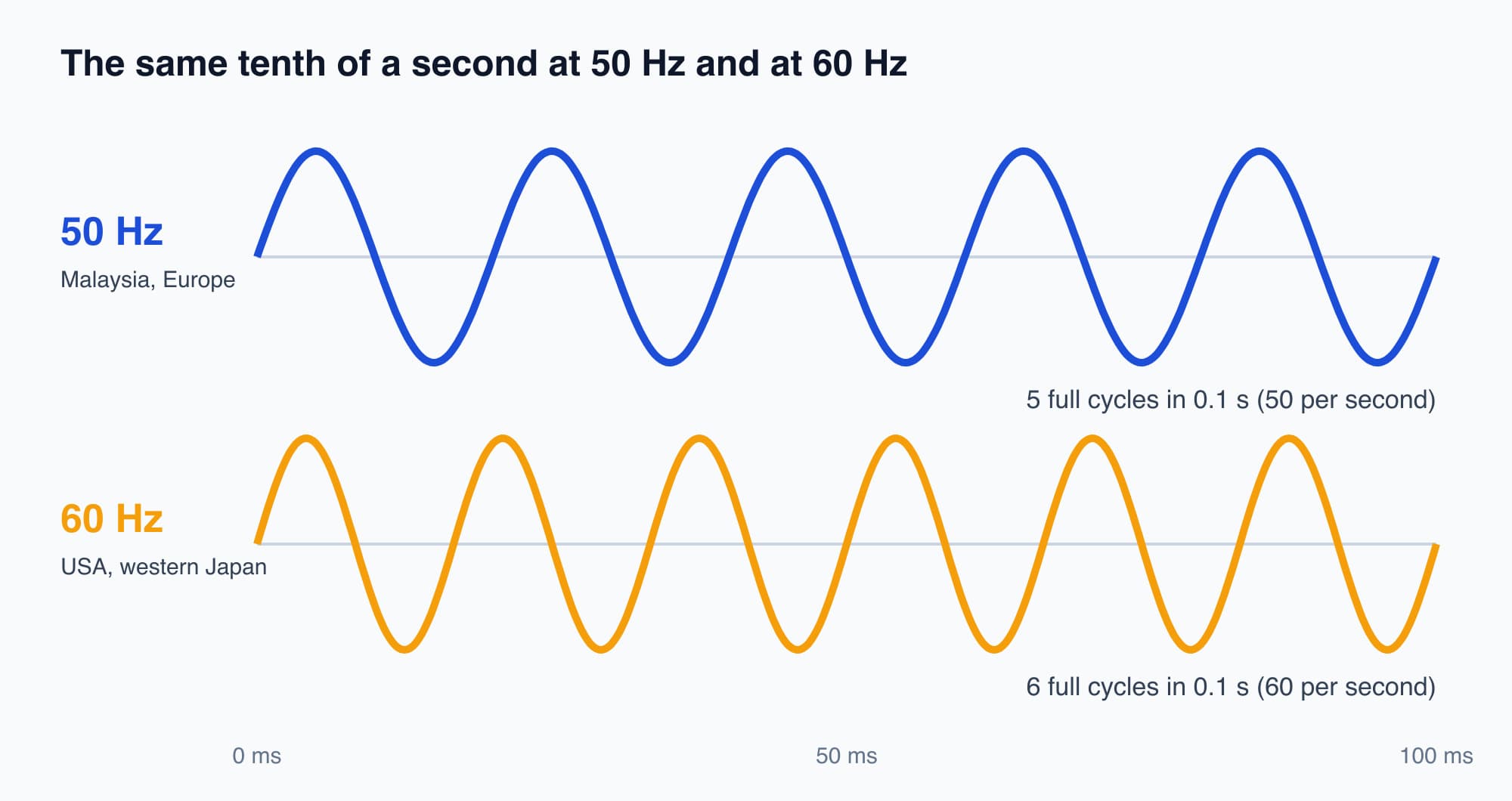
In one tenth of a second, a 50 Hz supply completes 5 cycles and a 60 Hz supply completes 6.
Why is Malaysia's grid frequency 50 Hz and not 60?
The two numbers were chosen by two companies around 1890, for practical reasons of their own.
In the United States, Westinghouse settled on 60 Hz around 1890. It wanted one frequency that could run both its arc lighting and the new induction motors it had licensed from Nikola Tesla. Tesla's motor needed a frequency well below the roughly 133 Hz then common in lighting circuits, and Westinghouse's arc-lighting equipment ran slightly better at 60 Hz, so 60 became the compromise (Utility frequency, Wikipedia).
In Germany, the manufacturer AEG went the other way. In 1891 its engineers saw lamps flicker visibly on a 40 Hz transmission line, so they decided 40 Hz was too low and standardised their generators on 50 Hz. AEG dominated the European market, so 50 Hz spread across Europe and to the places European firms supplied (Utility frequency, Wikipedia). Malaysia, supplied through British and European supply chains, inherited 50 Hz.
Neither number is clearly better. A lower frequency means lower losses in transformer cores and makes long lines slightly cheaper to run, but it needs bulkier iron in transformers and motors and makes lamp flicker more visible. 50 Hz and 60 Hz both sit in a sensible middle range. The choice came from manufacturers' preferences, not from anyone finding the best value.
(The AC and DC battle behind Westinghouse's choice is told in the optional side reading The War of the Currents.)
Why a country cannot switch frequency
Once a country's generators, transformers, motors, clocks and appliances are all built for 50 Hz, changing the frequency would mean replacing all of them at once. There is also no clearly better number to switch to. So the frequency stays where it is because of what has already been built, not because anyone proved it was correct (Utility frequency, Wikipedia). Economists call this path dependence: a choice that cost almost nothing in 1891 would cost a national economy to undo today.
Japan shows what happens when a country never agreed on one number. In 1895 Tokyo bought 50 Hz generators from AEG in Germany. In 1896 Osaka bought 60 Hz generators from General Electric in the United States (Electricity sector in Japan, Wikipedia).
That split has never been closed. Eastern Japan, including Tokyo and Hokkaido, still runs at 50 Hz, and western Japan, including Osaka and Kyushu, runs at 60 Hz. The two halves cannot be wired directly together, because generators running at different frequencies cannot share a line. They are joined only through a few frequency-converter stations, whose total capacity was long limited to around 1.2 gigawatts and is now being expanded (Electricity sector in Japan, Wikipedia; IEEE Spectrum). When the 2011 earthquake and tsunami knocked out power stations in the east, the west could send only a limited amount of help across those converters. Merging the two systems has been judged too costly since the 1930s, and the price today runs into trillions of yen (The Japan Times).
What grid frequency tells the operator
The frequency is not only a fixed number on a label. It moves slightly all the time, and those small movements tell the grid operator whether the power stations are producing as much power as everyone is using.
Here is why. Most of the grid's electricity comes from large generators in power stations that spin at a steady speed, and the speed at which they spin sets the frequency. All the large generators on a connected grid turn in step with each other. A useful comparison is one very long shaft with every power station attached to it: the grid frequency is how fast that shared shaft turns. How Generators Make Electricity, the next part, explains why spinning a generator produces AC, and why its speed sets the frequency. This only works because the grid runs on AC.
Now think about what happens when demand changes:
- When people switch on more equipment than the power stations are producing for, the extra load acts like a brake on the shared shaft. The generators slow down slightly, and the frequency drops below 50 Hz.
- When the power stations produce more than is being used, the generators speed up slightly, and the frequency rises above 50 Hz.
So the frequency works like a gauge of the balance between supply and demand. A falling frequency means the grid is short of power. Automatic speed controls on the generators (called governors), together with grid-wide control systems, respond within seconds to tens of seconds by adjusting how much fuel, steam or water drives the generators, bringing the frequency back towards 50 Hz (Utility frequency, Wikipedia).
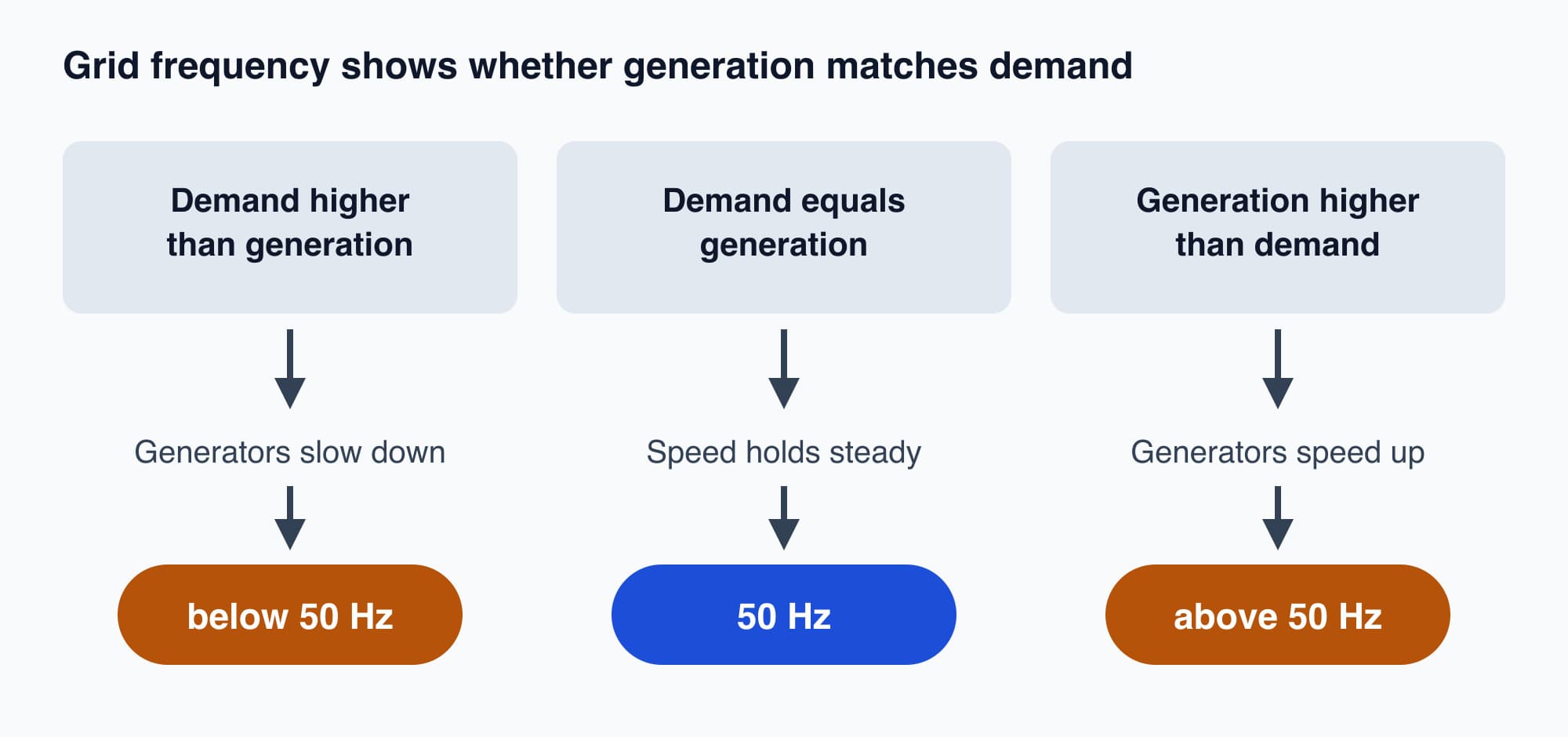
The grid frequency drops when demand is higher than generation and rises when generation is higher than demand.
Operators keep the frequency very close to 50 Hz. They also keep its long-term average at exactly 50 Hz, which matters for one old reason: mains clocks. Older electric clocks kept time by counting the cycles of the supply, so any time the frequency ran slightly slow or fast, those clocks drifted. In continental Europe, operators correct this by moving the target frequency up or down by up to about 0.01 Hz (0.02%) until the average is back to exactly 50 Hz. North America instead lets the clock error build up to a set limit before correcting it: 10 seconds on the Eastern grid, 3 seconds in Texas and 2 seconds on the Western grid (Utility frequency, Wikipedia).
How the grid frequency sets the speed of your motors
Most motors that drive fans and pumps in buildings are AC induction motors connected straight to the supply. Their speed is set by the grid frequency and by how the motor's windings are arranged (the number of magnetic poles), not by anything the operator dials in. How Electric Motors Work (Part 13) explains the mechanism.
At 50 Hz, a 2-pole induction motor turns at nearly 3,000 revolutions per minute (rpm). A 4-pole motor, the most common type for pumps and fans in Malaysian buildings and plants, turns at nearly 1,500 rpm (Utility frequency, Wikipedia; Three-phase electric power, Wikipedia). The same motor on a 60 Hz supply spins 20% faster, at nearly 1,800 rpm. ("Nearly" because a loaded induction motor always runs a few percent below these figures.)
This is why equipment designed for a 60 Hz country cannot always be connected here, even when the voltage matches. A fan designed to turn at 1,800 rpm moves less air at 1,500 rpm, and the motor's cooling and torque assumptions change with its speed. Such equipment may run slow, run hot or not work properly on a 50 Hz supply.
(For the curious: the hum you hear near a transformer is not at 50 Hz. The transformer's iron core changes shape very slightly as the magnetism in it rises and falls, and this happens twice in every cycle, so the main hum is at 100 Hz. How Transformers Work, Part 11, covers this.)
What comes next: how generators make the wave
In this part we said the grid frequency is set by how fast the power stations' generators spin, and that all of them turn in step. The next part, How Generators Make Electricity, shows how a spinning magnet and a coil of wire produce the AC wave in the first place, and why a two-pole generator must turn at exactly 3,000 rpm to make 50 Hz. Three-Phase Power Explained (Part 12) later shows why buildings with large motors take a three-phase 400 V supply.
Check your understanding
- Why does Malaysia use 50 Hz rather than 60 Hz? Because Malaysia's supply was built with British and European equipment, and European manufacturers, led by AEG in 1891, standardised on 50 Hz. The United States standardised on 60 Hz at about the same time. Neither number is clearly better; once a country has built everything for one frequency, changing it would mean replacing all of that equipment.
- The grid frequency drops to 49.9 Hz for a moment. What does that tell the operator? That more power is being used than the power stations are producing. The extra load slows the generators slightly, which lowers the frequency. Automatic controls then increase the generators' output to bring the frequency back to 50 Hz.
Recap: Frequency is the number of AC cycles per second, measured in hertz. Malaysia's 50 Hz and America's 60 Hz were business choices made around 1890, and they are now locked in by everything built for them; Japan still runs both. The large generators on a grid all turn in step, so the grid frequency shows whether generation matches demand: it drops when demand is higher and rises when generation is higher. The grid frequency also sets the speed of AC motors: about 1,500 rpm for a 4-pole motor at 50 Hz.
This is an optional side reading for Cobler's Electricity Fundamentals course. Back to the course: Part 7: How Generators Make Electricity.
Cobler builds CobiNeural, a platform that shows a facility team its building's electricity as live numbers: energy, demand and power quality across the whole site. To see how your building uses electricity, talk to us.
FAQ
Frequently asked questions
Ask us about this topic
Something in this article you want to dig into — or a situation in your own building it doesn't quite cover? Send us your question. We don't run public comments; the team replies to you directly by email.