Blog
How Electric Motors Work (and Run Everything)
Around half the world's electricity ends up spinning a motor. How electric motors work: the squirrel-cage induction motor, slip, starting surge and the nameplate.
 Tan Kok XinElectricity Fundamentals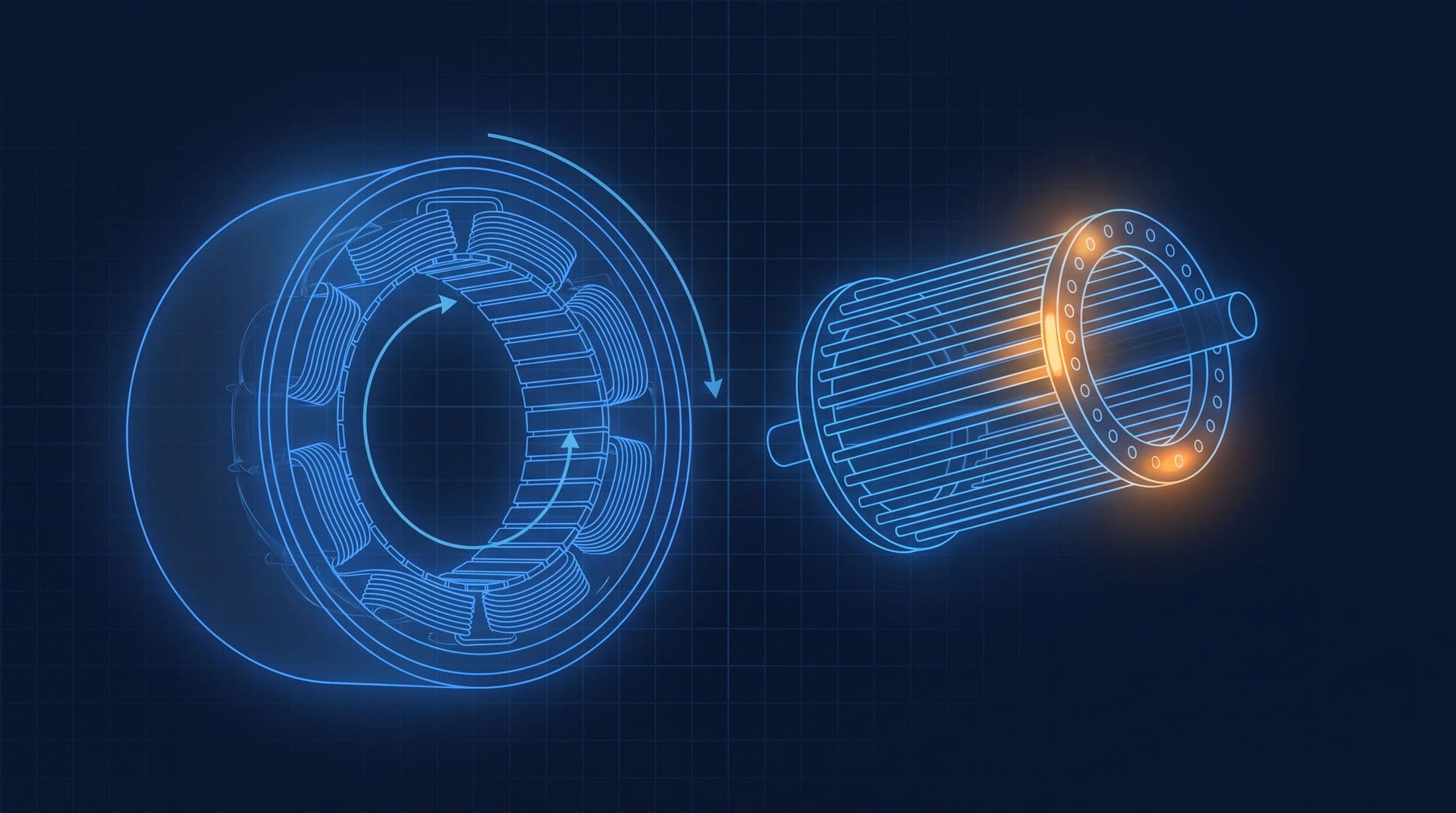
Part 10 of 15 in Cobler's Electricity Fundamentals course. New here? Start with the course map.
The spinning part inside most of the motors in a building has no wires connected to it at all. It is a cage of plain metal bars, and it still turns hard enough to drive a chiller compressor. Part 9 ended with the question "How does three-phase power turn a motor?", and that cage is where the answer ends up.
How electric motors work: three waves make a magnetic field that spins
Motors are everywhere in a building: the ceiling fan overhead, the fridge compressor that clicks on at night, the pump that starts when a tank runs low. In the office tower, the chiller plant alone uses about 35% of the building's electricity, and almost all of it goes into motors, in the chiller compressors, the pumps and the cooling tower fans. Most of these motors are one design, the induction motor.
Every electric motor starts from one fact: when current flows through a wire that sits in a magnetic field, the wire feels a push. Arrange many wires on a shaft so that the pushes all act in the same direction around it, and the shaft turns. In How Generators Make Electricity (Part 7), we saw that a generator and a motor are the same kind of machine. In a generator, turning the shaft produces electricity. In a motor, electricity turns the shaft.
An induction motor's outer part is the stator, a fixed ring of iron lined with three sets of windings, spaced evenly around the ring. Feed the three phases from Three-Phase Power Explained (Part 9) into those windings. Each set makes a magnetic field that rises and falls with its own phase. Because the phases peak one after another, the strongest point of the combined field moves around the ring, from one set of windings to the next. The result is a magnetic field that rotates around the inside of the motor, even though nothing in the stator moves. A useful picture is the chasing lights on a signboard: no bulb moves, but the bright spot travels around.
A home usually has only one phase, yet it is full of motors. A single winding fed from one phase makes a field that grows, shrinks and reverses, but does not rotate, so the motor cannot start on its own. Single-phase motors therefore add a second winding, placed at an angle to the first, whose current is shifted in time, usually by a capacitor. The two windings, peaking at different moments, make a field that rotates enough to start the motor. This is why a ceiling fan with a failed capacitor often hums without starting, or turns slowly. (Many newer air conditioners and fans labelled "inverter" or "DC" use electronic drives and a different type of motor; Rectifiers and Inverters (Part 13) covers the electronics.)
The rotor has no wires, yet it carries current
The inner part of an induction motor is the rotor. It is a set of aluminium or copper bars set into an iron core, with the bars joined together by a ring at each end. On its own, without the iron, the cage of bars looks like a hamster's exercise wheel, which is why this is called a squirrel-cage rotor. No brushes touch it and no wire runs to it.
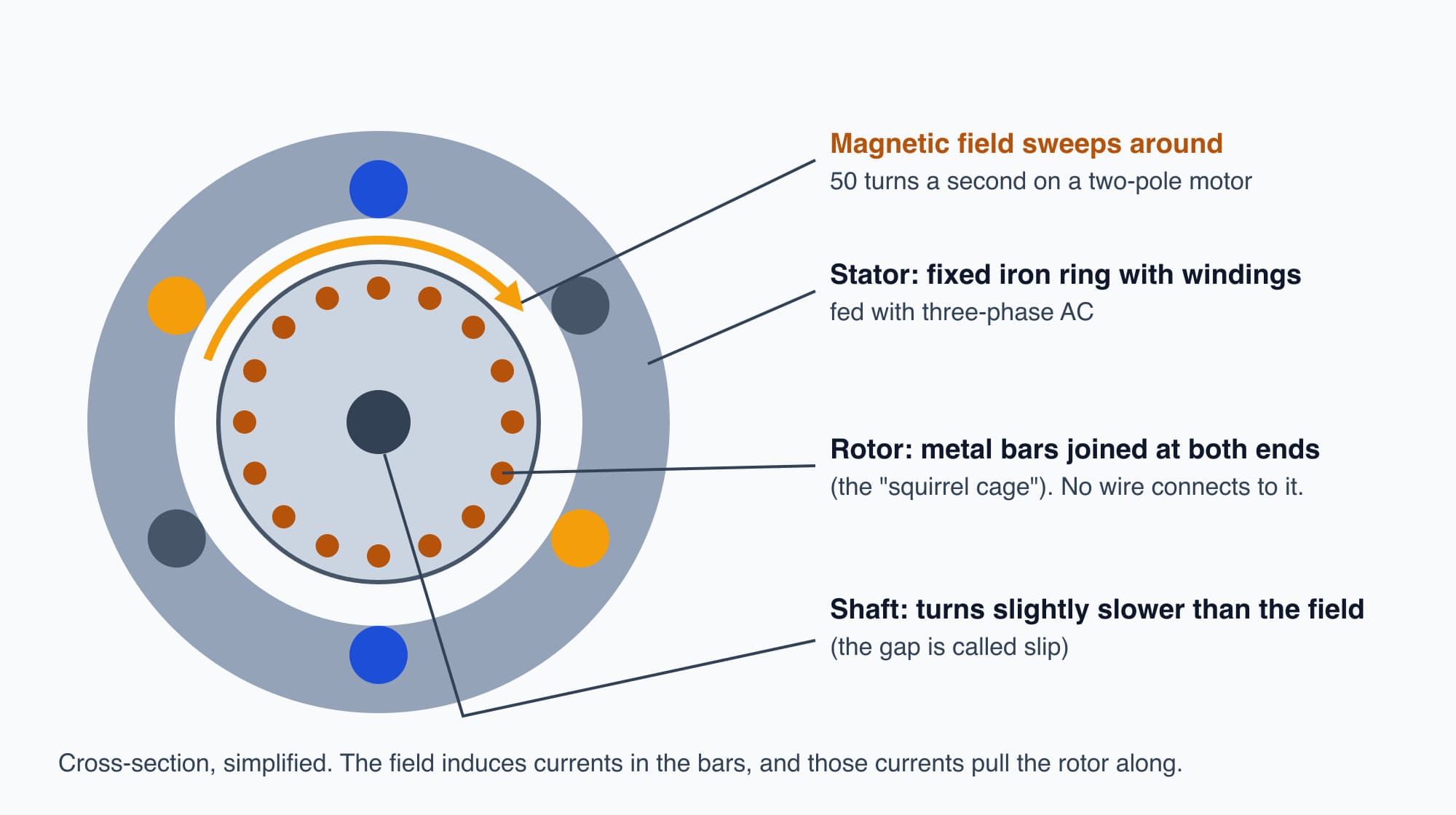
The stator's windings make a rotating magnetic field; the rotor is a cage of metal bars with no electrical connection to the supply.
The rotating field supplies the current. As the field sweeps past the rotor bars, the magnetism through them keeps changing, so it produces a voltage in them, just as changing magnetism produces a voltage in the secondary coil of a transformer (How Transformers Work, Part 8). The bars are joined at both ends, so current flows in them. Those currents, sitting in the stator's magnetic field, feel a push, and the push drags the rotor round in the same direction as the field. In effect, an induction motor is a transformer whose secondary coil is free to turn.
This is also why a "1,500 rpm" motor never quite reaches 1,500 revolutions per minute (rpm). The rotor bars only carry current while the field sweeps past them. If the rotor caught up with the field, the field would no longer be sweeping past the bars, the current would stop, the push would stop and the rotor would slow down. So the rotor always turns a little slower than the field, just enough to keep current flowing in the bars. That shortfall is called slip. A common four-pole motor on Malaysia's 50 Hz supply has a field that turns at 1,500 rpm, and at full load its rotor turns at around 1,440 rpm. Load it harder and it slips a little more; lighten the load and its speed rises back towards 1,500 rpm.
With no brushes, a squirrel-cage motor has almost nothing to wear out. Motors that feed current to the spinning part through carbon brushes need those brushes replaced, and the brushes spark, which is a hazard near dust or fumes. In a squirrel-cage motor, the only wearing parts are the two bearings the shaft turns on. It is cheap to build, tough and needs little maintenance, which is why it is the most common type of industrial motor.
Starting a big motor can dim the lights
You may have seen the lights blink for a moment when a fridge or air-conditioner compressor starts. At the moment of switch-on, a motor draws several times its normal running current.
When the rotor is standing still, the field sweeps past its bars at full speed, so the currents in the bars are very large, and the stator draws a large current from the supply to match. Connecting a motor straight to the supply, called direct-on-line (DOL) starting, typically draws 6 to 8 times its full-load current for the few seconds it takes to reach speed. That surge pulls the voltage down across the switchboard. Lights dip, and sensitive equipment nearby can trip when a large compressor starts. This is a voltage sag that the building makes for itself.
There are several ways to reduce the starting current, from simplest to most capable:
- A star-delta starter connects the motor's windings one way to start, then switches them to their normal connection near full speed. This cuts the starting current to about a third of the DOL current. (Side reading: Star vs Delta.)
- A soft starter uses electronics to raise the voltage gradually, holding the starting current to about two or three times the rated current and avoiding a mechanical jolt on belts and couplings.
- A variable frequency drive (VFD) changes both the voltage and the frequency, so the motor starts gently. It can also run a fan or pump at part speed, which saves energy. Its electronics draw current in short pulses rather than a smooth wave, which adds distortion to the supply (side reading: Electrical Harmonics).
An 11 kW motor uses more than 11 kW
Every motor has a nameplate, and its kW rating is the mechanical power at the shaft, the rated output. The electrical power the motor draws from the supply is higher, because some energy is lost as heat inside the motor.
Here is an example nameplate for a typical 11 kW four-pole motor. The values are illustrative, not from a specific product:
- Rated output: 11 kW at the shaft.
- Voltage: 400 V, 50 Hz (three-phase).
- Current: 20.4 A at full load.
- Speed: 1,460 rpm, which is 40 rpm of slip below the field's 1,500 rpm.
- Power factor: 0.85 at full load. Part 11 explains this number.
- Efficiency: 91.4%.
To find the electrical input, divide the output by the efficiency: 11 ÷ 0.914 ≈ 12.0 kW. The other 1.0 kW becomes heat in the motor.
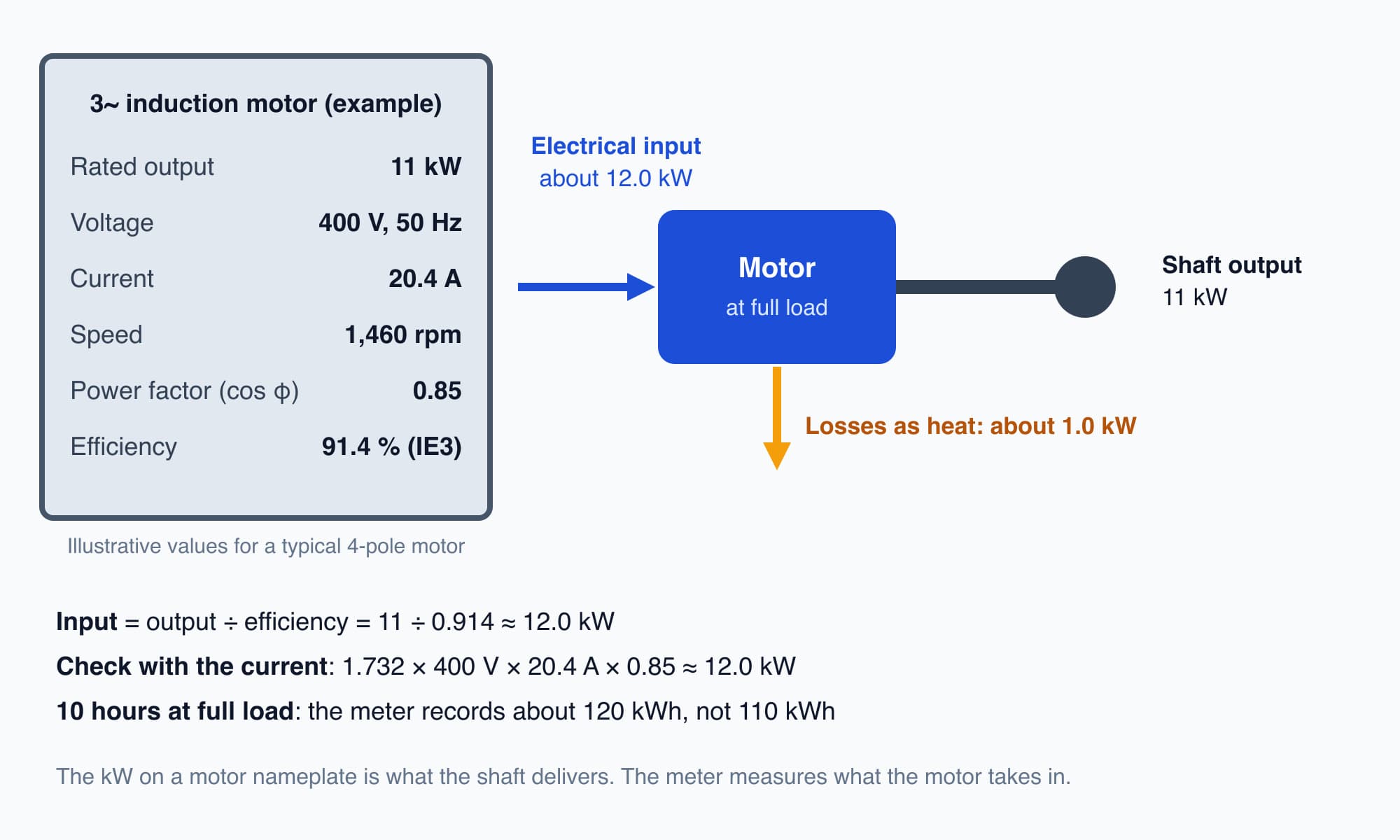
The nameplate kW is shaft output; the electricity meter sees the larger electrical input.
This matters when you estimate energy use. If this motor runs at full load for 10 hours, the electricity meter records about 12.0 × 10 = 120 kWh, not 110 kWh, because the meter measures what goes in, not what the shaft delivers. In practice, many motors run below full load, so their actual input is best found by measuring it.
Horsepower on motors and on air conditioners. Some motor nameplates also give the output in horsepower (hp). On a motor, 1 hp is about 746 W of shaft output. Air conditioners in Malaysia are also sold as "1 HP", "1.5 HP" and so on, but there the label means something different: it is a cooling capacity class. A "1 HP" air conditioner is a class of roughly 9,000 British thermal units per hour (BTU/h) of cooling, about 2.6 kW of heat removed. It does not mean the unit uses 746 W of electricity. An air conditioner moves heat rather than making it, so its electrical input is less than its cooling output. To find the electrical input, read the rated input power in watts on the unit's label.
Optional detail: The speed of the rotating field (the synchronous speed) is 120 × frequency ÷ number of poles. For a four-pole motor at 50 Hz, 120 × 50 ÷ 4 = 1,500 rpm. Full-load slip is typically 1 to 5%. >You can check the nameplate's input power from its current. A three-phase motor draws power on all three phases: each phase supplies 230 V × 20.4 A × 0.85, and three phases supply three times that, which is the same as 1.732 × 400 V × 20.4 A × 0.85. Both come to about 12.0 kW. Without the 0.85, 12.0 kW would need only about 17.4 A (12,035 W ÷ (1.732 × 400 V)). >The 91.4% efficiency meets the IE3 class. The IE efficiency classes, set by IEC 60034-30-1, run from IE1 (standard) through IE3 (premium) up to IE5 (ultra premium); each higher class has lower losses. The Association of Electrical and Mechanical Trades (AEMT) notes that for a typical motor, the purchase cost may be only 2 to 3% of its total cost of ownership, with the energy it uses making up most of the rest. So for a motor that runs many hours a year, a higher IE class usually costs less over its life. >Across the world, the IEA's 4E Electric Motor Systems Annex puts motors and motor systems at 53% of global electricity consumption.
What you now understand
- Three phases fed into evenly spaced windings make a magnetic field that rotates, with nothing in the stator moving; single-phase motors need a second winding and a capacitor to start.
- The rotating field induces current in a rotor that has no wires connected, and that current is pushed round by the field.
- The rotor must slip slightly behind the field, which is why a motor's speed is always a little below its field's speed.
- A motor draws a large surge as it starts, which can dim the lights.
- A nameplate's kW is shaft output; the meter records the larger electrical input, output divided by efficiency.
Check your understanding
- A four-pole motor on a 50 Hz supply has a nameplate speed of 1,440 rpm. Why not 1,500 rpm? The magnetic field turns at 1,500 rpm. The rotor must turn slightly slower than the field so that the field keeps sweeping past the rotor bars and producing the current that makes the push. That shortfall, 60 rpm here, is the slip.
- A motor nameplate says 11 kW and 91.4% efficiency. How much electricity does the motor use in 10 hours at full load? The 11 kW is shaft output. The electrical input is 11 ÷ 0.914 ≈ 12.0 kW, so in 10 hours the meter records about 120 kWh, not 110 kWh.
What comes next
Look again at the nameplate: 12.0 kW of input at 400 V, yet the motor draws 20.4 A, more than the kW alone would suggest. The office tower's standby generator from Part 7 shows the same gap from the other side: it is rated 1,000 kVA, yet it is expected to deliver only about 800 kW. Why do motors draw more current than their kW suggests? The next part, kW, kVA and kVAR: The Power Triangle, explains where the extra current goes.
Go deeper on video (optional)
This animated video shows the rotating field and the squirrel-cage rotor in motion, which may help after the first two sections. It is optional: you do not need it for the next part.
"How does an Induction Motor work?" by The Engineering Mindset
This is Part 10 of 15 in Cobler's Electricity Fundamentals course. Previous: Three-Phase Power Explained: Why Factories Get 400 V. Next: kW, kVA and kVAR: The Power Triangle, Explained.
Cobler builds CobiNeural, a platform that shows a facility team its building's energy, water and indoor air data as live numbers across the whole site. To see how your building performs, talk to us.
FAQ
Frequently asked questions
Ask us about this topic
Something in this article you want to dig into — or a situation in your own building it doesn't quite cover? Send us your question. We don't run public comments; the team replies to you directly by email.