Blog
Voltage Sags and Swells: Why Your Plant Trips
A voltage sag lasting a tenth of a second can stop a production line for four hours while the office lights barely flicker. Here is why sags trip plants, what causes them in Malaysia, and how to ride through.
 Tan Kok XinElectricity Fundamentals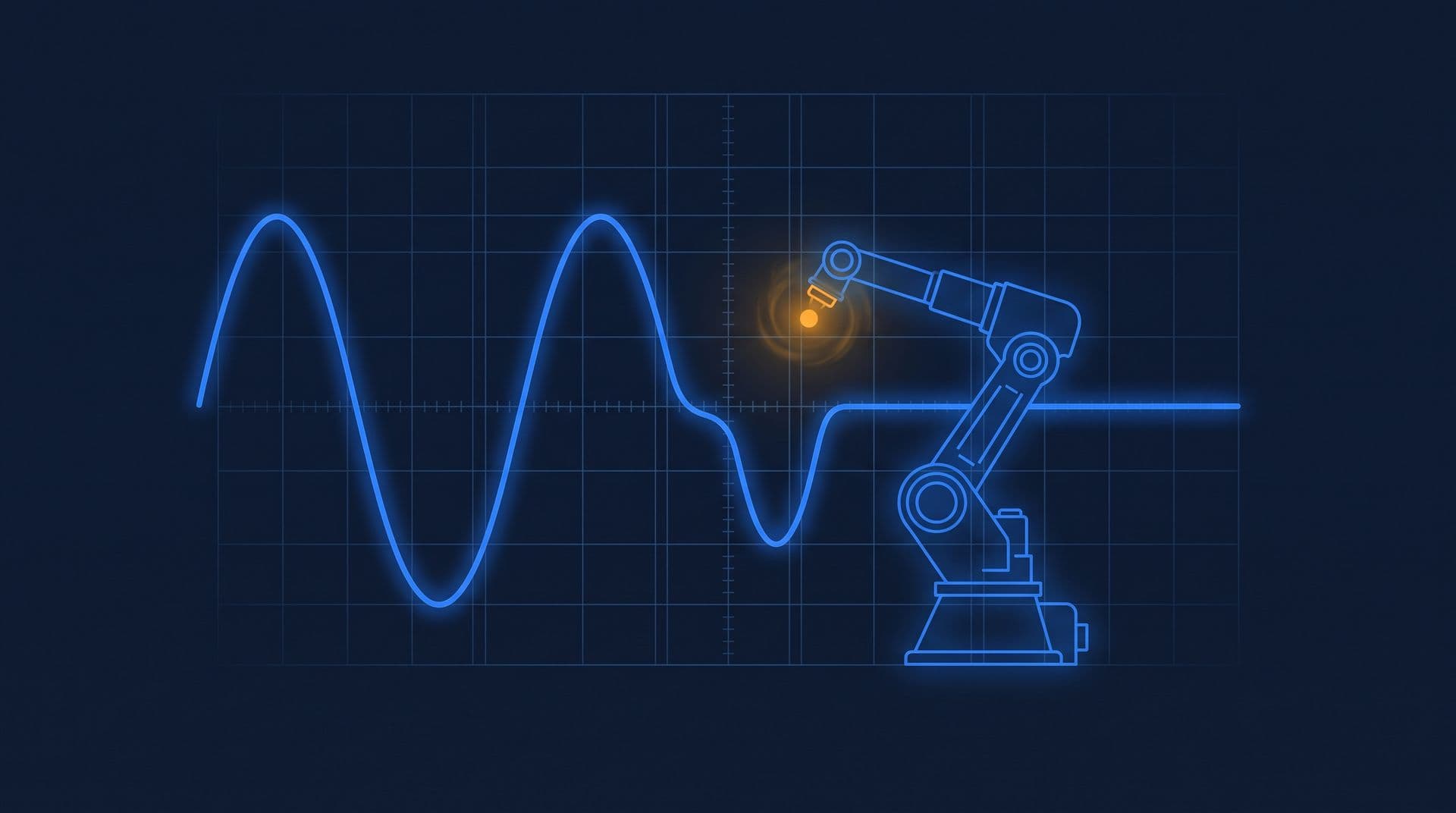
An optional side reading for Cobler's Electricity Fundamentals course. It goes with Part 13. See the course.
During a thunderstorm at home, the lights sometimes dim for a moment and then recover. The ceiling light carries on as normal, but the WiFi router or TV box restarts itself. What happened to the electricity in that moment, and why did one device carry on while another gave up?
What happened was most likely a voltage sag: a short drop in the supply voltage that recovers by itself. In a factory, the same kind of event can have a much larger cost. A fault on a TNB (Tenaga Nasional Berhad) feeder a kilometre away drops the voltage in your plant to 70 percent for five cycles, which at 50 Hz is one tenth of a second. The office lights barely flicker. On the production floor, a contactor lets go, a robot faults out and the injection-moulding line stops. Restarting it, clearing the scrap and checking the first good parts takes four hours. The sag never trips the main breaker and never shows on the bill.
This part explains what sags and swells are, what causes them, why they stop equipment, and how a site protects itself.
What is a voltage sag, and how is it different from an outage?
A voltage sag is a short drop in the supply voltage that recovers on its own, without the power ever going off completely. In an outage, the voltage falls to nothing and stays there until the supply is restored.
To measure a sag, engineers use the RMS voltage: the effective, working value of an AC voltage, which is 230 V for a normal single-phase supply (AC vs DC, Part 6, explains RMS). They often describe the voltage as a fraction of its normal (nominal) value, called per unit. For a 230 V supply, 1.0 per unit is 230 V, 0.9 per unit is 90 percent (about 207 V) and 0.7 per unit is 70 percent (about 161 V).
The American standard IEEE 1159 defines the events with numbers (powerquality.blog):
- A sag is the RMS voltage falling to between 0.1 and 0.9 per unit (between 10 and 90 percent of normal), lasting from half a cycle to one minute. International (IEC) standards call it a "dip".
- A swell is the opposite: the voltage rising to between 1.1 and 1.8 per unit, over the same range of durations.
- An interruption is the voltage falling below 0.1 per unit. This is the technical name for an outage.
At Malaysia's 50 Hz, one cycle lasts 20 milliseconds, so half a cycle is 10 ms. IEEE 1159 also groups sags by how long they last: instantaneous (half a cycle to 30 cycles), momentary (30 cycles to 3 seconds) and temporary (3 seconds to a minute). Almost every sag that stops a plant is in the instantaneous group, over in well under a second.
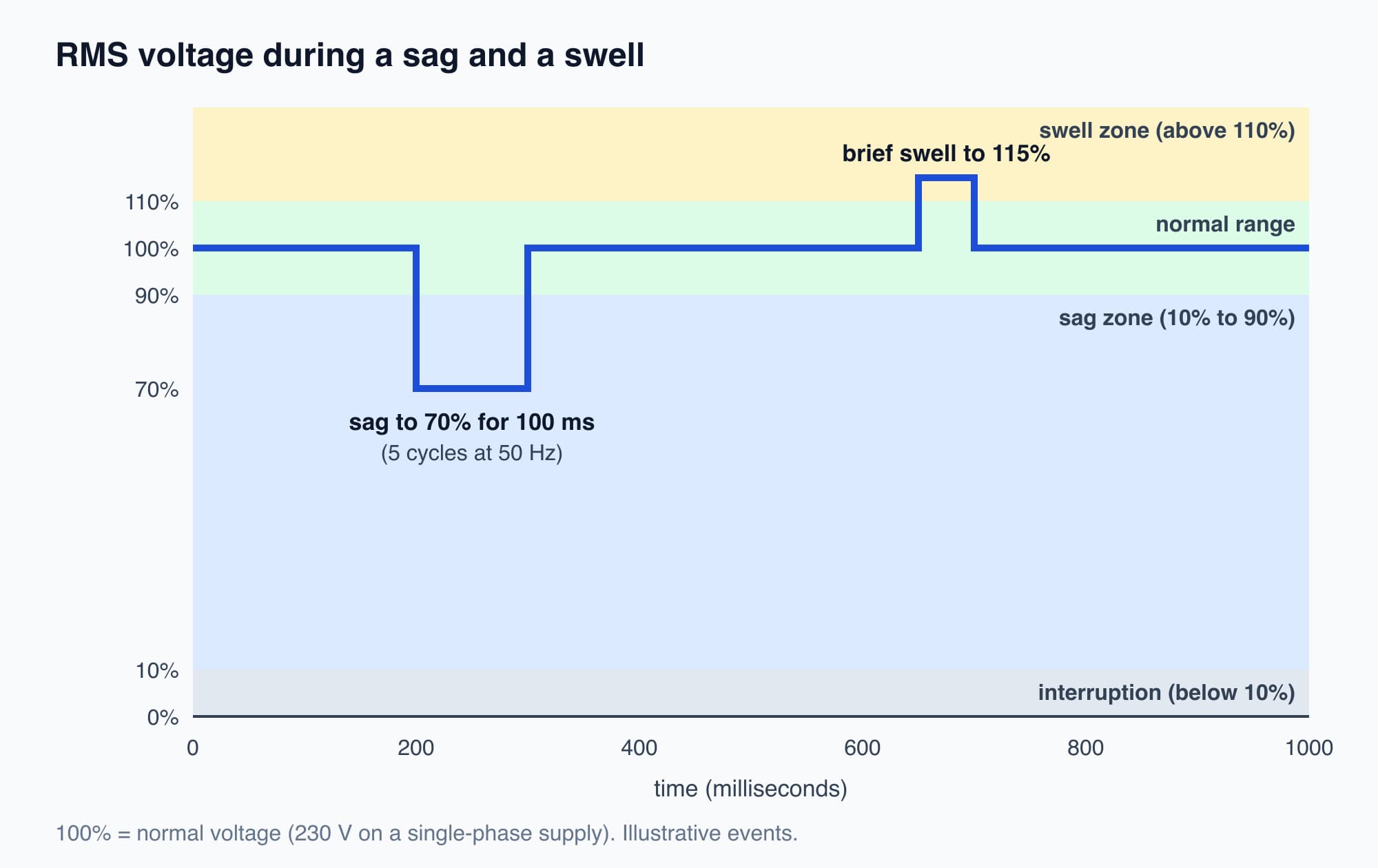
A sag is a short drop to between 10 and 90 percent of normal voltage; a swell is a short rise above 110 percent. Below 10 percent it counts as an interruption.
What causes voltage sags and swells?
Most voltage sags have one of three causes: a fault somewhere on the utility network, lightning, or a large motor starting. The Electric Power Research Institute (EPRI) attributes roughly 92 percent of power-quality problems on transmission and distribution networks to voltage sags, and its monitoring in the United States found that a typical customer sees 40 to 60 sag events a year (powerquality.blog).
Faults on the network. The most common single cause is a fault on a nearby feeder. Most of these are faults from one line to earth: a tree branch touching a line, a failed cable joint, an animal across a busbar, or an excavator digging into a cable on the next lot. (Earthing and RCDs, Part 4, explains what happens when current flows to earth.) For the few cycles it takes the utility's protection to disconnect the fault, the voltage sags across a wide area, including at your building. As How the Malaysia Electricity Grid Reaches Your Plug (Part 14) showed, you share the network with many neighbours, so a fault on their part of it can reach you.
Lightning. Lightning is a large cause of sags in Malaysia. The Klang Valley averages around 240 thunderstorm days a year, against roughly 10 for London, and Subang ranks among the most lightning-prone places in the world (Daily Express). The title of the world's most lightning-prone place usually goes to Bogor in Indonesia, but Malaysia is in the same top group. A strike does not have to hit your building to affect you. A strike on the network kilometres away causes a fault, the fault causes a sag, and the sag reaches your equipment.
Large motors starting inside your own site. When a large induction motor starts direct-on-line (switched straight onto the full supply voltage, with no soft-starter or drive), it draws six to ten times its running current for a second or two. That large current pulls down the voltage on your own switchboard. Internal causes like this are often quoted as 60 to 70 percent of the sags that equipment in a typical plant actually sees. You may have seen a small version at home: the lights dip briefly when the air conditioner or fridge compressor starts, then return to normal.
Swells are less common. They typically happen when a fault from one line to earth raises the voltage on the other, healthy phases, when a large load is switched off suddenly, or when a large capacitor bank is switched on. A swell can overstress and damage electronic components.
Why does a short dip stop a whole production line?
A production line stops when its most sensitive part stops, and that part then takes everything that depends on it down too.
Contactors. A contactor is a switch operated by an electromagnet, used to keep a motor's supply connected. The magnet's coil holds the contacts closed, and its pull becomes weaker as the voltage drops. Many contactors drop out when the voltage sags to between 70 and 85 percent of normal, and some only at 57.5 to 65 percent (Lee Contracting). Once a contactor opens, the motor stops, and it does not close again by itself when the voltage recovers a few cycles later.
Variable frequency drives (VFDs). As Rectifiers and Inverters (Part 17) explained, a VFD rectifies AC into DC before inverting it again. The drive watches the voltage of that internal DC stage to protect its own components. When a sag pulls it too low, commonly around 65 to 70 percent of normal, the drive switches itself off with an undervoltage fault (Voltage Disturbance). The drive is doing what it was designed to do, but the conveyor it drives stops.
Controllers. Programmable logic controllers (PLCs), their 24 V control power supplies, robots and vision systems reset if their supply is not backed up. Often the controller resets before any motor stops. This is the same thing that happens to a home router in a thunderstorm: its small power supply cannot ride through a dip that a ceiling light does not visibly react to.
Put these together and a sag lasting a tenth of a second becomes a full line stop, followed by hours of scrap, restarting and checking before the first sellable part is made.
Depth and duration decide whether equipment survives a sag
Whether equipment survives a sag depends on how deep the sag is and how long it lasts, taken together. A very deep sag that lasts only a couple of cycles can be harmless, while a shallower sag that lasts half a second can trip equipment.
This is the idea behind the ITIC curve (formerly the CBEMA curve), a chart of voltage against duration first drawn for computer equipment and published in its current form in 1996 (Voltage Disturbance). It draws a boundary: for a very short event, equipment is expected to tolerate a very deep dip, but the longer the dip lasts, the less depth it is expected to survive.
For example, a sag to 70 percent for two cycles is inside the tolerance of almost any equipment. The same 70 percent held for 40 cycles (0.8 seconds at 50 Hz) is outside the ITIC boundary, which only covers 70 percent for up to about half a second. One limit of this example: the ITIC curve is an American reference drawn for 60 Hz equipment, so use it as a way to think about depth and duration together, not as a Malaysian compliance limit.
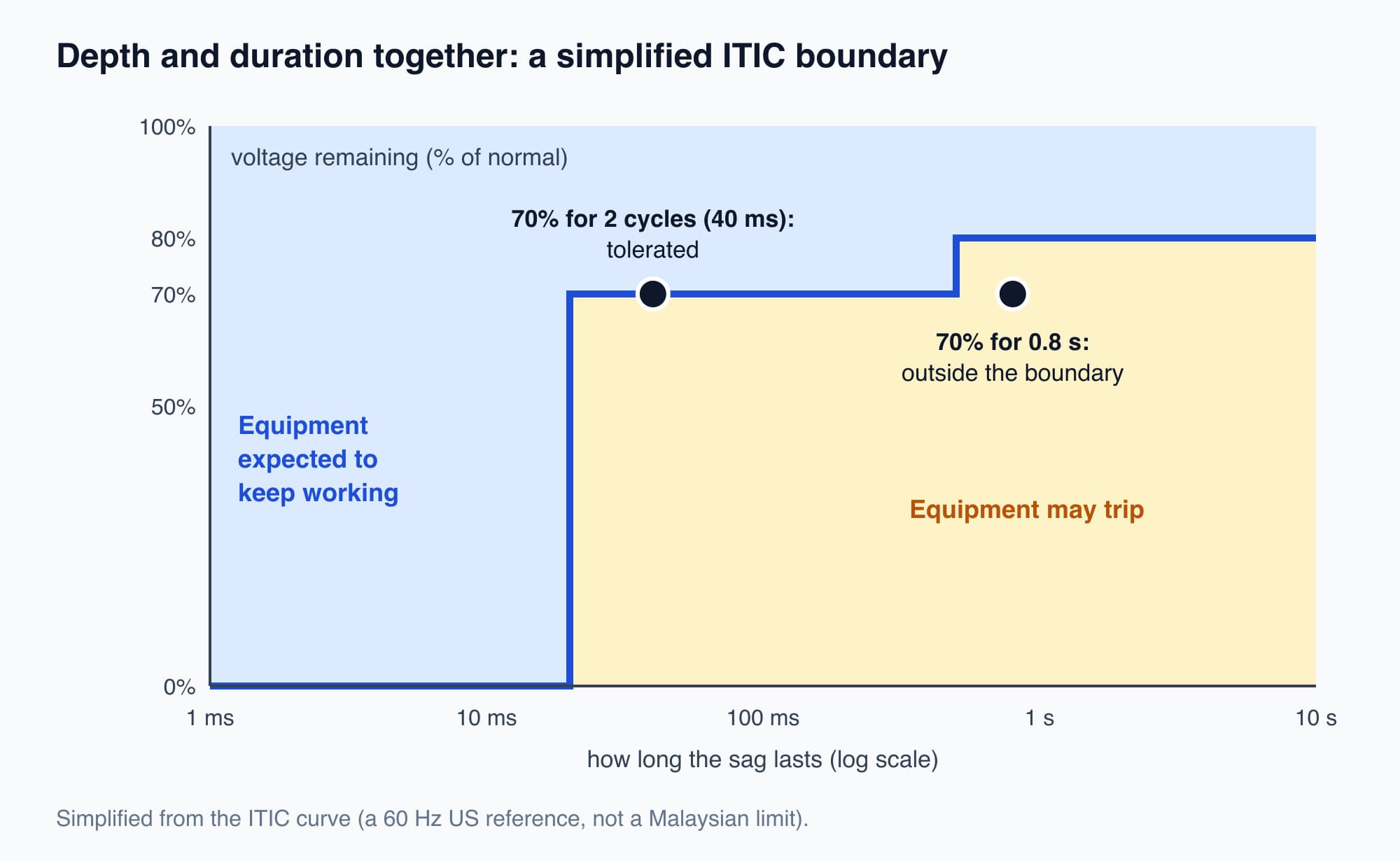
The same 70 percent sag is survivable for two cycles but falls outside the ITIC boundary when it lasts 0.8 seconds. Simplified from the ITIC curve.
How to ride through a voltage sag
A site usually does not try to keep the whole plant running through a sag. It protects the parts whose loss stops everything else, and it buys equipment that can tolerate sags.
- Put a UPS on the controls, not the whole line. A small UPS (uninterruptible power supply) that keeps the PLCs, operator screens, relays and vision systems running means the controls never reset. The motors may slow for a moment, but if the controls stay on, the line can recover instead of faulting. Backing up every motor is expensive and usually unnecessary; backing up the 24 V control supply costs far less and deals with the most common cause of a line stop.
- Fit contactor ride-through or coil-hold modules. These keep a contactor's coil energised through a short sag so it does not drop out.
- Use dip-proofing inverters or a dynamic voltage restorer for a critical process. These devices supply the missing voltage for the length of the sag, so the load stays up through events that would otherwise trip it.
- Specify sag tolerance when you buy equipment. For semiconductor manufacturing and similar tools, the SEMI F47 standard defines how deep and how long a sag a machine must ride through (Voltage Disturbance). Ask suppliers for immunity ratings before you place the order.
These measures usually cost much less than the downtime they prevent. ABB puts the cost of industrial downtime at up to 500,000 US dollars an hour (ABB). With several sags a year, a four-hour restart after a dip lasting a tenth of a second can become a regular event rather than a rare one.
Why a voltage sag leaves no trace on your bill
A billing meter records energy (kWh) and the highest 30-minute average demand. A sag lasts milliseconds and uses almost no extra energy, so it does not show up in either figure. The line stopped and the shift lost four hours, but the meter shows nothing unusual.
This makes sags hard to manage. To tell a utility fault apart from a motor starting on your own site, or to discuss an event with TNB, you need a record of each event: the time it happened, how deep the voltage fell and how long it lasted. A billing meter does not provide that. It needs power-quality monitoring equipment that records voltage events separately from the billing meter.
What comes next
The section on riding through a sag suggested keeping the controls running from a UPS, which covers a sag or a short outage by switching to a battery. The next part, How Batteries Store Energy (and Why It Is All DC), explains what is inside a battery, why it always supplies DC, and what the numbers on a battery storage system mean.
Check your understanding
- What is the difference between a voltage sag and an outage? In a sag, the RMS voltage drops to between 10 and 90 percent of normal and recovers by itself, within half a cycle to one minute. In an outage (an interruption), the voltage falls below 10 percent of normal and stays off until the supply is restored.
- The main breaker did not trip, so why did a sag lasting 0.1 seconds stop a production line? The most sensitive parts gave up first. Contactors can drop out when the voltage falls to around 70 to 85 percent, VFDs switch off when their internal DC voltage falls too low, and PLCs without a backed-up supply reset. Once these stop, the line stops, even though the voltage recovered a fraction of a second later.
Recap: A voltage sag is a short drop in RMS voltage to between 10 and 90 percent of normal, lasting from half a cycle to a minute; a swell is a short rise to between 110 and 180 percent. Most sags come from faults on the network (often triggered by lightning in Malaysia) and from large motors starting on site. Contactors, VFDs and unprotected controllers are the usual weak points. Depth and duration together decide whether equipment survives. Protect the controls with a UPS, fit ride-through modules and buy equipment rated for sags. A billing meter does not record sags; power-quality monitoring does.
This is an optional side reading for Cobler's Electricity Fundamentals course. Back to the course: Part 13: Rectifiers and Inverters.
Cobler builds CobiNeural, a platform that shows a facility team its building's electricity as live numbers: energy, demand and power quality across the whole site. To see how your building uses electricity, talk to us.
FAQ
Frequently asked questions
Ask us about this topic
Something in this article you want to dig into — or a situation in your own building it doesn't quite cover? Send us your question. We don't run public comments; the team replies to you directly by email.