Blog
Electrical Harmonics: How VFDs Distort Your Power
VFDs, LED drivers, UPS and servers draw current in gulps, not smooth waves. Here is how electrical harmonics form, why they cook a balanced building's neutral, and how to measure and fix them.
 Tan Kok XinElectricity Fundamentals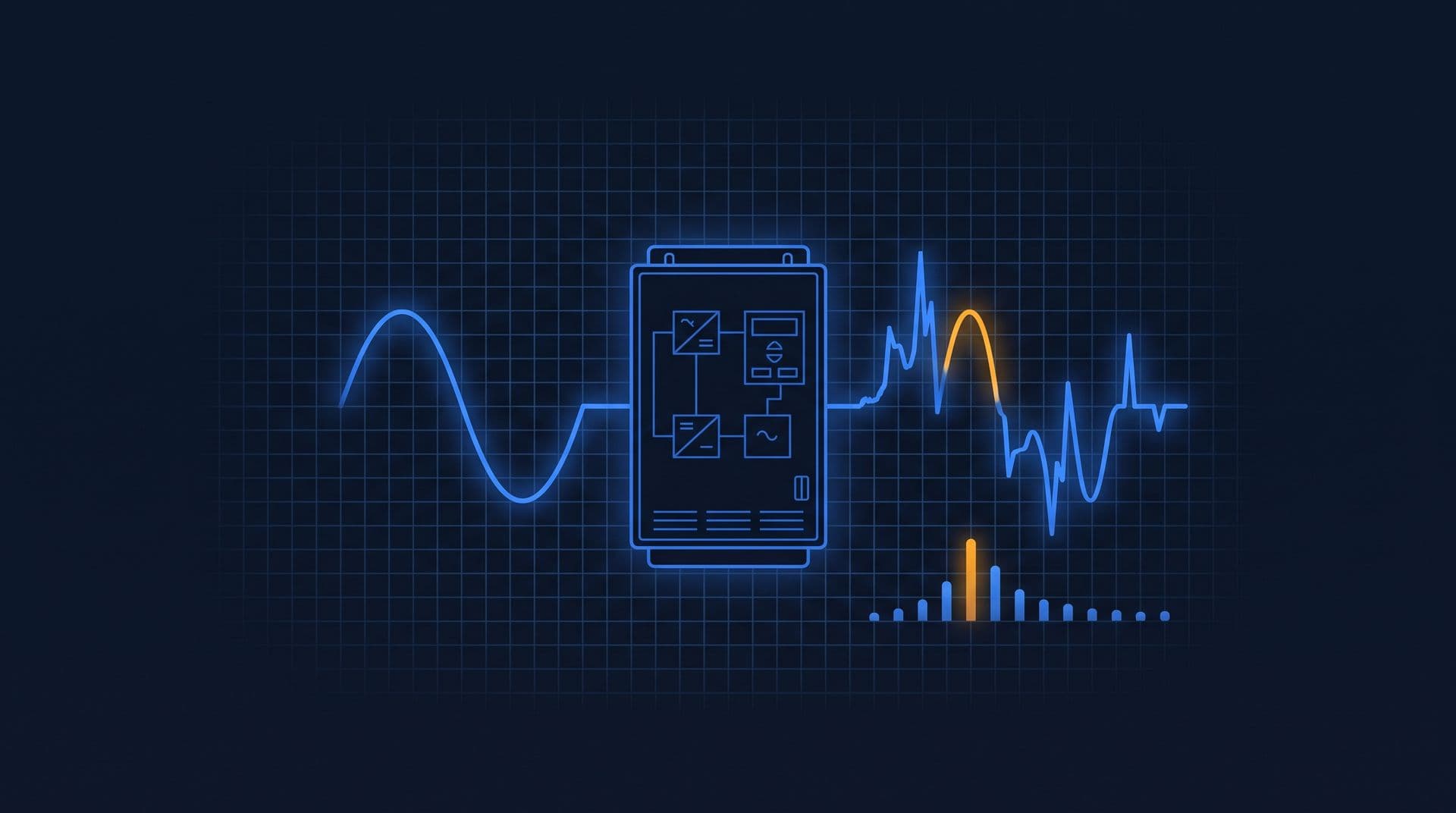
An optional side reading for Cobler's Electricity Fundamentals course. It goes with Part 13. See the course.
An office floor today is full of laptop chargers, LED lights and computers, and the plant room below has variable frequency drives on its pumps and chillers. In Rectifiers and Inverters (Part 17) we saw that each of these devices has a rectifier at its input, and that a rectifier draws current in short bursts rather than smoothly. What happens to a building's supply when thousands of devices all draw current this way?
The bursts change the shape of the current, and that change can be described as electrical harmonics: extra currents at whole-number multiples of 50 Hz. Harmonics do not show up on the electricity bill, but they can overheat cables, transformers and capacitor banks. This part explains where they come from, what they do and how buildings deal with them.
A kettle draws a smooth current, a rectifier does not
TNB (Tenaga Nasional Berhad) supplies electricity as a smooth 50 Hz wave: the voltage rises and falls in the same smooth shape fifty times a second. This shape is called a sine wave.
A simple heating element, such as the one in a kettle or an old incandescent lamp, draws current in exactly the same shape as the voltage. When the voltage is high, the current is high; when the voltage is low, the current is low. A load like this is called a linear load.
A rectifier behaves differently. As Part 17 explained, a rectifier's smoothing capacitor only takes current from the supply when the supply voltage rises above the capacitor's own voltage. That happens only near the top of each wave. So a rectifier draws nothing for most of the cycle, then a short, tall burst of current near each peak. A load like this is called a non-linear load. Variable frequency drives (VFDs), LED drivers, computer power supplies, UPS (uninterruptible power supply) units and phone chargers are all non-linear loads.
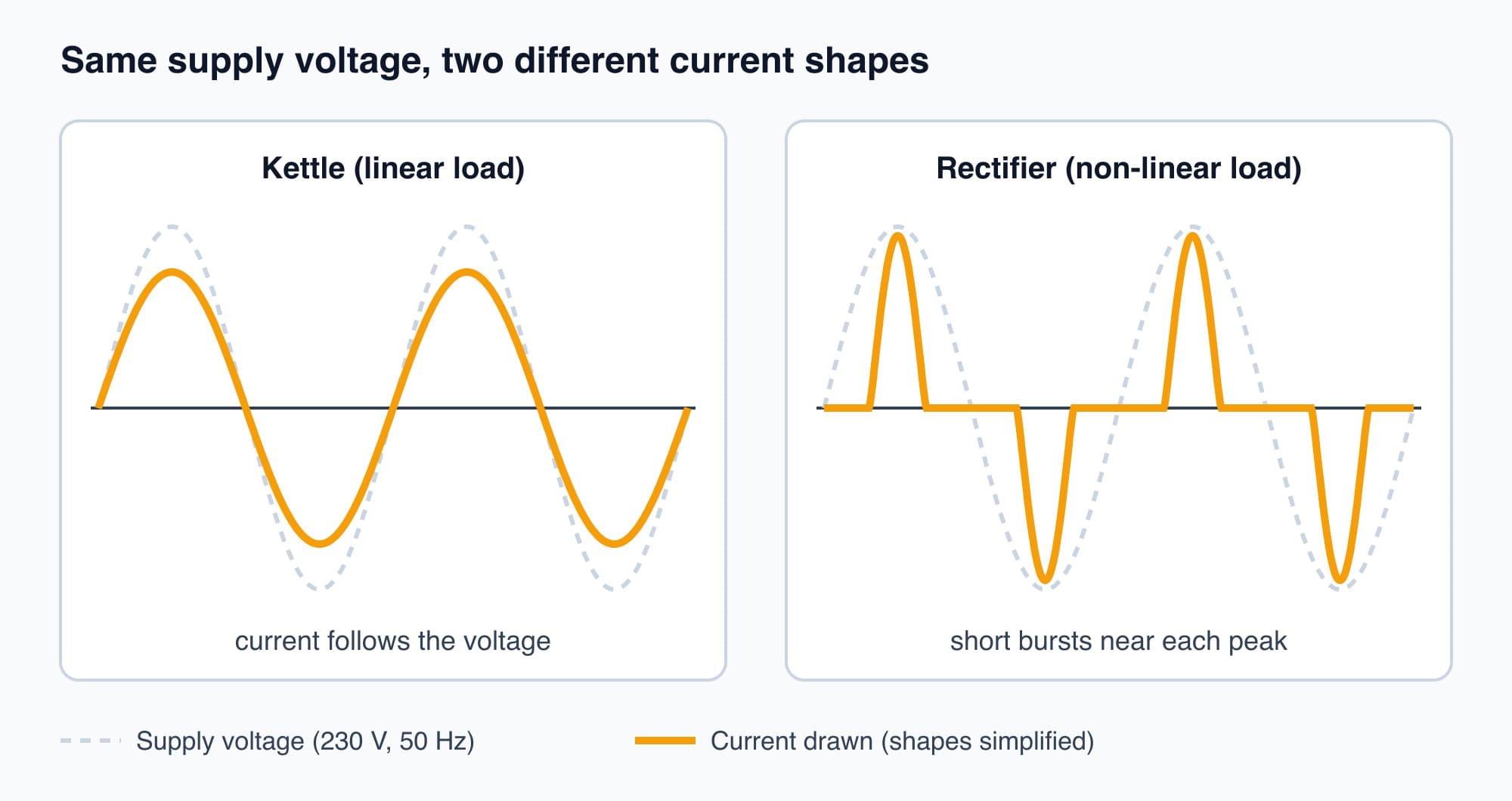
A kettle draws current in the same smooth shape as the voltage. A rectifier draws short bursts near each peak.
What are electrical harmonics?
Electrical harmonics are currents (and the voltages they cause) at whole-number multiples of the 50 Hz supply frequency. The 50 Hz part is called the fundamental. The 3rd harmonic is at 150 Hz, the 5th at 250 Hz, the 7th at 350 Hz, and so on.
They come from a useful mathematical fact: any wave shape that repeats itself 50 times a second, however jagged, can be built by adding together smooth sine waves at 50 Hz and at whole-number multiples of 50 Hz. So the bursty current drawn by a rectifier can be described as a 50 Hz current plus a set of harmonic currents at 150 Hz, 250 Hz, 350 Hz and higher. The more distorted the shape, the larger the harmonics.
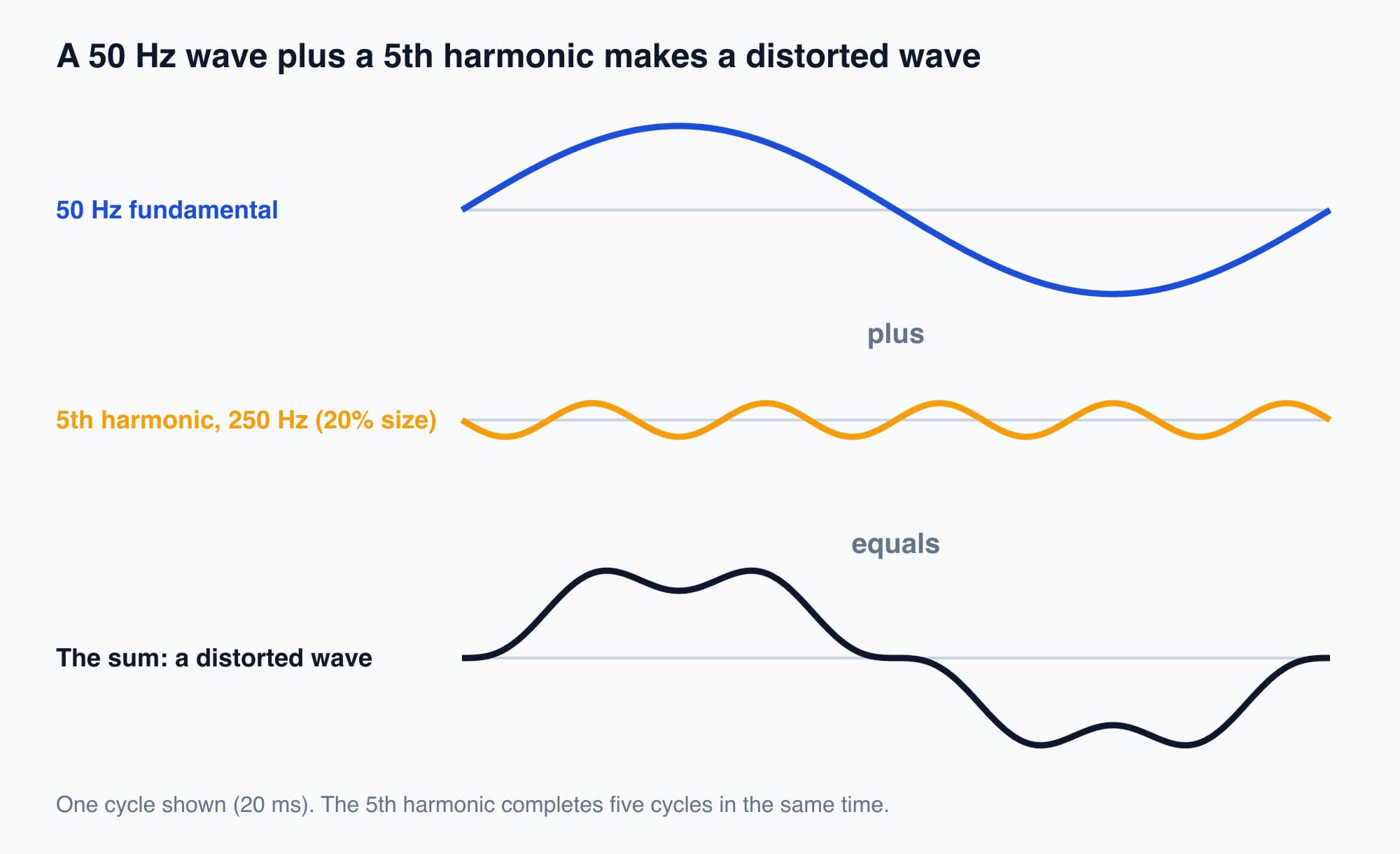
A 50 Hz wave plus a smaller 250 Hz wave (the 5th harmonic) adds up to a distorted shape. Working backwards, any distorted current can be split into parts like these.
A useful comparison is a musical note. A guitar string sounds one main note and, more faintly, higher tones at two, three and four times that frequency; those higher tones are also called harmonics. The comparison explains only the idea of multiples. Electrical harmonics are currents in the wiring, not sound.
In particular, the faint high-pitched whine from some LED drivers and chargers is not the sound of harmonics. As Part 17 explained, that whine comes from the fast on-off switching inside the device, which makes small parts such as coils vibrate.
How a VFD creates harmonics
Most VFDs have a six-pulse rectifier at their input: six diodes that turn the three-phase AC supply into DC. (A VFD then inverts that DC back to AC at whatever frequency the motor needs, as Part 17 and AC vs DC (Part 6) described. The harmonics come from the rectifier stage at the front.)
Because of the way those six diodes take turns to conduct, a six-pulse rectifier draws harmonics at a predictable set of orders: mainly the 5th, 7th, 11th and 13th. The 5th is the largest, commonly 25 to 40 percent of the fundamental current, and the 7th is commonly around 15 to 25 percent.
Engineers summarise how distorted a waveform is with one number, the total harmonic distortion (THD). THD is the combined size of all the harmonics, expressed as a percentage of the fundamental.
- For a six-pulse drive with no added filtering, the current THD depends on the design and the load. It commonly falls anywhere from 35 to 80 percent, with around 40 percent at full load a typical figure.
- Adding a line reactor (a coil in the supply to the drive) and a DC-link choke (a coil inside the drive) slows down the bursts of current. Most integrators fit these as standard, and together they bring current THD down to around 30 percent.
The harmonic currents flow back through the building's cables and transformers to the supply. Because these have some resistance and inductance, the harmonic currents also distort the voltage a little. A healthy supply voltage typically has a THD of a couple of percent. A switchroom feeding many unfiltered drives can push the voltage THD on its local busbar much higher.
Why a balanced building can still overheat its neutral
In a three-phase supply, the harmonics at multiples of three (the 3rd, 9th, 15th and so on, called triplen harmonics) add up in the neutral conductor instead of cancelling.
As Three-Phase Power Explained (Part 12) showed, the three phase currents are spaced one-third of a cycle (120 degrees) apart. When the three phases carry equal loads, their currents cancel where they meet in the neutral, so a balanced system needs only a modest neutral conductor.
The 3rd harmonic does not follow this rule. It completes three cycles for every one cycle of the fundamental. So a shift of 120 degrees at 50 Hz becomes a shift of three times 120, which is 360 degrees, at 150 Hz. A shift of 360 degrees is a full cycle, which means no shift at all. The 3rd harmonic currents in the three phases are therefore in step with each other, and in the neutral they add together instead of cancelling.
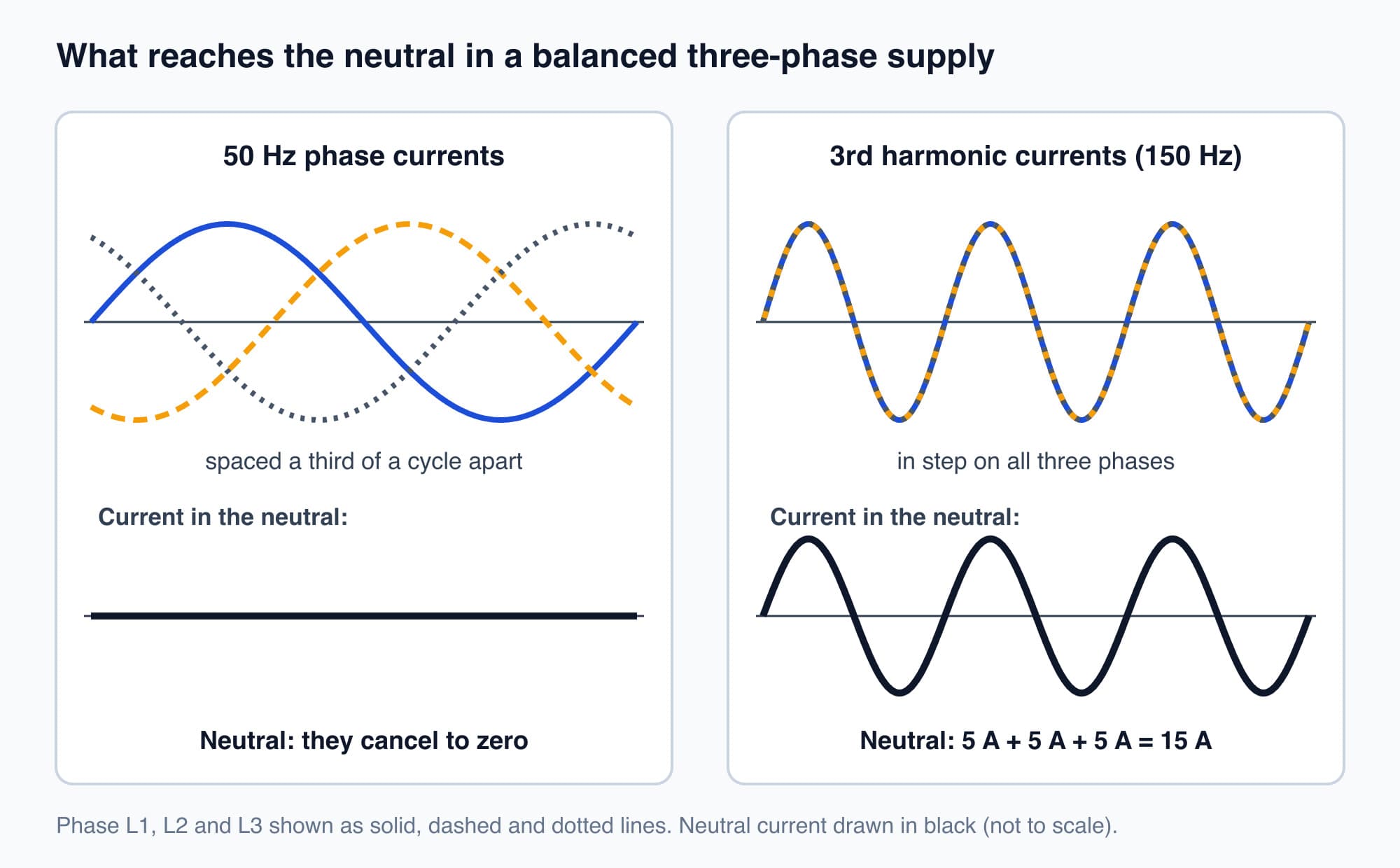
At 50 Hz the three phase currents cancel in the neutral. Their 3rd harmonic currents line up, so they add.
For example, if each phase carries 5 A of 3rd harmonic current, the neutral carries 15 A of it: three times the harmonic current on each phase. In a standard four-wire installation, the neutral is often not protected by its own overcurrent device, so nothing trips. The extra current heats the neutral, and over time the heat can damage its insulation and create a fire risk, even though the phase loads look balanced.
Triplen harmonics come mainly from single-phase electronics. Office floors full of laptop chargers, LED lighting and small UPS units are the usual source.
What harmonics do to transformers, capacitor banks and breakers
Harmonics cause extra heating, and in some cases they cause equipment to fail or trip without an obvious fault.
Transformers. Harmonic currents heat a transformer's windings more than the same amount of smooth 50 Hz current would. A transformer supplying a large non-linear load may have to be run below its rated capacity, or be replaced with a K-rated transformer designed to handle the extra heating.
Capacitor banks. Many buildings have banks of capacitors in the switchroom to correct power factor (Part 21 explains what they do). A capacitor bank and the inductance of the supply together form a circuit that has a natural frequency, called the resonant frequency. If that frequency is close to a harmonic being produced on site, the harmonic current is amplified instead of reduced. The capacitors overheat and fail early.
The usual fix is a detuned capacitor bank, which has a reactor (a coil) in series with the capacitors. A reactor sized at 7 percent of the bank's rating moves the resonant frequency down to 189 Hz; a 14 percent reactor moves it to 134 Hz. Both are below the 5th harmonic at 250 Hz, so at 250 Hz and above the bank behaves like a coil rather than a capacitor, and it cannot resonate with those harmonics. Power Factor Correction: What Capacitor Banks Do (Part 21) covers this in more detail.
Breakers and protection relays. Distorted current, and the extra heat it carries, can trip breakers or confuse protection relays even when no fault can be found.
The limits set by standards
Harmonic limits are measured at the point of common coupling, where a building's supply connects to the utility's network. How the Malaysia Electricity Grid Reaches Your Plug (Part 14) shows where that point sits in the supply chain.
The international reference is the American standard IEEE 519-2022. It limits voltage THD at the point of common coupling to 8.0 percent on low-voltage supplies (at or below 1 kV) and to 5.0 percent at medium voltage (between 1 kV and 69 kV), with tighter limits for each individual harmonic (IEEE 519 limits by voltage level). Your electrical consultant will confirm which limits apply to a connection in Malaysia.
Why harmonics are a newer problem, and how buildings reduce them
Thirty years ago, most building loads were linear: motors started directly on the supply, incandescent lamps and resistive heaters. They drew current in the same smooth shape as the voltage. Today most of the load is electronic: drives, LED lighting, IT equipment and UPS systems. Much of this equipment saves energy (a VFD on a pump, an LED replacing a halogen lamp), but each piece draws current in bursts. The answer is not to avoid this equipment, but to know what it does to the supply and to design for it.
Fixes range from simple and passive to active and more expensive:
- Oversize the neutral or run parallel neutrals, and specify K-rated transformers, so the extra heating is carried safely.
- Fit detuned reactors on power factor correction capacitor banks, so they cannot resonate with the site's harmonics.
- Install active harmonic filters. These measure the distortion continuously and inject an equal and opposite current to cancel it.
- Choose drives that produce fewer harmonics. Twelve-pulse and active-front-end drives cancel most of the lower-order harmonics inside the equipment.
Which of these a site needs depends on how much non-linear load it runs and how close it is to the limits. Where drives also control the plant, harmonic mitigation and drive and BMS automation are often specified together (BMS is the building management system).
Why harmonics do not appear on your electricity bill
An ordinary energy meter measures energy in kWh, and harmonics change that number very little.
A distorted current can carry a lot of harmonic current while the kWh total looks normal. Both old spinning-disc meters and modern smart meters (Part 15) are designed to report energy and demand, not the shape of the waveform. To find harmonics, you measure power quality directly: a power-quality analyser is connected to the busbar, the waveform shape is examined, and THD is recorded over hours or days. The meter tells you how much energy you used, but not the shape of the current you drew.
What comes next
Harmonics are a problem with the shape of the wave. The next part, Voltage Sags and Swells: Why Your Plant Trips, looks at a different power-quality problem: short drops and rises in the size of the voltage, and why a dip lasting a tenth of a second can stop a production line.
Check your understanding
- Why does a VFD draw harmonic current, while a kettle does not? A kettle's element draws current in the same smooth shape as the voltage. A VFD's rectifier only draws current near the peaks of each wave to charge its capacitor, so its current comes in bursts. That bursty shape is made up of the 50 Hz fundamental plus harmonics, mainly the 5th, 7th, 11th and 13th for a six-pulse drive.
- The three phases of a building are evenly loaded. Why can the neutral still overheat? At 50 Hz the three phase currents are spaced a third of a cycle apart and cancel in the neutral. But the 3rd harmonic currents of the three phases are in step with each other, so they add up. With 5 A of 3rd harmonic on each phase, the neutral carries 15 A.
Recap: Linear loads such as heaters draw current in the same smooth shape as the voltage. Rectifiers in drives, chargers, LED drivers and UPS units draw current in bursts, and those bursts are made of harmonics: currents at whole-number multiples of 50 Hz. THD summarises how distorted a wave is. Triplen harmonics add up in the neutral, harmonics heat transformers, and plain capacitor banks can resonate with them, which detuned reactors prevent. Standards such as IEEE 519 set limits at the point of common coupling. Harmonics do not show on a kWh meter; they are found with power-quality measurement. The whine from some chargers is switching noise, not harmonics.
This is an optional side reading for Cobler's Electricity Fundamentals course. Back to the course: Part 13: Rectifiers and Inverters.
Cobler builds CobiNeural, a platform that shows a facility team its building's electricity as live numbers: energy, demand and power quality across the whole site. To see how your building uses electricity, talk to us.
FAQ
Frequently asked questions
Ask us about this topic
Something in this article you want to dig into — or a situation in your own building it doesn't quite cover? Send us your question. We don't run public comments; the team replies to you directly by email.