Blog
How Electricity Meters Work: Disc to Smart Meter
The meter is the cash register of the whole electricity industry. Here is how the spinning-disc meter, the modern electronic meter, and TNB's smart meters actually measure your kWh, kW and kVARh.
 Tan Kok XinUnderstanding Your Electricity Bill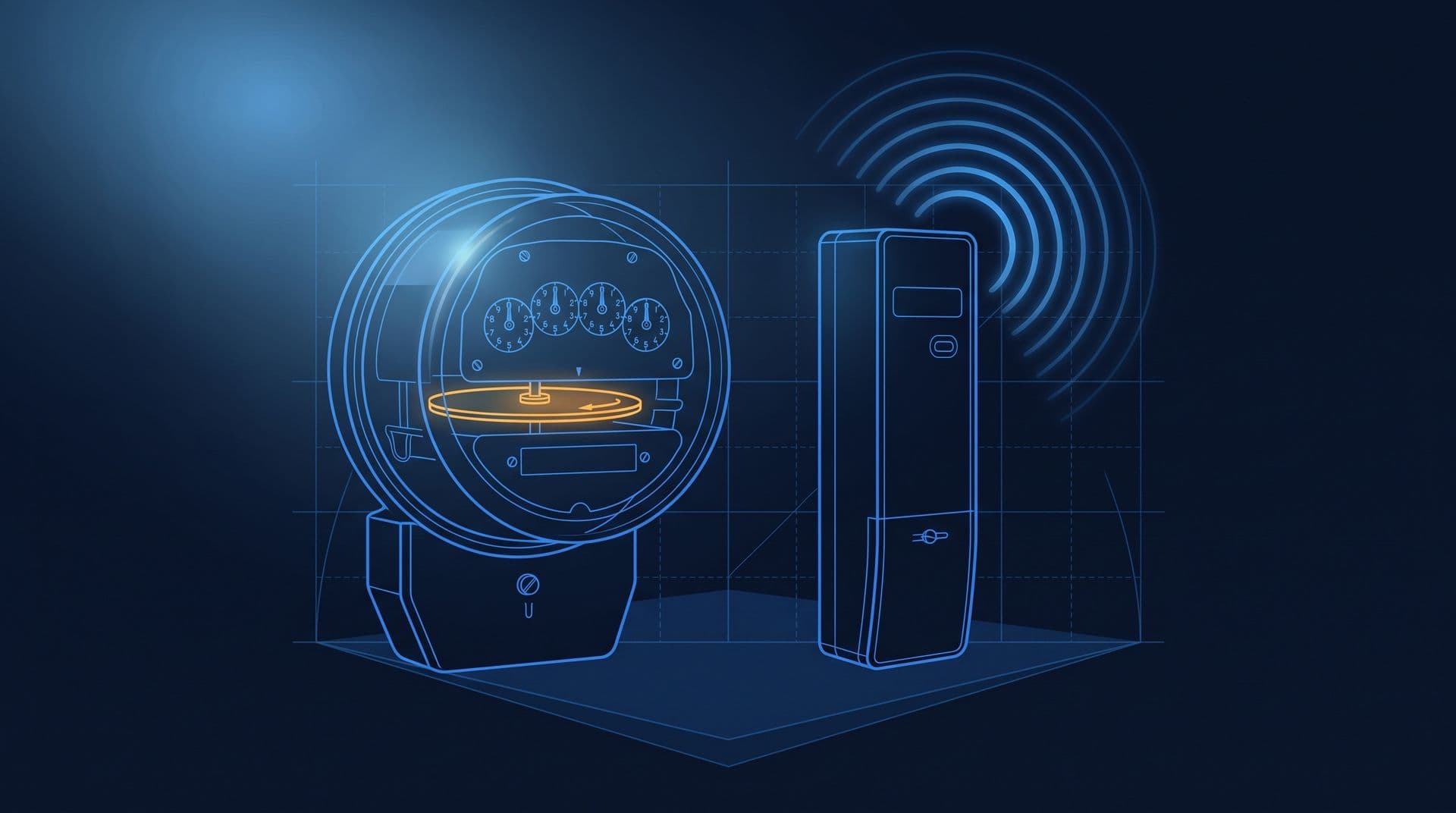
Part 2 of 7 in Cobler's Understanding Your Electricity Bill course. New here? See the course page.
In Part 1, Aina learned that her office tower's September bill is built from two numbers: 500,000 kWh of energy and a maximum demand of 1,600 kW. Before she explains either to the building owner, she wants to know where they come from: who measured the 500,000 kWh and the 1,600 kW, and how?
The answer is the TNB meter, and this part shows how electricity meters work. Somewhere near a house's front gate, or in a building's switch room, there is a meter, often with a small red light that blinks faster when more is switched on. It measures the voltage and the current, multiplies them to get power, and adds that power up over time to get energy. Every figure on the bill starts as a reading from that box. It helps to start with the older kind, a spinning aluminium disc behind glass, and then move to the electronic meters in use today.
In the office tower, the TNB meter is at the 11 kV intake in the building's substation. In the shoplot, it is at the building's incoming point. Our Electricity Fundamentals lesson on how the grid reaches your building follows the supply up to that point.
How electricity meters work: the spinning-disc meter
The classic meter turns power into the speed of a disc. Draw twice the power and the disc spins twice as fast.
Inside the meter, two coils of wire sit on either side of a thin aluminium disc. One coil follows the supply voltage. The other carries the current the building draws. Together their magnetic fields push the disc round, and the push grows with the useful power the building is drawing. A small permanent magnet over the edge of the disc acts as a brake, so the disc settles at a speed that matches the power instead of spinning faster and faster.
A set of gears counts the disc's turns and moves the number dials. Speed shows power, and the count of turns over time shows power multiplied by hours. So the dials show kilowatt-hours (kWh), the unit from Part 1. If power flows the other way, as it does when a rooftop solar system exports to the grid, the disc turns backwards.
This is why energy is billed in kWh. One kWh is 3.6 megajoules of energy, but no meter was built to display megajoules. The dials count what the disc does, and the disc adds up power over time.
How modern electronic meters measure energy
An electronic meter does the same multiplication with a chip instead of a disc. It measures voltage and current thousands of times a second. For each pair of readings it multiplies voltage by current to get the power at that instant. Adding those results over time gives energy.
Because the meter keeps the actual voltage and current readings, it can report more than a disc could. It can show the useful power in kW, the power factor (explained below), and how much energy was used in each half hour of the day.
The small red light on a TNB electronic meter replaces the disc. Each flash marks a fixed amount of energy, just as each turn of the disc did.
Large buildings use current transformers
A meter cannot carry the full current of a large building, so it measures a small, scaled-down copy of it.
A house or small shop draws tens of amps, and the meter's own circuit can carry that directly. A large three-phase supply can draw hundreds or thousands of amps. No compact meter can carry 2,000 amps without overheating.
The answer is a current transformer (CT), a small version of the transformer that changes voltage on the grid. A CT is a ring of iron around the main busbar, the thick metal bar that carries the incoming supply. The ring gives out a small current, typically 5 A or 1 A, that rises and falls in exact step with the large current. The meter measures the small current and multiplies it back up. For example, with a CT marked 2,000/5, a busbar current of 2,000 A gives 5 A at the meter, and the meter multiplies what it sees by 400.
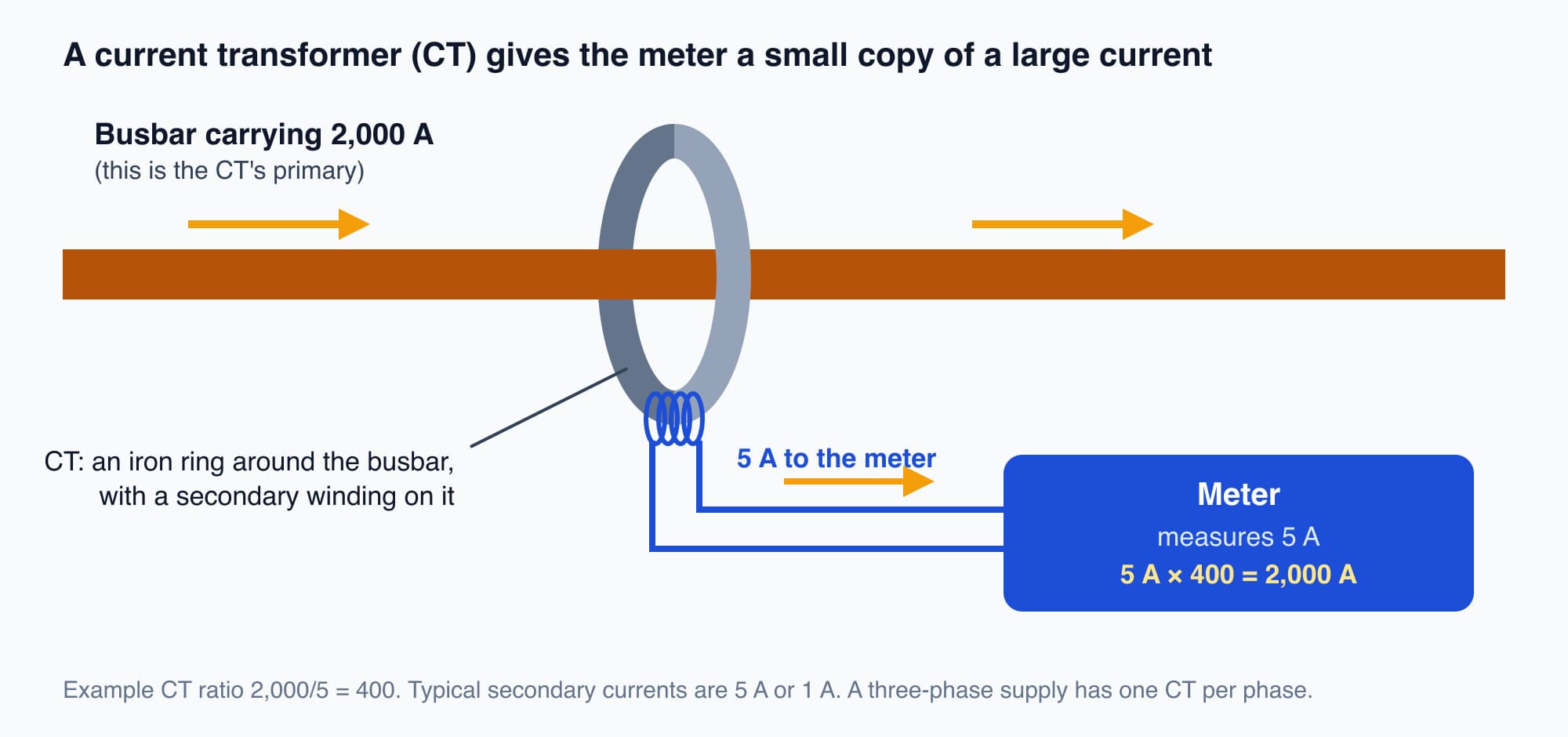
A current transformer sends the meter a small copy of the busbar current; the meter multiplies it back up by the CT ratio.
This is why a large meter cabinet has ring-shaped CTs on the incoming cables, one per phase, all feeding one small meter. At Aina's tower, the TNB meter is on the 11 kV side, where the voltage is also far too high to connect to a meter directly. So voltage transformers step the voltage down for the meter in the same way, and the meter scales its readings back up.
What a commercial TNB meter records
A TNB meter on a larger commercial or industrial supply keeps at least three running records, called registers. Each one feeds a different line on the bill.
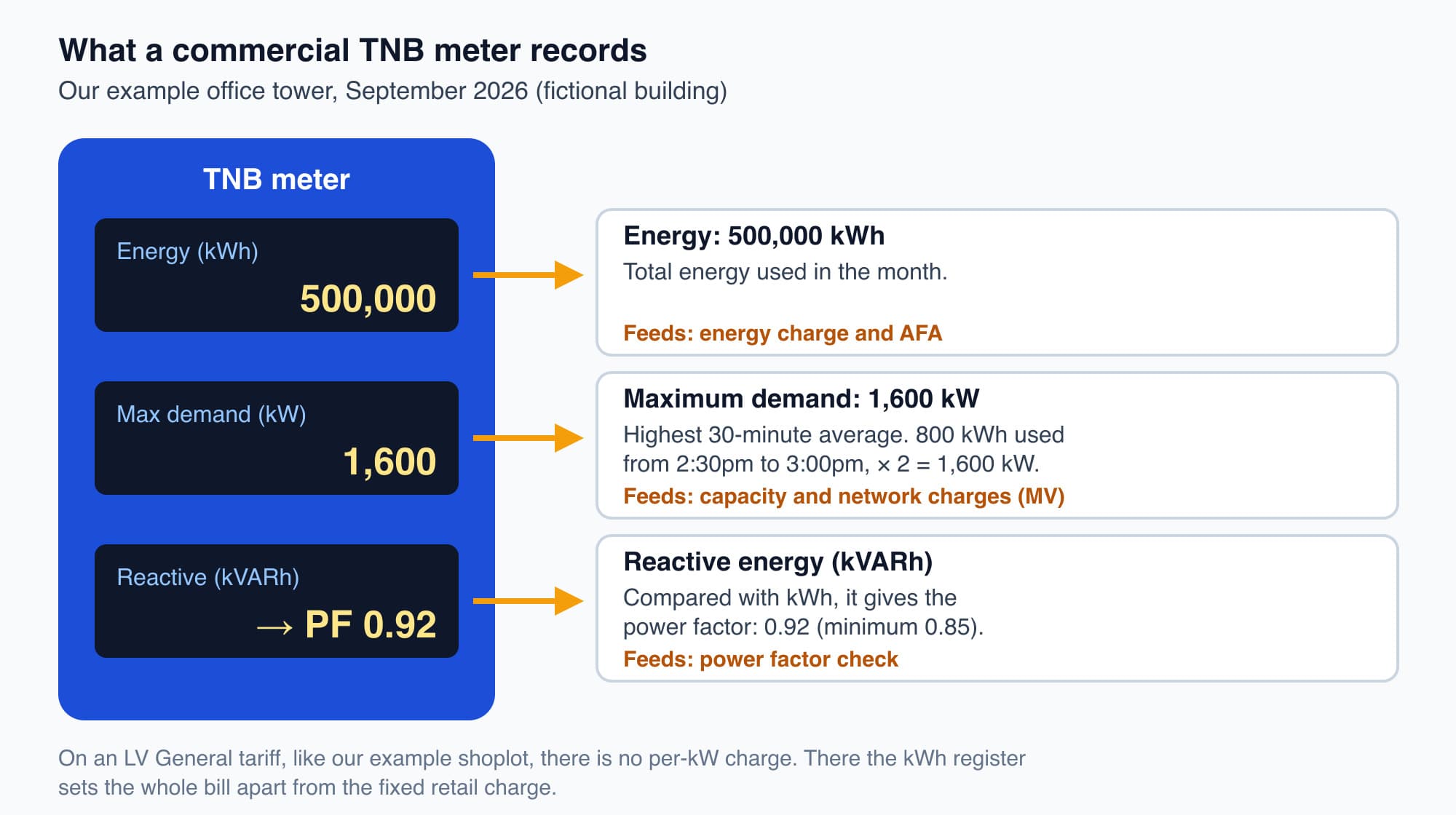
Our example office tower's meter in September 2026: one register for energy, one for maximum demand, and one for reactive energy, which gives the power factor.
1. Energy (kWh). This is the total energy used in the month. Aina's tower used 500,000 kWh in September 2026. On a Time-of-Use (ToU) tariff, the meter splits the total into peak and off-peak kWh, because each is priced differently. Part 3 gives the peak hours and the rates.
2. Maximum demand (kW). This is not total use. It is the single highest 30-minute average power in the billing month. To get a 30-minute average in kW, the meter takes the kWh used in that half hour and multiplies by 2. That converts half an hour's energy into a rate per hour, the same way 40 km covered in 30 minutes means 80 km/h. Aina's tower used 800 kWh between 2:30pm and 3:00pm on Thursday 17 September 2026, a hot weekday, so its maximum demand was 800 × 2 = 1,600 kW.
Which half hours count depends on the tariff:
- On a General tariff, such as the tower's MV non-domestic General, maximum demand counts at any hour of any day.
- On the medium voltage (MV) ToU tariff, only the half hours inside the weekday peak window count towards the demand you are charged for. A spike late at night or on a Sunday is not charged.
On an MV bill, this one register sets two whole lines, the capacity charge and the network charge. Part 3 shows what those lines cost, and Part 4 looks at how to lower the number itself. Low voltage (LV) customers, such as the shoplot, have no per-kW charge, so for billing their meter's kWh total is what matters.
Worth knowing: Maximum demand is not a separate kind of measurement. It is the energy used in one half hour, doubled. Any meter that logs kWh every half hour, including a building's own sub-meters, can show exactly which half hour set the month's maximum demand, and which parts of the building were drawing the most at that time.
3. Reactive energy (kVARh). Some equipment, mainly electric motors in pumps, fans and chillers, draws extra current that flows back and forth without doing useful work. The meter adds up this reactive energy separately. Comparing it with the kWh total gives the power factor: a number up to 1.0 that shows how much of the current is doing useful work. A lower power factor means more current in TNB's cables for the same useful energy. If it falls below TNB's minimum, a power factor surcharge is added to the bill, and Part 6 explains the rule and the fix. Aina's tower has capacitor banks and runs at about 0.92, so it pays no surcharge. (Our Electricity Fundamentals course explains power factor in full, in the lesson kW, kVA and kVAR.)
Once you know these three registers, you can match most of a commercial bill to what the meter measured.
Smart meters send readings automatically
A smart meter is an electronic meter with a communications link. It sends its readings in 30-minute intervals without anyone visiting the site. That makes remote reading and ToU billing practical for millions of customers, and it is why meter readers no longer need to visit every premises.
TNB is replacing older meters across Peninsular Malaysia under its Advanced Metering Infrastructure programme. As of 31 March 2025, TNB had installed about 4.57 million smart meters, towards a target of 9.1 million, with coverage expanding towards roughly 10.4 million premises by 2028 and beyond (TNB smart meters). These figures will have moved since then.
Why your own sub-meter never matches TNB's exactly
A sub-meter is a meter a building owner installs to measure part of the building. Aina's tower has sub-meters on its chiller plant, each riser, the car park and the tenant floors. Their total will not match TNB's meter exactly. The meters are different, their CTs have different accuracy classes, they take readings at slightly different moments, and some energy is lost in the cables between TNB's meter and the sub-meters. A gap of a percent or two is normal. We explain the reasons in why your sub-meter and TNB's never match.
The two kinds of meter answer different questions. TNB's meter tells you what you owe: one set of numbers for the whole site, once a month. Your sub-meters tell you why: which chiller, which floor or which half hour set the maximum demand.
Optional detail: The idea of a rotating magnetic field, which the disc relies on, came from Galileo Ferraris in 1885. Oliver Shallenberger, an engineer at Westinghouse, turned it into the first practical AC meter, an induction ampere-hour meter patented on 14 August 1888, whose disc speed followed the current. In 1894 he developed the watt-hour form described earlier in this part, whose disc speed follows real power (Wikipedia: Electricity meter). Around the same time, Elihu Thomson at General Electric built a recording wattmeter, and the Hungarian engineer Ottó Bláthy of the Ganz Works showed an AC kilowatt-hour meter at the Frankfurt Fair in autumn 1889. Disc meters of essentially the same design were still on walls into the 2000s. The war of the currents is the wider story of that era.
What comes next: the bill
Aina now knows what the meter records: the month's kWh, the maximum demand in kW, and the reactive energy that gives the power factor. She can see where 500,000 kWh and 1,600 kW came from. Her next question is how those two readings become RM310,532: which price is applied to which reading, and what are the other lines on the bill? The next part, Your TNB Bill, Line by Line, takes each line of the bill, shows which register it comes from, and works through the September 2026 bills of both example buildings.
Check your understanding
- Aina's tower used 800 kWh between 2:30pm and 3:00pm. What was its average demand in that half hour, and why? 1,600 kW. The half hour's energy (800 kWh) is multiplied by 2 to turn it into a rate per hour. If that is the highest half hour of the month, 1,600 kW is the month's maximum demand.
- Why does a large building's meter need current transformers? A large supply can carry hundreds or thousands of amps, far more than a compact meter can carry. A CT around the busbar gives a small current (typically 5 A or 1 A) in exact step with the large one, and the meter multiplies it back up by the CT ratio.
Recap: A disc meter turns power into disc speed and counts the turns as kWh. An electronic meter multiplies voltage and current thousands of times a second and adds up the results, so it can also report power factor and half-hourly use. Large supplies are measured through current transformers. A commercial TNB meter keeps registers for energy (kWh), maximum demand (the highest 30-minute average kW; at any hour on General tariffs, peak window only on MV ToU) and reactive energy (kVARh), which gives the power factor. Smart meters send 30-minute readings automatically. Sub-meters will not match TNB's meter exactly, but they show where the energy went.
This is Part 2 of 7 in Cobler's Understanding Your Electricity Bill course. Previous: Power vs Energy: What You Actually Pay For. Next: Your TNB Bill, Line by Line.
Cobler builds CobiNeural, a platform that shows a facility team its building's energy, water and indoor air data as live numbers across the whole site. To see how your building performs, talk to us.
FAQ
Frequently asked questions
Ask us about this topic
Something in this article you want to dig into — or a situation in your own building it doesn't quite cover? Send us your question. We don't run public comments; the team replies to you directly by email.