Blog
How the Malaysia Electricity Grid Reaches Your Plug
Follow one kWh across the Malaysia electricity grid, from a Perak dam through 500 kV lines and substations to the 230 V at your socket. Then see why the tariff charges for peak demand and power factor, not just energy.
 Tan Kok XinElectricity Fundamentals
Part 12 of 15 in Cobler's Electricity Fundamentals course. New here? Start with the course map.
The electricity boiling your kettle right now was made less than a second ago, in a power station that may be hundreds of kilometres away. Almost none of it was stored anywhere on the way. This lesson follows that journey across the Malaysia electricity grid and answers the question Part 11 ended on: how does all this electricity get from the power station to your building?
Why do the lines along the highway run at 275,000 volts?
In a power station, fuel is burned to raise steam or to drive a gas turbine, or falling water turns a turbine at a hydro dam. The turbine turns a generator, which produces three-phase AC at 50 Hz, as described in How Generators Make Electricity (Part 7) and Three-Phase Power (Part 9). Most of Malaysia's electricity comes from coal and gas, with hydro a large minority.
The first thing that happens after the generator is a step up. A transformer at the power station raises the voltage to 132 kV, 275 kV or 500 kV before the electricity enters the National Grid. The 500 kV lines are the highest level in Peninsular Malaysia (National Grid, Malaysia). These are the bare wires hung between the tall steel towers you see along the highways. The higher the voltage, the taller the tower and the wider the gap it keeps between the wires.
The reason is heat in the wires. Power equals voltage times current (Part 2), so at a higher voltage the same power needs less current. Less current means much less energy lost as heat in the cables, as AC vs DC (Part 6) explained: double the voltage and the loss falls to a quarter.
This only works because the grid runs on AC. A transformer changes AC voltage with no moving parts, as How Transformers Work (Part 8) showed.
Your electricity passes through four or five transformers before it reaches a socket
A 275 kV line cannot be plugged into a building, so a series of substations steps the voltage back down. Each substation has transformers that bring the voltage to the next level: from 500 kV or 275 kV to 132 kV, then to 33 kV, then to 11 kV, as the electricity moves from the national lines onto regional and local networks. A final distribution transformer, often in a kiosk near your building or on a pole, brings it down to 400/230 V.
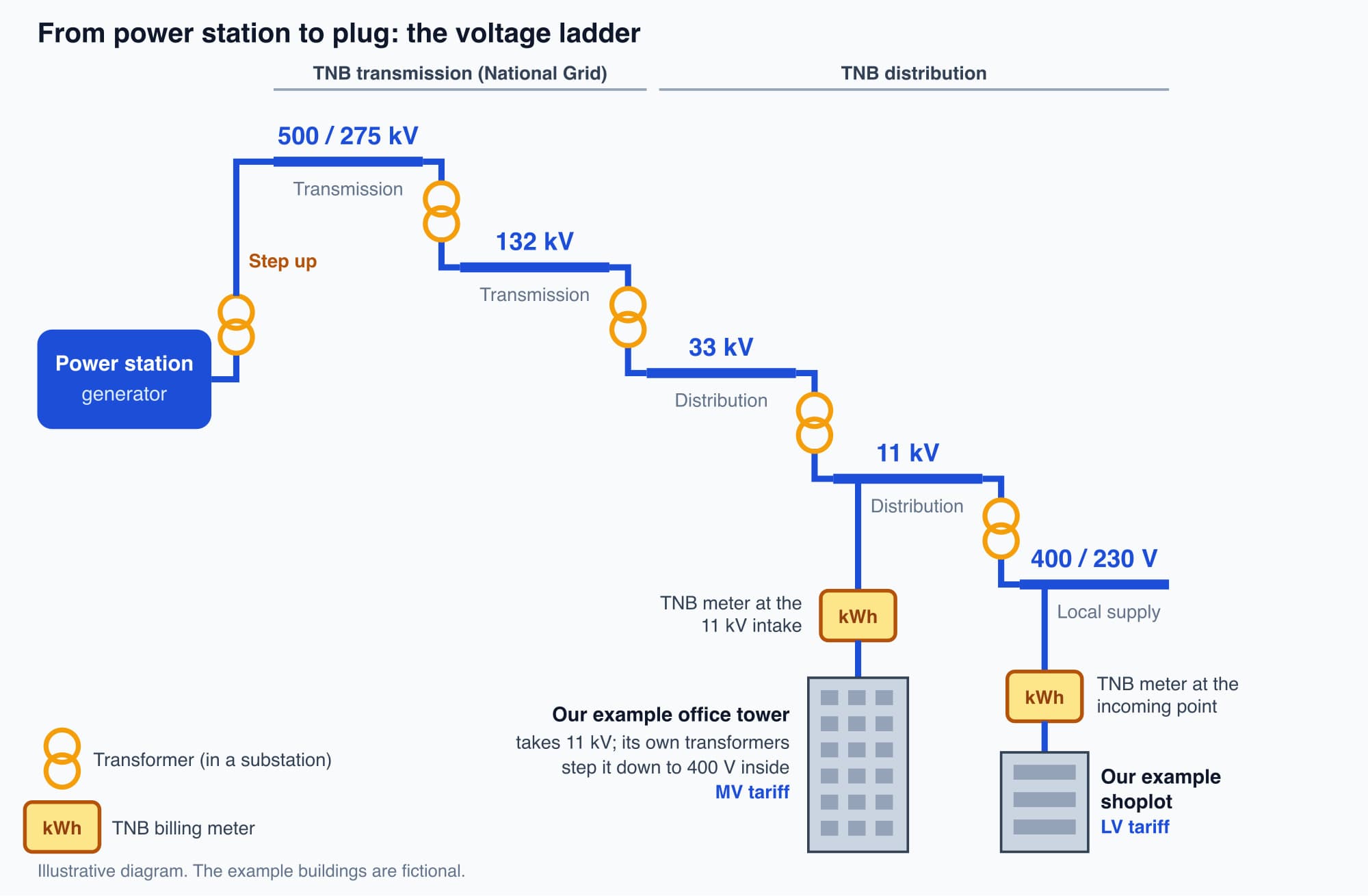
The voltage steps down at each substation, and each building connects at the level that suits its size.
Buildings join this ladder at different steps. The office tower takes its supply at 11 kV. It has its own substation, with two 1,500 kVA transformers that bring the voltage down to 400 V inside the building. The example shoplot from Part 9 takes a three-phase 400/230 V supply from a TNB substation down the street. A house usually takes one 230 V phase from the same kind of local transformer.
Counting the step-up at the power station, the electricity reaching a socket in the office tower has passed through four or five transformers. Where a building joins the ladder also decides where the TNB meter sits: at the 11 kV intake for the office tower, and at the incoming point for the shoplot. It decides which tariff the building is on, too; the money side is covered in the Understanding Your Electricity Bill course.
Nobody stores it, so who keeps the Malaysia electricity grid balanced?
In Peninsular Malaysia, Tenaga Nasional Berhad (TNB) owns almost all of the transmission and distribution network. The Single Buyer, a unit of TNB, buys the electricity from the power stations, both independent producers and TNB's own. The Grid System Operator, also part of TNB, runs the grid in real time: it decides, second by second, which power stations raise or lower their output (Single Buyer reform). Sabah and Sarawak run separate grids.
The operator has to keep generation matched to demand at every moment, because very little electricity is stored along the way. When thousands of buildings switch on their air conditioning on a hot afternoon, power stations must raise their output within seconds. The signal the operator watches is the grid frequency, which dips just below 50 Hz when demand runs ahead of generation, as Part 7 explained.
Want the full story? The side reading Why 50 Hz? explains the frequency, and why blackouts happen covers what happens when the balance is lost.
Less is lost on the wires than at the power station
The long journey loses less energy than most people expect. Raising the voltage keeps the loss in the grid's lines and transformers to a small share, even over hundreds of kilometres. The larger loss happens before the electricity leaves the power station: a coal plant turns well over half of the fuel's energy into waste heat.
Rooftop solar panels skip most of the journey. They generate electricity at the building where it is used, so it does not go through the step-up, the long-distance lines or the chain of substations. The panels produce direct current (DC), and a device called an inverter turns it into AC at 230 V or 400 V. The next part explains how that conversion works. (Optional side reading: how solar panels make electricity.)
Optional detail: In 2023 Malaysia generated more than 43% of its electricity from coal and around 37% from natural gas; hydro supplied roughly 17% and solar under 2% (EIA country analysis). These shares change every year. TNB's transmission losses were about 1.47% in 2020 and 1.6% in 2021 (Southeast Asia Infrastructure). The grid's operation follows the Malaysian Grid Code.
What you now understand
- Electricity is made at the moment it is used, so the grid operator must match generation to demand every second, using the 50 Hz frequency as its signal.
- The voltage is raised to 132, 275 or 500 kV for long distances because less current means much less heat lost in the wires, and transformers make that easy with AC.
- Substations step the voltage down through 132, 33 and 11 kV to 400/230 V, and each building joins this ladder at the level that suits its size.
- More energy is lost turning fuel into electricity at the power station than in carrying it across the grid.
Check your understanding
- Why does the grid raise the voltage to 275 kV or 500 kV for long distances? At a higher voltage, the same power needs less current, so much less energy is lost as heat in the cables: double the voltage and the loss drops to a quarter. Transformers can only do this easily with AC, which is one reason the grid uses AC.
- The office tower takes its supply at 11 kV and the shoplot at 400/230 V. Name two things that this difference changes. It changes where the TNB meter sits (at the 11 kV intake for the tower, at the incoming point for the shoplot). It also means the tower needs its own transformers to bring 11 kV down to 400 V, and it puts the two buildings on different tariffs.
What comes next
The grid delivers AC to every socket, yet your phone has never run on AC, and neither have the LED lights or the computers in the office tower. Phones, LEDs and computers run on DC. How is the AC from the grid turned into DC? The next part, Rectifiers and Inverters, answers that.
Go deeper on video (optional)
This video walks through the same chain, from power station to transmission lines to local substations. Some of the voltages it mentions may differ from Malaysia's, but the steps are the same. It is optional: you do not need it for the next part.
"How Does the Power Grid Work?" by Practical Engineering
This is Part 12 of 15 in Cobler's Electricity Fundamentals course. Previous: kW, kVA and kVAR: The Power Triangle, Explained. Next: Rectifiers and Inverters: Electricity's Translators.
Cobler builds CobiNeural, a platform that shows a facility team its building's energy, water and indoor air data as live numbers across the whole site. To see how your building performs, talk to us.
FAQ
Frequently asked questions
Ask us about this topic
Something in this article you want to dig into — or a situation in your own building it doesn't quite cover? Send us your question. We don't run public comments; the team replies to you directly by email.