
Blog
Power Factor Surcharge: Why TNB Penalises Low PF
A power factor surcharge is a penalty for how you draw power, not how much you use - and it's almost always avoidable. Here's what triggers it and how to stop paying.
 Tan Kok XinTNB Bills & Tariffs
What is the power factor surcharge?
A power factor surcharge is a penalty TNB adds to a commercial or industrial bill when the site's power factor falls below the required threshold: 0.85 for supply at 33kV and below, and 0.90 at 132kV and above. It is one of the few charges on your bill that exists purely because of how your site draws power, not how much energy it uses, and it is almost always avoidable. Many Malaysian factories pay it month after month without realising it's there or knowing what's causing it.
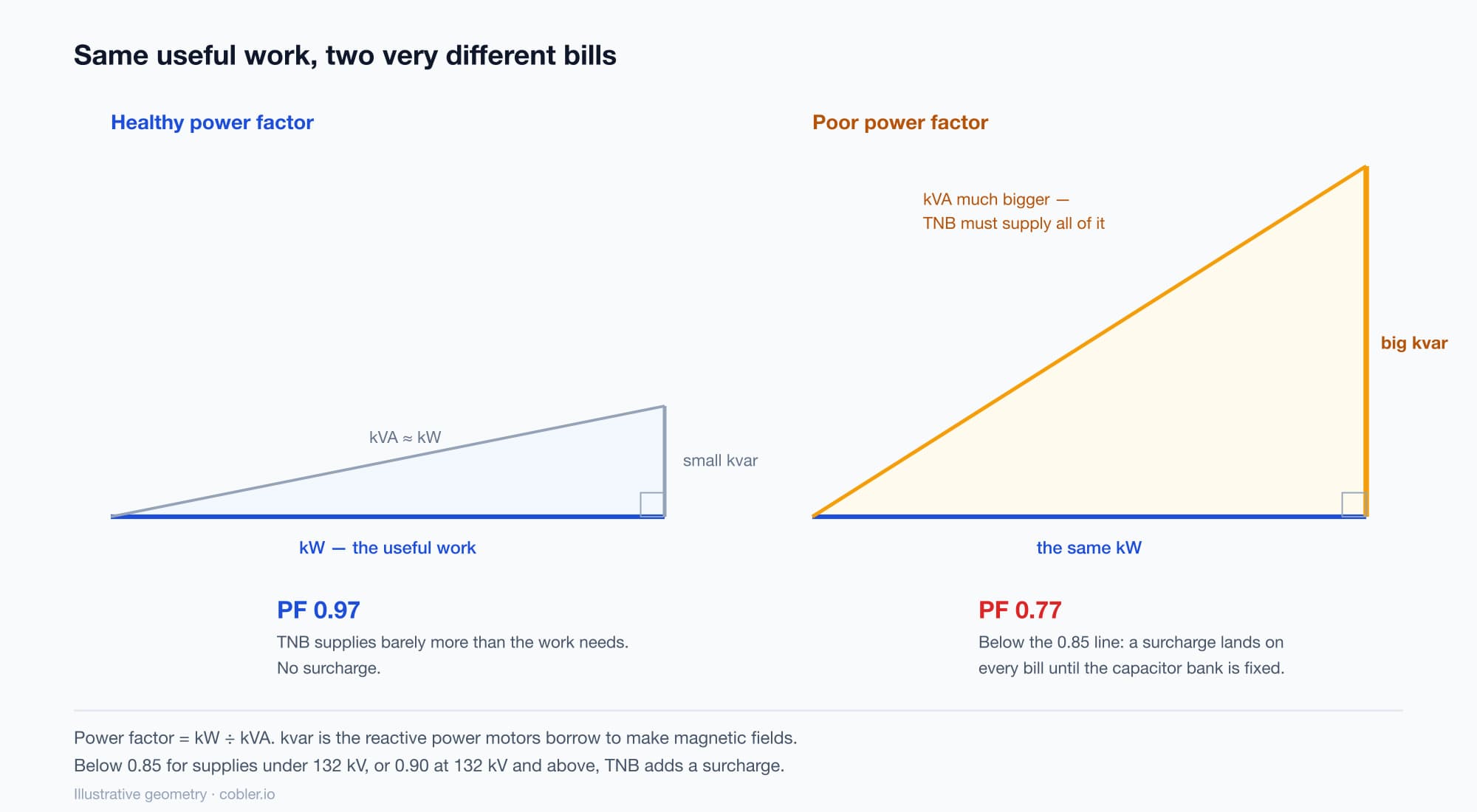
The geometry of the surcharge: the fatter the kvar side, the more kVA TNB must supply for the same useful kW.
This is what power factor is, why TNB penalises a low one, what drags it down, and how to stop paying the surcharge.
In short
- TNB adds a power factor surcharge once your site's power factor falls below 0.85 (below 33kV) or 0.90 (at or above 132kV).
- A low power factor costs you twice: the surcharge itself, plus the extra current your equipment draws to do the same work.
- Motors, especially lightly loaded ones, are the usual cause of a dragging power factor.
- Correcting power factor typically pays back through the avoided surcharge, but the payback period depends on how far below the threshold you currently sit.
What power factor actually measures
Power factor is the ratio of real power (kW), the power that does useful work, to apparent power (kVA), the total power the grid has to supply. A power factor of 1.0 means every amp delivered is doing work. A power factor of 0.7 means a large share of the current is sloshing back and forth doing nothing useful, while the grid still has to carry it.
The culprit is reactive power, drawn by inductive loads: motors, transformers, fluorescent ballasts, welding sets. These are everywhere in a factory, and each one pulls the power factor down. The energy meter doesn't bill you for reactive power directly, but the network still has to be sized to carry it, which is why TNB prices a poor power factor separately.
A useful picture: think of a glass of beer. The liquid is real power (what you wanted), the foam is reactive power (what you're also carrying), and the full glass is apparent power. A low power factor is a glass that's mostly foam — you're hauling a big glass to get a small drink.
How the TNB power factor surcharge works
TNB requires commercial and industrial customers to maintain a minimum power factor. Per TNB's power factor rules, the thresholds are:
- 0.85 for customers supplied at 33kV and below (most medium-voltage commercial and industrial sites).
- 0.90 for customers supplied at 132kV and above.
Fall below the threshold and a power factor surcharge is applied to your bill, and it grows the further your power factor drops. The penalty is structured so that a worse power factor costs proportionally more: a gentle dip below 0.85 is a modest surcharge, while a badly lagging plant at 0.7 pays a serious one every month. Confirm the exact current surcharge formula for your tariff against TNB's charges and penalties schedule, as the rates sit alongside the broader RP4 tariff structure.
Why a low power factor costs you twice
The surcharge is only the visible cost. A poor power factor quietly penalises you a second way: because more of your current is reactive, your site draws more total current (kVA) to do the same work. That means higher losses in your own cables and transformers, and it inflates the apparent demand your infrastructure has to carry. Correcting power factor often frees up capacity in an existing supply that looked maxed out, sometimes deferring an expensive upgrade.
So the case for fixing it is rarely just "avoid the penalty." It's avoid the penalty, cut internal losses, and recover capacity, all from the same correction.
What drags power factor down
The usual suspects in a Malaysian plant or building:
- Lightly loaded or oversized motors. A big motor running well below its rated load has a poor power factor, common where equipment was specified with generous margin.
- Idle or lightly loaded transformers, which draw magnetising current regardless of load.
- Older lighting with magnetic ballasts.
- Welding equipment and induction heating, which are heavily inductive.
- Variable speed drives and other electronics, which can introduce harmonics that complicate the picture (and sometimes need a different fix than simple capacitors).
Because these vary through the day and with production, power factor isn't a fixed number; it moves with what's running. That's exactly why it's hard to manage blind.
How to stop paying the surcharge
Correcting power factor is well-established engineering:
- Measure it first, continuously. You can't size a fix or prove it worked without seeing power factor as it actually moves across the day and across your loads.
- Install power factor correction, usually capacitor banks that supply reactive power locally so the grid doesn't have to. Automatic capacitor banks switch steps in and out to track the load.
- Mind harmonics. Where drives and electronics are significant, plain capacitors can resonate; a detuned or active solution may be needed. Get this assessed rather than assumed.
- Right-size equipment over time so motors and transformers aren't running lightly loaded.
- Verify and hold the gain. After correction, keep monitoring so a failed capacitor step or a load change doesn't quietly drop you back below the threshold, a common way the surcharge creeps back.
That last point matters. Capacitor banks fail silently. A site that corrected its power factor years ago can drift back into surcharge territory without anyone noticing until the bill is examined.
Where monitoring closes the gap
Power factor is a textbook case for the power-factor KPI under CobiNeural's Energy Insights: it's billed, it's invisible on a monthly statement, and it drifts. The platform tracks power factor live (site-wide and down to equipment) so you can see which loads are dragging it down, confirm a correction is working, and get alerted if a capacitor step fails and your power factor starts slipping back toward the surcharge threshold.
It also sits alongside the other controllable lines on your bill. We cover the largest in the maximum demand charge under RP4 and the volatile one in the Automatic Fuel Adjustment. Power factor is the one most operators overlook, and often the cheapest to fix. The same monitoring that surfaces it supports your EECA energy management obligations too.
If you're not certain what your power factor is doing right now, or whether you're quietly paying a surcharge, book a CobiNeural walkthrough and we'll show you where it sits and what it's costing.
Sources
If you want to see this on your own bill, our free maximum demand calculator estimates the charge from your kW and tariff. For the full mechanics of a TNB bill, see our free course Understanding Your Electricity Bill.
FAQ
Frequently asked questions
Ask us about this topic
Something in this article you want to dig into — or a situation in your own building it doesn't quite cover? Send us your question. We don't run public comments; the team replies to you directly by email.