Blog
Earthing and RCDs: Why Birds Don't Get Shocked
A bird sits on a live line unharmed because there is almost no voltage difference across its body. That idea explains earthing, TT and TN-S, RCDs, and how to act near a fallen line.
 Tan Kok XinElectricity Fundamentals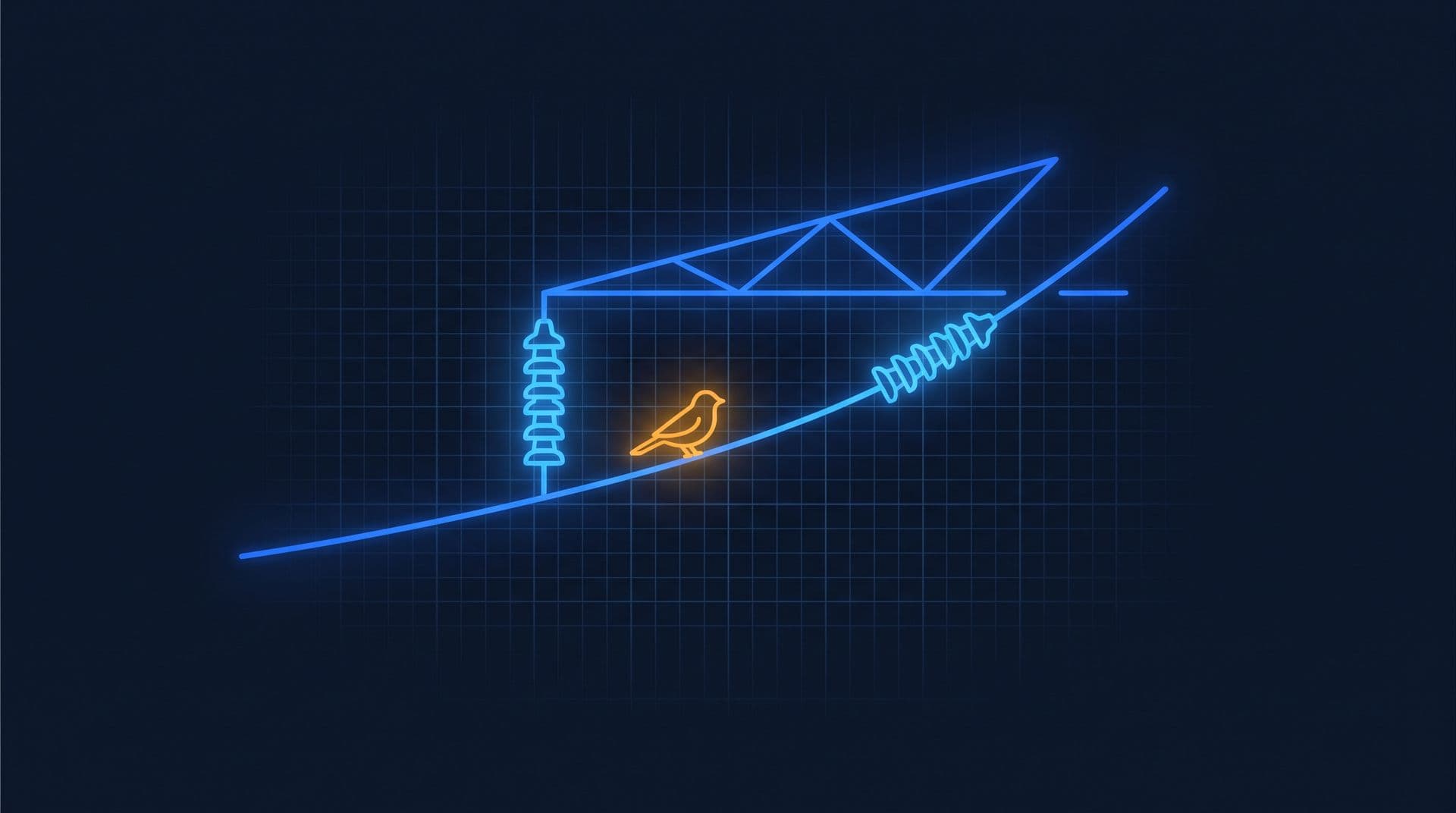
Part 4 of 15 in Cobler's Electricity Fundamentals course. New here? Start with the course map.
A bird can land on an 11,000 V overhead line, sit there, and fly off unharmed, while a person who touches the same line can be killed. Part 3 ended with a danger: a current through a person can be too small to trip an ordinary circuit breaker. Earthing and a residual current device (RCD) help reduce the risk, but they cannot prevent every shock. The bird is the best place to start.
This lesson describes practice in Peninsular Malaysia, where the rules are set by Suruhanjaya Tenaga (ST), the Energy Commission. Sabah and Sarawak have separate regulatory requirements.
A bird can sit on an 11,000 V line. Why doesn't it get a shock?
Current flows through something when there is a voltage difference across it (the push from Volts and Amps) and a path for the current to flow.
The bird's body connects two nearby points on the same wire. There is very little voltage difference between those points, so very little current flows through its body. If the bird touched another wire or an earthed support at the same time, it could receive a dangerous shock.
A person is often in a different position. They usually stand on the ground or touch something connected to it, such as a metal frame, a pipe or a wet floor. If they touch a live conductor, there can be a large voltage difference across their body, and current can flow through them to earth. A person can also receive a shock between live and neutral, or between two phases, without touching the ground at all.
So the basic rule is: a shock happens when current passes through the body between two points at different voltages.
Several layers of protection work against this. Insulation and covers keep people away from live parts. Earthing provides a path for fault current, and a protective device disconnects the affected circuit. These measures reduce risk, but they do not make live equipment safe to touch.
What does the earth wire do?
Many appliances and machines have metal casings: a washing machine, a motor frame, a distribution board enclosure. Normally those casings are not live.
Now imagine a fault inside an appliance: a damaged live wire touches the metal casing. On a 230 V supply, that fault can bring an unearthed casing close to 230 V relative to earth. If there is no effective return path, too little current may flow to operate the protection. The casing is already dangerous: touching it and an earthed surface at the same time can complete a path through a person.
Equipment designed to use protective earthing has its exposed metal casing connected to a protective conductor (the green-and-yellow wire). For a plug-connected earthed appliance, this connection runs through the plug's earth contact. Class II equipment ("double insulated") uses double or reinforced insulation instead and does not need an earth connection. The earth wire is not intended to carry the ordinary load return current, although small leakage currents can flow through it during normal operation.
If a live wire touches an earthed casing, the protective conductor provides a path for fault current. With an effective earth path and correctly selected protection, the protective device disconnects the affected circuit within the required time. A person touching the casing can still receive a shock before the circuit is disconnected.
How the fault is cleared depends on the building's earthing arrangement. The ST safety code describes one arrangement, called TT, as generally used. In TT, the protective conductors connect to the building's own earth electrode system, such as rods or a buried earth grid. An earth fault then returns to the source through the protective conductor, the installation's electrode system, the ground and the source's earthing system. The resistance of this loop can make the current too low for a fuse or circuit breaker to disconnect quickly, so an RCD normally provides fault disconnection. The earth path and the RCD must both be checked. For a consumer-owned transformer substation, the code recommends a different arrangement, TN-S, subject to its conditions.
For building professionals: the TT and TN-S arrangements, the ST code sections and the Malaysian RCD rules are set out in Neutral and Earth: Why They Stay Separate (TT and TN-S), part of our Building Electrical Fundamentals course.
A damaged earth connection may have no visible warning. Inspection and electrical tests can reveal defects before a fault occurs, so earthing and protective-device tests belong in the building's maintenance schedule. Electrical monitoring does not replace these tests. Ask the electrical competent person responsible for the installation to confirm its earthing arrangement against the drawings and test records. In Peninsular Malaysia, that is a person registered with ST, such as a registered electrical engineer, chargeman or wireman, whose registration and certificate must cover the work concerned.
An RCD can detect leakage too small to trip an ordinary breaker
A residual current device (RCD) detects an imbalance in circuit current. On a single-phase circuit, it compares the current in live and neutral. On a three-phase circuit (see Three-Phase Power Explained, Part 9), it monitors all the phase conductors and the neutral, if present, together. Current returning outside those monitored conductors, for example through a faulty casing to earth, or through a person to earth, creates an imbalance.
Small leakage currents can occur during normal operation. A correctly selected and working RCD trips when the imbalance meets its operating conditions. How quickly it trips depends on the device and the residual current.
This is why an RCD adds protection that an ordinary circuit breaker cannot provide. A breaker's overcurrent function reacts to the total current being too high. The residual current function responds to an imbalance, even when the current is too small to operate ordinary overcurrent protection.
An RCD protects the circuit connected through it. It may not trip if a person touches live and neutral and the current returns entirely through the monitored conductors.
On a distribution board you may see two kinds. A residual current circuit breaker (RCCB) is one type of RCD and needs separate protection against overloads and short circuits. A residual current circuit breaker with overcurrent protection (RCBO) combines both functions in one device.
A fast-acting RCD rated at 30 milliamperes (mA) or less provides additional protection against electric shock. Its rating does not limit the current through a person to 30 mA or guarantee survival. Insulation, earthing and safe isolation are still needed. Malaysian law (Electricity Regulations 1994, Regulation 36) sets the maximum rating allowed for each kind of final circuit, for example 30 mA where hand-held equipment is used or likely to be used. These are maximum ratings, not targets, and the competent designer applies them. They are not permission for an occupant to bypass an RCD.
The test button. Use the RCD's test button at the interval stated by its manufacturer and the site's maintenance procedure, after arranging for the power interruption. Operate only a safely accessible button; do not remove a board cover. A successful trip checks the built-in test function, but it does not prove the earthing is sound or replace measured RCD testing. If it does not trip, report it immediately and have the affected circuit made safe and checked.
You can get a shock near a fallen line without touching it
A live fallen cable can send current into the ground. Ground voltage generally falls with distance from a contact point, but the pattern can be uneven. Two nearby places can still be at different voltages.
If you take a normal stride near a fallen cable, your two feet can land at points with different voltages. Current can then flow up one leg and down the other, even though you never touched the cable. This is called step voltage (or step potential). It is the bird's rule from earlier working against you: two points at different voltages, with your body between them.
Treat every fallen line as live and stay well away, including from fences, vehicles or other objects it touches. Keep others back and call the utility or emergency services from a safe place. If you are already close, move away with short shuffling steps, keeping your feet together and on the ground. This reduces step voltage; it does not make the area safe. Do not approach or touch the line or attempt a rescue in the affected area.
What you now understand
- A shock happens when current passes through the body between two points at different voltages. The bird is safe because both its feet are on the same wire.
- The earth wire provides a path for fault current so that the protection can disconnect the circuit. It does not make a faulty casing safe to touch. A damaged earth connection may give no warning, so it has to be tested.
- An RCD notices current that leaks out of the circuit, even a current far too small to trip a breaker. It adds protection but cannot prevent every shock.
- Near a fallen line, the ground itself can put a voltage across your legs, so stay well away and shuffle away only if you are already close.
Check your understanding
- Why can a bird sit on a live wire safely, while a person touching it from the ground cannot? The bird's feet touch nearby points on one wire, so the voltage difference across its body is very small. A person touching a live wire and earth can have a large voltage difference across their body. Touching two conductors at different voltages can also cause a shock without ground contact.
- Why can an RCD catch a leak through a person that an ordinary circuit breaker misses? A breaker's overcurrent function reacts only when the total current is too high, and a leak through a person can be far too small for that. An RCD compares the current going out with the current coming back, so it responds to the imbalance, provided it meets the RCD's operating conditions.
What comes next: measuring how much electricity is used
Now that we can use electricity safely, how do we measure how much of it something uses? Power vs Energy answers that, starting with a small standby light that uses more energy than a kettle.
Go deeper on video (optional)
This video shows what happens to current that flows into the ground:
"Where Does Grounded Electricity Actually Go?" by Practical Engineering
This is Part 4 of 15 in Cobler's Electricity Fundamentals course. Previous: What Is an Electric Circuit? Series vs Parallel. Next: Power vs Energy: The Difference Between kW and kWh.
Cobler builds CobiNeural, a platform that shows a facility team its building's energy, water and indoor air data as live numbers across the whole site. To see how your building performs, talk to us.
FAQ
Frequently asked questions
Ask us about this topic
Something in this article you want to dig into — or a situation in your own building it doesn't quite cover? Send us your question. We don't run public comments; the team replies to you directly by email.