Blog
How Transformers Work: The Grid's Quiet Machine
The machine that made the national grid possible has no moving parts. How transformers work: two coils, one iron core, a changing field, and why it only runs on AC.
 Tan Kok XinElectricity Fundamentals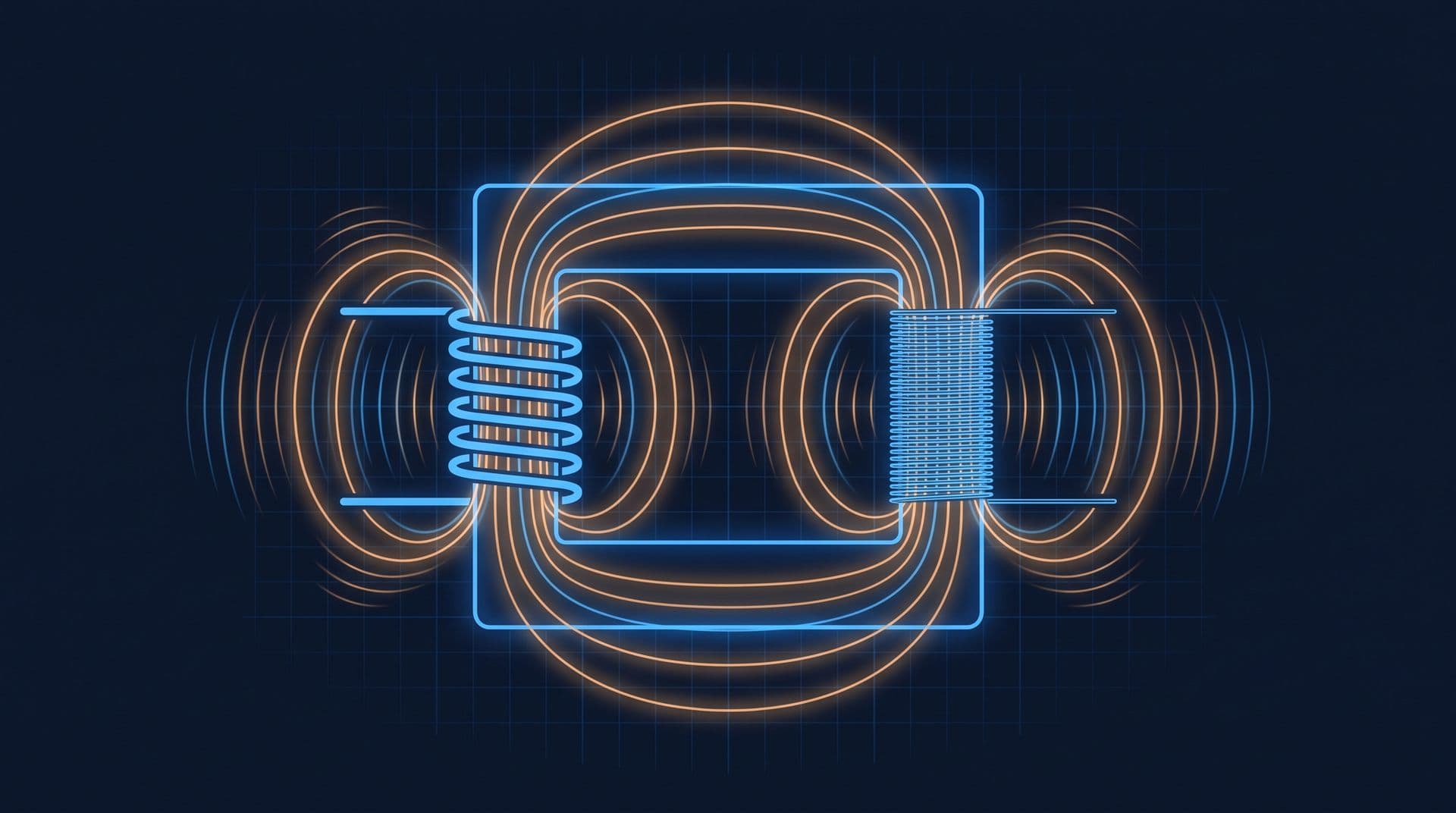
Part 8 of 15 in Cobler's Electricity Fundamentals course. New here? Start with the course map.
The office tower gets its electricity through two machines that have no moving parts and no wire joining their input to their output. Each one takes in 11,000 volts (11 kV) from TNB and hands the building 400 V. Part 7 ended with the question "A power station makes electricity at thousands of volts. How does it become 230 V?", and these machines, transformers, are the answer.
How transformers work: power crosses a gap with no wire
A transformer has three main parts:
- The primary coil, which is connected to the supply.
- The secondary coil, which is connected to the load.
- An iron core that both coils are wound around.
In How Generators Make Electricity (Part 7), we saw that changing magnetism passing through a coil produces a voltage in it. A generator makes the magnetism change by spinning a magnet. A transformer does it with no moving parts, because the AC current in the primary already changes all the time: on our 50 Hz grid it reverses direction 100 times a second.
Here is the sequence. The AC current in the primary magnetises the iron core. As the current rises, falls and reverses, the magnetism in the core grows, shrinks and reverses in step with it. The core guides that changing magnetism through the secondary coil, and it produces a voltage there. The two coils never touch. The changing magnetism in the core, not a wire, carries the energy across.
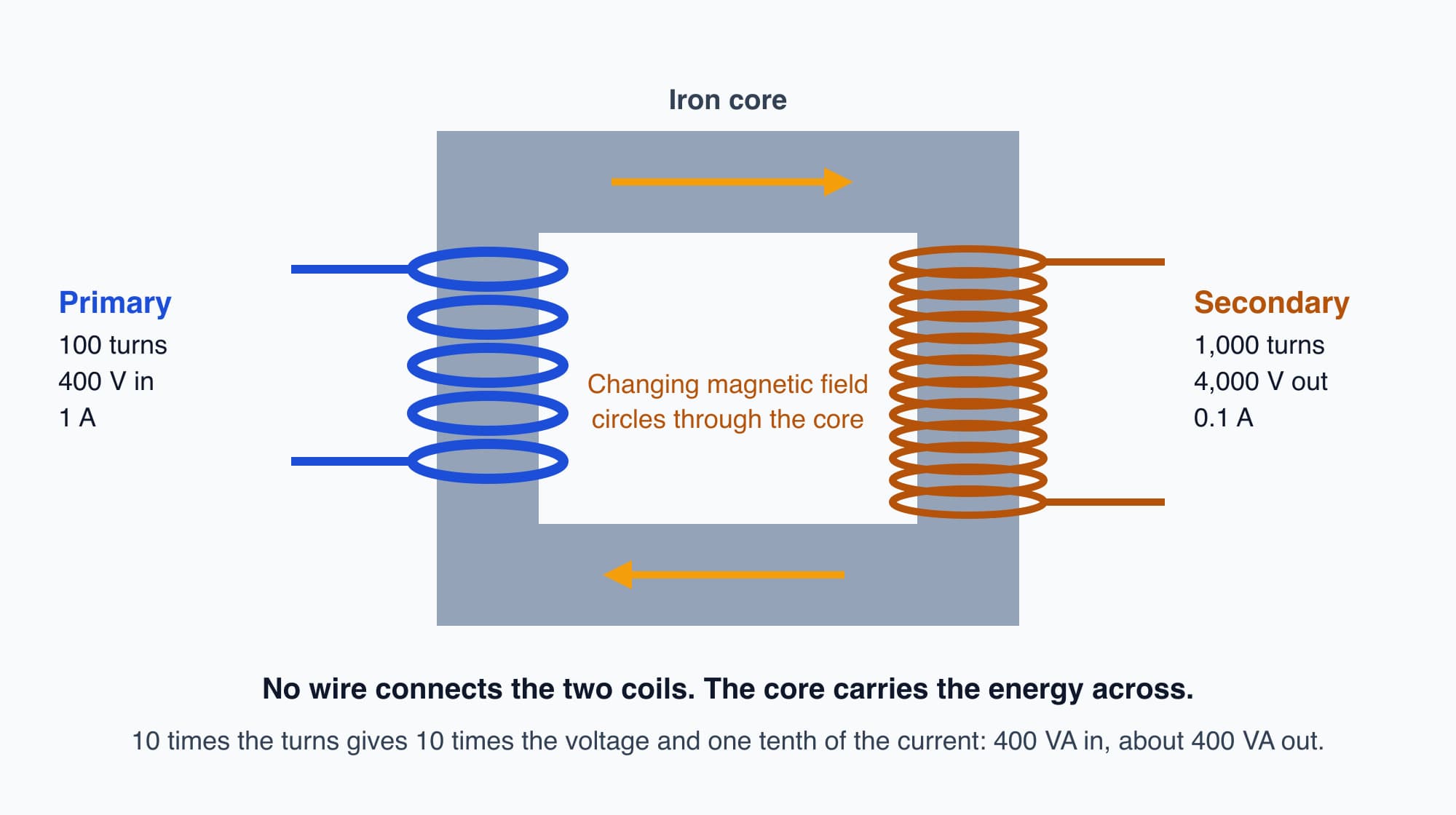
The primary and secondary share an iron core but are not connected by any wire; the changing magnetic field in the core links them.
This also explains why a transformer only works on AC. Feed a steady DC voltage into the primary and the core is magnetised once, to a fixed level, and stays there. Magnetism that does not change produces no voltage, so you would read zero volts at the output, except for a brief flick at the instant the DC is switched on or off. AC keeps reversing, so it keeps the magnetism changing, and the secondary gets a steady supply. That is why, in the 1880s, only AC could be cheaply changed in voltage and sent far, as AC vs DC (Part 6) described.
Ten times the voltage means a tenth of the current
The voltage out of a transformer depends on how many times each coil is wound around the core. Each loop of wire is called a turn. If the secondary has ten times as many turns as the primary, it produces ten times the voltage. If it has a tenth as many turns, it produces a tenth of the voltage. The comparison between the two numbers of turns is called the turns ratio.
A transformer cannot create energy, so the power going out is almost the same as the power going in. If the voltage goes up, the current available must go down by the same factor. Here is a worked example:
- The primary has 100 turns. It is fed with 400 volts and draws 1 amp: 400 × 1 = 400 volt-amperes (VA) going in.
- The secondary has 1,000 turns, ten times as many. It produces 4,000 volts.
- It can supply only a tenth of an amp, because 4,000 × 0.1 = 400 VA, the same as went in (minus a small loss).
So a transformer trades voltage for current, and the power stays almost the same. That trade is exactly what the grid needs. Part 6 showed that the heat lost in a long line depends on the current multiplied by itself, so power stations use transformers to raise the voltage for the journey and cut the current. Transformers nearer to you then bring the voltage back down in steps: the office tower's pair take 11 kV and give 400 V, with high voltage and low current going in, and low voltage and higher current coming out. How the Malaysia Electricity Grid Reaches Your Plug (Part 12) follows that journey step by step.
The hum from a transformer is not at 50 Hz
You have probably heard the steady hum from a substation or a green kiosk by the road. You might expect it to be at 50 Hz, the grid's frequency. It is at 100 Hz.
The hum comes from the iron core. When iron is magnetised, it changes shape by a very small amount, an effect called magnetostriction. The core is made of thin iron sheets called laminations, and as the magnetism builds and collapses, those sheets stretch and relax slightly. That movement makes the sound.
The iron stretches in the same way whichever direction the magnetism points, so it stretches twice in every electrical cycle. On our 50 Hz grid, that gives a 100 Hz hum, a little more than an octave below middle C (Wikipedia, mains hum). A transformer on a 60 Hz grid hums at 120 Hz. A steady hum is normal operation, not a fault.
The green box outside a condominium is rated in kVA, not kW
Each transformer you can see from the road is one step on the way from the power station to the socket:
- In rural areas, a pole-mounted transformer, a drum fixed near the top of a concrete pole, steps an 11 kV line down to 400 V for a street or a few houses.
- Outside condominiums, shoplots and shopping blocks, a kiosk substation, a locked green or grey cabinet, does the same job for a bigger load. Its nameplate gives a rating such as 500 kVA, not 500 kW.
- In a large building like the office tower, larger units of 1,000 kVA or more feed the main switchboard.
kVA means kilovolt-amperes: the volts multiplied by the amps, divided by 1,000. A transformer is rated this way because what limits it is heat and insulation. The current in the windings heats them, whatever that current is doing, and the voltage across the insulation stresses it. For a kettle, volts times amps gives the same number as the useful power in kW. For motors and some other equipment, part of the current does no useful work but still heats the transformer, so the kVA is larger than the kW. kW, kVA and kVAR (Part 11) explains why. The manufacturer cannot know what each customer will connect, so the rating is given in kVA.
The office tower's two transformers are rated 1,500 kVA each, 3,000 kVA in total. The building's highest demand in a typical month is 1,600 kW, which needs a little more than 1,600 kVA, for the reason Part 11 explains. That is a little over half of the combined rating.
Optional detail: The turns ratio and the power balance can be written as two short formulas: V_out ÷ V_in = N_out ÷ N_in, and V_in × I_in ≈ V_out × I_out. Here V is voltage, I is current and N is the number of turns; "in" is the primary and "out" is the secondary. The first says the voltage changes by the same ratio as the turns; the second says voltage times current is about the same on both sides, less the losses. Those losses are small: large transformers typically pass on more than 99% of the power that enters them, and a US government design study of a large power transformer reports 99.5% (OSTI).
What you now understand
- A transformer moves energy between two coils that never touch, using changing magnetism in a shared iron core.
- Because it needs changing magnetism, a transformer only works on AC.
- The turns ratio sets the voltage, and the current changes the opposite way, which is how the grid sends power at high voltage and delivers it at 400/230 V.
- A transformer's size is given in kVA because its windings heat with all the current they carry.
Check your understanding
- A transformer's primary has 100 turns and its secondary has 1,000 turns. If 400 V goes in, what comes out, and what happens to the current? About 4,000 V comes out, ten times the input, because the secondary has ten times the turns. The current available is about a tenth of the input current, because the power in and the power out are nearly the same.
- Why does a transformer hum at 100 Hz on a 50 Hz supply? The iron core changes shape slightly each time it is magnetised (magnetostriction). It stretches the same way whichever direction the magnetism points, so it stretches twice per cycle: 2 × 50 = 100 times a second.
What comes next
The 400 V from a building transformer does not arrive on one live wire. It arrives on three, each carrying its own AC wave. Each live wire is 230 V from neutral, yet between two of them you measure 400 V, not 460 V. Why do buildings get three live wires instead of one? The next part, Three-Phase Power Explained, answers that.
Go deeper on video (optional)
This animated video shows the coils, core and magnetic field of a transformer, which may help after the first section. It is optional: you do not need it for the next part.
"How does a Transformer work" by The Engineering Mindset
This is Part 8 of 15 in Cobler's Electricity Fundamentals course. Previous: How Generators Make Electricity: Spin Meets Wire. Next: Three-Phase Power Explained: Why Factories Get 400 V.
Cobler builds CobiNeural, a platform that shows a facility team its building's energy, water and indoor air data as live numbers across the whole site. To see how your building performs, talk to us.
FAQ
Frequently asked questions
Ask us about this topic
Something in this article you want to dig into — or a situation in your own building it doesn't quite cover? Send us your question. We don't run public comments; the team replies to you directly by email.