
Blog
kW, kVA and kVAR: The Power Triangle, Explained
AC power comes in three flavours: real kW does the work, reactive kVAR builds magnetic fields, and apparent kVA is what the wires carry. Here is the power triangle, power factor, and why transformers are rated in kVA.
 Tan Kok XinElectricity Fundamentals
Part 11 of 15 in Cobler's Electricity Fundamentals course. New here? Start with the course map.
The office tower's standby generator is rated 1,000 kVA, not 1,000 kW, and it is expected to deliver only about 800 kW of useful power. That rating assumes part of the current in its windings will carry energy into the magnetic fields of motors and straight back again, without using it up. That back-and-forth flow is also the answer to the question Part 10 ended on: why do motors draw more current than their kW suggests?
A kettle uses every amp it draws. A ceiling fan does not.
For a kettle, the rule from Volts and Amps (Part 2) works as it stands: watts equal volts times amps. A 3 kW kettle on 230 V draws about 13 A, and all of that current heats the element. On AC you use the effective values from AC vs DC (Part 6), and the current rises and falls exactly in step with the voltage.
A motor is different. As Part 10 showed, a motor turns because of a magnetic field. On AC that field has to be built up, taken down and built again in the opposite direction, 50 times a second. The ceiling fan, the fridge compressor and the chillers in the office tower all do this. So do transformers and the older magnetic ballasts in fluorescent light fittings. Equipment that works through a magnetic field like this is called an inductive load.
Building a magnetic field takes energy, and when the field collapses a moment later, that energy flows back to the supply. So part of the motor's current flows in to build the field and then flows back out again. This part is called the magnetising current. It does no useful work overall, but it still flows through the cables, the switchboard and the transformer.
Because of this back-and-forth flow, the current wave peaks a little after the voltage wave. Engineers say the current lags the voltage.
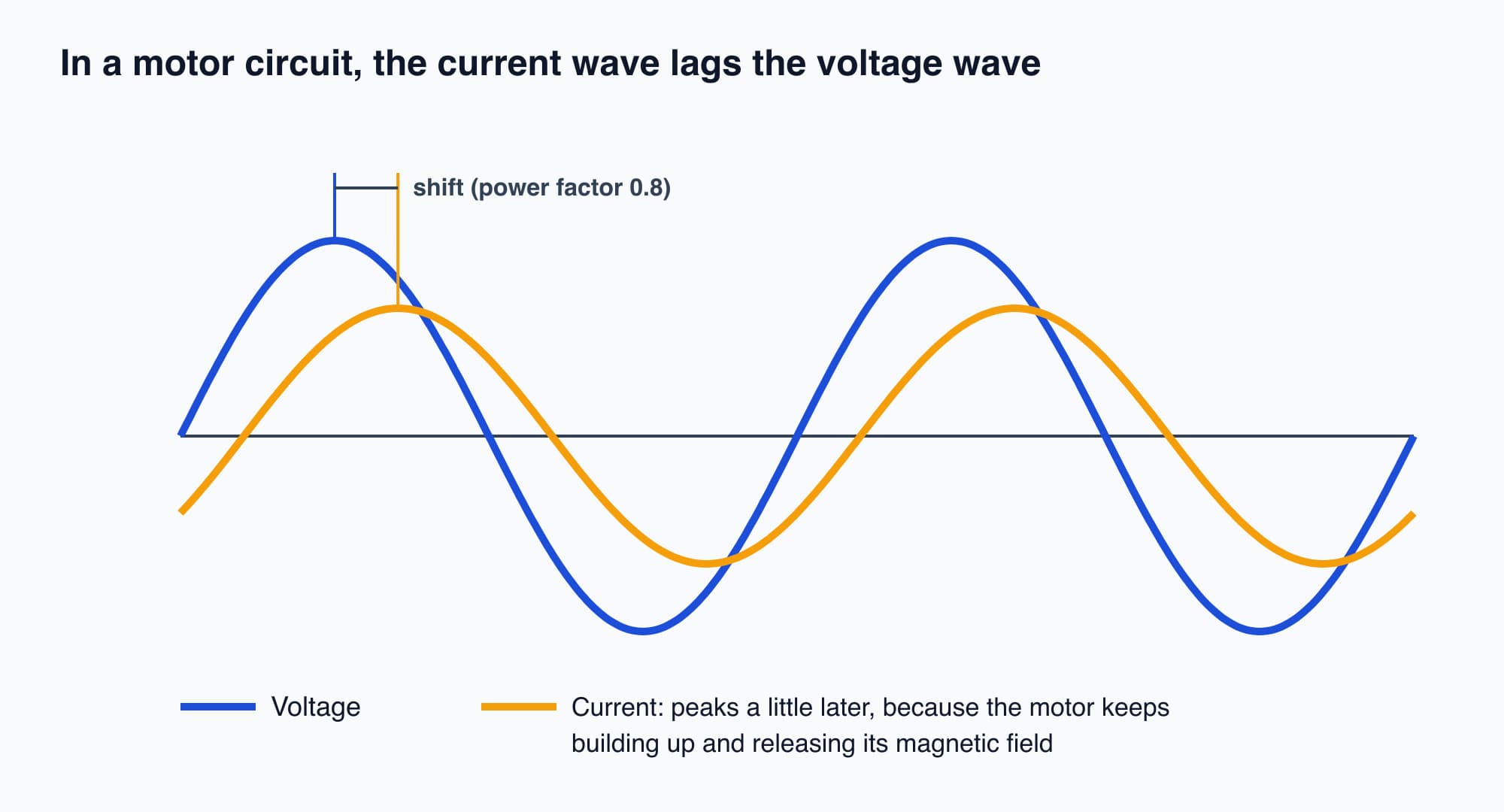
In a motor circuit the current peaks a little after the voltage, because part of the current goes into building and releasing the motor's magnetic field.
This is the first half of the answer to Part 10's question. A motor's current has two parts. One part does the work that shows up as kW. The other part keeps the magnetic field going, and it adds current without adding any kW.
Reactive power goes back and forth and is not used up
On Malaysia's 50 Hz supply, energy flows into a motor's magnetic field and back out to the supply 100 times a second, twice in every cycle. Over each full cycle, the energy that went in equals the energy that came back, so the field uses up nothing overall. Because the current now does two jobs, AC power is described with three numbers:
- Real power (kW) does something useful: it turns a shaft, heats an element or lights a lamp. It leaves the circuit for good as motion, heat or light, and it is what your kWh meter counts.
- Reactive power (kVAR, kilovolt-ampere reactive) flows into magnetic fields and back again. It does no net work, but motors and transformers cannot run without it.
- Apparent power (kVA, kilovolt-ampere) is the total the wires carry: the effective voltage times the effective current, whether or not that current does useful work.
These definitions are for a single-phase supply. Three-phase power (Part 9) uses the same three quantities with slightly different arithmetic.
If the reactive energy comes back, why does it matter? Because the current that carries it still flows through real copper. Take a load that draws 4 A of working current and 3 A of magnetising current. The two parts peak at different moments, so they do not add up to 7 A. They combine like the two short sides of a right-angled triangle, and the cable carries 5 A. Cable heating grows with the current multiplied by itself (Part 6), so 5 A heats the cable about 1.6 times as much as the 4 A doing the work would.
Power combines in the same way. A load drawing 800 kW of real power and 600 kVAR of reactive power presents 1,000 kVA to the supply, not 1,400 kVA. Engineers draw this as the power triangle.
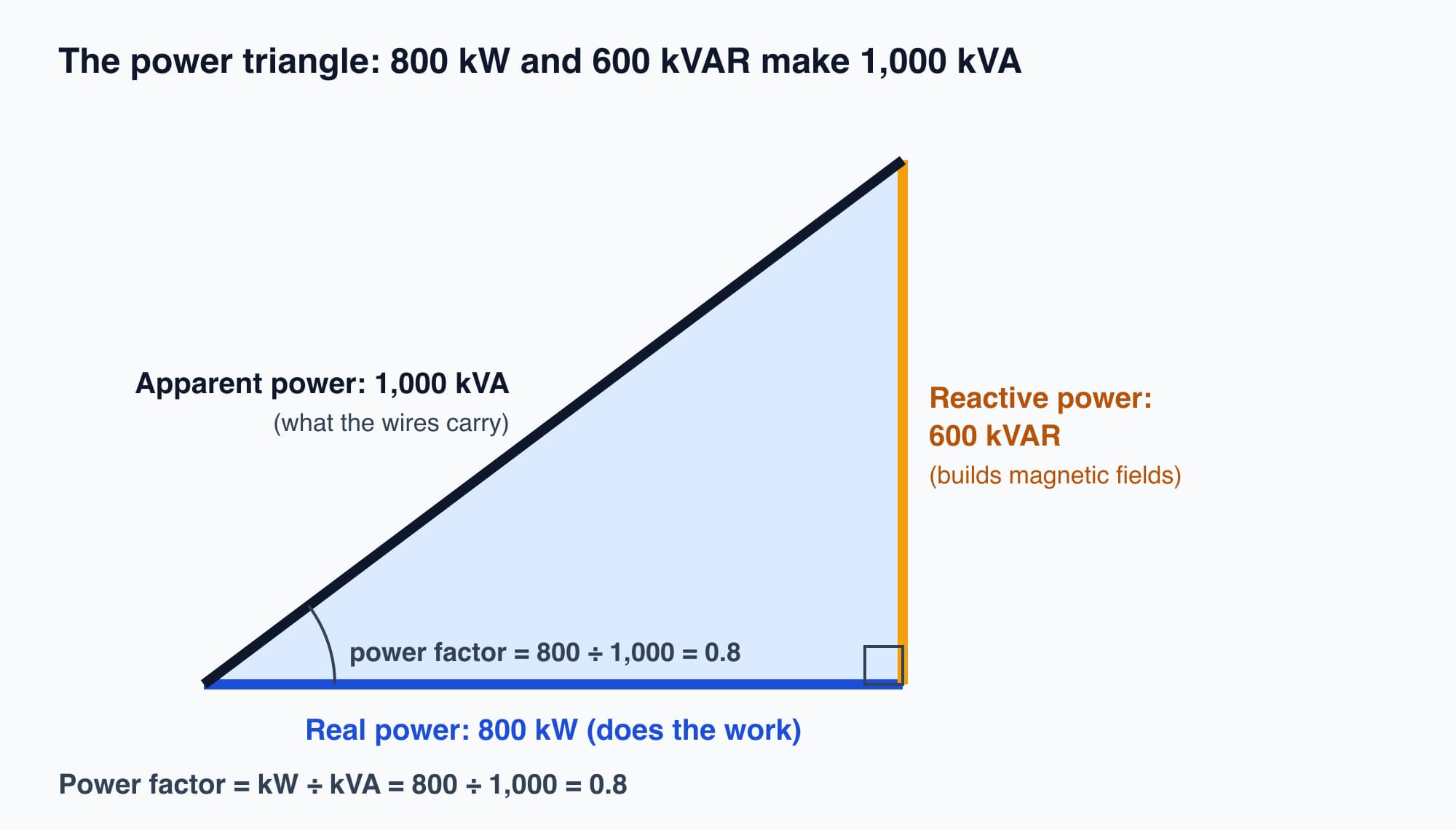
Real power and reactive power combine at right angles: 800 kW and 600 kVAR make 1,000 kVA, and the power factor is 800 ÷ 1,000 = 0.8.
The triangle also explains the kVA rating on a transformer or generator. As How Transformers Work (Part 8) explained, windings heat up according to the current, and the current follows the kVA, not the kW (Schneider Electric).
Want the full story? The side reading Reactive Power Is Not Wasted Energy follows the energy in and out of a motor's field through one cycle.
Why does a motor doing almost nothing still draw so much current?
The share of the kVA that does useful work is called the power factor. It is kW ÷ kVA. The kettle has a power factor of 1.0, because all of its current does useful work and its kVA equals its kW. The 800 kW load above has a power factor of 800 ÷ 1,000 = 0.8.
A motor needs roughly the same magnetising current whether it is working hard or barely working. That current is typically 20 to 60 percent of the motor's full-load current. The working current is different: it grows and shrinks with the load on the shaft. At full load, the working current is large and an induction motor runs at a power factor of about 0.85. With no load on the shaft, the working current falls towards zero while the magnetising current stays, and the power factor can drop to about 0.15 to 0.30.
This completes the answer to Part 10's question. A motor draws more current than its kW suggests because some of its current only builds the magnetic field. When the motor is lightly loaded, that magnetising current becomes most of the current it draws. A 30 kW motor installed to do a 12 kW job spends its whole life in this state.
Now back to the generator in the opening. Its 1,000 kVA rating is set by the current its windings can carry. The engine that turns it has its own limit, usually quoted at an assumed power factor of 0.8, so a 1,000 kVA set is typically rated about 800 kW. Even with a load at a power factor of 1.0, the engine limit means it cannot deliver 1,000 kW. Anyone sizing a generator has to check both numbers.
The same arithmetic applies to the whole office tower. Its maximum demand (Part 5) in a typical month is 1,600 kW, at a power factor of about 0.92. At that moment its two transformers carry about 1,600 ÷ 0.92 ≈ 1,740 kVA. If the power factor fell to 0.80, the same 1,600 kW of useful power would need 1,600 ÷ 0.80 = 2,000 kVA. That is about 15% more current through the same transformers, cables and switchboard for the same work, which means more heat and less spare capacity.
A cabinet of capacitors can lend the motors their reactive power
A motor cannot do without its reactive power, but the reactive power does not have to come all the way from the power station. A capacitor is a component that stores energy in an electric field, in the way a coil stores it in a magnetic field. Its current peaks before the voltage, which is the opposite timing to a motor's.
When capacitors sit near the motors, the two swap energy between themselves. As the motor's field collapses, the capacitor takes the energy; as the field builds again, the capacitor gives it back. The reactive current then flows only in the short loop between them. The motor still gets its field, but the cable back to the supply carries only the working current: 4 A instead of 5 A in the example above.
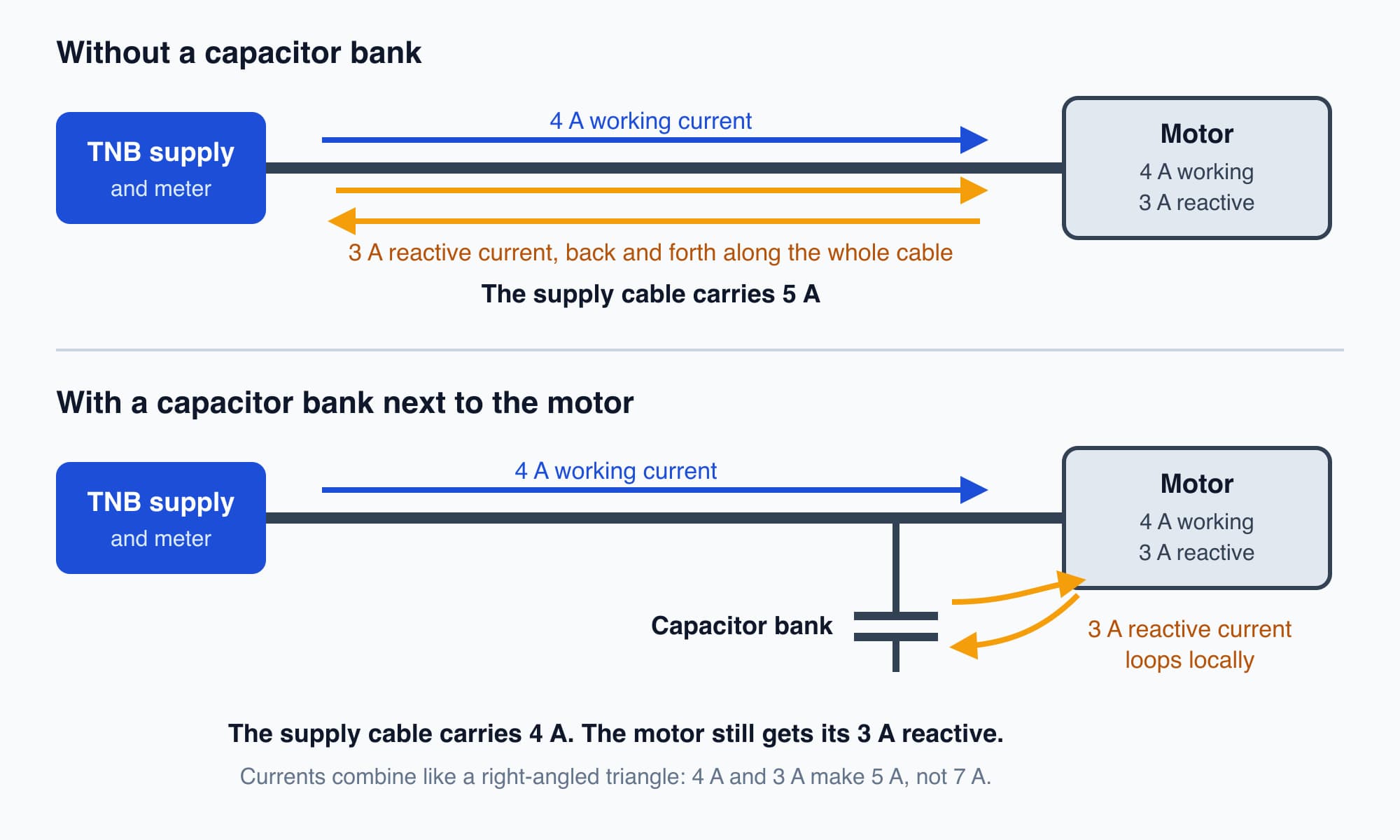
A capacitor bank next to the motor supplies its reactive current locally, so the cable back to the supply carries only the working current.
The office tower has automatic capacitor banks at its main switchboard, which is why its power factor sits at about 0.92. Here is what a capacitor bank changes and what it leaves alone:
- It changes the current in the cables and transformers upstream of the bank, the heat lost in them, the kVA the site draws and the power factor seen at the TNB meter.
- It barely changes the kW and kWh. The motors do the same work, so they draw almost the same real power as before.
TNB (Tenaga Nasional Berhad) requires a power factor of at least 0.85 for supplies below 132 kV, and at least 0.90 at 132 kV and above (TNB power factor page). A site below its threshold pays a surcharge. The money side, and how capacitor banks are sized, is covered in the Understanding Your Electricity Bill course, including Power Factor Correction: What Capacitor Banks Do.
Optional detail: The triangle rule is Pythagoras: kVA² = kW² + kVAR². For the example load, 800 × 800 + 600 × 600 = 1,000,000, and the square root of 1,000,000 is 1,000 kVA. The currents work the same way: 4 × 4 + 3 × 3 = 25, and the square root of 25 is 5 A. Engineers also describe the lag between the current and voltage waves as an angle, where one full cycle is 360 degrees. On motor nameplates and meters you may see power factor written as "cos φ" or "cos θ": it is the same number as kW ÷ kVA. Some countries, including parts of India, bill customers on apparent energy (kVAh). Malaysian bills charge energy in kWh, and TNB meters record reactive energy (kVARh) only to work out the power factor. For where the name "watt" comes from, see the side reading Why Is Power Measured in Watts?
What you now understand
- A kettle's current all does useful work, but a motor's current has two parts: working current and magnetising current for its magnetic field.
- Reactive power (kVAR) flows into magnetic fields and back again, so it is not used up, but the current that carries it still heats cables and takes up capacity. kW, kVAR and kVA combine like the sides of a right-angled triangle, and power factor is kW ÷ kVA.
- Lightly loaded motors have a poor power factor, because their magnetising current stays while their working current shrinks. That is why a motor can draw more current than its kW suggests.
- Transformers and generators are rated in kVA because their windings heat according to the current, and a poor power factor uses up that rating without doing any extra work.
- Capacitor banks supply reactive power close to the motors, which lowers current and kVA but hardly changes kW or kWh.
Check your understanding
- A load draws 800 kW and 600 kVAR. What is its apparent power and its power factor? The two combine like the sides of a right-angled triangle, so the apparent power is 1,000 kVA, not 1,400 kVA. The power factor is 800 ÷ 1,000 = 0.8.
- A site installs a capacitor bank and its power factor rises from 0.80 to 0.95. Do its kW and kWh fall by the same proportion? No. The capacitors supply reactive power, not real power. The motors still do the same work, so kW and kWh stay almost the same. What falls is the current, the kVA, the heat lost in the cables and any power factor surcharge.
What comes next
You now know what the office tower draws: kW for the work, and extra current for its motors' magnetic fields. All of it has to reach the building first, and the electricity arriving right now was made less than a second ago, in a power station that may be hundreds of kilometres away. The next part, How the Malaysia Electricity Grid Reaches Your Plug, asks: how does all this electricity get from the power station to your building?
Go deeper on video (optional)
This video goes over power factor and the power triangle again, with animations. Its title talks about bills, but the explanation is the same physics as this lesson. It is optional: you do not need it for the next part.
"Power Factor Explained: Your Electricity Bill Money Drain" by The Engineering Mindset
This is Part 11 of 15 in Cobler's Electricity Fundamentals course. Previous: How Electric Motors Work (and Run Everything). Next: How the Malaysia Electricity Grid Reaches Your Plug.
Cobler builds CobiNeural, a platform that shows a facility team its building's energy, water and indoor air data as live numbers across the whole site. To see how your building performs, talk to us.
FAQ
Frequently asked questions
Ask us about this topic
Something in this article you want to dig into — or a situation in your own building it doesn't quite cover? Send us your question. We don't run public comments; the team replies to you directly by email.