Blog
Why Is Power Measured in Watts? Blame the Steam Engine
James Watt never saw an electric grid, yet his name is on every light bulb. The story of horsepower, the watt, and why 1 hp = 746 W lets an operator compare a motor, a heater and a server on one scale.
 Tan Kok XinElectricity Fundamentals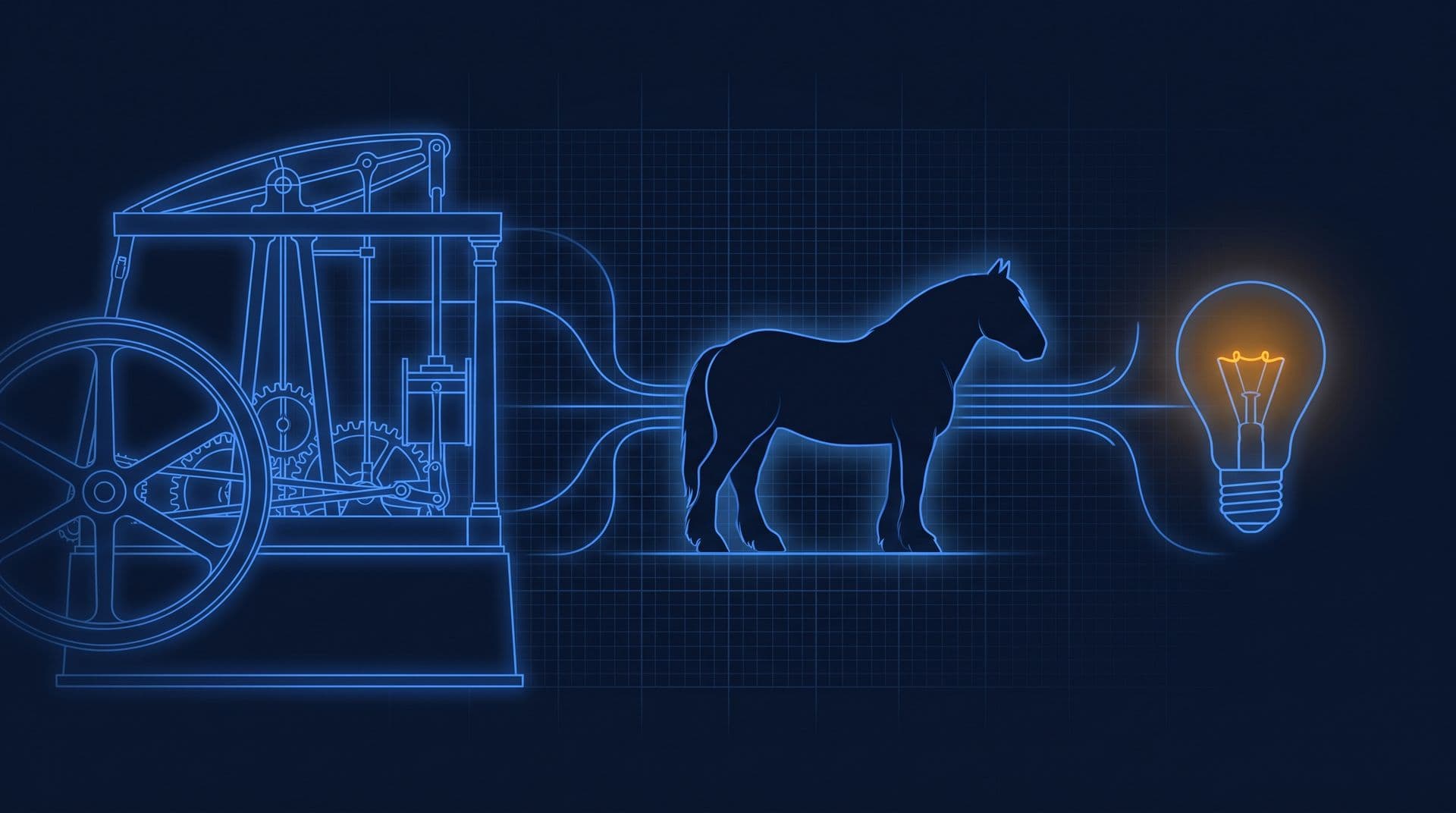
An optional side reading for Cobler's Electricity Fundamentals course. It goes with Part 5. See the course map.
You have read his name your whole life without noticing it: the little "W" on a bulb box, on a hairdryer, on the back of your phone charger. James Watt died in 1819, decades before anyone lit a room with electricity. He spent his working life with steam, brass, and coal. Yet his name is stamped on every light bulb you own, on the plate of your chiller pump motor, and on the TNB bill that lands each month. A man who never saw a grid ended up naming its most important unit. So why is power measured in watts, and why his name? The reason is not sentiment. It is physics, and that same logic is why an operator can compare a motor, a heater, and a server rack on a single number.
Why is power measured in watts?
Because power is the rate of doing work, and that rate is the same idea no matter what does the working. One watt is one joule of energy delivered every second. Whether the joule comes from burning coal, a falling weight, or electrons pushed through a wire, a watt is a watt. It is why a "9W" LED can replace the "60W" bulb you grew up with and still light the room: the watt only measures how fast each one spends energy, and the LED simply spends slower. The unit is named after James Watt because he, more than anyone, forced the industrial world to think about machines in terms of the rate at which they turned energy into useful output.
If the difference between energy and its rate feels slippery, we pulled it apart in Power vs Energy: the difference between kW and kWh. Short version: energy is the total, power is how fast you spend it. The watt measures the speed.
Who was James Watt, and what did he actually invent?
An instrument maker who fixed a broken model of somebody else's engine, and in doing so sharply improved the efficiency of steam power. Watt was born in Greenock, Scotland, in 1736, and worked as an instrument maker at the University of Glasgow from around 1757, building and repairing precision scientific gear (Wikipedia). He was a mechanical engineer in the most literal sense, not a theoretician.
The engine of his era was the Newcomen engine, and it was wasteful. It heated a cylinder with steam, then sprayed cold water inside to condense that steam and create a vacuum, then reheated the whole cylinder again on the next stroke. Heating and cooling the same iron cylinder, over and over, threw away most of the fuel.
In May 1765, walking across Glasgow Green while turning over a model Newcomen engine he had been asked to repair, Watt saw the fix: condense the steam in a separate chamber so the working cylinder never has to cool down (Science Museum). He patented the separate condenser in 1769 (Wikipedia). The result was an engine that burned only about 25 to 30 percent of the coal a Newcomen engine needed for the same work (Britannica). In 1775 he went into business with the manufacturer Matthew Boulton, and Boulton & Watt engines began pumping water out of Cornish mines the following year.
Where did "horsepower" come from?
From a sales problem. Watt and Boulton did not sell engines outright at first. They charged a royalty equal to a share of the fuel money a customer saved by switching from an old Newcomen engine. That worked neatly when the customer already ran a steam engine, because there was a coal bill to measure the saving against. It fell apart when the customer used horses. A horse-driven mill burns no coal, so there was no saving to take a cut of (Wikipedia).
Watt needed to express his engine's output in a unit those buyers already understood: the work a horse could do. Around 1782 he ran the numbers on a working horse turning a mill. A horse pulling roughly 180 pounds of force on a wheel of about 12 foot radius, going round some 2.4 times a minute, worked out to roughly 32,500 foot-pounds of force per minute. He rounded it up to a clean 33,000 foot-pounds per minute, slightly generous to the horse, and called it one horsepower (Wikipedia).
It was one of history's great marketing metrics. A factory owner deciding whether to replace a team of horses could now read an engine's rating and know exactly how many animals it stood in for. Horsepower was never really a physicist's unit. It was a unit invented to let a machine be compared to the thing it replaced, which is precisely the job the watt does today across every kind of machine.
Why does an electrical unit honour a steam engineer?
Because when the electrical age needed a name for its own unit of power, the whole point was that power does not care where it comes from. By the 1880s, electric lighting and motors needed a practical unit for the rate of energy conversion, exactly as steam had a century earlier. In August 1882, at the British Association for the Advancement of Science, C. William Siemens proposed naming that unit the watt, arguing that the units of a practical system should carry the names of leading engineers and physicists (Wikipedia). The name was formally adopted by the association in 1889.
It took decades to nail down precisely. In 1948 the ninth General Conference on Weights and Measures redefined the watt in absolute mechanical terms, as one joule per second, and in 1960 it was folded into the International System of Units as the SI unit of power (Wikipedia). The definition that matters to an operator is compact:
1 watt = 1 joule per second = 1 volt × 1 amp.
That last equality is the bridge. In an electrical circuit, power is voltage multiplied by current. Push harder (more volts) or push more charge per second (more amps), and you get more watts. If those two quantities are still fuzzy, Volts and Amps: electrical pressure and flow lays out the plumbing. And because a joule is a joule whether it heats water or lifts a weight, the same watt measures a steam engine, a waterfall, and a wire. The reason energy itself carries two unit names, the joule and the kWh, is a separate and slightly stranger story we told in Joules vs kWh.
What is one horsepower in watts?
One mechanical horsepower is about 746 watts (Wikipedia). That single conversion ties Watt's two worlds together. His horse, his steam engine, and your electric motor are all measured on one scale, because they are all doing the same thing: converting energy into work at some rate. It is also why the aircon in your living room is still sold as a "1 HP" or "1.5 HP" unit: two centuries on, the shop is quietly pricing your cooling by the horse.
This is not just trivia for a plant engineer. A 7.5 kW chiller pump motor is, in Watt's own currency, a ten-horse team pulling continuously. A 3.7 kW motor is a five-horse team. When a nameplate quotes both "5 hp" and "3.7 kW," those are not two different ratings, they are the same rate of work written in the language of two different centuries.
Why does this matter to a facility operator?
Because the watt lets you put every load in your building on one honest scale. A 9 kW duct heater and a 7.5 kW pump motor share nothing mechanically with a rack of servers drawing 4 kW. One makes heat, one moves water, one runs computation. But each is spending energy at a rate you can read in kilowatts, add up, compare, and bill. That common scale is what makes an energy audit possible at all. Without it you would be comparing coal to horses to electrons with no shared ruler.
It is also why the number on your meter is directly actionable. Every kilowatt you draw is a rate, and your TNB demand charges are levied on the peak rate you hit, not just the total energy. Under the RP4 tariff, a medium-voltage site on a flat tariff pays RM89.27 per kW each month as a combined capacity-and-network demand charge, while one on a time-of-use tariff pays RM97.06 per kW. Trim the peak rate at which your building pulls power and you cut that bill directly. That is the whole game: knowing which watts you are spending, when, and whether you need to be. CobiNeural's energy monitoring puts every powered load on that single watt scale in real time, and its Max Demand KPI watches the peak so you can act before the charge lands.
James Watt built a better way to turn coal into motion, then invented the metric to sell it. Two centuries on, that metric is how you read your own building. Not bad for a man who never flipped a light switch.
This is an optional side reading for Cobler's Electricity Fundamentals course. Back to the course: Part 5: Power vs Energy: The Difference Between kW and kWh.
Want to see every load in your facility on one scale, in real time? Book a demo and we will walk you through your own demand profile.
FAQ
Frequently asked questions
Ask us about this topic
Something in this article you want to dig into — or a situation in your own building it doesn't quite cover? Send us your question. We don't run public comments; the team replies to you directly by email.