
Blog
Joules vs kWh: Why Energy Has Two Names
Physics has one energy unit, the joule, but your TNB bill reads in kWh, food in Calories, and petrol in megajoules. Same currency, different rulers, and why each field picked its own.
 Tan Kok XinElectricity Fundamentals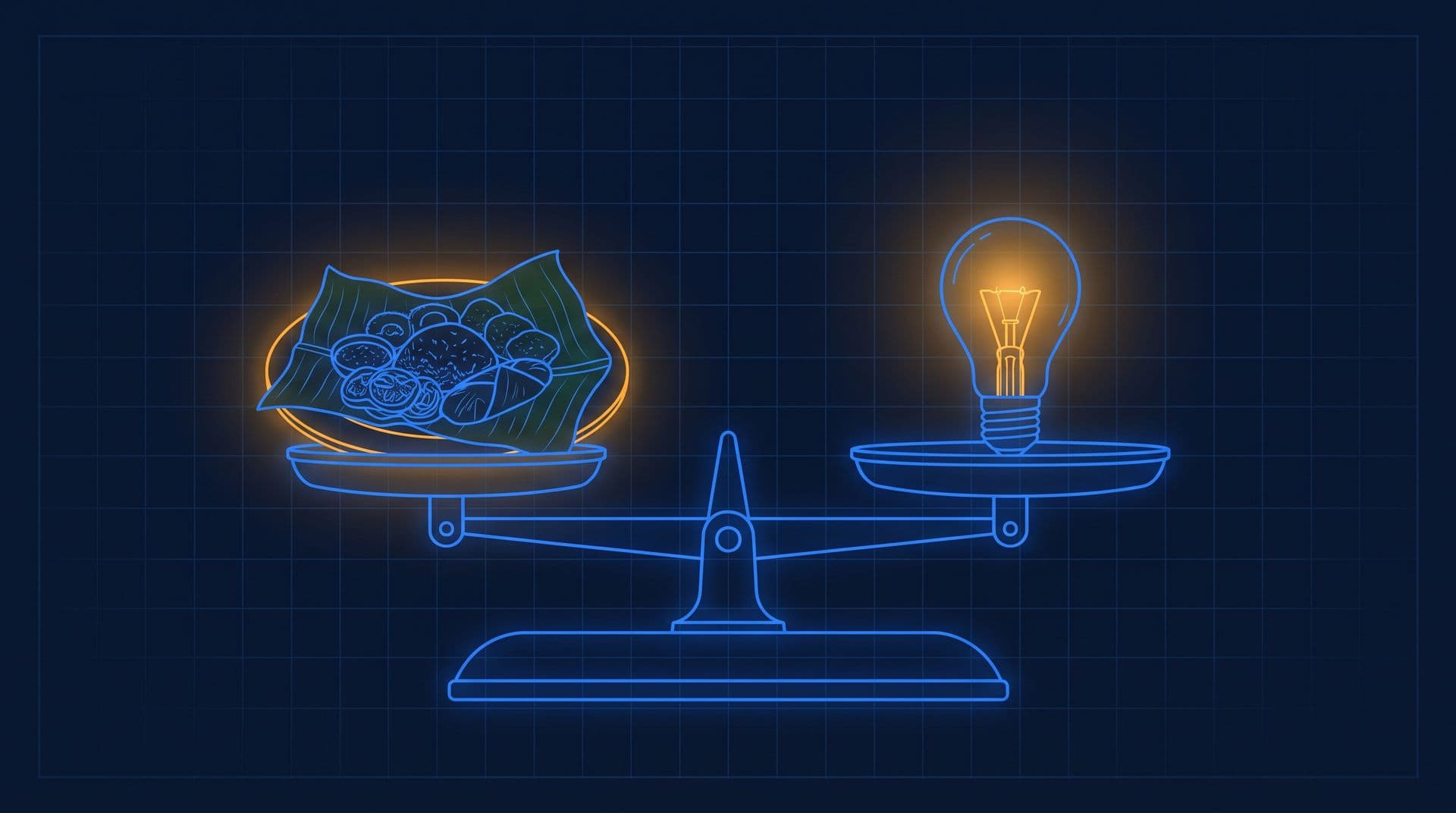
An optional side reading for Cobler's Electricity Fundamentals course. It goes with Part 5. See the course map.
Lift an apple from the floor to a bench about a metre up, and you have just spent roughly one joule of energy. Boil that same apple's weight in water, drive a car, or run a chiller for a shift, and the bill is measured in the same currency. Physics only recognises one unit of energy: the joule. Yet your TNB bill is printed in kilowatt-hours, a food label counts Calories, and a petrol pump sells by the litre, but each of those litres is really about 34 megajoules of stored fuel. Same quantity, four different rulers: that is the puzzle of joules vs kWh. Here is why energy ended up with so many names, and why the one on your electricity bill is not the one the textbooks use.
Are joules and kWh the same thing?
Yes. They both measure energy, and they convert exactly: 1 kWh = 3.6 megajoules (3,600,000 joules). A kilowatt-hour is not a different quantity from a joule any more than a kilometre is a different quantity from a mile. It is the same physical thing measured with a bigger, more convenient tick mark.
The joule is the SI (International System) unit of energy, defined as one watt for one second: 1 J = 1 W·s = 1 newton-metre (the work of pushing with a one-newton force over one metre). A kilowatt-hour is one kilowatt (1,000 watts) sustained for one hour. Multiply it out: 1,000 watts times 3,600 seconds gives 3,600,000 watt-seconds, which is 3.6 MJ (Wikipedia: Kilowatt-hour). No approximation, no rounding. The two units describe identical energy; only the label changes.
Why is the joule the "universal" energy unit?
Because energy is one currency that flows between forms, and the 19th-century physicist James Prescott Joule proved it converts at a fixed exchange rate. His famous paddle-wheel experiment let a falling weight stir water in an insulated barrel; the friction warmed the water by a repeatable, measurable amount. A fixed quantity of mechanical work always produced the same quantity of heat (Wikipedia: Mechanical equivalent of heat).
That result became a cornerstone of the first law of thermodynamics: heat, mechanical work, and later electrical energy are the same thing wearing different clothes. Once you know they convert at fixed rates, a single unit can measure all of them. The joule is that unit, and it shows up identically across every domain:
- Mechanical work. Raising a 100-gram apple one metre takes energy equal to mass times gravity times height (mgh): 0.1 kg times 9.8 times 1 metre, which is about 0.98 J, near enough to one joule (OpenStax: Gravitational Potential Energy).
- Heat. Warming one kilogram (one litre) of water by one degree Celsius takes 4,184 J (Britannica: calorie). That is why a kettle feels so much hungrier than a lightbulb: heating water is expensive in joules.
- Chemical energy in food. A nutrition "Calorie" with a capital C is a kilocalorie, and one kilocalorie is 4,184 J (Wikipedia: Calorie). Every joule in your body arrived as chemical energy from food.
- Chemical energy in fuel. A litre of petrol holds roughly 34 MJ, about 9.5 kWh (Alternative Fuels Data Center). That density is exactly why liquid fuel still beats batteries for range.
How many kWh is a plate of nasi lemak?
About 0.7 kWh, and the arithmetic is a nice way to feel how big these units really are. Convert using the two fixed facts above: 1 kcal is 4,184 J, and 1 kWh is 3,600,000 J, so 1 kcal is about 0.001163 kWh.
A roti canai kosong runs around 300 kcal (Gleneagles health digest), which works out to roughly 0.35 kWh of chemical energy. A nasi lemak loaded with fried chicken sits near 600 kcal (Calculator Malaysia), about 0.70 kWh. To put that in appliance terms, 0.70 kWh would run a 100-watt bulb for seven hours. Your breakfast carries the same energy a small light burns through in an evening. (Treat the calorie figures as ballpark ranges; portions vary. The conversion itself is exact.)
The point of the exercise is not the food. It is that a roti canai, a lifted apple, a kettle of hot water, and a unit on your electricity bill can all be written in one currency, because Joule showed they are the same currency.
Why does electricity use kWh instead of joules?
Because of how the meter works and how big the numbers get. An electricity meter does not measure joules directly; it measures power and adds it up over time. Energy is average power multiplied by hours, so watts times hours falls straight out of what the device is physically counting (Wikipedia: Electricity meter). The watt-hour is the meter's native unit. Billing in it means billing in exactly what you measured, with no conversion step to fumble. If you want the deeper split between power and energy, we cover it in Power vs Energy: the difference between kW and kWh; the early watt-hour meters that made utility billing possible get their own treatment in How electricity meters work.
The second reason is human scale. A house drawing 500 kWh in a month is an easy number to read, budget, and argue with TNB about. Write the same month in joules and it becomes 1.8 gigajoules: 1,800,000,000 J, a figure nobody wants on a monthly statement. The kilowatt-hour keeps household energy in the tens and hundreds, and industrial energy in the thousands, instead of forcing everyone to juggle billions. Formally the kWh is a non-SI unit, but it is explicitly sanctioned for commercial energy trade for exactly this reason (Wikipedia: Kilowatt-hour).
None of this makes the kWh more "correct" than the joule. It makes it more convenient for the audience that reads electricity bills.
Joules vs kWh: same energy, different rulers
Energy has many names because each field picked the ruler that made its own numbers behave. Physicists use joules because it is the clean SI unit that ties into force, mass, and time. Nutritionists use kilocalories because a food's energy is really about heating and metabolising, which is a heat quantity. Air-conditioning and heating engineers still quote BTUs (British Thermal Units, a heat unit). The power bank in your bag makes the point even more bluntly: it prints its capacity twice, once in mAh and once in watt-hours, the same stored charge under two labels. Electricity uses kilowatt-hours because that is what the meter counts and what keeps a monthly bill legible.
The choice is about the reader, not the physics. Nothing stops a utility from billing in joules, and some do bill energy that way: in Australia, residential natural gas is sold in cents per megajoule, while electricity on the same street is sold in cents per kWh (Econnex: megajoules explained). Same energy, one gas ruler and one electricity ruler, chosen by convention rather than by nature.
For a facility operator the practical takeaway is simple. When a chiller spec is in kW, a gas contract is in MJ, a diesel genset is rated in litres, and a solar quote talks kWh, they are all quoting the same currency in different denominations. Convert them to one unit before you compare, and the picture snaps into focus: 1 kWh is 3.6 MJ, 1 litre of petrol is about 9.5 kWh, and 1 kcal is 0.001163 kWh. Once every input is in the same currency, an energy decision stops being a units puzzle and becomes an arithmetic one. It is also why you can finally settle the EV-versus-petrol argument: put the charge and the tank in that same kWh, and the cost comparison stops being an apples-to-oranges guess.
This is an optional side reading for Cobler's Electricity Fundamentals course. Back to the course: Part 5: Power vs Energy: The Difference Between kW and kWh.
Turning kWh on a bill into decisions on the plant floor is what CobiNeural is built for. Book a demo and we will show you your own energy in numbers you can act on.
FAQ
Frequently asked questions
Ask us about this topic
Something in this article you want to dig into — or a situation in your own building it doesn't quite cover? Send us your question. We don't run public comments; the team replies to you directly by email.