Blog
Building Energy Intensity (BEI): Malaysia's Energy Label
Malaysia's EECA 2024 star label grades large offices by building energy intensity. The official formula, GFA exclusions, star bands and a worked BEI calculation from real metered data.
 Tan Kok XinCompliance & Incentives
Malaysia now grades its large office buildings the way it grades refrigerators. Under the Energy Efficiency and Conservation Act 2024 (Act 861) and its Regulations, both in force since 1 January 2025, offices of 8,000 m² and above must work out their building energy intensity (BEI), apply for an energy intensity label from the Energy Commission, and display the star rating in a visible part of the building. The rating bands are set out in Suruhanjaya Tenaga's guideline GP/ST/No.48/2024, and they are unforgiving: a typical Malaysian office running around 210 kWh/m²/year lands in the bottom band. One star.
This post stays on the metric itself: the official formula, what counts as floor area, the star bands, and how to compute your number from real metered data. For the Act's wider duties, see our EECA compliance guide.
In short
- Since 1 January 2025, Malaysian offices of 8,000 m² and above must calculate their building energy intensity (BEI) and display an energy intensity label, similar to a refrigerator's energy rating.
- BEI is calculated from metered energy divided by air-conditioned floor area, using the Act's official formula.
- Malaysian offices span a wide range of scores, and many sit well below the top star bands.
- Moving up a star band usually comes down to a handful of levers: chiller efficiency, operating hours and setpoint discipline.
What is building energy intensity (BEI)?
Building energy intensity is the total energy a building consumes over 12 consecutive months divided by its gross floor area (GFA), expressed in kWh/m²/year. That is the statutory definition in GP/ST/No.48/2024: all energy used for cooling, lighting and building operations, whether it arrives as electricity, natural gas, purchased chilled water or anything else, summed over a year and divided by GFA.
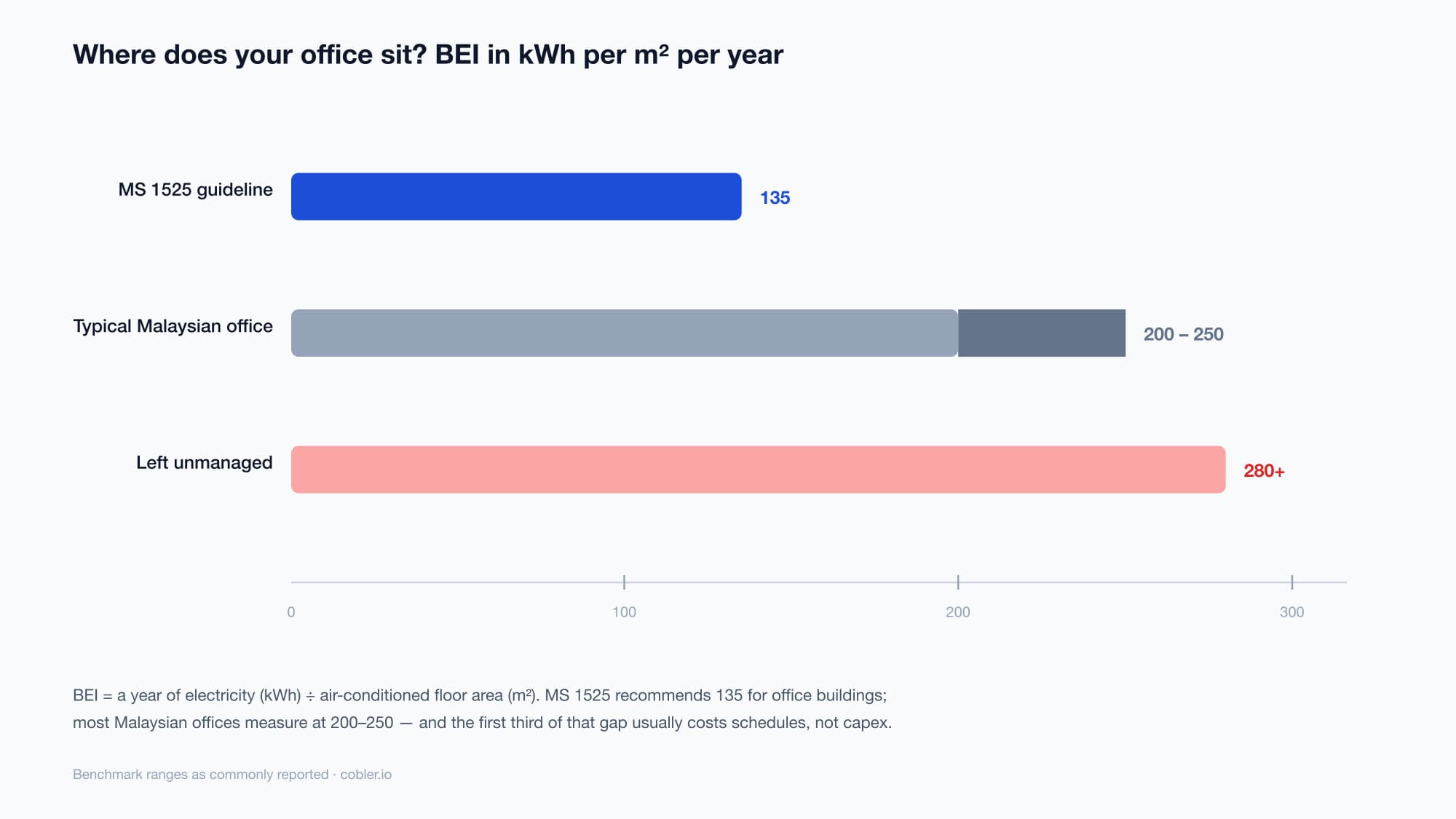
Where offices actually sit against the MS 1525 guideline. The first stretch of the gap usually costs schedules, not capital.
The formula is deliberately blunt:
BEI = total annual energy consumed (kWh) ÷ gross floor area (m²)
No weather correction, no adjustment for operating hours or occupancy. If your building burns the energy, it counts. That bluntness is the point; the label is meant to be comparable across every large office in the country, computed from utility meters rather than models.
You will also see BEI called EUI (energy use intensity) in international literature and inside energy platforms. Same ratio, different name. The Malaysian statutory instrument uses "energy intensity performance", measured as BEI.
The official BEI formula: what counts as energy, what counts as floor area
Energy side. Everything crossing the metering boundary counts, converted to common units using the guideline's Appendix A coefficients: electricity and solar PV at 0.0036 GJ/kWh, purchased chilled water at 0.01266 GJ/RTh, natural gas at 0.02898 GJ/m³, and steam at 10 bar at 2.7771 GJ/tonne. Two details catch people out. First, on-site solar PV generation counts as energy consumed; the guideline's metering diagram places the PV meter inside the GFA boundary, so rooftop solar does not reduce your BEI. Second, the bands are officially expressed in GJ/m²/year (5-Star is ≤ 0.324 GJ/m²), with 1 GJ = 277.778 kWh; everyone works in kWh in practice.
Floor area side. GFA is measured between the external sides of walls (party walls to their centres), and the guideline lists exactly what to strip out:
- parking spaces and the circulation and M&E spaces within the parking area
- open or covered parking outside the building
- staircases and lift shafts on every floor except ground and lobby levels
- loading and waiting areas for commercial vehicles
- rooftop or podium gardens and recreational facilities
- pedestrian pathways connecting to the building or to transit stations
- public walkways within the building
Note this is still gross floor area, not nett lettable or air-conditioned area. Older Malaysian benchmarking work, including the my-BEI portal definitions and many academic studies, computed BEI on nett or air-conditioned floor area, which produces a higher number for the same building. The legal metric under EECA is GFA-based per GP/ST/No.48/2024. Do not compare your statutory BEI against an NFA-based figure and conclude you are fine.
The metering boundary. The Energy Commission determines the building's boundary from the point where energy is supplied, and the guideline illustrates six scenarios. Multiple blocks in one compound behind a single utility meter are treated as one boundary. A multi-tenant office where each tenant holds its own utility account is assessed differently. And a building operating as a public installation licensee, reselling electricity to tenants through sub-meters, includes the tenants' floors in its boundary. Getting this wrong changes both the numerator and the denominator, so pin it down before you compute anything.
Malaysia's star-rating bands for office buildings
For a standard office building, EECR 2024 subregulation 12(1), reproduced as Table 1 of the guideline, sets:
- 5-Star: BEI ≤ 90 kWh/m²/year (very efficient)
- 4-Star: above 90 to 110
- 3-Star: above 110 to 160 (moderately efficient)
- 2-Star: above 160 to 200
- 1-Star: above 200 kWh/m²/year (least efficient)
A separate table (Table 2) applies to offices served by external chilled water supply, such as district cooling, because purchased chilled water counts as energy input at the boundary:
- 5-Star: ≤ 190 kWh/m²/year
- 4-Star: above 190 to 240
- 3-Star: above 240 to 340
- 2-Star: above 340 to 420
- 1-Star: above 420 kWh/m²/year
One myth to retire: several vendor articles claim EECA "caps" office BEI at 250 kWh/m²/year. No 250 figure appears in the official band tables; the 1-Star threshold for standard offices is anything above 200, and legal commentaries describe the working expectation as a minimum 2-Star rating, meaning at or below 200 kWh/m²/year (Christopher & Lee Ong).
Who must display the energy intensity label?
Any office building with a GFA of 8,000 m² and above, solely built or used for office purposes, subject to the Energy Commission's determination based on the metering point (guideline para 4.1). The label is applied for from the Energy Commission, must be displayed in a visible part of the building at all times, and per legal commentaries must be renewed annually. Failing to display it carries a fine of up to RM50,000 (RDS Law Partners).
The rating has teeth beyond the wall plaque. If the building's energy intensity performance does not meet the prescribed rating, section 13 lets the Commission issue a written notice; the person in charge must then have a registered energy auditor conduct an audit and submit an energy efficiency improvement plan within one year. We cover that process in the EECA energy audit guide. This duty is separate from the Registered Energy Manager obligation, which attaches to any consumer above 21,600 GJ/year (roughly 6 GWh) regardless of building type. And offices are only phase one: hotels, malls, private hospitals and data centres are expected to follow under the national BEI benchmarking programme.
How do Malaysian offices actually score?
The benchmarks tell a consistent story. MS 1525:2019 recommends a BEI of 200 kWh/m²/year for Malaysian offices (the older 135 kWh/m² figure belongs to the 2007/2014 editions), and the Green Building Index sets 150 kWh/m²/year as its benchmark for full BEI points (IAQVEC 2023 study). Typical Malaysian offices run around 210 kWh/m²/year, and audits show most exceed 200. Read against Table 1: the average office is 1-Star, a GBI-benchmark office is 3-Star, and 5-Star demands the territory of national exemplars like the GEO Building in Bandar Baru Bangi at roughly 30 kWh/m²/year with PV, or ST's own Diamond Building at about 85 (MJSAT review).
Government buildings have lived with this logic since 2019, when the national BEI labelling scheme required any building below 2 stars to conduct an audit and submit an improvement plan. EECA extends the same mechanism to private-sector offices.
How do you calculate your BEI from metered data?
Take a 26,000 m² office tower. Measured between external walls, GFA comes to 26,000 m²; strip out 4,200 m² of in-building parking with its circulation and M&E space, 500 m² of rooftop garden, and 300 m² of stair and lift cores above the lobby level. Eligible GFA: 21,000 m².
Now the energy side. Twelve consecutive months of TNB bills total 4,494,000 kWh. No gas, no district cooling, so no unit conversion needed. BEI = 4,494,000 ÷ 21,000 = 214 kWh/m²/year. That is 1-Star.
Two practical warnings from doing this on real buildings. First, you need sub-metering to defend the boundary: if car park floor area is excluded but the car park ventilation and lighting sit on the same incoming meter, the Commission's boundary rules decide what you may and may not carve out, and you need meter data to show it. Second, do not confuse the statutory number with the GBI/MS 1525-style audit formula, BEI = [(TBEC − CPEC) × 52] ÷ [GFA excluding car park × weighted weekly operating hours], which subtracts car park energy and normalises for operating hours. That normalised figure is useful in audits and green ratings, but the label is computed on the raw statutory formula.
What moves a building up a star band?
Run the arithmetic on the worked example. To reach 2-Star, consumption must fall to 4,200,000 kWh, a cut of 294,000 kWh or about 6.5%. That is schedule discipline and setpoint housekeeping territory. To reach 3-Star at 160 kWh/m², the building needs to shed 25%, which almost always means the chiller plant, since cooling dominates Malaysian office loads; a plant drifting at poor kW/RT is the single largest lever, and we have written about what good chiller plant efficiency looks like.
The buildings that hold a band, rather than visiting it once, run continuous monitoring with measurement and verification behind each improvement. This is the machinery CobiNeural provides: the Energy module tracks EUI as a live KPI alongside consumption, demand and power factor; sub-meter data collection separates car park, tenant and central plant loads so the statutory boundary is defensible; Plan & Verify handles M&V for each measure; and EECA-aligned reporting produces the evidence trail when the Commission, or an auditor, asks how the number was derived.
For how a chiller plant fits together end to end, see our free course Cooling Fundamentals.
A BEI label is recalculated from twelve months of data, so the time to influence next year's star rating is now, not the month before renewal. If you want to see your buildings' live BEI against the Table 1 bands, request a demo and we will set it up on your own meter data.
FAQ
Frequently asked questions
Ask us about this topic
Something in this article you want to dig into — or a situation in your own building it doesn't quite cover? Send us your question. We don't run public comments; the team replies to you directly by email.