
Blog
Chiller Replacement Cost in Malaysia: The Real Budget
Indicative RM per RT ranges for replacing a chiller in Malaysia, plus the hidden half of the project: rigging, piping, electrical, controls and downtime. And the measurement that should happen before you sign anything.
 Tan Kok XinHVAC & Chiller Plants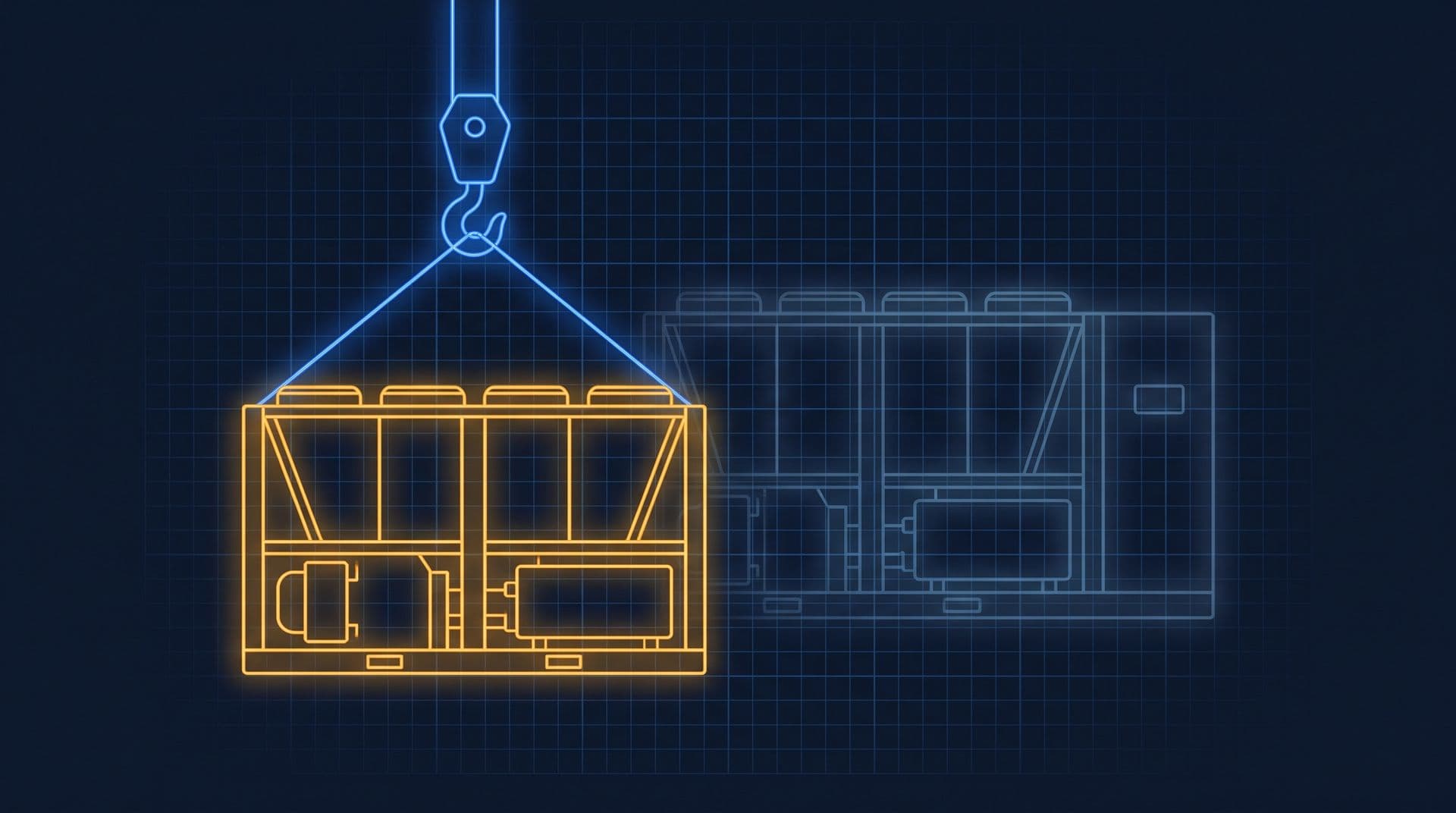
Ask three contractors for a chiller replacement cost and you will get three numbers that differ by more than the price of the machine itself. That is not vendors playing games. It is because the chiller is roughly half the project, and the other half depends entirely on how your plant room was built, where a mobile crane can legally stand on the day, and what you are prepared to do to the electrical riser. Before any of that, there is a question worth more than the quote: do you know what your existing plant actually consumes per ton of cooling it delivers?
In short
- Chiller replacement cost quotes commonly differ by more than the price of the machine itself, because the chiller is only about half the project.
- The other half depends on plant room access, crane logistics and how the existing plant room was built, factors that vary site to site.
- Measuring your actual kW/RT before replacing anything tells you whether the problem is the chiller or something else in the plant.
- A retrofit can beat full replacement when the existing chiller shell and infrastructure still have useful life left.
What does a chiller replacement cost in Malaysia?
Everything below is an indicative Malaysian market range, not a quotation. The bands are wide on purpose. Real prices move with capacity, refrigerant, efficiency tier, brand tier, site access and the scope your consultant writes.
For equipment supply alone, water-cooled screw and centrifugal machines commonly land somewhere in the region of RM1,200 to RM3,000 per RT. Air-cooled screw packages usually sit lower per RT on the invoice and cost you more every single year in kW/RT. Small air-cooled scroll units serving a 100 RT office block are a different market again and can be cheaper per RT than either.
Installed, the more honest planning tool is a multiplier rather than a price. On typical Malaysian commercial retrofits, the turnkey figure often lands at something like 1.6 to 2.5 times the bare equipment cost. Translated into a per-RT band for a straightforward water-cooled replacement in an accessible plant room, budget holders usually work with roughly RM2,500 to RM5,500 per RT all in. A basement plant with a single tight access route, or a rooftop job that needs road closure and a large crane, can sit above that band, and nobody will know which case you are until a contractor walks the route with a tape measure.
Use those numbers to size a budget line and to sanity-check a quote that looks suspiciously cheap. Do not use them to negotiate. A tender that comes in far below the band is usually one that has quietly moved the hidden half into variation orders.
The hidden half of a chiller quote
Rigging and access. Getting the old machine out is frequently harder than getting the new one in, because the old one was installed before the building was finished. Expect line items for crane hire and lifting plan, road permits or lorry access, hoarding and protection works, temporary removal of louvres, doors or a slab section, skidding and jacking inside the plant room, and reinstatement afterwards. On constrained sites, contractors specify a knock-down or modular chiller that is carried in as pieces and rebuilt on the plinth. That decision alone can shift the equipment price by a large margin and is often the single biggest swing factor in the whole project.
Piping and hydraulics. A new machine rarely has the same nozzle positions, pressure drop or flow requirement as the one it replaces. Budget for chilled water and condenser water pipe modifications, new flexible connectors, valves, strainers, pressure and temperature test points, insulation reinstatement, chemical cleaning and flushing, plus water treatment for the first fill. If you are moving to variable primary flow, add bypass line, control valve and flow meter.
Electrical. Cable sizing, breaker rating, starter type and the incoming panel all need checking against the new machine, not the old one. High-efficiency chillers with VSD compressors often draw less current but bring harmonic and power factor questions with them. Under RP4, power factor below 0.85 for supplies under 132 kV attracts a surcharge, so the electrical scope should include a look at capacitor bank condition rather than assuming it still works.
Controls integration. This is the line item most often left as a provisional sum, and the one most likely to cause grief at handover. The new chiller talks BACnet or Modbus, your existing BMS front end was commissioned years ago by a contractor who has since closed, and the graphics need rework. Insist that the scope names the protocol, the point list, who writes the sequences, and who proves them.
Downtime. For a hospital, data centre, hotel or manufacturing plant, temporary chiller rental plus mobilisation, temporary piping, temporary power and demobilisation is a real and sometimes uncomfortable cost. Sequencing the works during a shutdown window, or replacing one machine at a time in a multi-chiller plant, is usually cheaper than renting cooling.
The small print. Statutory registration of pressure vessels, recovery and disposal of the old refrigerant charge, testing and commissioning, testing adjusting and balancing, operator training, as-built documentation, and the service contract for years two onwards. That last one is not optional in practice. Price it during tender, while the vendor still wants the job.
Measure kW/RT before you replace anything
The most expensive mistake in chiller capex is buying an efficient machine and operating it badly. A chiller rated at 0.55 kW/RT at full load can run at 0.9 kW/RT in a real plant with fouled condenser tubes, a low delta T syndrome, oversized pumps running flat out and staging logic that keeps three machines at 30 percent load each.
So the first spend is measurement, not equipment. You want power to the chiller, chilled water flow and supply and return temperatures, logged over a full cooling season, turned into a plant kW/RT curve against load. Our guide on chiller plant efficiency and kW/RT benchmarks covers what good looks like for Malaysian conditions. Very often the data shows the plant is not short of capacity at all: it is short of correct staging, clean tubes and a sensible chilled water reset. Those symptoms are covered in more detail in our piece on oversized chillers, short cycling and dirty coils.
Measurement also gives you the one thing a chiller replacement business case usually lacks, which is a defensible baseline. Without it you are comparing a nameplate to a nameplate.
When does a retrofit beat replacement?
Replacement earns its price when the machine is genuinely at end of life: heavy refrigerant loss, tube failures, obsolete controls, parts no longer available, or a refrigerant you cannot economically keep buying. It also earns it when the plant is grossly oversized for a load that has changed since the building opened, because no amount of tuning fixes a 1,000 RT plant serving a 350 RT load.
Short of that, the cheaper moves usually deliver most of the kW/RT gain for a fraction of the capital:
- Condenser tube cleaning and a proper water treatment regime, which is the highest return per ringgit in the entire plant room
- VSD on condenser water pumps and cooling tower fans, plus a condenser water temperature reset that lets the chiller ride lower lift on mild nights
- Fixing low delta T at the air handling units, since valves that never close force flow up and drag efficiency down across the whole plant
- Rewriting staging and sequencing so machines run near their best load point instead of all part loaded
- Chilled water supply temperature reset where the humidity load allows it
A sensible order of works is to fix operation first, measure the result, then decide whether the remaining gap justifies the capex. If it does, you now have an accurate load profile to size the new machine against, which usually means buying a smaller and cheaper chiller than the one you were about to specify.
Making the business case stack up under RP4
RP4 makes the arithmetic unusually easy. Medium Voltage demand charges run at RM89.27 per kW per month on the General tariff and RM97.06 per kW per month on Time of Use, billed on the highest 30-minute interval in the month, with energy roughly 29 to 31 sen per kWh. Current rates are published at tnb.com.my.
Take a 500 RT plant improving from 0.85 to 0.65 kW/RT. At full load that is 100 kW. Over 4,000 operating hours at 30 sen, energy alone is around RM120,000 a year. If that 100 kW reduction also lands on the month's peak interval, demand charges add roughly another RM107,000 a year at RM89.27 per kW. Even 10 kW of avoided peak is about RM10,700 annually, which is why the peak coincidence matters as much as the efficiency gain.
The honest caveat is that demand savings only count if the reduction is present during the billing peak, so the business case should be built on measured interval data, not on rated performance. Contract the savings the same way, with a proper measurement and verification plan agreed before works start. Our overview of measurement and verification for energy savings sets out how to structure that so the retention sum is released against evidence rather than opinion.
What to insist on in every quote
Ask each bidder to price the same scope, itemised: equipment with certified performance at your actual conditions including part load, rigging and access, piping and electrical modifications, controls integration with a named protocol and point list, temporary cooling if required, commissioning and TAB, and the service contract. Ask for kW/RT guarantees at the load points your plant actually runs at, not just full load. Ask who owns the risk if access turns out to be worse than assumed. A quote that cannot answer those questions is a budget estimate wearing a tender cover.
Continuous kW/RT visibility is what turns a new chiller into sustained savings rather than a one-year improvement that quietly drifts. CobiNeural monitors chilled water plant performance, energy and Max Demand in real time, sends alerts by WhatsApp or email when efficiency drifts, and produces the M&V and EECA reporting that finance teams need to see the capex working. It runs standalone or as an overlay on an existing BMS, which is often the pragmatic answer when the BMS you inherited no longer has a supporting contractor.
For how a chiller plant fits together end to end, see our free course Cooling Fundamentals.
If you are costing a replacement this year, the cheapest useful step is to measure the plant you already have. Request a demo and we can walk through what your current kW/RT curve would need to look like to justify the spend.
FAQ
Frequently asked questions
Ask us about this topic
Something in this article you want to dig into — or a situation in your own building it doesn't quite cover? Send us your question. We don't run public comments; the team replies to you directly by email.