Blog
Oversized Chillers, Short-Cycling and Dirty Coils: The Cheapest Efficiency Wins
Why bigger chillers waste energy through short-cycling and how dirty coils quietly starve cooling capacity — the cheapest efficiency fixes in any building.
 Tan Kok XinCooling Fundamentals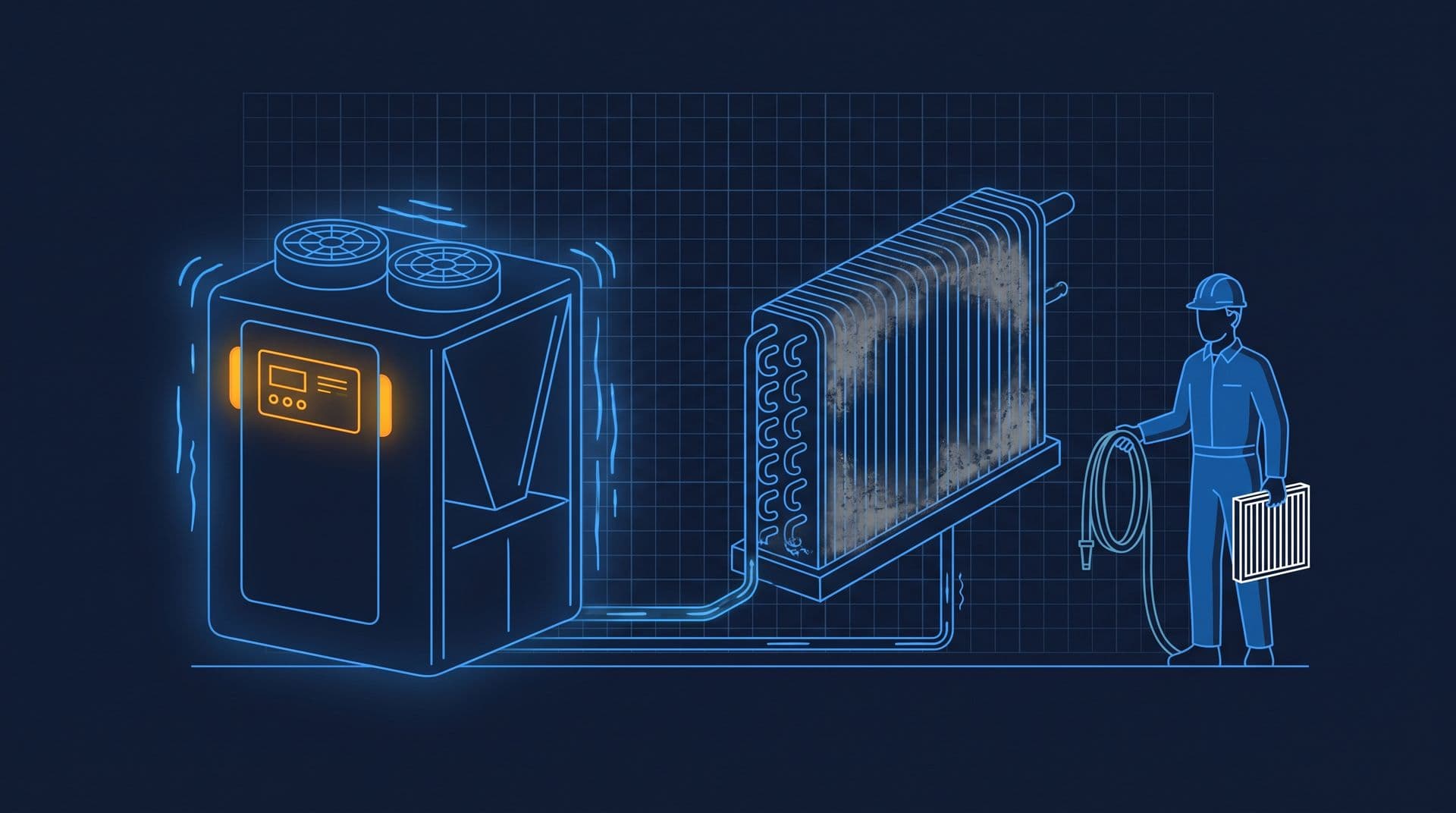
Part 18 of 20 in Cobler's Cooling Fundamentals course. New here? See the course page.
Part 17 ended with dirty coils as a common cause of low delta-T, and with a question about a second waste that starts when the plant is designed: does a cooling machine that is bigger than the building needs cost anything, if the extra size just sits there as spare capacity?
It does. "Size up to be safe" sounds sensible: the building might one day be hotter, fuller or busier than expected. So the consultant adds a margin, the contractor adds another, and the machine that arrives is larger than the building will ever need. An oversized cooling machine does not simply hold capacity in reserve: it switches on and off too often, which wastes energy, wears the machine faster and leaves rooms clammy. This part covers that problem, called short-cycling, and a second one that is even more common: coils so coated in dust that the surface meant to move heat starts to block it. Many complaints that "the chiller is struggling" are fixed with a coil clean and a filter change, and, at replacement time, with a machine sized from measured data.
If your building uses split units or cassettes (DX), like the shoplot, the sections on short-cycling and on dirty coils apply to you directly: small DX units short-cycle and their coils get dirty too. The sections on sizing and staging chillers are about central plants.
Oversizing starts with margins added on top of margins
Cooling equipment is usually sized before the building exists. The designer calculates the cooling load for the worst case: the hottest afternoon, a full building and every heat source running (How to Calculate a Building's Cooling Load, Part 6). Those calculations are already cautious. Then each party in the chain adds a little more "just in case".
The result is a machine sized for a peak that occurs rarely, if ever. As Part 15 showed, even a correctly sized chiller spends most of its hours at part load. An oversized one spends even more of its hours at light load, and some of them at loads too light for it to run steadily.
Short-cycling is running in short bursts, then stopping
Short-cycling is when a cooling machine runs for only a short time, switches off, then starts again soon after, over and over, instead of running steadily. The "short" refers to the short running time between stops.
A cooling machine works to hold a temperature at its setpoint, the target it is given. For a chiller, that is the chilled water temperature. For a split unit, it is the room temperature. When the building needs, say, 60% of what a well-sized machine can produce, the machine turns its output down and runs steadily.
An oversized machine may not be able to turn down that far. It produces far more cooling than the building is asking for, pulls the temperature down to setpoint in a few minutes, and switches off. A few minutes later the temperature has drifted back up, so it starts again, pulls the temperature down again, and stops again.
How easily this happens depends on the machine:
- Small machines with fixed-speed compressors, such as many older split units and small chillers, can only run at full output or stop. They short-cycle whenever they are much bigger than the load.
- Large chillers, like the centrifugal chillers in the office tower, can turn their output down smoothly, using guide vanes or a variable-speed drive (Part 15). They short-cycle only when the load falls below the lowest output they can hold steadily, for example on a quiet evening or a mild weekend.
A useful comparison is driving in traffic by pressing the accelerator hard, braking hard, then pressing hard again, instead of holding a steady speed. The car uses more fuel, the brakes and engine wear faster, and the ride is jerky. Short-cycling does the same to a cooling machine.
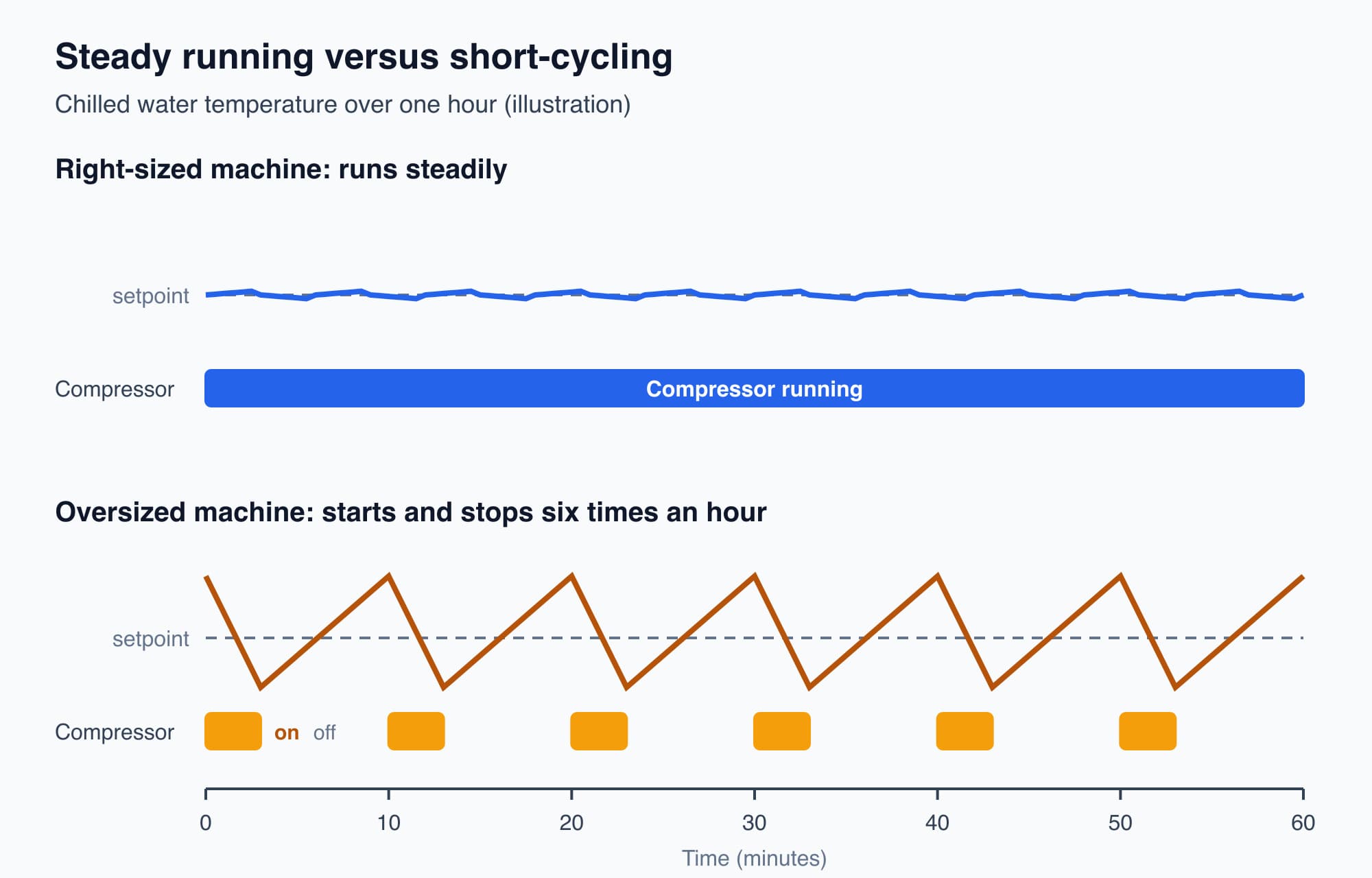
A machine that fits the load runs steadily. An oversized one keeps overshooting, stopping and restarting.
Each restart costs energy and wear, and the room gets clammy
Starting is the least efficient part of a machine's run. At start-up the compressor draws a surge of current, the oil and refrigerant are still settling, and the machine has not reached its normal operating conditions. A machine that runs steadily for an hour spends most of that hour working efficiently. A machine that starts six times an hour spends much of its time starting and never fully settles.
So short-cycling costs in three ways:
- Repeated inefficient start-ups. The least efficient part of the run keeps repeating.
- Extra wear. Every start stresses the compressor, its motor and the contactors that switch it. More starts mean a shorter life and more maintenance. (Monitoring energy and temperatures does not diagnose that wear, but an operator who sees a machine cycling knows to ask a technician to look.)
- Poor comfort, especially humidity.
The comfort problem comes from moisture. In Part 3 we saw that cooling does two jobs: it lowers the air temperature (sensible cooling) and it removes moisture from the air (latent cooling). Moisture is removed when water vapour condenses on a coil that is colder than the air's dew point. That only happens while the coil is cold, so drying the air needs the machine to keep running.
A short-cycling machine does not give it that time. It brings the temperature down quickly and switches off before it has dried the air properly. In Malaysia's humid climate, the room reaches its temperature setpoint but feels cold and clammy, and damp conditions can encourage mould. Occupants then turn the setpoint lower, which uses more energy and still does not fix the humidity. A steadier, right-sized machine would have given drier air at a higher, cheaper setpoint.
Right-size a replacement from the measured peak cooling load
The fix for oversizing is right-sizing: matching the installed cooling capacity to the building's measured peak cooling load, the most cooling it actually needed, plus a reasoned margin, rather than to a stack of safety margins.
For a new building, the load calculation is all you have. For a replacement plant, you can do much better, because the building already exists. Its true peak load, and its load profile (how demand rises and falls across the day, the week and the year), can be measured. Part 16 explains how: chilled water flow and temperatures give the cooling in kW (using the formula from Part 9), and dividing by 3.517 gives RT.
For example, a building assumed to need 500 RT might, on the evidence of a year's data, peak at 380 RT and spend most of its hours below 250 RT. Nobody can read that from a nameplate. It comes from a trend. Sizing the next plant from that evidence, rather than from default margins, is one of the most valuable decisions an owner makes.
Several smaller chillers follow the load better than one big one
The second fix is staging: instead of one large chiller, install several smaller ones and run only as many as the load needs. Good chiller plants are built this way. The office tower has three 500 RT chillers, two on duty and one on standby.
As Part 15 showed, a chiller typically runs most efficiently in the middle to upper part of its range, with cool condenser water, and less well at very light load, where it may also be unable to run steadily.
Compare two ways of serving a building whose cooling load swings between 100 RT on quiet evenings and 300 RT on busy afternoons:
- One 600 RT chiller. At 300 RT it runs at 50% load, which is within its working range. At 100 RT it runs at about 17% load, below the range where it works well and close to where it may have to stop and restart.
- Three 200 RT chillers. At 300 RT, two run at 75% each and the third is off. At 100 RT, one runs at 50% and the other two are off.
With staging, the plant adds a chiller as the building fills up and heats up, and drops one as the evening empties it. Each running machine stays in its working range. The opposite mistake also wastes energy: running more chillers than the load needs, each lightly loaded, with each one's pumps and tower fan also running. Part 15 and Part 17 described how that happens.
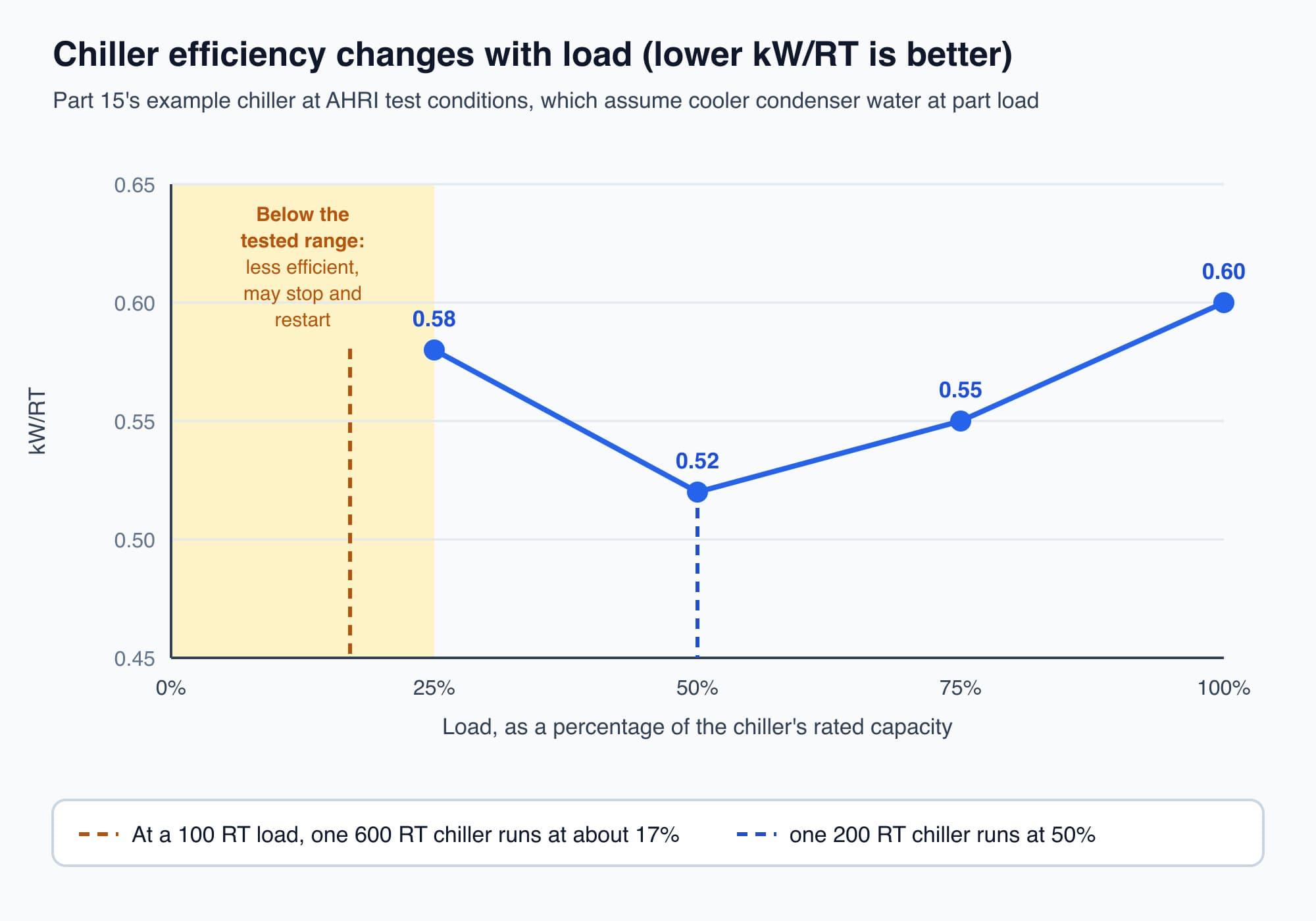
At a light 100 RT load, a single 600 RT chiller runs below its working range, while one of three 200 RT chillers runs at 50%.
A dirty coil is wrapped in a layer that blocks heat
Now the cheapest waste of all, and the one most likely to be in your building today.
A coil is a heat exchanger: rows of tubes with thin metal fins, carrying refrigerant or water, with air blowing across them. Its job is to offer a large, clean metal surface so heat crosses easily between the air and the fluid inside. Two coils matter here:
- The cooling coil, the cold coil that cools the air blown into the space. Every AHU, fan coil unit and split unit indoor unit has one.
- The condenser coil, the hot coil that releases the building's heat to the outdoor air. Split units and air-cooled chillers have one, in the outdoor unit.
Both sit in moving air, and the air carries dust, pollen, grease and dirt. Over months, the debris settles on the fins and builds into a felt-like layer. That layer resists heat transfer: the surface designed to pass heat now has a blanket over it. It also narrows the gaps between the fins, so less air gets through.
Dirty coils cut capacity and raise the power needed
A dirty cooling coil passes less heat from the air to the chilled water or refrigerant. The unit delivers less cooling than its rating, so it runs longer and harder for the same comfort, and a room at the end of the line may never reach its setpoint.
A dirty condenser coil cannot release heat as easily. The refrigerant then condenses at a higher temperature and pressure, and the compressor has to work harder to push the heat out: it uses more electricity for each unit of cooling. In a water-cooled plant like the office tower's, the condenser is a bundle of tubes inside the chiller, cooled by water from the towers. Scale and dirt inside those tubes have the same effect.
A dirty coil in an AHU also harms the whole chilled water plant, not just one room. The coil cannot pull heat out of the air well, so the AHU's valve opens wider and more chilled water flows through the coil for the heat it picks up. The water returns to the plant colder than it should. That is low delta-T (Part 17), and it makes the pumps move more water and can start extra chillers. One dusty coil adds cost across the entire plant.
Clean coils, clean filters and slower fans are the cheapest fixes
The remedies are cheap compared with almost anything else in the building:
- Clean the coils. Often this needs only a soft brush, a coil cleaner and a hose, used by trained maintenance staff with the unit switched off. It restores much of the lost capacity and efficiency for an afternoon's labour.
- Change the filters on schedule. Filters exist to stop dust reaching the coil. A clogged filter also restricts airflow, so the fan works harder and the coil gets too little air. New filters are cheap protection for the far more expensive coil behind them.
- Control fan speed. A fan that always runs at full speed, when the building needs only part of the airflow, wastes energy every hour. A variable-speed drive (VSD), an electronic controller that slows the fan motor to match demand, is one of the highest-return measures in building services. Rectifiers and Inverters in our Electricity Fundamentals course explains the electronics, and Part 11 covers fan-speed control in cooling.
Why are such cheap fixes so often neglected? From the outside, an AHU with a dirty coil looks the same as one with a clean coil. A coil that has lost part of its capacity gives no alarm, no error code and no puddle on the floor. It makes the plant work a little harder every hour, and the cost hides inside the total electricity bill, where no single person is responsible for it. These fixes get priority when the loss is measured: when someone can show from trends which unit is delivering less cooling than it should.
Worth knowing: The total of every machine's rated capacity, sometimes called the connected capacity, tells you what is installed, not what the building needs. Size a replacement from the measured peak cooling load instead.
What comes next: the controls that run the plant
So far this module has looked at the machines and what goes wrong with them. The next part, What Is a BMS? How Building Controls Run the Cooling Plant, looks at the building management system (BMS) and the control strategies that save energy. It answers the question: who decides which machines run, when and at what setpoints, and how do they stay coordinated?
Check your understanding
- A building's cooling load ranges from 100 RT on quiet evenings to 300 RT on busy afternoons. Why might three 200 RT chillers serve it better than one 600 RT chiller? At 100 RT, the single 600 RT chiller would run at about 17% load, below its working range and close to stopping and restarting. One of the 200 RT chillers would run at 50% load, in its working range. At 300 RT, both options run within their working range, so the smaller machines help most at light load.
- Why can a dirty cooling coil in one AHU raise the electricity use of the whole chilled water plant? The dirty coil passes less heat, so the AHU's valve opens wider and more chilled water flows through it for the heat it picks up. The water returns colder, which lowers the plant's delta-T. The pumps then move more water, and the plant may start extra chillers, all for the same cooling.
Recap: Margins added on top of margins make chillers and split units too big for their buildings. An oversized machine short-cycles: it runs in short bursts and stops, repeating its least efficient start-up, wearing faster and leaving rooms clammy because it stops before the air is dried. Size a replacement from the measured peak cooling load and load profile, not from connected capacity. Several smaller chillers, staged to the load, keep each running machine in its working range, especially at light load. Dirty coils block heat transfer, cut capacity, raise compressor power and cause low delta-T. Coil cleaning, filter changes and fan-speed control are the cheapest fixes, and measuring the loss is what gets them done.
Go deeper on video (optional)
This video looks at practical ways to improve an existing chiller's efficiency, including the coil and condenser cleaning covered above. It is optional.
The Engineering Mindset walks through the cheapest ways to improve an existing chiller's efficiency, including condenser and evaporator coil cleaning.
This is Part 18 of 20 in Cobler's Cooling Fundamentals course. Previous: Low Delta-T Syndrome: The Silent Efficiency-Killer of Chilled-Water Plants. Next: What Is a BMS? How Building Controls Run the Cooling Plant.
Cobler builds CobiNeural, a platform that shows a facility team its building's energy, water and indoor air data as live numbers across the whole site. To see how your building performs, talk to us.
FAQ
Frequently asked questions
Ask us about this topic
Something in this article you want to dig into — or a situation in your own building it doesn't quite cover? Send us your question. We don't run public comments; the team replies to you directly by email.