Blog
What Is a BMS? How Building Controls Run the Cooling Plant
What is a building management system? Learn the sense-compare-act control loop, BACnet vs Modbus, smart cooling strategies, and the honest limit of a BMS.
 Tan Kok XinCooling Fundamentals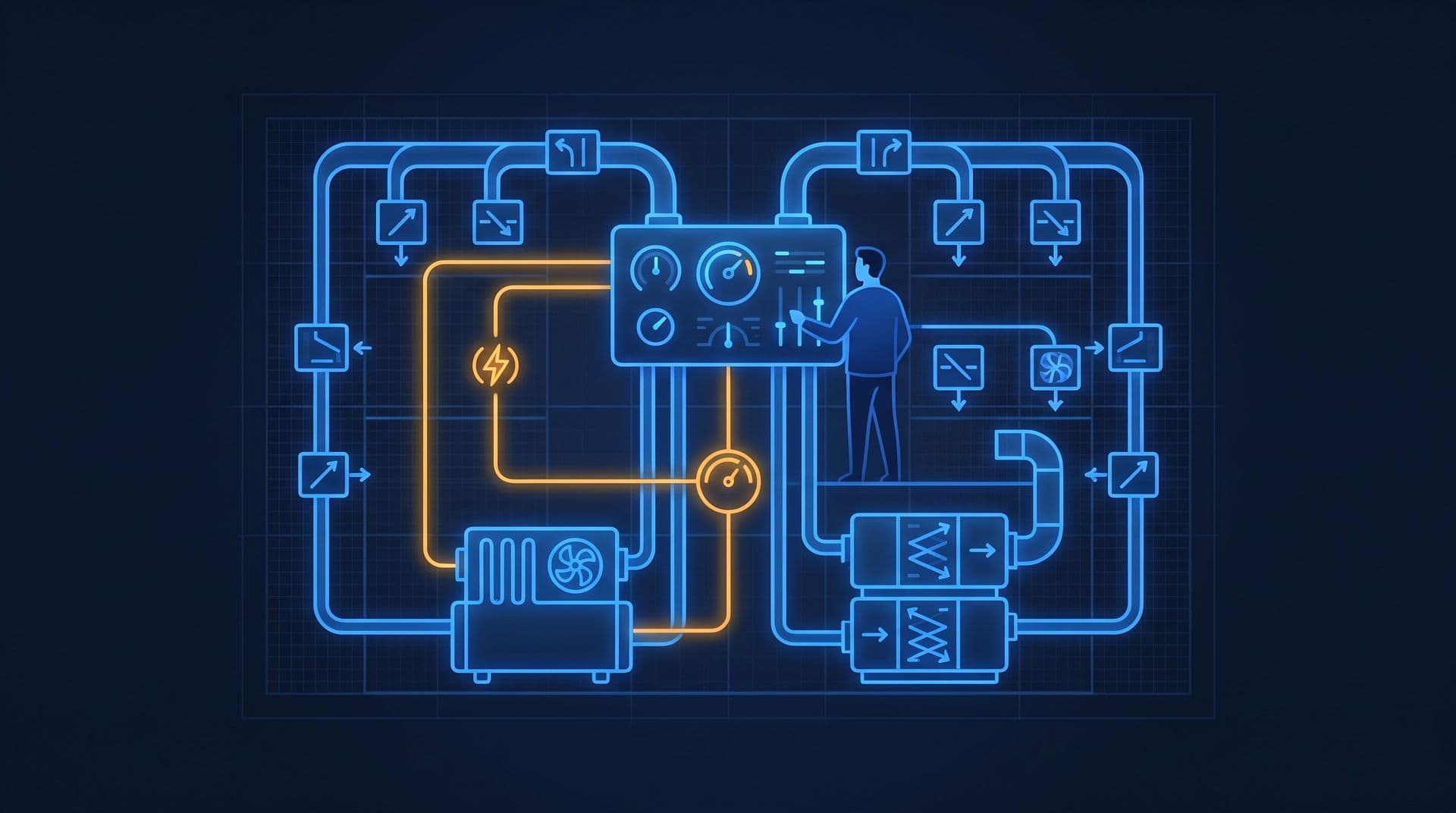
Part 19 of 20 in Cobler's Cooling Fundamentals course. New here? See the course page.
Part 18 looked at what goes wrong with the machines themselves. Something also has to decide which of them run, when and at what setpoints. A thermostat on an office wall makes one such decision: it measures the room, compares it with the temperature you asked for, and turns the cooling up or down. The office tower has hundreds of places that need the same kind of decision: every air handling unit (AHU), every variable air volume (VAV) box, every chiller, pump and cooling tower fan. Who decides all of those, and how do they stay coordinated?
The answer is the building management system (BMS). So, what is a building management system? It is a network of small controllers, each running its own equipment, joined to one central system where the facility team sets schedules and targets, receives alarms and watches trends. This part explains how a single control loop works, how the BMS joins the loops together, and the control strategies that save energy in a cooling plant.
If your building uses split units or cassettes (DX), like the shoplot, it probably has no BMS. Each unit has its own thermostat, and its remote control or timer sets its schedule. The first section (the control loop) and the parts about setpoints and schedules apply to you; the plant strategies in the section on control strategies do not.
Every control does the same three things: sense, compare, act
Every control in the building, from a wall thermostat to a chiller plant, repeats three steps:
- Sense: measure what is actually happening.
- Compare: check that reading against the setpoint, the target you want.
- Act: adjust something to close the gap.
Then it senses again, and repeats. This is called feedback control.
Take AHU-12A, which serves the east half of level 12 in the office tower. Its controller is set to deliver supply air at 14 °C. A sensor in the supply duct reads 15 °C, one degree too warm. The controller opens the chilled water valve on the cooling coil a little more. More chilled water flows through the coil, the air comes out cooler, and a moment later the sensor reads closer to 14 °C, so the controller eases the valve back. The same loop can hold a room temperature, a water pressure or a duct pressure.
How hard the controller should move the valve, so that it settles quickly instead of overshooting and swinging back and forth, is a question of tuning. Feedback and PID control explained covers it.
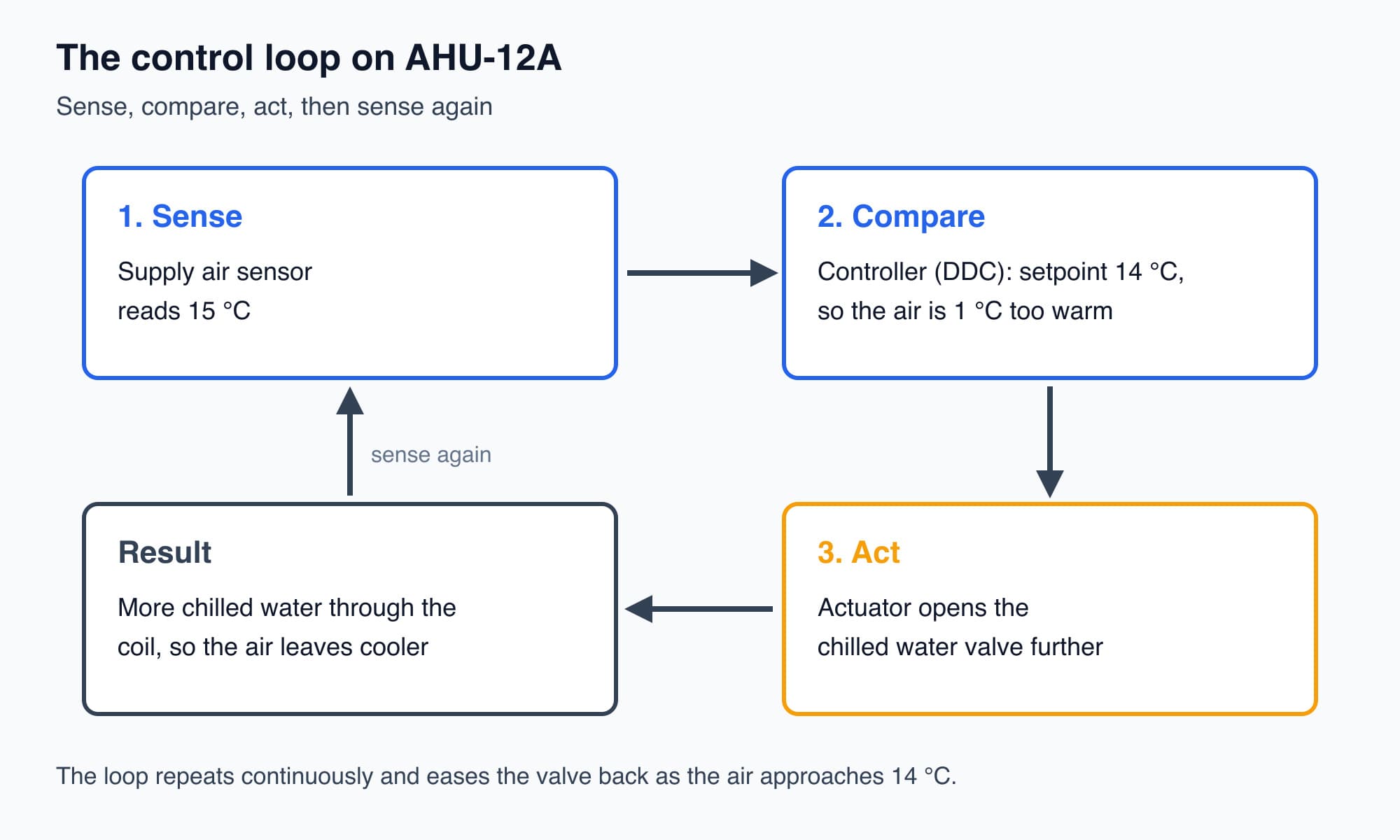
The control loop on AHU-12A: sense the supply air, compare it with the setpoint, act on the chilled water valve, then sense again.
Sensors, controllers and actuators do the three jobs
Each of the three steps has its own piece of equipment.
- Sensors do the sensing. In a cooling system they measure temperature (of chilled water, supply air and rooms), humidity, pressure (in the ducts or the water pipes) and carbon dioxide (CO2), which rises when more people are breathing in a space.
- Controllers do the comparing. In modern buildings each is a direct digital controller (DDC): a small dedicated computer that runs the compare-and-decide logic in software. "Direct digital" means a microprocessor makes the decision, rather than an older pneumatic or mechanical device.
- Actuators do the acting. An actuator is the part that moves: a motor that opens a valve, a motor that turns a damper to let more or less air through, or a variable-speed drive (VSD) that changes the speed of a pump or fan.
The VSD deserves a closer look. It lets the controller run a motor at any speed, instead of only full speed or off, so the BMS can slow a pump or fan to match the load. It does this with power electronics, explained in Rectifiers and Inverters in our Electricity Fundamentals course.
What is a building management system? One system that joins the loops
A single control loop manages one thing. A building management system (BMS), also called a building automation system (BAS), ties all the loops together into one coordinated system.
In the office tower, the BMS controls the AHUs, the VAV boxes, the chiller plant (which chillers run, and in what order), the car park ventilation fans and the lighting schedules.
The facility team works with the BMS through one central screen, where they can:
- Set schedules, such as starting the chiller plant before office hours and easing it back after hours.
- Receive alarms, such as a chiller that has tripped or a room that is drifting warm.
- Watch trends, which are recorded readings plotted over time.
Instead of walking the plant room with a clipboard, one person can supervise the whole building from a desk.
For all this equipment to share one system, the controllers need a common language, called a communication protocol. The office tower's BMS uses one called BACnet, and it reads data from the chillers through a gateway that translates another protocol, Modbus. How these protocols work, and how to choose and commission them, is covered in our Building Automation Fundamentals course. For this course, you only need to know that the BMS can read and command all the cooling equipment.
Control strategies adjust setpoints to save energy
A BMS that only held fixed setpoints would already be useful. Most of the energy savings come from control strategies: logic that changes setpoints and decides which equipment runs as conditions change. These are the main ones in a cooling plant.
Chiller staging and sequencing. Most plants have several chillers. The BMS stages chillers on and off, so that just enough are running for the load, and sequences them, deciding which one starts first. As Part 18 showed, the aim is to keep each running chiller in its working range and avoid running extra machines with their own pumps and tower fans. If the staging logic starts chillers based on water flow, low delta-T (Part 17) can fool it into starting chillers it does not need.
Chilled water temperature reset. On a mild or lightly loaded day, the AHUs do not need water as cold as 6 °C. Raising the chilled water setpoint a little lets the chillers work less hard, so they use fewer kilowatts of electricity for each RT of cooling (a lower kW/RT). There are two limits. Warmer chilled water makes the AHU valves open wider, so the pumps move more water. And in Malaysia's humid climate, warmer water makes the coils warmer, so they remove less moisture from the air (Part 3). A good reset strategy watches valve positions and humidity as well as the chiller.
Condenser water temperature reset. On the other side of the chiller, the cooling towers cool the condenser water. When the outdoor air allows, the BMS can let the towers make that water cooler, which lowers the lift the compressor must provide and reduces its power. How cool the towers can get the water is limited by the outdoor wet-bulb temperature (Part 12), and colder water needs more tower fan power, so the best setpoint balances the two within the limits the chiller maker allows.
Duct static pressure reset. On the air side, each AHU's supply fan holds a set pressure in its duct so the VAV boxes can draw the air they need (Part 11). When the VAV boxes are asking for little air, the BMS lowers that pressure setpoint, and the fan, on its VSD, slows down instead of pushing against an unnecessarily high target.
Demand-controlled ventilation (DCV). Outside air must be cooled and dried, so bringing in more than people need wastes energy. With DCV, the BMS uses CO2 sensors to estimate how many people are present and brings in outside air to match. When a space is nearly empty, it brings in less; when the space fills up, it brings in more. Part 4 explains CO2 as a guide to ventilation.
Schedules and unoccupied setpoints. The simplest strategy is to run cooling only when people are there. When a zone is empty, the BMS can let its cooling setpoint drift up, so the plant eases off instead of cooling an empty room to a daytime target.
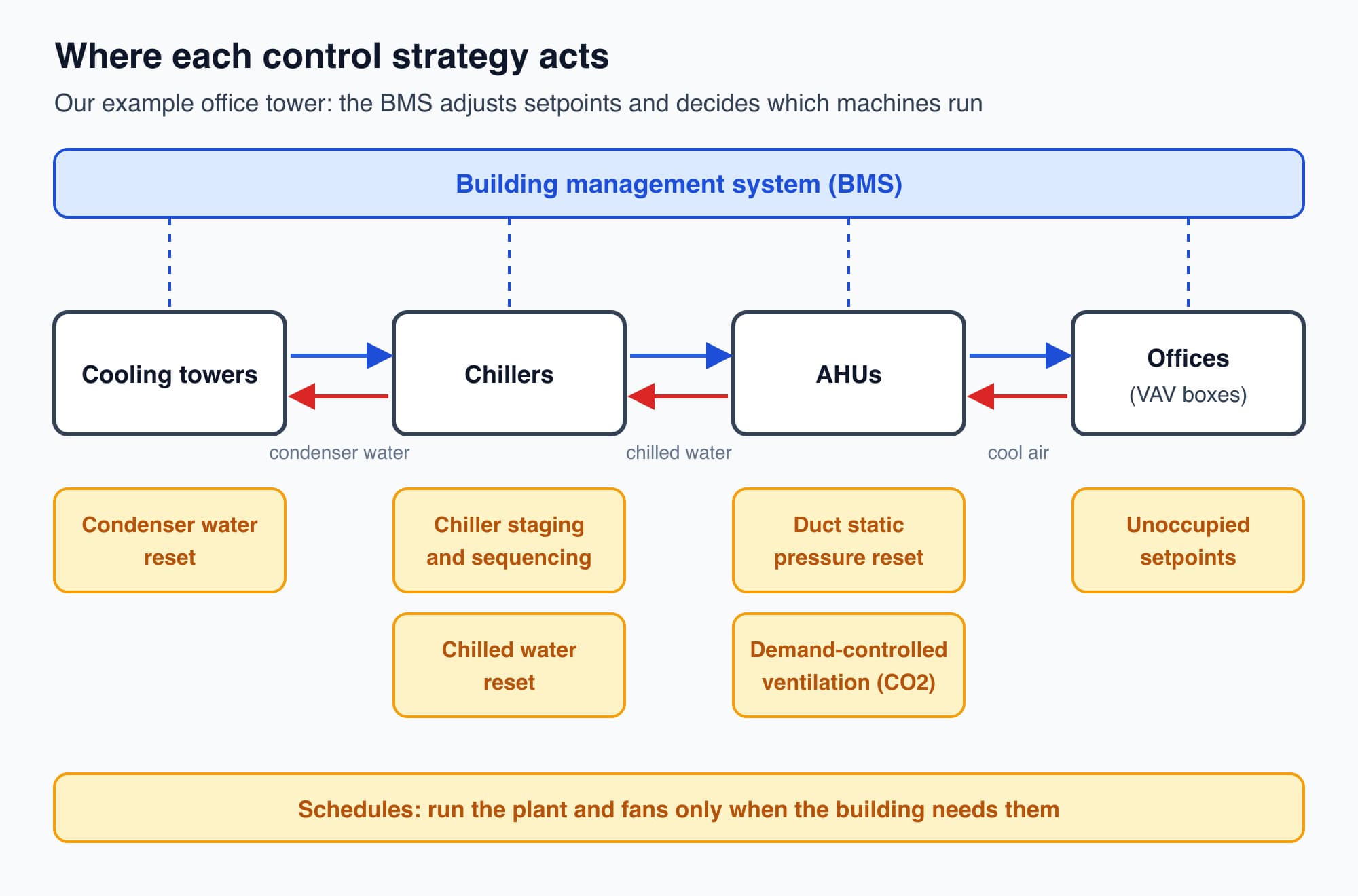
Each strategy adjusts one setpoint or decides which machines run, at one point in the plant.
A BMS controls the plant now; judging performance needs measurement
A BMS is very good at one job: deciding and acting, right now. It senses this moment, compares it with the setpoint, and moves a valve or a drive to keep the building comfortable. A well-set-up BMS does this all day without a break.
Judging whether the building is running well over months is a different job. The BMS will hold whatever setpoints it is given, including ones that cost money. It does not, by itself, tell you that a chiller's kW/RT has drifted up over a year, or that this month's plant is performing worse than last year's. To answer that, someone needs a record of flow, temperatures and electrical power kept over months, and needs to compare it with a baseline, as Part 16 described.
So the BMS answers "what should run right now?" Measurement answers "is the building running well, and is it getting better or worse?" A building needs both.
Worth knowing: Many BMS installations keep only limited trend history. The long-term record of flow, temperatures and power that shows whether a plant is getting better or worse is therefore often kept in a separate monitoring system.
Optional detail: Variable-speed drives distort the current they draw and add electrical harmonics to the building's supply, which the electrical designer must allow for when a building has many of them.
What comes next: a worked plant check
This is the last new idea in the course. The final part, One Complaint, Three Loops: A Worked Cooling Plant Check, gives you trend data from the office tower and a warm, humid complaint on level 12, and asks you to use the tools from the whole course to answer one question: which of the three loops is causing it, and how do you find out?
Check your understanding
- AHU-12A's supply air is 15 °C and its setpoint is 14 °C. Describe what the control loop does. The sensor measures 15 °C (sense). The controller compares it with 14 °C and finds the air one degree too warm (compare). It opens the chilled water valve further, so more chilled water flows through the coil (act). It then measures again and eases the valve back as the air approaches 14 °C.
- Why can raising the chilled water temperature on a mild day save energy, and what limits it in Malaysia? Warmer chilled water lets the chillers work less hard, so they use fewer kW for each RT of cooling. But the AHU valves open wider, so the pumps move more water, and warmer coils remove less moisture from the air. In a humid climate, the reset must stop before rooms become humid.
Recap: Every control senses, compares with a setpoint and acts, then repeats. Sensors measure, DDC controllers decide, and actuators (valves, dampers and VSDs) move. A building management system joins all the loops, with schedules, alarms and trends on one screen; protocols such as BACnet and Modbus let the equipment share data, and the Building Automation Fundamentals course covers them. The main cooling strategies are chiller staging and sequencing, chilled water reset, condenser water reset, duct static pressure reset, demand-controlled ventilation and schedules. A BMS controls the plant in the present; judging performance over months needs measured data compared with a baseline.
Go deeper on video (optional)
This video walks through a complete office building's cooling system in 3D, showing where the sensors, controllers and BMS fit. It is optional, but it is a good picture of how the parts of this course connect.
The Engineering Mindset walks a full 3D HVAC system for an office building, showing how sensors, controllers and the BMS work together to cool the plant.
This is Part 19 of 20 in Cobler's Cooling Fundamentals course. Previous: Oversized Chillers, Short-Cycling and Dirty Coils: The Cheapest Efficiency Wins. Next: One Complaint, Three Loops: A Worked Cooling Plant Check.
Cobler builds CobiNeural, a platform that shows a facility team its building's energy, water and indoor air data as live numbers across the whole site. To see how your building performs, talk to us.
FAQ
Frequently asked questions
Ask us about this topic
Something in this article you want to dig into — or a situation in your own building it doesn't quite cover? Send us your question. We don't run public comments; the team replies to you directly by email.