
Blog
Low Delta-T Syndrome: The Silent Efficiency-Killer of Chilled-Water Plants
Low delta-T syndrome forces chilled-water plants to over-pump and over-stage chillers for the same comfort. Learn what it is and why it hides on the bill.
 Tan Kok XinCooling Fundamentals
Part 17 of 20 in Cobler's Cooling Fundamentals course. New here? See the course page.
Part 16 showed how two temperature sensors and a flow meter measure the cooling a plant delivers. The same sensors reveal one of the most common faults, so what does low delta-T look like, and why does it waste energy?
Take a busy weekday afternoon in the office tower. The offices are comfortable and nobody has called the helpdesk. In the plant room, the chilled water leaves the chillers at 6 °C, as designed. It was designed to come back from the building at 12 °C, but today it comes back at 9 °C. Is anything wrong? Yes. That 3 °C shortfall means the plant is pumping more water, and often running more chillers, than the building needs. The name for it is low delta-T syndrome, and it is one of the most common ways a chilled water plant wastes energy while every room stays comfortable. This part explains what it is, why it costs money, where it comes from and how to find it.
If your building uses split units or cassettes (direct expansion, or DX), like the shoplot, it has no chilled water, so you can skip this part. Dirty coils, which the next part covers, apply to your building too.
Delta-T is how much the chilled water warms up
Delta-T (written ΔT, meaning "difference in temperature") is the difference between the water coming back to the chillers and the water going out:
$$\Delta T = T_{return} - T_{supply}$$
In the office tower, the chillers send water out at 6 °C and it is designed to come back at 12 °C, so the design delta-T is 6 °C (Part 8 explained that this is a common design choice, not a rule).
The water warms up because it has done its job. It leaves the chiller cold, flows to the cooling coils in the air handling units (AHUs) and fan coil units, picks up heat from the building's air, and returns warmer. The bigger the rise, the more heat each litre of water carried away.
Cooling depends on flow multiplied by delta-T
The cooling a chilled water loop delivers depends on two things: how much water flows, and how much each litre warms up. In Pumps, Valves and Flow (Part 9) we used this relationship:
cooling (kW) = flow (L/s) × 4.19 × ΔT (°C)
It shows that the same cooling can be delivered in two ways. Take one of the office tower's 500 RT chillers at full output: 500 × 3.517 = 1,758.5 kW of cooling.
- At the design delta-T of 6 °C, the flow needed is 1,758.5 ÷ (4.19 × 6) = about 70 L/s.
- At a delta-T of only 3 °C, the flow needed is 1,758.5 ÷ (4.19 × 3) = about 140 L/s.
Halving the delta-T doubles the water the pumps must move for the same cooling.
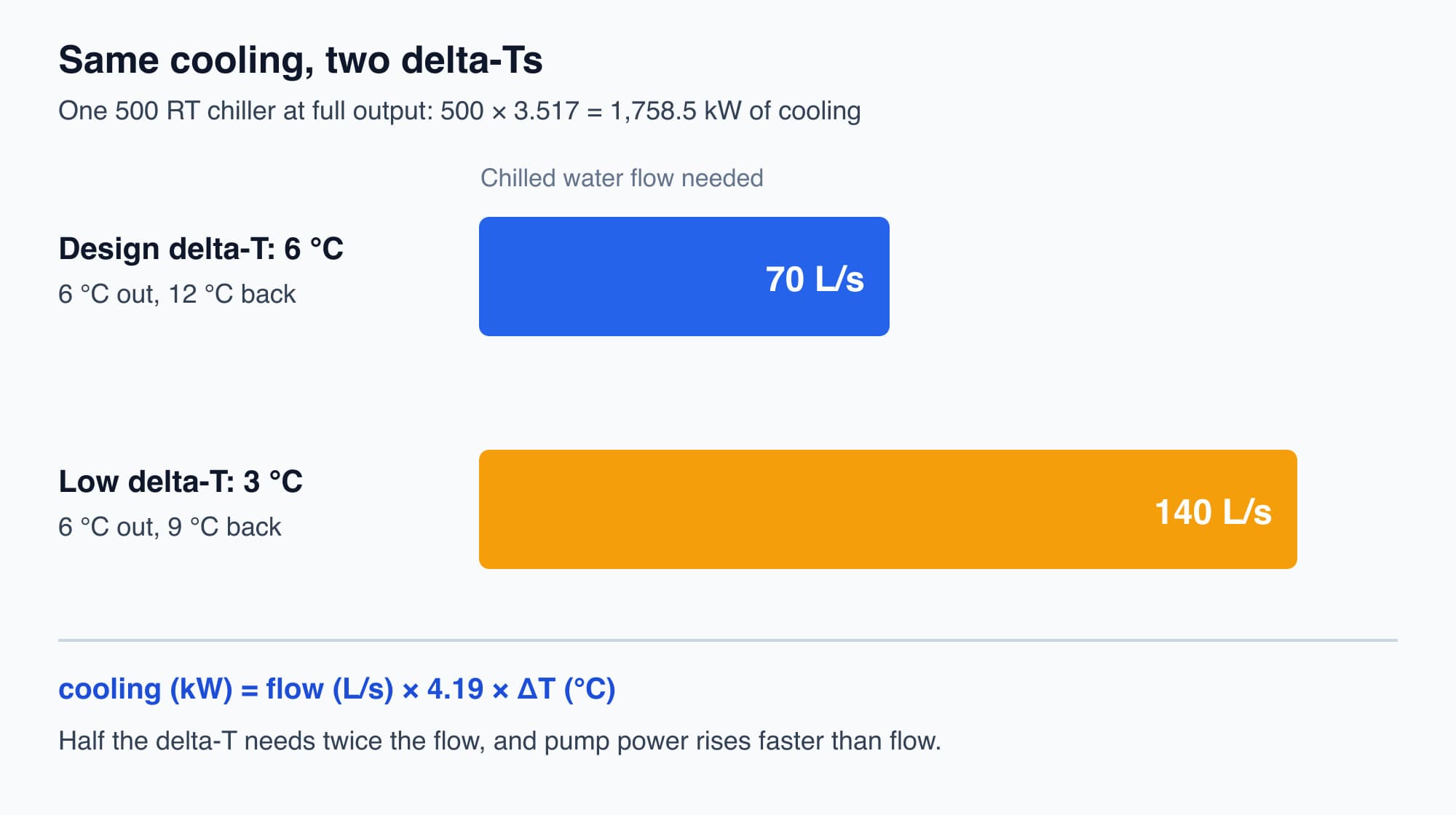
The same cooling at half the delta-T needs twice the water flow, and the pumps must move all of it.
Low delta-T syndrome means the rise stays well below design
Every chilled water plant is designed around a target delta-T. Its chillers, pipes, pumps and control logic are all sized on the assumption that the water comes back with that full rise.
Low delta-T syndrome is the condition where the actual delta-T stays well below the design figure, especially during busy hours. In the opening example, the water returns at 9 °C instead of 12 °C, so the delta-T is 3 °C instead of 6 °C. Each litre of water is doing about half the cooling work it was designed to do.
The building still needs the same total cooling. So the plant has to move about twice as much water to deliver it.
A small delta-T makes the pumps and chillers work harder
The extra water has three costs: more pump energy, extra chillers running and, as the box at the end of this part shows, lost capacity.
The pumps use much more energy. Pumps are driven by electric motors, and How Electric Motors Work explains that side. In a closed chilled water loop, the pressure a pump must supply rises steeply as more water is pushed through the same pipes, so pump power rises faster than flow. In the ideal case described by the cube law for pumps (Part 9), twice the flow needs about eight times the pump power. Real plants whose pumps hold a set pressure see a smaller rise, but pushing twice the flow always takes more than twice the power. None of this extra energy makes the building any cooler.
The plant starts chillers it does not need. The office tower has primary-secondary pumping (Part 9). Each running chiller has its own constant-speed primary pump, which moves about 70 L/s through it. Separate secondary pumps, with variable speed drives, send water out to the building. Suppose the building needs 600 RT of cooling (2,110.2 kW):
- At a 6 °C delta-T, the building needs about 84 L/s. Two chillers, with 140 L/s between them, deliver 600 RT easily, each at 300 RT.
- At a 3 °C delta-T, the building needs about 168 L/s. That is more than the 140 L/s the two chillers' pumps provide. The extra water flows back through the decoupler pipe, and warm return water mixes into the supply, so the water going to the building is warmer than 6 °C. The controls respond by starting the third chiller and its pump. Now three chillers share 600 RT at 200 RT each.
The third chiller also brings its own condenser water pump and cooling tower fan. More machines run for the same cooling.
These costs show up in the plant's efficiency figure, kW/RT: the electrical kilowatts the whole plant uses for each refrigeration ton of cooling it delivers. COP, EER and kW per Ton (Part 13) explains it. Low delta-T adds pump kilowatts and extra machines without adding any tons, so kW/RT rises.
Low delta-T comes from cold water reaching the return without doing its work
Low delta-T usually has several small causes rather than one big one. Most of them let cold water reach the return pipe before it has picked up its full share of heat.
- Dirty or fouled cooling coils. Dust on the coil's fins resists heat transfer. The AHU's valve opens wider to try to reach its supply air temperature, more water flows through the coil, and each litre picks up less heat. The next part covers dirty coils in detail.
- Three-way valves. Some older AHUs use a three-way valve. When less cooling is needed, it sends part of the cold water straight around the coil into the return pipe, instead of reducing the flow. That cold water mixes with the warmer water from the coil and pulls the return temperature down. A two-way valve reduces the flow instead, so it does not do this (Part 9).
- Bypass and decoupler flow. Anywhere cold supply water flows directly into the return, through a bypass line, a leaking valve or a badly controlled decoupler, it lowers the return temperature.
- Supply air setpoints the coil cannot reach. If an AHU is told to make its supply air colder than the chilled water allows, its valve stays fully open. Water keeps flowing through the coil, but the coil cannot take much more heat from the air, so the water returns cool.
- Coils and valves chosen for a smaller delta-T than the plant was designed for, or control valves too large to control the flow finely. These pass more water than the heat they pick up needs.
- Sensor errors. Sometimes the delta-T is fine and the reading is wrong. A supply or return sensor that drifts by a degree or two can hide a real problem or create a false one. A trustworthy delta-T needs trustworthy sensors.
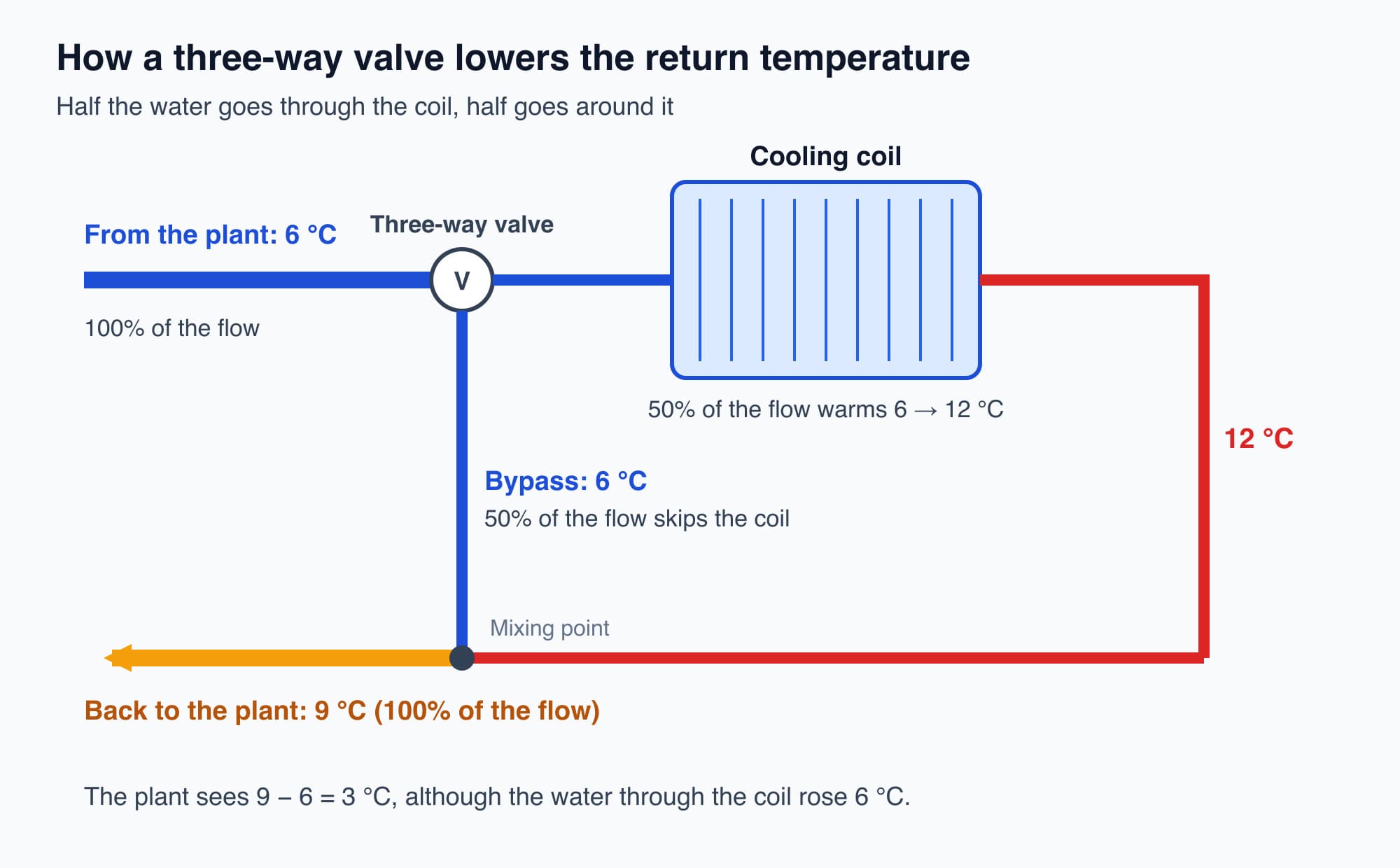
When half the water bypasses the coil, 6 °C bypass water and 12 °C coil water mix, and the plant sees a 9 °C return.
Low delta-T is hidden in the plant room, so you find it by measuring
Most plant problems announce themselves. A failed pump trips an alarm, and a warm office produces complaints. Low delta-T does neither. The rooms stay comfortable because the plant makes up for it with more water and more machines. The only symptom is a higher electricity bill, spread across every hour of operation.
You find it by measuring:
- Put calibrated temperature sensors on the chilled water supply and return pipes.
- Trend the difference through busy hours, not just once.
- Compare it with the plant's design delta-T.
- Add a flow reading, so you can see whether a lot of water is moving for a small temperature rise.
If the delta-T stays well below design while the building is working hard, the syndrome is present. A slow drift in delta-T only shows up over weeks of recorded data, which is why a chilled water plant benefits from trending its supply temperature, return temperature and flow continuously, rather than checking them once a year. The previous part (Part 16) explains where these meters go and how to read them.
Worth knowing: Low delta-T can make a plant look too small. With water returning at 9 °C and leaving at 6 °C, each chiller can only cool its 70 L/s by 3 °C. That is 70 × 4.19 × 3 = 879.9 kW, or about 250 RT, from a chiller rated 500 RT. All three chillers together can then deliver only about 750 RT, although the building's peak cooling load is about 900 RT. The chillers are not the problem: the water is coming back too cold.
What comes next: oversized chillers and dirty coils
Dirty cooling coils are one of the most common causes of low delta-T. The next part, Oversized Chillers, Short-Cycling and Dirty Coils, explains what dirty coils cost, together with a second waste that starts when the plant is designed. It opens with the question: does a cooling machine that is bigger than the building needs cost anything, if the extra size just sits there as spare capacity?
Check your understanding
- The office tower needs 600 RT. How much chilled water must flow at the design delta-T of 6 °C, and how much at a delta-T of 3 °C? 600 RT is 2,110.2 kW. At 6 °C: 2,110.2 ÷ (4.19 × 6), about 84 L/s. At 3 °C: 2,110.2 ÷ (4.19 × 3), about 168 L/s, twice as much water for the same cooling.
- The offices are comfortable, but the chilled water returns at 9 °C instead of the design 12 °C. Why does this cost money if nobody feels it? Each litre of water carries only about half its design heat, so the pumps must move about twice as much water for the same cooling, and the plant may start extra chillers with their own pumps and tower fans. The building gets the same comfort, but the plant uses more electricity for it.
Recap: Delta-T is the chilled water's temperature rise: return minus supply. Cooling (kW) = flow (L/s) × 4.19 × ΔT, so halving the delta-T doubles the water needed for the same cooling. Low delta-T syndrome is a delta-T that stays well below design. It makes the pumps use far more energy, starts extra chillers and limits the plant's real capacity, so kW/RT rises. Common causes are dirty coils, three-way valves, bypass flow, unreachable supply air setpoints, poorly chosen coils and valves, and faulty sensors. Occupants cannot feel it, so you find it by trending supply and return temperatures and flow.
Go deeper on video (optional)
This short video explains chilled water delta-T with animations. It covers the same idea as the first two sections, so it is optional.
The Engineering Mindset breaks down chilled-water delta-T (supply vs. return temperature) in plain terms, the core concept the whole article rests on.
This is Part 17 of 20 in Cobler's Cooling Fundamentals course. Previous: BEI Malaysia: Scoring Your Building's Cooling by Measuring It. Next: Oversized Chillers, Short-Cycling and Dirty Coils: The Cheapest Efficiency Wins.
Cobler builds CobiNeural, a platform that shows a facility team its building's energy, water and indoor air data as live numbers across the whole site. To see how your building performs, talk to us.
FAQ
Frequently asked questions
Ask us about this topic
Something in this article you want to dig into — or a situation in your own building it doesn't quite cover? Send us your question. We don't run public comments; the team replies to you directly by email.