Blog
District Cooling Malaysia: What You Actually Pay For
Putrajaya's ministries have run without their own chillers since 1999. How district cooling works in Malaysia, what RT and RTh mean on the bill, why delta-T can cost you, and what running a plant at 0.7 kW/RT taught us about the economics.
 Tan Kok XinHVAC & Chiller Plants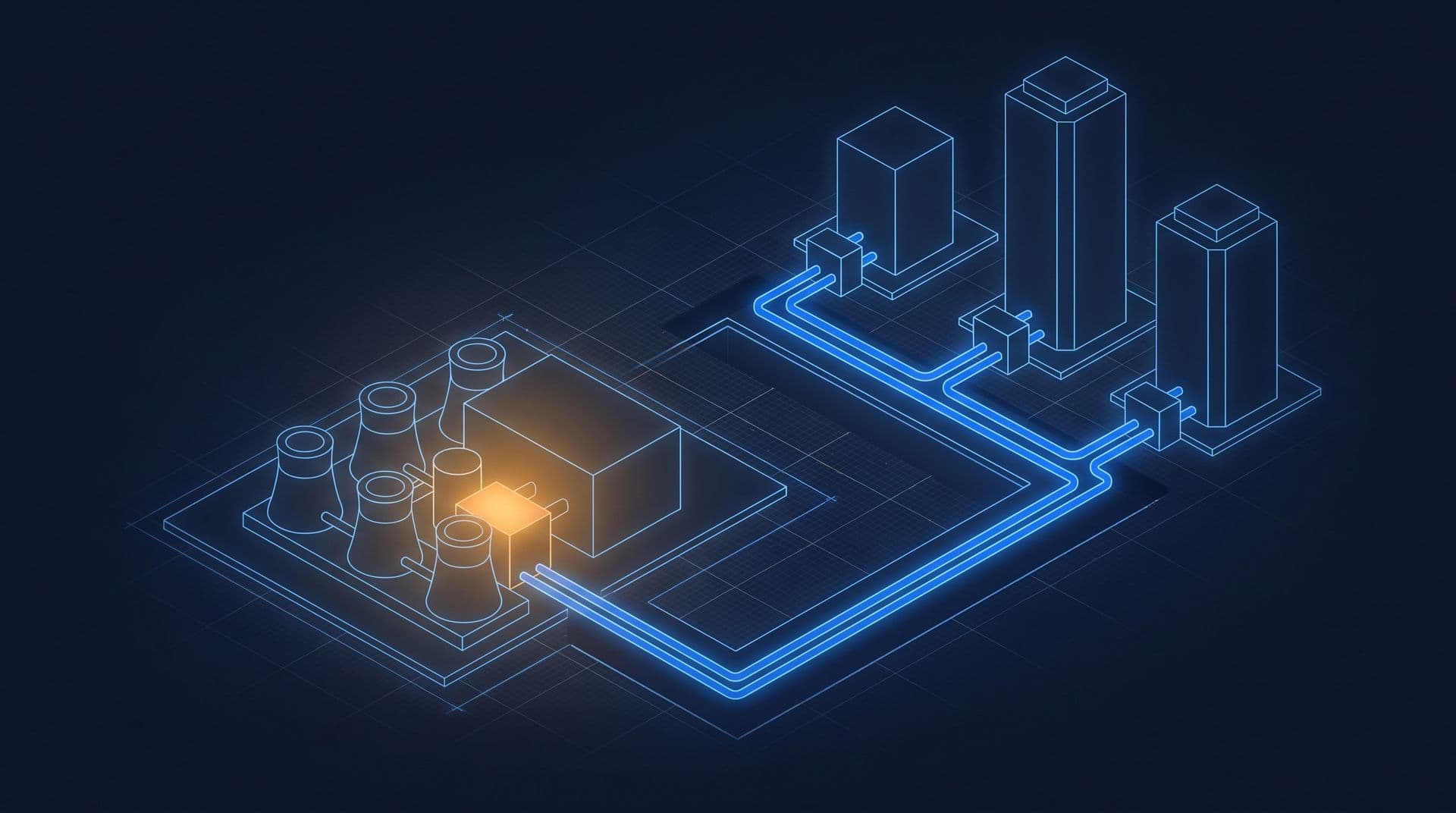
In a typical district cooling Malaysia contract, you pay for reserved cooling capacity and the cooling your building uses. Your contract sets the rates, adjustments and minimum-consumption terms.
Since 1999, most government buildings in Putrajaya have used district cooling instead of owning chillers. A central plant near the ministries makes chilled water around the clock and pumps it through insulated underground pipes to dozens of buildings. Each building takes cooling through a basement heat exchanger and returns warmer water to the plant.
Malaysia operates some of the region's largest district cooling schemes. For an owner, buying cooling removes the need to own chillers, but whether it saves money depends on the contract and how the building runs.
In short
- A district cooling contract typically charges for reserved cooling capacity plus the cooling your building actually uses, set by your specific contract terms.
- Since 1999, most government buildings in Putrajaya have run on district cooling instead of owning chillers.
- Plant efficiency and delta-T, the temperature difference between supply and return chilled water, affect your cost even though you do not operate the plant yourself.
- Check your bill against the boundary meter, not your own building's estimate.
Who runs district cooling in Malaysia?
The three longest-running schemes serve Putrajaya, Kuala Lumpur City Centre (KLCC) and Kuala Lumpur International Airport (KLIA), and Cyberjaya.
Area | Operator | Notes |
|---|---|---|
Putrajaya | PETRONAS group; supplies government precincts under a long-term concession dating from 1999 | |
KLCC and KLIA | Malaysia's largest district cooling provider; runs co-generation plants, which produce electricity and useful heat, and cooling plants in the Klang Valley | |
Cyberjaya | Sole district cooling provider in Cyberjaya since 1998 |
Newer districts also have central plants. Tun Razak Exchange in Kuala Lumpur supplies its towers and mall from a central energy plant. Hospitals and universities increasingly use the same model on a smaller scale, with one plant serving several buildings.
Malaysia needs cooling throughout the year. With no winter, a central plant can run profitably all year, and buildings sharing a large, well-run plant can use less energy than those with separate, poorly maintained chiller rooms. The efficiency advantage depends on how well the shared plant operates.
How chilled water reaches your building
The central plant sends chilled water through a distribution network to a heat exchanger in your building. Each part has a different job:
- The central plant contains chillers, pumps, cooling towers and controls. Many plants also store chilled water in large tanks. They make it at night, when electricity is cheaper and demand is lower, and use it during the afternoon peak.
- The distribution network carries supply water to buildings, typically at about 4 to 6 °C, and returns warmer water to the plant.
- The energy transfer station (ETS) contains plate heat exchangers that transfer cooling to your building's own chilled-water loop. The district and building water circuits do not mix. A billing meter records the cooling delivered at the ETS.
The operator's responsibility ends at the heat exchanger. You still manage the secondary pumps, air handling units (AHUs), fan coil units (FCUs), operating schedules and tenant comfort. These need a properly tuned building management system (BMS).
Connecting to district cooling will not resolve hot-office complaints caused by the equipment that moves and cools air inside the building. For that part of the system, see how a chilled-water system works.
What a district cooling Malaysia bill charges for
A typical bill has a capacity charge and a consumption charge, plus contract adjustments. The distinction is similar to capacity and usage on a Tenaga Nasional Berhad (TNB) maximum-demand bill.
A refrigeration tonne (RT) measures the rate of cooling being delivered. One RT equals 3.517 kilowatts (kW) of cooling. A refrigeration tonne-hour (RTh) measures the amount delivered over time: 1 RT sustained for one hour.
For example, a building drawing an average of 800 RT over a 10-hour working day uses:
$$800\ \text{RT} \times 10\ \text{h} = 8{,}000\ \text{RTh}$$
Over 30 such days, consumption reaches 240,000 RTh. The contract applies one rate to reserved capacity and another to metered consumption:
$$\text{Bill} = C_{\text{cap}} \times RT_{\text{contracted}} + C_{\text{use}} \times RTh_{\text{metered}} + \text{adjustments}$$
The capacity rate, \(C_{\text{cap}}\), is multiplied by your contracted RT. This charge pays for the right to draw that capacity whether you use it or not, and funds the operator's plant and pipes. The consumption rate, \(C_{\text{use}}\), is multiplied by the RTh recorded by the meter.
Rates and definitions differ between schemes and contracts, so one headline rate is not enough to compare proposals. Contracting too much capacity means paying every month for cooling you do not use. Contracting too little can make expansion difficult.
Before signing, check:
- How contracted capacity is set and whether measured peaks can reset it.
- What the minimum-consumption clause requires you to pay.
- Who owns the billing meter and who calibrates it.
Plant efficiency affects the cost of cooling
A plant's electricity use per unit of cooling affects what it costs to operate. The measure is kW/RT: kilowatts of electricity used for each refrigeration tonne of cooling delivered. Most plants operate between 0.85 and 1.0 kW/RT.
The plant serving the Employees Provident Fund (EPF), Malaysia's national retirement fund, holds 0.7 kW/RT through the day against a target of 0.7. Cobler delivered the BMS for this district cooling plant serving EPF's headquarters on a project led by Malaysian Resources Corporation Berhad (MRCB). The building operates around the clock, so the controls must maintain efficiency as cooling demand changes.
For illustration, a plant delivering 5,000 RT that improves from 0.9 to 0.7 kW/RT reduces electrical demand by:
$$(0.9 - 0.7)\ \text{kW/RT} \times 5{,}000\ \text{RT} = 1{,}000\ \text{kW}$$
That is a megawatt less electrical power for the same cooling, sustained while the plant runs at that load. This efficiency allows an efficient operator to offer a competitive tariff that an inefficient operator cannot match. It also gives you a comparison for your own chiller room if you keep it.
Most of the improvement from 0.9 to 0.7 comes from staging, which means choosing how many chillers run as demand changes. Chillers have an efficient operating range and waste energy when lightly loaded or running at full output. The controls let the most efficient machine carry the base load and switch a chiller off as soon as demand falls enough.
Pumps and cooling towers then follow the actual load instead of serving unused capacity. Maintaining 0.7 through the day takes continuing adjustments by the control system as demand rises and falls.
Low delta-T increases water flow and can raise charges
Low delta-T forces the network to move more water to deliver the same cooling. Delta-T is the difference between the return-water and supply-water temperatures.
Cooling power depends on the water flow, water's specific heat and this temperature difference. Specific heat describes how much heat is needed to change the water's temperature:
$$Q = \dot{m} \times c_p \times \Delta T$$
Here, \(Q\) is cooling power, \(\dot{m}\) is water flow, \(c_p\) is water's specific heat and \(\Delta T\) is delta-T. If delta-T falls, flow must rise to remove the same amount of heat.
A building designed for a 6 °C delta-T but operating at 4 °C needs:
$$\frac{6}{4} = 1.5 \times \text{the design water flow}$$
That means half again as much water for the same cooling. The extra flow uses pumping energy and network capacity that the operator planned to supply to other customers.
Common causes on the building side include:
- Control valves stuck open or leaking.
- Oversized bypasses that let water return without absorbing enough heat.
- Fouled coils or inaccurate sensors.
- AHUs operating beyond their coils' ability to absorb heat.
These faults return water cooler than intended. Many contracts address low delta-T through a penalty rate, a flow limit or a minimum return temperature. Check your contract and investigate what causes low delta-T syndrome and how to fix it.
Should you connect, or keep your own chillers?
Choose by comparing costs over the full contract term and testing them against different cooling loads. The main trade-offs are:
Issue | Own chillers | District cooling |
|---|---|---|
Upfront cost | You fund chillers, towers and the plant room | Connection and ETS costs only; the plant is off-site |
Space | Plant room and roof space for heat rejection | A compact ETS room |
Redundancy | You design and maintain backup capacity | Depends on the operator's plant and network standards |
Control | Full control of plant and setpoints | Your control stops at the heat exchanger |
Cost exposure | Electricity, maintenance, overhaul and replacement | Contracted capacity and consumption rates, plus escalation clauses |
Efficiency | Depends on your team, often 0.85 to 1.0 kW/RT | The operator manages it and prices it into the tariff |
Include the ETS and internal distribution costs, chiller replacements you would avoid, and the rental value of any plant room space you can release. Account for escalation clauses, which allow rates to rise, and minimum-take terms, which require you to pay for a minimum amount of cooling.
Test more than one load profile across the full contract term. A tower that reserves generous capacity and then loses an anchor tenant can still face capacity charges for empty floors.
Use the boundary meter to check your bill
Independent records at the ETS help you check billed cooling against what your building received. Where practical, collect these separately from the operator's billing system:
- Record supply and return temperatures, water flow, instantaneous RT and accumulated RTh.
- Align meter timestamps, integration periods and meter constants before comparing readings. Two meters may not agree at every five-minute interval.
- Compare daily and monthly totals against the meter tolerance allowed in the contract.
- Track delta-T alongside cooling load to spot faults and potential charges early.
When a bill rises, these records help you distinguish increased cooling use from a meter issue that needs investigation.
CobiNeural supports ETS metering, chilled-water and energy trends, delta-T and kW/RT tracking, alerts and bill verification. It can run on its own or work with an existing BMS, programmable logic controller (PLC), or supervisory control and data acquisition (SCADA) system. We monitor the same plant-side figures at EPF's headquarters.
For how a chiller plant fits together end to end, see our free course Cooling Fundamentals.
Bring last month's bill when you talk to us about a proposed or existing district cooling contract. We can help you make sense of the charges.
FAQ
Frequently asked questions
Ask us about this topic
Something in this article you want to dig into — or a situation in your own building it doesn't quite cover? Send us your question. We don't run public comments; the team replies to you directly by email.