
Blog
Measurement and Verification (M&V): Proving Energy Savings Are Real
After an energy project, how do you prove it worked? Measurement and verification turns claimed savings into defensible evidence finance and auditors accept.
 Tan Kok XinEnergy Monitoring & Analytics
You upgrade the chillers, retrofit controls, or commission a rooftop solar array, and the vendor promises a saving. Six months later the TNB bill looks ambiguous, production has shifted, the weather was hotter, and nobody can say with confidence whether the project actually paid back. Measurement and verification is the discipline that settles the argument: it converts a claimed kWh saving into a number you can defend to finance, to an auditor, and to a board that signed off the capital.
This matters more in Malaysia now than it did two years ago. Under the new RP4 tariff structure effective 1 July 2025, demand-side charges alone run RM89.27/kW per month for general commercial and industrial accounts (Capacity RM29.43 + Network RM59.84) and RM97.06/kW on the Time-of-Use schedule, according to the Tenaga Nasional tariff schedule. When demand and energy both carry a real price tag, the difference between a project that saved 8% and one that saved 3% is no longer a rounding error. You need to measure it.
In short
- M&V settles whether a claimed retrofit saving is real by converting it into a checkable number, adjusted for weather and production changes.
- Estimated savings from a vendor's brochure are not evidence; a defensible baseline built before the change is.
- Continuous M&V, not a one-off pre/post study, catches a saving that erodes months after commissioning.
- The usual mistakes are skipping the baseline, ignoring changed conditions, and treating one comparison as proof.
What measurement and verification actually is
Measurement and verification compares energy use before and after a change, adjusted for the variables that move on their own, then reports the difference as savings. The phrase that makes M&V honest is adjusted for. Raw before-and-after numbers lie, because production volume, ambient temperature, occupancy and operating hours all shift between the two periods. A credible M&V exercise isolates the effect of the project from everything else.
The global reference is the International Performance Measurement and Verification Protocol (IPMVP), maintained by the Efficiency Valuation Organization. IPMVP does not prescribe one method. It gives you four options to match the measurement boundary to the project:
- Option A: Retrofit isolation, key parameter measured. You measure the one parameter most likely to vary (e.g. operating hours of new LED fixtures) and estimate the rest. Lowest cost, used for simple, well-understood retrofits.
- Option B: Retrofit isolation, all parameters measured. You sub-meter the affected system continuously (e.g. a chiller plant) and measure both load and consumption. Higher confidence, suited to variable loads.
- Option C: Whole-facility. You use the utility meter or main incomer and a regression model to separate project savings from baseline drivers. Best when the project touches many systems or savings exceed roughly 10% of the whole-building bill.
- Option D: Calibrated simulation. You model the facility and calibrate it against measured data. Used when no clean baseline exists, such as a new build or a deep renovation.
The choice is an engineering decision about boundary and budget, not a formality. A lighting swap rarely justifies Option C; a plant-wide controls upgrade rarely survives Option A.
Why estimated savings are not enough
Savings claims built on nameplate ratings, vendor datasheets or a spreadsheet model ignore how equipment behaves in your actual plant. A chiller rated for a certain coefficient of performance at full load spends most of its life at part load, where efficiency curves bend. A variable speed drive saves far less on a constant-torque load than the affinity-law headline suggests. Without measured data, the saving is a forecast wearing the costume of a fact.
That gap has consequences beyond pride. Green financing, GITA tax allowances and ESG disclosures increasingly ask for verified, not estimated, reductions. An EECA submission under the Energy Efficiency and Conservation Act is stronger when the energy saving measures it reports are backed by metered evidence rather than assumptions. And if you are claiming savings to justify the next round of capital, finance will eventually ask the only question that counts: how do you know?
How to build a defensible baseline
The baseline is the whole game, and most M&V failures are baseline failures. Three rules keep it honest.
Pick a representative baseline period. Use a full operating cycle, typically twelve months, so the baseline captures seasonal swing, production peaks and shutdowns. A baseline taken during a quiet quarter will flatter every result that follows.
Identify the independent variables that drive consumption. For a Malaysian commercial building, cooling degree days and occupancy dominate. For a factory, it is usually production output, sometimes raw material grade or shift pattern. You then build a regression that explains baseline energy as a function of those drivers, and you keep the R-squared honest. A model that explains 30% of the variance cannot defend a 5% saving.
Document the static factors and define how you handle changes. If a new production line is added after the baseline, that is a non-routine adjustment, and the M&V plan must say in advance how it will be treated. Deciding after the fact is how M&V loses credibility.
A worked sketch makes it concrete. Suppose a plant's baseline regression says monthly energy equals a fixed base load plus a coefficient times production tonnes plus a coefficient times cooling degree days. After a compressed-air and controls project, you feed the post-period's actual production and weather into the baseline model. That gives you what the plant would have consumed without the project. Subtract the metered actual, and the difference is your avoided energy, normalized for the things you do not control. Multiply by the blended tariff, including any reduction in monthly peak demand at the RP4 rates above, and you have a ringgit figure that survives scrutiny.
Continuous M&V beats the one-off study
The strongest M&V is continuous, not a single report filed and forgotten. A one-off study verifies the saving in month three and tells you nothing about month thirty. Equipment drifts: setpoints get nudged during a complaint, a sensor fails quietly, a maintenance team disables an optimization sequence to troubleshoot something else. Performance degrades, and on a static study nobody notices until the annual review.
This is where the platform matters. CobiNeural holds the baseline model and the live meter data side by side, so the saving is re-verified every month against actual production and weather rather than re-discovered once a year. The Plan and Verify module manages the M&V project itself: the baseline, the measurement boundary, the independent variables and the ongoing comparison. The Insights to Energy module supplies the metered consumption, demand and Max Demand KPI that feed it, while sub-metering gives Option B the equipment-level resolution it needs. When savings start to erode, Alerts flags the drift over WhatsApp or email before a quarter of gains quietly evaporates.
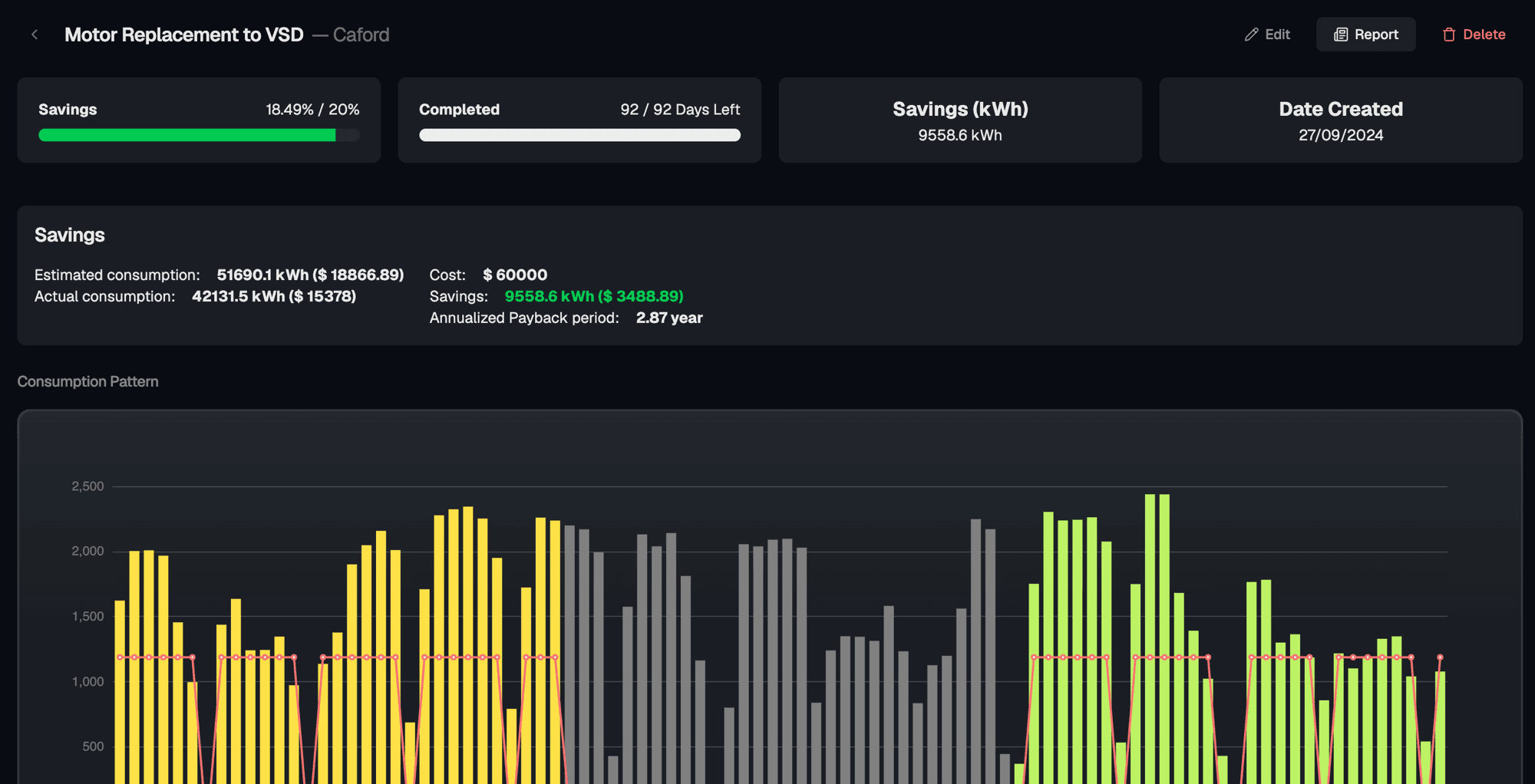
CobiNeural Plan & Verify: actual consumption measured against the adjusted baseline to quantify verified savings.
Because the system deploys as an overlay on existing BMS, PLC and SCADA, you are not ripping out instrumentation to do this. You are reading the meters you already have and adding the baseline logic on top. The same verified evidence base then feeds EECA reporting, ISO 50001 energy performance indicators, and ESG disclosure without re-keying numbers between systems.
Common M&V mistakes to avoid
- Comparing raw bills. Two bills with no normalization for production or weather measure the season, not the project.
- Cherry-picking the baseline. A baseline period chosen to maximize apparent savings will not survive an auditor who asks why those twelve months.
- Ignoring demand savings. Under RP4, shaving the monthly peak is worth real money. M&V that only counts kWh and ignores the per-kW demand charges undercounts the result.
- Stopping after one report. Savings that are verified once and never again are savings on trust, not on evidence.
- No written M&V plan. Without a plan agreed before the project, every adjustment looks like moving the goalposts.
If you want to see this on your own bill, our free maximum demand calculator estimates the charge from your kW and tariff. For the full mechanics of a TNB bill, see our free course Understanding Your Electricity Bill.
If you are running energy projects across a building or a plant and need to prove the savings hold month after month, see how the CobiNeural Smart Operation Platform handles continuous M&V, or request a demo and bring one of your own projects to test against a real baseline.
FAQ
Frequently asked questions
Ask us about this topic
Something in this article you want to dig into — or a situation in your own building it doesn't quite cover? Send us your question. We don't run public comments; the team replies to you directly by email.