Blog
Cold Storage Energy Management in Malaysia
Refrigerated warehouses fail at energy in ways no dry warehouse does: latent load through doors, defrost that heats the room you just cooled, and a billed peak set by coincidence. What to meter, and why your temperature records are half the answer already.
 Tan Kok XinIndustry Guides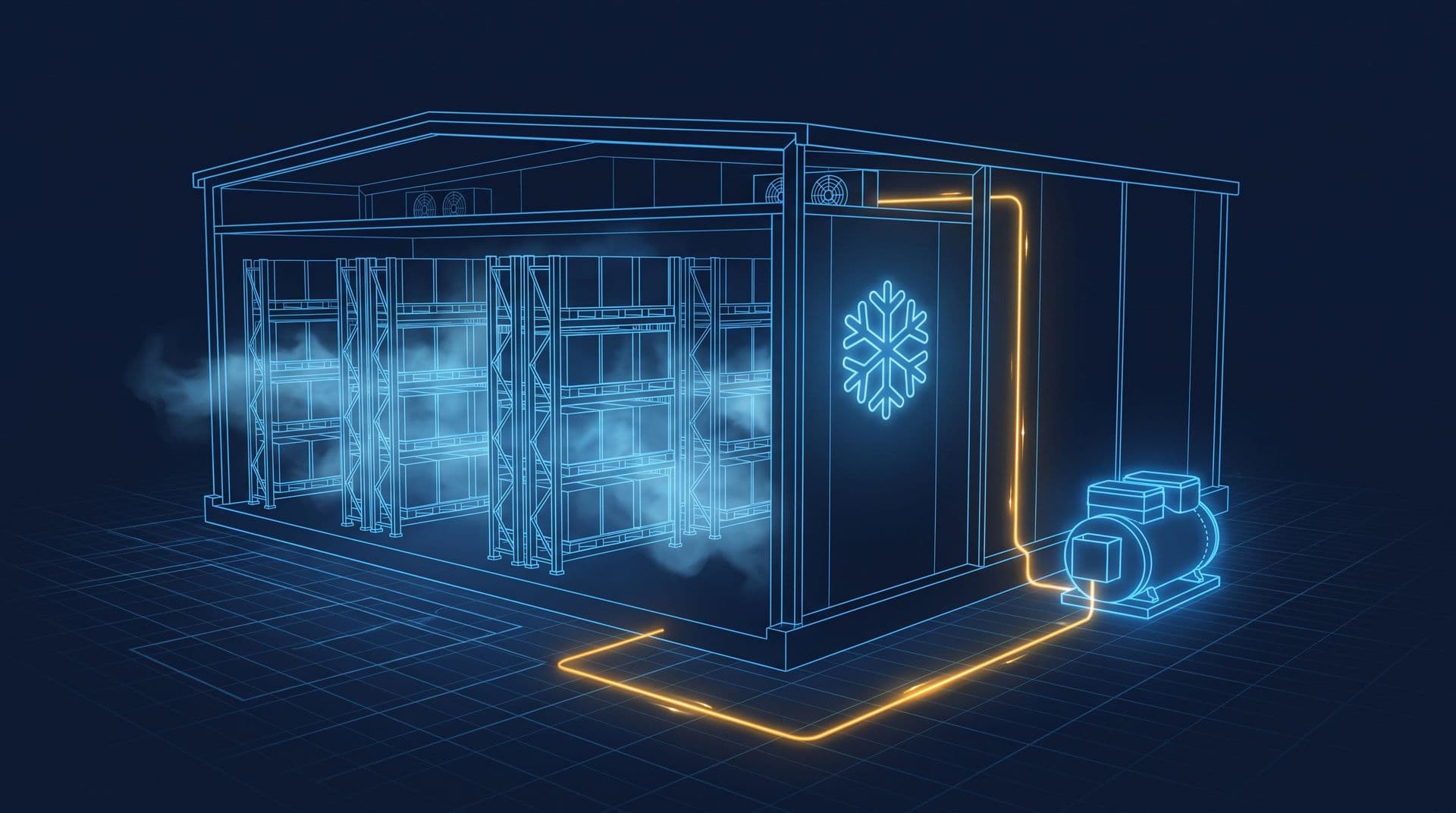
Two-forty on a humid Klang afternoon. A chilled room door opens for a pallet transfer and stays open ninety seconds while the driver squares up the load. Outside air rolls over the threshold in a visible sheet of fog, drops its heat, and leaves its moisture frozen onto the evaporator fins. Room temperature drifts up. A second compressor stages on, and the fans that were coasting go to full speed. Nobody logs anything, because the product never went out of spec.
Those ninety seconds are cold storage energy in miniature. The cost is real, it is recurring, and almost none of it appears in any record the facility currently keeps.
In short
- A cold store behaves nothing like a dry warehouse because every door opening brings in warm, humid air that has to be re-cooled and re-dried.
- Maximum demand in a refrigerated warehouse is usually set by compressors staging on together after a door event or a defrost cycle.
- The costliest failure modes are usually quiet: door seals, iced evaporator coils and drifting setpoints, not dramatic equipment failure.
- Temperature records a cold store already keeps for food safety can be connected to energy data to explain demand spikes.
Why a cold store behaves nothing like a dry warehouse
Because the load follows weather, doors and product, not occupancy. A dry warehouse is mostly lighting and a few dock levellers, and its consumption tracks the shift pattern. A cold store runs its refrigeration plant 8,760 hours a year against an envelope that is always losing the fight, and the plant is the dominant end use by a wide margin. Turning off the lights at 6pm changes very little.
Malaysia adds a second load that temperate-climate design guides treat as secondary: moisture. METMalaysia puts the average daily maximum relative humidity above 94% almost everywhere in the country, which means the air crossing a door threshold carries a large latent load. That moisture has to be paid for twice. Once when it condenses and freezes on the coil, reducing airflow and driving suction pressure down, and again during defrost, when heat is deliberately added inside the insulated envelope to melt it off. The plant then removes that heat too. If you want the thermodynamics behind why coil and condenser conditions matter so much, we covered the refrigeration cycle in plain language separately.
What actually sets maximum demand in a refrigerated warehouse?
Coincidence, not average load. Under the RP4 tariff structure effective 1 July 2025, a medium-voltage commercial site pays a Capacity Charge of RM 89.27/kW plus a Network Charge of RM 97.06/kW on its recorded maximum demand: RM 186.33 for every kilowatt in a single half-hour interval, every month. A cold store can run efficiently for 29 days and still hand back its savings in one thirty-minute window.
Three things line up to create that window, and in a Malaysian facility they line up in the afternoon:
Defrost termination. Several evaporators finishing defrost together all return to full pull-down at the same moment, on rooms that have just been warmed by their own defrost heaters.
Goods-in pull-down. A receiving bay that has been open for an hour leaves a chamber, its doors, and its incoming product all needing to be brought back down at once.
Ambient at the condensers. The hottest part of the day raises condensing pressure, so every compressor draws more power for exactly the same cooling duty.
The scheduling fixes are unglamorous. Stagger defrost start times per circuit so terminations never coincide. Where operations allow it, shift the largest receiving window away from peak ambient. Interlock the biggest pull-down against a demand limit so the plant sheds a stage rather than setting a new peak. The general methods for cutting TNB maximum demand charges apply here too, but the defrost interaction is specific to refrigeration and is usually the one nobody has looked at.
The failure modes that cost money quietly
An iced evaporator coil is the classic. Airflow falls, the compressor runs longer at worse efficiency, and the room still holds temperature, so the operator sees nothing wrong. The only visible symptom is kWh per hour creeping upward at the same room temperature and the same ambient.
Door seals and curtains degrade in slow motion. Regulation 25(5) of the Food Hygiene Regulations 2009 already requires cold room doors to be fitted with an air curtain or other effective means of avoiding loss of cold air, so in most facilities the hardware exists. It is the torn strip curtain, the air curtain fan someone switched off because it was noisy, and the door leaf that no longer seats squarely that quietly reopen the infiltration path.
Short-cycling compressors accumulate starting current and mechanical wear while delivering very little useful capacity, usually a symptom of oversized staging or a badly tuned control band. Fouled condensers are the tropical special: dust, rain-driven deposits, and coastal air steadily raise condensing temperature, and every degree of that rise is compressor power you paid for and did not use. Track condenser approach, the gap between condensing temperature and ambient, and the fouling shows up long before anything trips.
The last failure mode is human and entirely rational. Operators buy insurance against product excursions by dropping setpoints a degree or two below what the product needs. Nobody is going to argue against protecting stock, and no energy programme should try. What monitoring can do is put a number on that insurance premium, so the decision is made deliberately rather than by default.
What to measure to control cold storage energy
Power at the refrigeration plant, split by function, plus the conditions that explain it. A single incoming meter tells you the bill went up and nothing else.
- Compressor power per circuit or rack, metered separately from condenser fans, evaporator fans, and defrost heaters. Without that split, a defrost problem and a compressor problem look identical.
- Room air temperature at more than one location per chamber, alongside product temperature where it is already logged.
- Door state. A contact sensor on each personnel and dock door yields open count and open-minutes per shift, which is the only honest way to attribute infiltration load to a behaviour.
- Ambient dry-bulb and humidity at the condenser deck, not at the office wall.
- Suction and discharge conditions where the plant is instrumented, or condensing temperature against ambient where it is not.
- Sub-metering per cold room, which becomes mandatory in practice the moment chambers are let to different tenants and cost has to be allocated.
The value is in the ratios rather than the raw channels. Compressor kWh per room-day, normalised against ambient. Defrost energy per cycle, per evaporator. Consumption per pallet moved. Alerts should fire on drift rather than absolutes: a steady week-on-week rise in compressor power at the same room temperature and ambient is a coil or a condenser telling you something, days before it becomes a temperature excursion and weeks before it becomes product loss. Multi-site operators get a second benefit, which is being able to rank chambers across a portfolio on the same normalised basis, as in our warehouse portfolio monitoring work.
You already keep temperature records, so connect them to energy
Cold-chain operators in Malaysia run a temperature discipline because the law requires one. Under the same Food Hygiene Regulations 2009, regulation 38(3) sets storage at minus 1°C to 10°C for chilled food and minus 18°C for frozen, regulation 38(4) requires that the cold chain is not interrupted, regulation 25(4)(d) requires any device used to record temperature to be accurate to plus or minus 1°C, and regulation 11(1)(d) requires records of storing and distributing food to be maintained and made available for inspection. Regulation 25(4)(b) goes further and requires the facility to be defrosted whenever necessary "to maintain refrigeration efficiency". The link between hygiene compliance and energy is already written into the rules.
So the sensors, the logging habit, the audit trail and the operator routine all exist. What is missing is one more channel on the same timeline. Put kW next to °C and the pair answers questions that neither answers alone: what a temperature excursion actually cost in recovery energy, whether a chamber holds setpoint because it is well sealed or because the plant is brute-forcing it, and which room is expensive per pallet rather than merely expensive.
For how a chiller plant fits together end to end, see our free course Cooling Fundamentals.
If you are running refrigerated space in Malaysia and your energy data stops at the incoming meter, that is the gap worth closing first. CobiNeural can sit over the refrigeration plant and controls you already have, and we are happy to walk through what circuit-level metering would show in your facility: request a demo and bring your last three bills.
FAQ
Frequently asked questions
Ask us about this topic
Something in this article you want to dig into — or a situation in your own building it doesn't quite cover? Send us your question. We don't run public comments; the team replies to you directly by email.