Blog
The Refrigeration Cycle Explained Simply: The Loop That Carries Heat Outside
The refrigeration cycle explained in plain language: one fluid boils indoors to soak up heat and condenses outdoors to dump it, round and round forever.
 Tan Kok XinCooling Fundamentals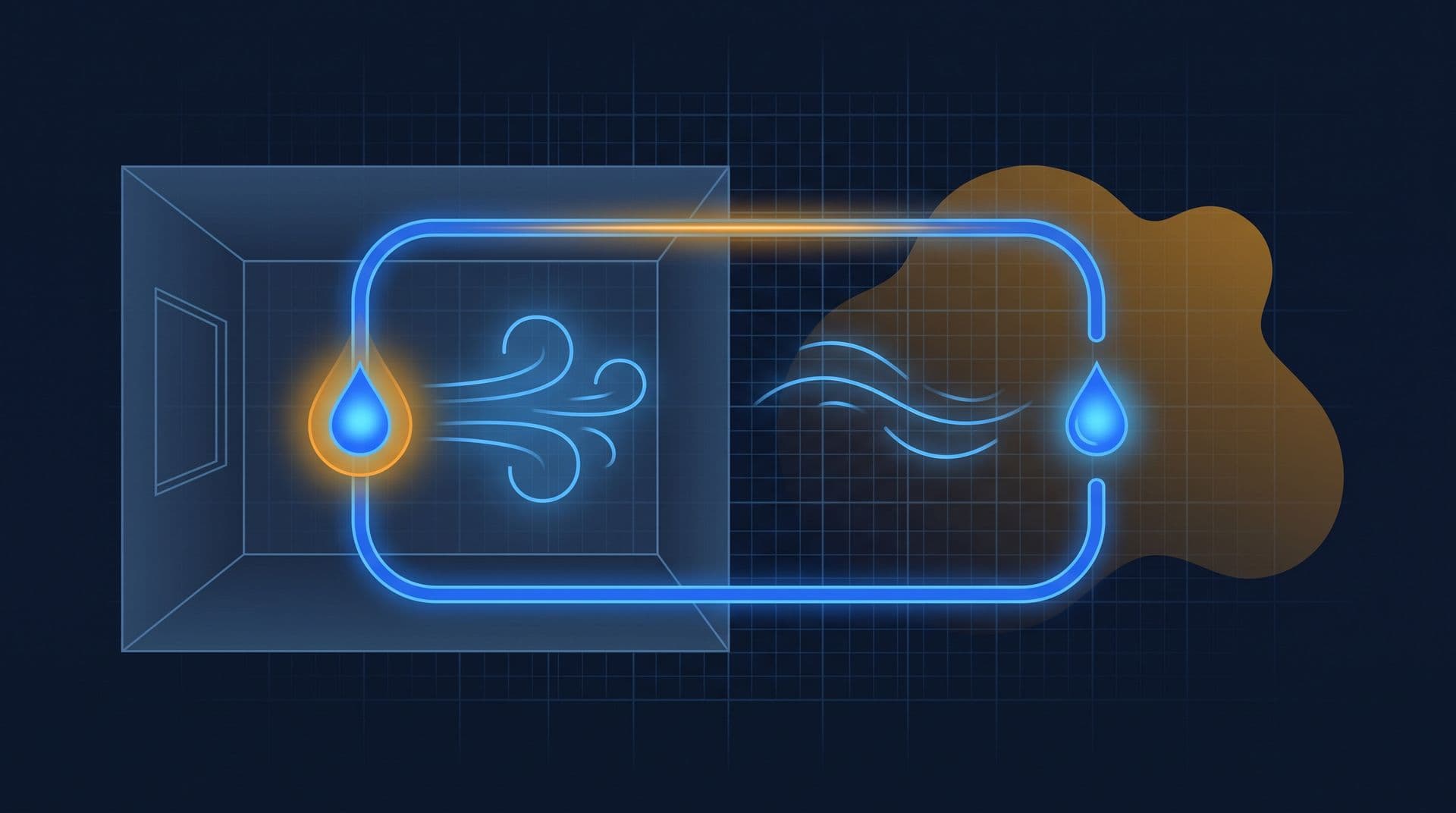
Part 2 of 20 in Cobler's Cooling Fundamentals course. New here? See the course page.
How Does an Air Conditioner Work? ended with a question: how can a machine pick up heat in a 24 °C room and release it into 33 °C outdoor air, when heat naturally flows the other way? This part answers it. Here is the refrigeration cycle explained in one sentence: a fluid boils inside the indoor unit, taking in heat from the room, then condenses in the outdoor unit, giving that heat to the outdoor air, and the machine changes the fluid's pressure so that each of these happens in the right place.
We take that sentence apart one piece at a time, then follow the fluid round the four main parts of the machine. It starts with an effect you have felt yourself. Step out of a swimming pool on a hot afternoon and, for a moment, you feel cold, even though the air around you is warm. The water on your skin was evaporating, turning from liquid into vapour, and to do that it took heat from your body. The heat left with the vapour, and your skin was left cooler.
A fluid called refrigerant carries the heat, and it is never used up
The fluid inside an air conditioner is called the refrigerant. It is not a fuel. Petrol is burned and is gone. The refrigerant is not burned or consumed at all. A useful comparison is a delivery rider: it picks up heat in one place, drops it off in another, and comes straight back for more. The refrigerant in your air conditioner today is the same refrigerant that was in it a year ago.
This works because the loop is sealed. The refrigerant travels round a closed circuit of copper pipe with no opening to the outside. If a system runs low on refrigerant, that means there is a leak, which is a fault to be found and fixed. It is never the result of normal use.
(There are several types of refrigerant, such as R32 and R410A, and they keep changing for environmental reasons. You do not need the details for this course. If you are curious, see the optional side reading What Is Refrigerant, and Why Does It Keep Changing?)
So if the refrigerant is never used up, how does it carry heat? The answer is the same effect that cooled your skin at the pool: a change from liquid to gas.
Boiling takes in heat, and condensing gives it back
When a liquid turns into a gas, by boiling or evaporating, it takes in a large amount of heat. When that gas turns back into a liquid, by condensing, it gives out the same amount of heat again.
The heat involved in this change is called latent heat, from a Latin word meaning "hidden". It is hidden because it changes the form of the substance, not its temperature. A pot of water on a stove shows this. As you heat the water, a thermometer in it climbs steadily. Once the water reaches a rolling boil, the thermometer stops at about 100 °C, even though the stove is still putting heat in. That heat is now being used to turn liquid water into steam. It is called the latent heat of vaporisation, and it is large.
An air conditioner uses this. It makes the refrigerant:
- boil indoors, so it takes in heat from your room, and
- condense outdoors, so it gives that heat to the outside air.
The heat your room loses is the heat the outdoor unit releases. The refrigerant carries it across.
That raises an obvious problem. Water boils at 100 °C. How can one fluid boil in a room at 24 °C and then condense outdoors, where the air might be 33 °C? Boiling in the cooler place and condensing in the hotter place seems backwards. The answer is pressure.
Pressure sets the temperature at which a fluid boils
Water boils at 100 °C only at normal atmospheric pressure, near sea level. Its boiling temperature depends on the pressure around it:
- Lower pressure, lower boiling temperature. High on a mountain, the air pressure is lower, and water boils well below 100 °C. That is why a mountaineer's tea is never very hot.
- Higher pressure, higher boiling temperature. Inside a sealed pressure cooker, the pressure is higher, and water gets hotter than 100 °C before it boils. That is why food cooks faster in it.
The same is true of a refrigerant, and the same temperature works both ways: at a given pressure, a fluid boils and condenses at the same temperature. So by choosing the pressure, the machine chooses where the refrigerant will boil and where it will condense. It uses two very different pressures for the two jobs:
- Low pressure in the indoor coil. At low pressure, the refrigerant's boiling temperature is lower than the temperature of your room. Warm room air blowing over the coil is warm enough to make it boil. As it boils, it takes in heat, and the room air comes out cooler.
- High pressure in the outdoor coil. At high pressure, the refrigerant's condensing temperature is higher than the outdoor air, even on a hot afternoon. The refrigerant is now hotter than the air around it, so heat flows out of it into the outdoor air, and it condenses back to a liquid.
Notice that heat still only flows from hot to cold at each coil. Indoors, the refrigerant is colder than the room air, so heat flows into it. Outdoors, it is hotter than the outside air, so heat flows out of it. The machine does not break the rule from Part 1. It changes the pressure so that the rule works in its favour.
Squeezing a gas heats it, and dropping the pressure lets a liquid boil cold
Two everyday effects explain how the machine changes the refrigerant's pressure and temperature.
Squeezing a gas makes it hotter. A bicycle pump gets warm as you pump up a tyre, because you are squeezing air into a smaller space. An air conditioner squeezes the refrigerant gas in the same way, which raises both its pressure and its temperature.
Dropping the pressure on a liquid lets it boil at a low temperature. A can of "compressed air" duster, used to clean keyboards, actually holds a liquid kept under pressure. When you spray it, the pressure inside the can falls, some of the liquid boils, and that boiling takes heat from the rest of the liquid and from the can. After a few seconds the can feels icy. An air conditioner does the same thing on purpose: it lets the high-pressure liquid refrigerant drop to a low pressure, and it turns cold.
With these two effects, the loop is complete. Four parts carry it out.
Four main parts on one loop: compressor, condenser, expansion device and evaporator
Every air conditioner, from a bedroom split unit to a building's chiller, has the same four main parts connected in one sealed loop:
- The compressor squeezes the refrigerant gas.
- The condenser releases heat outdoors, and the gas condenses into a liquid.
- The expansion device drops the pressure.
- The evaporator takes in heat from the room, and the liquid boils into a gas.
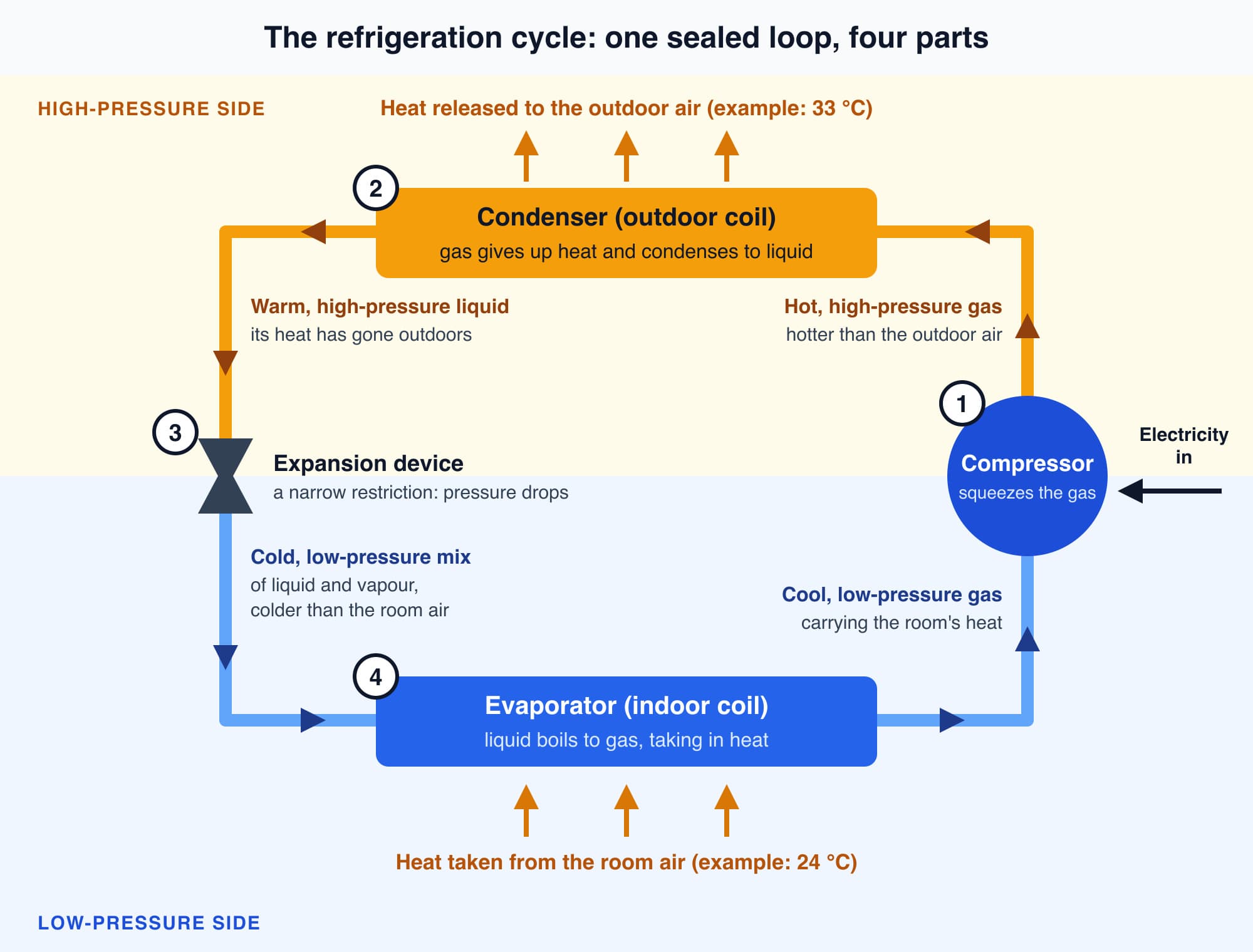
The four main parts of the refrigeration cycle, with the state of the refrigerant between each one.
Let us follow the refrigerant round the loop once, starting where it leaves the indoor coil as a cool, low-pressure gas carrying heat from the room.
1. The compressor squeezes it hot. The compressor takes in the cool, low-pressure gas and squeezes it hard. The gas leaves as a hot, high-pressure gas, hotter than the outdoor air. The compressor is an electric motor driving a pump, and it is by far the biggest user of electricity in an air conditioner. The fans that blow air across the coils use much less. When your electricity use rises on hot days, it is mainly because the compressor is working harder.
2. The condenser releases the heat outdoors. The condenser is a coil of pipe with thin metal fins, in the outdoor unit, with a fan blowing outdoor air across it. The refrigerant arrives hotter than that air, so heat flows out of it into the air. As it loses heat, the gas condenses into a warm, high-pressure liquid, which is where the condenser gets its name. The warm air you feel coming off an outdoor unit is this heat, which a few minutes earlier was in your room.
3. The expansion device drops the pressure. The warm liquid now reaches a narrow restriction in the pipe. In larger units this is a valve. In some small units it is simply a fixed, very narrow tube or opening. As the liquid is forced through, its pressure falls sharply. At the new, low pressure, its boiling temperature is below the temperature of the room, so part of the liquid boils straight away. That boiling takes heat from the rest of the liquid, just as in the aerosol can, and the refrigerant leaves as a cold, low-pressure mix of liquid and vapour. No heat has left the room yet. This step only makes the refrigerant cold enough to take in heat in the next part.
4. The evaporator takes in the room's heat. The cold mix flows into the indoor coil, the evaporator, and a fan blows warm room air across it. The air is warmer than the refrigerant, so heat flows from the air into the refrigerant. The rest of the liquid boils, or evaporates, which gives the evaporator its name. The air, having given up heat, blows back into the room cooler. The coil is also cold enough to condense some moisture from the air, which drips away (Part 3 explains this).
The refrigerant leaves the evaporator as a cool, low-pressure gas carrying the room's heat, and flows back to the compressor. The loop repeats for as long as the machine runs.
A short way to remember the loop is squeeze, release heat, drop pressure, take in heat:
Part | What it does | Refrigerant going in | Refrigerant coming out |
|---|---|---|---|
Compressor | Squeezes the gas, using electricity | Cool, low-pressure gas | Hot, high-pressure gas |
Condenser | Releases heat to the outdoor air | Hot, high-pressure gas | Warm, high-pressure liquid |
Expansion device | Drops the pressure | Warm, high-pressure liquid | Cold, low-pressure liquid and vapour |
Evaporator | Takes in heat from the room air | Cold, low-pressure liquid and vapour | Cool, low-pressure gas |
A split unit puts the four parts in two boxes
In a home split unit, the loop is literally split between two boxes joined by copper pipes. The evaporator is in the quiet indoor unit on your wall. The compressor and condenser are in the noisier outdoor unit.
Now you can see why they are arranged this way. The coil that takes in heat stays inside with you. The coil that releases heat, and the compressor, whose electricity also ends up as heat (Part 1), go outside, where that heat belongs.
The ceiling cassettes in the shoplot work the same way: the evaporator is in the ceiling, and the compressor and condenser are outdoors. A large building's chiller runs the same four-part loop inside one big machine. The main difference is that water, rather than room air, brings the building's heat to its evaporator. How Does a Chilled-Water System Work? (Part 8) explains that arrangement.
The compressor is where cooling meets electricity
The compressor is an electric motor under load, so everything true of motors is true of it. It draws current, it has a power rating in kilowatts (kW), and how well it turns electricity into squeezing decides much of what you pay.
The size of the machine decides how the compressor is supplied:
- A home split unit's compressor is usually a single-phase motor running on 230 V, the same ordinary supply as your fridge and kettle.
- The compressors in large chillers, like those in the office tower, usually run on three-phase power at 400 V, the supply used for large motors. Each one can draw hundreds of kilowatts instead of one or two.
If single-phase and three-phase are new to you, the Electricity Fundamentals course explains them in How Electric Motors Work and Three-Phase Power Explained. In short, a single-phase supply has one live wire, like a wall socket, and a three-phase supply has three, which suits large motors.
Later in this course, the compressor's kilowatts become a key number. You divide the cooling you get out by the electricity the compressor and its helpers use, and the result tells you how efficient the machine is. Part 13 explains how.
Worth knowing: Boiling a pot of water dry takes several times more energy than heating the same water from room temperature to boiling. That is why an air conditioner uses a fluid that boils and condenses: changing between liquid and gas carries far more heat than warming or cooling a liquid.
What comes next: moisture, and a room that is cool but humid
In the section on the four main parts, the evaporator did two things: it cooled the room air, and it condensed some water out of it. Those are two different jobs, and an air conditioner can do the first well and the second badly. The next part, Why Is My Office Cool but Still Humid?, explains humidity, dew point and the two kinds of heat an air conditioner removes, to answer the question: why can a room feel cool and still be humid?
Check your understanding
- Why must the refrigerant be at a low pressure inside the indoor coil? At low pressure, its boiling temperature is below the temperature of the room. The warm room air can then make it boil, and as it boils it takes in heat from the air.
- Does the room lose its heat at the expansion device or at the evaporator? At the evaporator. The expansion device only drops the pressure so the refrigerant becomes cold. The room's heat moves into the refrigerant in the evaporator, where the room air blows across the cold coil.
Recap: The refrigeration cycle is a sealed loop in which one refrigerant is used over and over. It boils in the indoor coil, taking in heat from the room, and condenses in the outdoor coil, giving that heat to the outdoor air. Pressure sets the temperature at which it boils and condenses, so low pressure indoors makes it colder than the room, and high pressure outdoors makes it hotter than the outside air. Four parts do the work: the compressor squeezes the gas hot and uses most of the electricity, the condenser releases the heat outdoors, the expansion device drops the pressure, and the evaporator takes in the room's heat.
Go deeper on video (optional)
These two animated videos show the loop from this part. The first follows the refrigerant as it boils and condenses. The second looks at each of the four main parts. Both are optional.
The Engineering Mindset walks through the refrigeration loop with clear animation, showing how the refrigerant boils to soak up heat and condenses to dump it.
The Engineering Mindset walks through the compressor, condenser, expansion valve, and evaporator with clear animations of refrigerant moving around the loop.
This is Part 2 of 20 in Cobler's Cooling Fundamentals course. Previous: How Does an Air Conditioner Work? It Moves Heat, It Doesn't Make Cold. Next: Why Is My Office Cool but Still Humid? Sensible Heat, Latent Heat and Dew Point.
Cobler builds CobiNeural, a platform that shows a facility team its building's energy, water and indoor air data as live numbers across the whole site. To see how your building performs, talk to us.
FAQ
Frequently asked questions
Ask us about this topic
Something in this article you want to dig into — or a situation in your own building it doesn't quite cover? Send us your question. We don't run public comments; the team replies to you directly by email.