The 4 Main Parts of an Air Conditioner (and What Each Does)
Compressor, condenser, expansion valve, evaporator: meet the four parts of every air conditioner and follow one droplet of refrigerant all the way around.
 Tan Kok XinCooling Fundamentals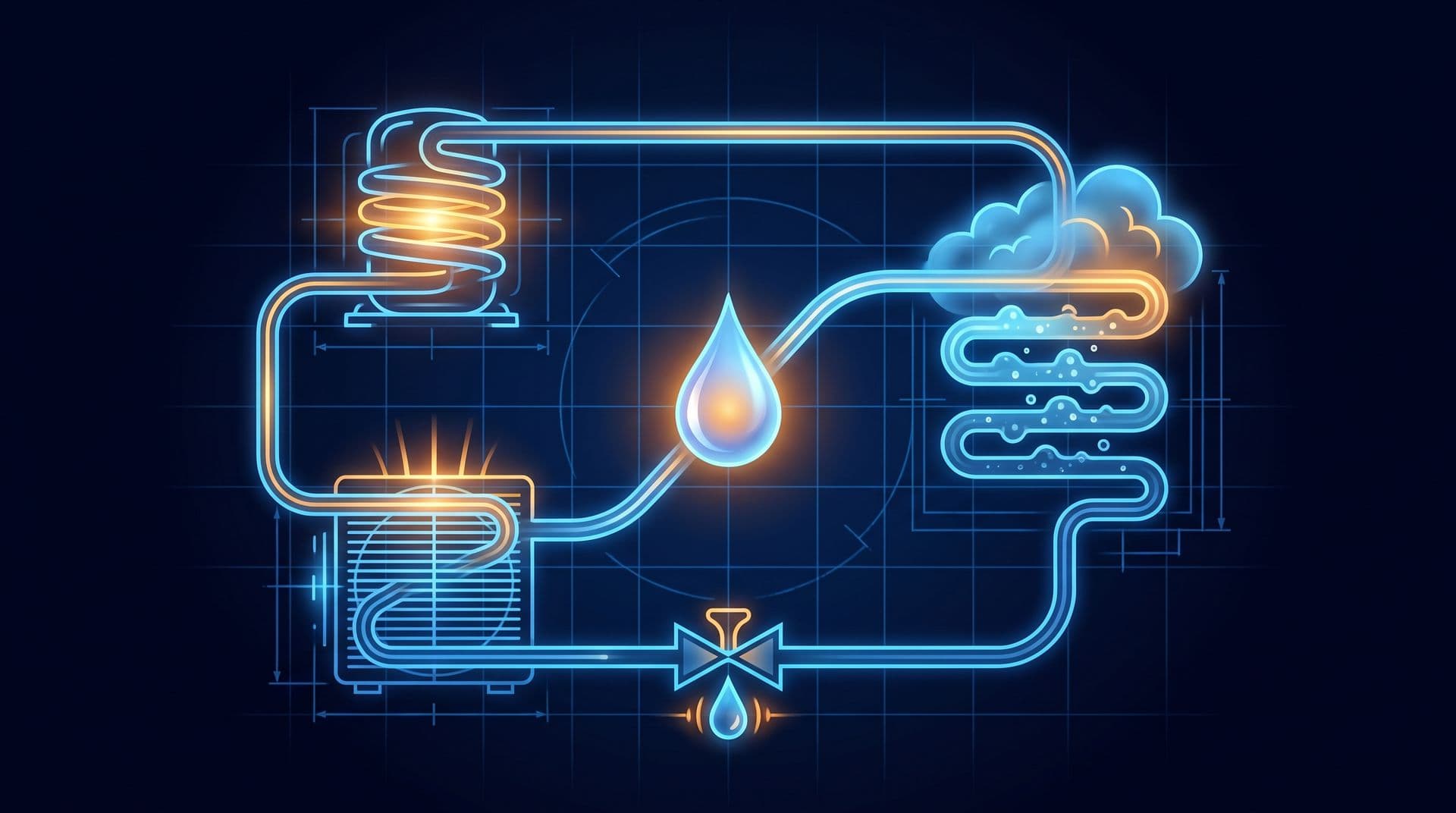
The whole machine is just four workers on a loop
An air conditioner looks complicated from the outside — a humming box on a wall, a bigger box outside, copper pipes running between them. But strip away the casing and the plastic, and there are really only four working parts, connected end to end in a sealed loop. A special fluid called refrigerant flows around that loop forever, never used up, doing one job: picking up heat inside your building and dumping it outside.
That is the whole trick of cooling. You cannot destroy heat. You can only move it from where you don't want it to where you don't mind it. The four parts are the crew that does the moving.
Their names sound technical, but each one has a plain job:
- Compressor — the squeezer (and the muscle that uses the electricity)
- Condenser — the outdoor radiator that dumps heat
- Expansion valve — the pinch-point where it actually gets cold
- Evaporator — the indoor cold coil your room air blows across
The best way to understand them is not to memorise a diagram. It is to become the refrigerant — to follow one droplet all the way around the loop until the whole thing clicks. So let's do that.
Follow one droplet around the loop
Pick up our droplet at the evaporator, the cold coil sitting indoors. Right now it is a cold, low-pressure gas — think of it as tired and cool, having just finished its work of soaking up heat from your room (we'll see how in a moment). It drifts along the pipe toward the outdoor unit and arrives at the first worker.
1. The compressor: squeeze it hot
The compressor grabs our cool, low-pressure gas and squeezes it hard. Anyone who has pumped up a bicycle tyre knows the pump gets warm — squeezing a gas heats it up. The compressor does this on purpose and in a big way. Our droplet leaves as a hot, high-pressure gas, far hotter than the air outside.
This is the single most important machine in the whole system, for one reason: the compressor is a motor. It is an electric motor driving a pump, and it is the only major part that consumes serious electricity. The fans elsewhere sip power; the compressor gulps it. When your electricity bill goes up in hot weather, it is overwhelmingly the compressor's doing.
This is also the moment the cooling story quietly opens a second door — the electrical side. A compressor is an electric motor under load, and everything true of motors is true of it: it draws current, it has a rating in kilowatts, and how efficiently it turns electricity into "squeeze" decides how much you pay. In a much later part of this course, when we talk about efficiency, the compressor's kilowatts become the number that matters — the one you divide by the cooling you get out. Hold that thought.
For now, our droplet leaves the compressor hot and high-pressure, and moves to the part that will cool it down.
2. The condenser: dump the heat outdoors
The condenser is a coil of pipe with thin metal fins, sitting in the outdoor unit, with a fan blowing outdoor air across it. Our droplet arrives as a hot gas — hotter than the outside air — and here nature does us a favour. Heat always flows from hotter to cooler. Because the refrigerant is now hotter than the outdoor air, it naturally gives up its heat to that air. The fan just hurries the process along by pulling a constant stream of fresh air across the fins.
As our droplet loses heat, it does something familiar: it condenses. Just as steam turns back to water when it cools, our hot refrigerant gas turns into a high-pressure liquid. (That is where the name comes from — the condenser is where the gas condenses.) The warm breeze you feel from the back of a window unit, or from the outdoor box of a split system, is exactly this heat being thrown away — the heat that used to be in your room.
Our droplet is now a warm, high-pressure liquid. It is calmer, but it is not cold yet. That comes next, and it is the part most people find surprising.
3. The expansion valve: drop the pressure, get cold
Here is the twist in the tale. So far nothing has actually become cold — we squeezed a gas hot, then cooled it back down to a warm liquid. Where does the coldness come from?
From a deliberate restriction. The expansion valve (in a small unit it can be as simple as a fixed narrow orifice — a tiny fixed hole) is a pinch-point in the pipe. The high-pressure liquid is forced through this narrow gap, and on the far side the pressure suddenly collapses. And a liquid that suddenly finds itself at very low pressure turns very cold and begins to boil.
It feels backwards — boiling sounds hot — but "boiling" just means "turning from liquid to gas," and refrigerants are chosen precisely because they boil at very cold temperatures once the pressure is low. Think of how a spray can gets cold in your hand as you release it: the propellant is dropping in pressure and chilling as it escapes. The expansion valve does the same thing on purpose.
Our droplet emerges as a cold, low-pressure mix of liquid and vapour — genuinely cold now, and primed to boil. This is where the cold is made. Everything before it was just preparation.
4. The evaporator: soak up the room's heat
Our cold droplet now arrives back indoors at the evaporator — the cold coil hidden inside the wall unit, with a fan blowing your warm room air across it.
Remember the rule: heat flows from hotter to cooler. Your room air is now warmer than our freezing refrigerant, so heat flows out of the air and into the droplet. As the droplet drinks in that heat, it finishes boiling from a cold liquid-and-vapour mix into a cool gas. That is where the name comes from — the liquid evaporates. The room air, having handed over its heat, blows back out as the cool draught you feel.
There is a bonus. The evaporator coil is cold enough that moisture in your humid room air condenses onto it, like beads of water on a cold glass of iced drink. That water drips into a tray and out through the drain pipe — which is why the outdoor end of a running air conditioner drips. In our hot, sticky climate this dehumidifying is half of what makes a room feel comfortable, and we'll give humidity a whole part of its own later in the course.
Our droplet is now a cool, low-pressure gas — exactly where we picked it up. It drifts back to the compressor, and the loop begins again, thousands of times a minute, for the life of the machine.
A four-word memory aid
If you remember nothing else, remember the loop in four beats:
Squeeze hot → dump → drop cold → soak up.
- Squeeze hot — compressor
- Dump — condenser (heat out, gas becomes liquid)
- Drop cold — expansion valve (pressure falls, it gets cold)
- Soak up — evaporator (indoor coil absorbs room heat and moisture)
And here is the layout that makes it physical. In a typical home split unit, the loop is literally split between two boxes: the evaporator sits indoors (the quiet wall unit blowing cold air), while the compressor and condenser live outside (the noisier, warmer box). Now you know why they are arranged that way — you keep the cold-making coil inside with you, and you put the heat-dumping and the hard-working, heat-generating compressor outside where the waste heat belongs.
Meet the motor: where the electricity comes in
That outdoor compressor is worth one more look, because it is your first real meeting with the electrical side of cooling.
The size of the machine decides how it is wired. A home split's compressor is a single-phase motor running on 230 V — the same ordinary supply as your fridge and your kettle. But scale up to the big chillers that cool an office tower or a mall (we devote a later part to those), and their compressors are large enough to need three-phase power at 400 V — the heavier-duty supply built for serious motors. It is the same four-part loop we just walked through, just enormously bigger, and its compressor may draw hundreds of kilowatts instead of a fraction of one.
If the words single-phase, three-phase and 400/230 V are fuzzy, the sibling Electricity Fundamentals course lays them out plainly — start with how electric motors work and, for the big machines, three-phase power explained. The two courses meet right here, at the compressor: cooling is a heat story that runs on an electricity story.
The Engineering Mindset walks through the compressor, condenser, expansion valve, and evaporator with clear animations of refrigerant moving around the loop.
The takeaway
An air conditioner is not a mysterious cold-making box. It is four workers passing one droplet of refrigerant around a sealed loop: the compressor squeezes it hot and burns the electricity; the condenser dumps that heat outdoors and turns the gas to liquid; the expansion valve drops the pressure so it finally gets cold; and the evaporator is the indoor coil that soaks up your room's heat and moisture. Squeeze hot, dump, drop cold, soak up — every air conditioner ever made, from a bedroom unit to a skyscraper's chiller, is a version of that same loop.
Next, we zoom in on the fluid doing all the travelling. In the following part we meet the refrigerant itself — what it is, why it can boil cold and condense hot on command, and how choosing the right one makes the whole loop possible.
Frequently asked questions
Ask us about this topic
Something in this article you want to dig into — or a situation in your own building it doesn't quite cover? Send us your question. We don't run public comments; the team replies to you directly by email.