Blog
What Is Refrigerant, and Why Does It Keep Changing? R22, R410A, R32 Explained
Why new air conditioners say R32 while old ones said R22 or R410A. A plain-language guide to refrigerants, GWP, phase-downs, safety classes, and leaks.
 Tan Kok XinCooling Fundamentals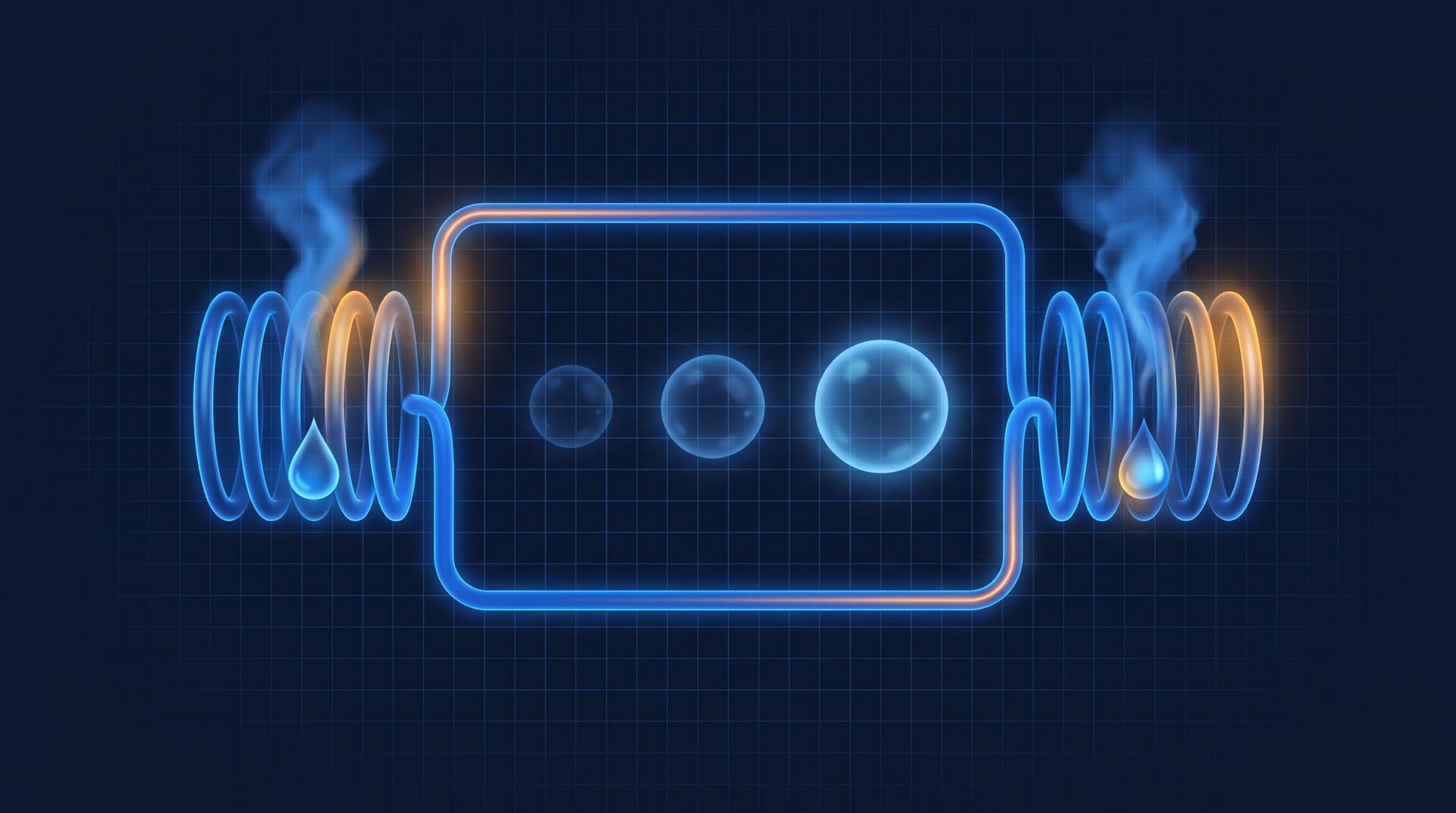
An optional side reading for Cobler's Cooling Fundamentals course. It goes with Part 2. See the course.
The fluid that does all the work — and none of the cooling
Here is a strange truth about your air conditioner: the refrigerant inside it does not actually make cold. Nothing does. As we saw in the last part on the sealed cooling loop, cooling is really just moving heat from where you don't want it to where you don't mind it — out of your room and into the outdoor air.
The refrigerant is the vehicle that carries that heat. Think of it as a courier on a permanent delivery run: it picks up heat inside your building, carries it outside, drops it off, and comes straight back for the next load. It never rests, and it never gets consumed.
So why does the label on a new unit say R32, while the one you replaced said R410A, and the ancient one before that said R22? Why does the courier keep changing? The short answer is that the industry keeps searching for a courier that does the job well and does the least damage if it ever escapes. This part explains what a refrigerant actually is, what those code numbers mean, and why the switch is happening.
What makes a fluid a good refrigerant
The whole trick of the cooling loop rests on one property: a good refrigerant boils at a conveniently low temperature.
We usually think of boiling as something that needs a lot of heat — water boils at 100 degrees Celsius. But boiling temperature depends on pressure, and different fluids boil at wildly different temperatures. A refrigerant is simply a fluid chosen so that, at the pressures inside an air conditioner, it will:
- Boil (evaporate) at the indoor coil, where it is cold. Boiling absorbs heat — that is the whole point. Turning a liquid into a gas soaks up a large amount of heat from the air passing over the coil, and that is what leaves your room feeling cool.
- Condense (turn back to liquid) at the outdoor coil, where it has been squeezed to a higher pressure. Condensing releases that same heat, dumping it into the outdoor air.
That is the entire cycle: boil inside to grab heat, condense outside to release it, repeat forever. The refrigerant is picked precisely because its boiling point can be tuned — with pressure — to sit right where we need it, cold on the inside, hot on the outside.
Any number of fluids could do this. What separates a good refrigerant from a bad one is a checklist: it should carry a lot of heat per kilogram, it should be stable and not corrode the pipes, it should be safe to be near, and — increasingly the deciding factor — it should do little harm to the planet if it leaks out. That last item is why the courier keeps changing.
Two kinds of environmental harm
Refrigerants have been redesigned twice for two different reasons. It helps to keep them separate.
First problem: the ozone layer
The oldest common refrigerant on this list, R22, belongs to a family called HCFCs (hydrochlorofluorocarbons). The chlorine in these molecules, when released high into the atmosphere, chews away at the ozone layer — the part of the sky that shields us from the sun's harshest ultraviolet radiation. Under a global agreement called the Montreal Protocol, ozone-damaging refrigerants have been steadily banned. R22 is now phased out for new equipment almost everywhere. If you still run a system on R22, spare parts and gas are getting scarce and expensive, which is usually the practical signal to replace it.
Second problem: global warming
Fixing the ozone hole led to a new generation of refrigerants — HFCs (hydrofluorocarbons) — with no chlorine and therefore no ozone damage. R410A is the best-known example and has been the standard in split-type air conditioners for two decades.
The catch: many HFCs are extremely potent greenhouse gases. If they leak, they trap heat in the atmosphere far more aggressively than carbon dioxide does. So the very fix for the ozone problem created a climate problem, and that is what the current round of changes is trying to solve.
GWP: measuring the damage of a leak
To compare refrigerants fairly, the industry uses a number called Global Warming Potential, or GWP.
GWP answers a simple question: if one kilogram of this gas leaks, how much warming does it cause over the next 100 years, compared with one kilogram of carbon dioxide? Carbon dioxide is the yardstick, so CO2 has a GWP of 1 by definition. Everything else is measured against it.
Here are the figures for our three refrigerants (using the IPCC's AR4 100-year GWP values, the basis most commonly quoted in the industry — different IPCC assessment reports give slightly different numbers, so you may see minor variations elsewhere):
- R22 — GWP around 1,810
- R410A — GWP around 2,088
- R32 — GWP around 675
Read that carefully. A single kilogram of R410A leaking into the air does roughly the same warming as two tonnes of carbon dioxide. A typical home air conditioner holds one to two kilograms of refrigerant; a commercial chiller holds far more. So a leak is not a trivial matter — it is the climate equivalent of a small car's worth of emissions escaping silently from your wall.
Now the logic of the switch becomes obvious. R32 has a GWP of about 675 — roughly a third of R410A's. Same cooling job, far less damage if it escapes. That is the single biggest reason new units are built around R32, and why blends such as R454B (GWP around 466) are appearing in newer commercial equipment. The direction of travel is always the same: lower GWP.
Why lower-GWP refrigerants can be flammable
If R32 is so much kinder to the atmosphere, why didn't we always use it? Because there is a trade-off, and it is about safety.
Refrigerants are graded by a safety class — a two-part code describing how toxic and how flammable they are. The letter A means low toxicity; the number and any trailing letter describe flammability:
- A1 — non-flammable. R410A is A1. It will not burn.
- A2L — mildly flammable. R32 is A2L. It burns only slowly and needs quite specific conditions to ignite, but it is no longer completely inert.
That "L" stands for lower flammability, and A2L refrigerants sit at the gentle end of the flammable range — they are much harder to ignite than, say, cooking gas. But "hard to ignite" is not "impossible to ignite." This is the price of a lower-GWP molecule: the chemistry that makes R32 less harmful to the atmosphere also makes it faintly combustible.
In practice this changes almost nothing for you as a building occupant — an A2L system is engineered with this in mind and is safe to live and work around. What it changes is who is allowed to open the pipes.
This is why DIY refrigerant work is unsafe
Handling an A2L refrigerant requires trained, licensed technicians using tools rated for flammable gas, proper ventilation, and correct charging procedures. An untrained person brazing a joint or venting gas near an ignition source is taking a genuine risk — and, in most jurisdictions, breaking the law. Refrigerant work is a licensed trade for good reason. If someone offers to "just top up the gas" cheaply and casually, that is a warning sign, not a bargain.
The most important rule: refrigerant is not a consumable
Here is the point that saves the most money and the most emissions, and it is the one most often misunderstood.
Refrigerant is sealed inside the loop and reused indefinitely. It does not wear out. It is not burned or "used up" like fuel. The exact same kilograms that were charged into your system on installation day should still be there in ten years. The charge circulates, boils, condenses, and circulates again — forever, in a properly sealed system.
So if an air conditioner needs regular topping up, it has a leak. Full stop. There is no other explanation. And a leak is bad on three fronts at once:
- It wastes energy. An undercharged system cannot move heat properly, so it runs longer and harder to deliver weaker cooling. Your electricity bill quietly climbs.
- It vents a greenhouse gas. Every top-up is, by definition, replacing gas that escaped into the atmosphere — with all the GWP consequences above.
- It gets worse. Leaks don't heal. A slow leak becomes a fast one, and the compressor may eventually be starved and damaged.
The correct response to a low charge is never "add more gas." It is find the leak, seal it, then recharge to the correct amount. A contractor who keeps refilling without hunting for the leak is treating a symptom and billing you for the privilege — while venting greenhouse gas on every visit.
Bringing it together
The refrigerant is the courier at the heart of every cooling system — a fluid chosen for one talent, boiling at a conveniently low temperature so it can absorb heat indoors and release it outdoors, over and over, in a sealed loop. The code on the label keeps changing because the industry keeps hunting for a courier that does that job with the least collateral damage: first moving away from ozone-destroying R22, now moving down from high-GWP R410A toward gentler options like R32 and R454B. The lower-GWP fluids ask one thing in return — a little mild flammability, which is precisely why refrigerant is a licensed technician's job and never a DIY one.
And the golden rule beneath all of it: a healthy cooling system never gets thirsty for refrigerant. If it does, you are looking at a leak — one that is costing you energy, money, and a quiet stream of greenhouse gas out through the wall.
The takeaway
Refrigerant isn't consumed, it's circulated; the letters and numbers on the label (R22, R410A, R32) track a decades-long march toward fluids that do less harm when they leak — and a system that needs topping up is a system that is leaking, not one that is thirsty.
Understanding the fluid is only half the story of comfort. In the next part we turn to something you feel but rarely think about — humidity, and why removing moisture from the air matters just as much as lowering its temperature in a hot, sticky climate.
This is an optional side reading for Cobler's Cooling Fundamentals course. Back to the course: Part 2: The Refrigeration Cycle Explained Simply.
FAQ
Frequently asked questions
Ask us about this topic
Something in this article you want to dig into — or a situation in your own building it doesn't quite cover? Send us your question. We don't run public comments; the team replies to you directly by email.