
Blog
Why Is My Office Cool but Still Humid? Sensible Heat, Latent Heat and Dew Point
Why is my room cool but humid? Learn how sensible and latent heat, relative humidity and dew point explain sticky air in tropical Malaysian buildings.
 Tan Kok XinCooling Fundamentals
Part 3 of 20 in Cobler's Cooling Fundamentals course. New here? See the course page.
In The Refrigeration Cycle Explained Simply we saw that the indoor coil, the evaporator, cools the room air and also condenses some water out of it. That left a question: why can a room feel cool and still be humid?
You may know the feeling. You walk into a meeting room, the air conditioner is running and the thermometer on the wall shows a sensible 23 °C. Yet within ten minutes your shirt is sticking to your back and the whiteboard markers feel damp. It feels wrong, because we tend to assume that cold air is also dry air.
So why is my room cool but humid? Because temperature and moisture are two separate things, and an air conditioner has to deal with both. It can lower the temperature well and still leave too much water in the air. This part explains how that happens, starting with what humidity actually is.
Air carries invisible water vapour, and warm air can carry more
Mixed in with the nitrogen and oxygen in the air is a small amount of water vapour: water in the form of a gas. It is completely transparent, so you cannot see it, but you can feel it on your skin as humidity.
The most water vapour that air can carry depends on its temperature. Warm air can carry more water vapour than cool air. A useful comparison is a sponge that changes size: warm air is a big sponge with plenty of room, and cool air is a small sponge that fills up quickly. (Air is not really a sponge. The limit comes from the water vapour itself, which condenses once there is too much of it for the temperature. But the picture works for everything in this course.)
Malaysian outdoor air is both warm and very wet. It is a big sponge, and it is usually carrying a lot of water, much more than the air in a cool, dry climate.
Relative humidity is how full the air is, compared with the most it can hold
The number most people have heard of is relative humidity (RH). Relative humidity is how much water vapour the air is carrying right now, as a percentage of the most it could carry at that temperature. At 60% RH, the air is carrying 60% of the water vapour it could carry before water starts to condense.
It is called "relative" because that maximum changes with temperature. If you warm the air, the sponge grows. If you cool it, the sponge shrinks.
This causes most of the confusion about humidity. The actual amount of water in the air, sometimes called absolute humidity, can stay exactly the same while the relative humidity changes, simply because the air got warmer or cooler.
Dew point is the temperature at which water starts to condense
If you cool air far enough without removing any water, the shrinking sponge eventually becomes completely full: 100% RH. Cool it any further and the extra water vapour turns back into liquid water. The temperature at which this starts is the dew point.
You have seen this many times. Dew forms on grass early in the morning because the grass has cooled below the dew point of the air around it. A glass of iced drink "sweats" on a warm day for the same reason: its outer surface is colder than the dew point of the room air, so water from the air condenses on it.
Engineers describe a sample of air with four related readings. For room air at 24 °C and 60% RH, they are:
- Dry-bulb temperature: 24 °C. This is what an ordinary thermometer reads, and what people usually mean by "the temperature".
- Relative humidity: 60%. How full the air is, as described in the previous section.
- Wet-bulb temperature: about 19 °C. This is what a thermometer reads when its bulb is wrapped in a wet cloth with air moving past. Water evaporates from the cloth and cools it. The drier the air, the faster the water evaporates and the lower the reading. The wet-bulb temperature matters later in the course, because it sets how cold a cooling tower can make its water (Part 12).
- Dew point: about 16 °C. Cool this air to 16 °C and water starts to condense.
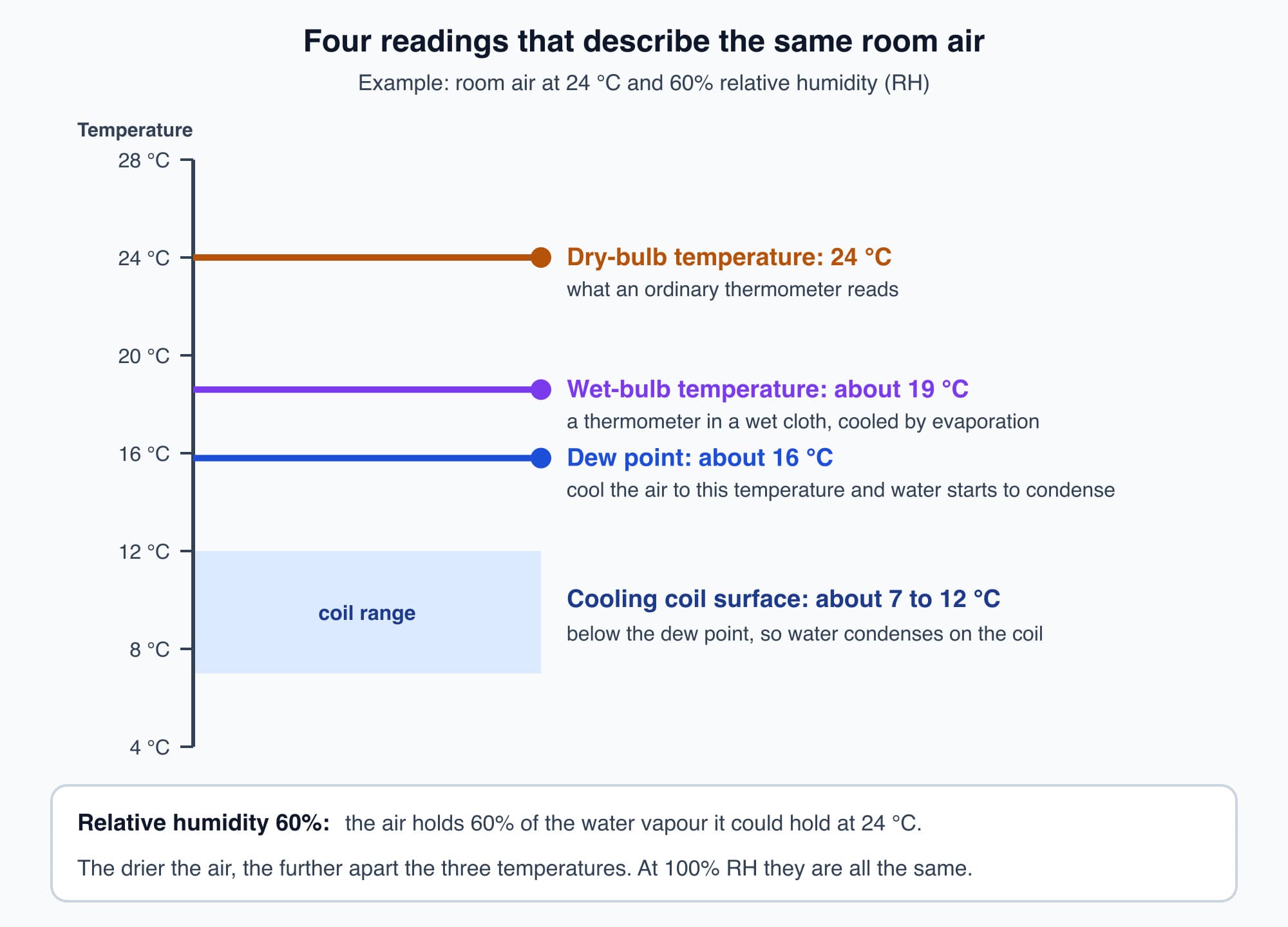
For the same room air, the dry-bulb, wet-bulb and dew point temperatures are different. A cooling coil runs below the dew point.
The drier the air, the further apart the dry-bulb, wet-bulb and dew point temperatures are. At 100% RH, all three are the same.
Why is my room cool but humid? Sensible heat and latent heat
When an air conditioner cools air, it removes heat. That heat comes in two kinds, and they feel very different.
Sensible heat is the heat that changes the temperature. It is called "sensible" because you can sense it directly, and a thermometer can measure it. When a room goes from 30 °C down to 24 °C, sensible heat has been removed.
Latent heat is the heat carried by water vapour. In Part 2 we saw that turning liquid water into vapour takes a large amount of heat, and that this heat stays in the vapour without raising its temperature. When the vapour condenses back into liquid, that heat is released again.
So the water vapour in your office air carries latent heat that a thermometer cannot see. You can cool the air as much as you like, but until the water vapour is actually taken out of the air, the moisture and the sticky feeling that comes with it are still there.
This is the answer to the question in the title. A room feels cool but humid when the air conditioner has removed enough sensible heat, so the temperature has dropped, but not enough latent heat, so the moisture has stayed.
The cooling coil removes water because it runs below the dew point
To take water out of the air, an air conditioner uses the dew point on purpose. The indoor cooling coil (the evaporator in a split unit, or a coil fed with chilled water in a large building) is a cold surface, typically somewhere around 7 to 12 °C. The room air in our example, at 24 °C and 60% RH, has a dew point of about 16 °C. In very humid conditions, a room's dew point can be around 17 to 20 °C.
Because the coil runs colder than the dew point of the room air, air passing over it is cooled below its dew point, and water condenses onto the coil's fins, just like on the iced glass. The water drips into a tray and runs out through the condensate drain. The drip you see outside a split unit is moisture that has been taken out of your room.
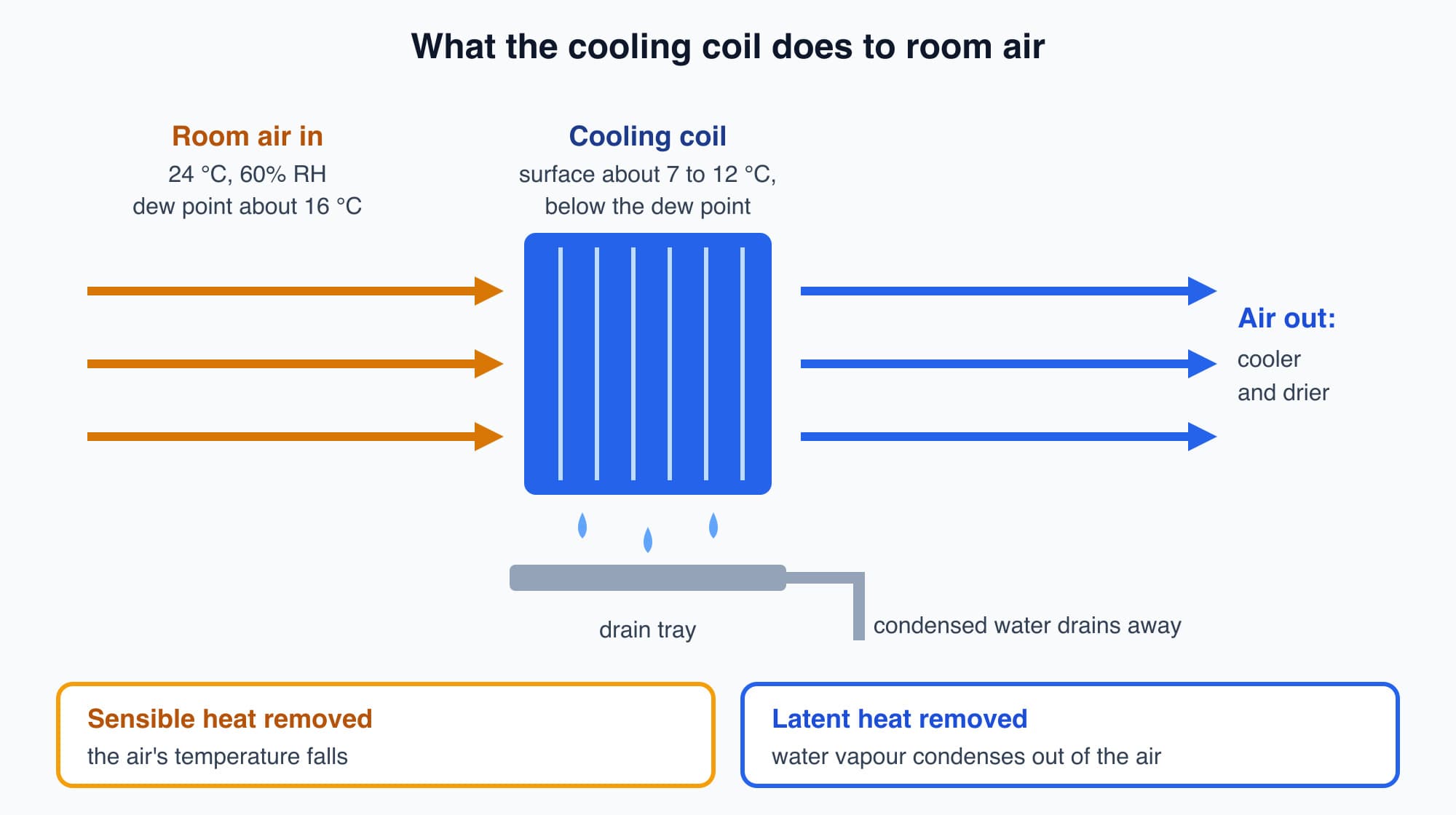
One pass over a cold coil removes both kinds of heat: the temperature falls, and water vapour condenses out.
So the coil does two jobs in one pass:
- it removes sensible heat, so the air comes out cooler, and
- it removes latent heat, so water condenses out and the air comes out drier.
The result is that a working air conditioner lowers the actual amount of water in the room air. That is dehumidification. In a tropical climate it is about half of what makes a room comfortable.
In Malaysia, a large part of the cooling job is removing moisture
In a dry climate, most of an air conditioner's work goes into sensible heat: lowering the temperature. The incoming air is already fairly dry, so there is little latent heat to remove.
Malaysia is the opposite. The outdoor air is warm and full of water vapour nearly all year, so a large share of the total cooling job is latent: taking water out of the air that comes into the building, hour after hour. Every litre of water that the coil condenses and drains away is latent heat that the machine had to carry outdoors, and that takes electricity. Most of that electricity is used by the compressor and fans, which are electric motors (How Electric Motors Work explains them).
This is why a cooling system in the tropics has to be able to handle both kinds of heat. There are two common reasons it fails to remove enough moisture:
- The unit is too large for the room. An oversized unit brings the temperature down to its setting within a few minutes and then switches its compressor off, before the coil has been cold long enough to condense much water. The room is left cold and clammy, the problem we started with. Part 18 looks at oversizing and this stop-start running, called short-cycling, in detail.
- The coil is not cold enough. If the coil runs close to or above the room's dew point, it lowers the temperature but condenses little water.
Part 6 shows how the total cooling load of a building is built up from its sensible and latent parts.
Too much humidity causes discomfort, condensation and mould
Air that is not dehumidified enough is more than a comfort problem. When indoor RH stays high for long periods, three things follow:
- Clammy discomfort. People feel warmer than the thermometer says, because their sweat evaporates slowly into air that is already nearly full. They often turn the setpoint down, which uses more energy on sensible cooling and does not fix the moisture problem.
- Condensation. Any surface colder than the room's dew point collects water: cold water pipes, air ducts carrying cold air, windows. That leads to drips, stains and corrosion.
- Mould and mildew. Moulds grow well above roughly 60 to 70% RH. Damp ceiling tiles, carpets and wall corners become places for mould to grow, which causes musty smells and allergy complaints. The optional article Humidity and Mould in Buildings: A Malaysian Fix goes further.
Malaysia's code of practice on indoor air quality, which Part 4 introduces, gives an acceptable range for offices of 23 to 26 °C and 40 to 70% RH. Many buildings aim for the middle of that range, roughly 24 °C and 50 to 60% RH. Hit both numbers together and the room feels fresh. Hit only the temperature and you get the cold but sticky room.
Worth knowing: A wall thermometer only measures temperature. Most rooms never have their humidity measured at all, so a complaint that a room "feels clammy" is hard to act on. An RH sensor that records readings over time turns that complaint into a number you can compare with the 40 to 70% range.
Optional detail: You may have read that "cooling raises relative humidity". That is true only if no water is removed. Air at 24 °C and 60% RH, cooled to 20 °C with the same water still in it, would be at about 77% RH, because the sponge has shrunk. A real cooling coil does not work that way. It runs below the dew point and removes water as it cools, so in a room with a working air conditioner, both the temperature and the actual amount of water in the air go down.
What comes next: fresh air and indoor air quality
Humidity is one part of indoor air quality (IAQ), which describes how comfortable and healthy the air is to breathe. Much of the moisture a building has to remove arrives with the fresh outdoor air that the building brings in for people to breathe. The next part, Indoor Air Quality in Offices, also looks at what that fresh air costs in cooling, and it starts from two questions: why does a building have to bring in fresh outdoor air at all, and how can you tell whether a room is getting enough?
Check your understanding
- A room is at 24 °C and 60% RH, so its dew point is about 16 °C. Will a glass of water at 20 °C "sweat"? Will a can of drink at 5 °C? The glass at 20 °C will not, because its surface is warmer than the dew point. The can at 5 °C will, because its surface is below the dew point, so water from the room air condenses on it. A cooling coil at 7 to 12 °C collects water for the same reason.
- Why can an oversized air conditioner leave a room cold but clammy? It brings the temperature down quickly and then switches its compressor off. The coil does not stay below the dew point for long enough to condense much water, so the sensible heat is removed but much of the latent heat, the moisture, stays.
Recap: Temperature and moisture are separate. Relative humidity is how full the air is with water vapour, compared with the most it can carry at its temperature, and warm air can carry more. The dew point is the temperature at which water starts to condense. Sensible heat changes the temperature and shows on a thermometer. Latent heat is carried by water vapour and does not. A cooling coil runs below the dew point, so it removes both: the air leaves cooler and drier. A room feels cool but humid when enough sensible heat is removed but not enough latent heat. In Malaysia, removing moisture is a large part of the cooling job, and too much humidity leads to discomfort, condensation and mould.
Go deeper on video (optional)
This short animated video shows the difference between sensible heat and latent heat described earlier. It is optional.
Zebra Learnings uses simple animation to show how sensible heat changes temperature while latent heat is the hidden energy locked in humidity - the exact mechanism behind cool-but-sticky air.
This is Part 3 of 20 in Cobler's Cooling Fundamentals course. Previous: The Refrigeration Cycle Explained Simply: The Loop That Carries Heat Outside. Next: Indoor Air Quality in Offices: Fresh Air, Filters and What CO2 Really Tells You.
Cobler builds CobiNeural, a platform that shows a facility team its building's energy, water and indoor air data as live numbers across the whole site. To see how your building performs, talk to us.
FAQ
Frequently asked questions
Ask us about this topic
Something in this article you want to dig into — or a situation in your own building it doesn't quite cover? Send us your question. We don't run public comments; the team replies to you directly by email.