
Blog
Indoor Air Quality in Offices: Fresh Air, Filters and What CO2 Really Tells You
How offices keep air healthy with ventilation, filters and CO2 sensing — why 1000 ppm is Malaysia's legal limit and how fresh air costs cooling energy.
 Tan Kok XinCooling Fundamentals
Part 4 of 20 in Cobler's Cooling Fundamentals course. New here? See the course page.
Part 3 ended on the fresh outdoor air that carries much of a building's moisture in with it. That raised two questions: why does a building have to bring in fresh outdoor air at all, and how can you tell whether a room is getting enough? This part answers both, and shows what that fresh air costs in cooling.
Walk into a meeting room at 9 a.m. and the air feels fresh. Sit through a two-hour workshop there with a dozen people and the same room feels heavy. People start yawning, someone opens the door, and everyone feels more awake. The thermostat has not moved, and nothing smells wrong. What changed was the quality of the air, not its temperature. Cooling a building well is only half the job: the air also has to be fresh enough to breathe comfortably. That is indoor air quality (IAQ), and carbon dioxide (CO2) is the simplest way to check it.
People change the air in a room all the time
Every breath you take removes some oxygen from the air and adds carbon dioxide, moisture and a little body heat. In a room full of people, this adds up quickly.
People are not the only source. Printers, cleaning products, carpets, furniture and paints slowly give off gases, and food eaten at desks adds odours. Over a working day, the air in a closed room gradually fills up with things you would rather not keep breathing.
The only way to get rid of them is to replace some of the room air with fresh outdoor air, or to clean the air, or to stop the pollution being released in the first place.
A sealed, efficient building has to bring in fresh air on purpose
A modern office is built to be airtight: sealed windows, doors with seals, insulated walls. This is deliberate. Every gap that lets hot, humid outdoor air leak in adds to the cooling load, including the moisture load we met in Part 3. So a good building is sealed like a cooler box.
In an older, leaky building, draughts flushed some stale air away by accident. In a sealed modern building, stale air stays unless the building's systems deliberately move it out. So fresh air has to be planned and supplied on purpose.
How that happens depends on the building:
- In the office tower, each floor has air handling units (AHUs). An AHU is a large fan unit that mixes fresh outdoor air with air returning from the rooms, passes it through filters, cools and dries it over a cooling coil, and sends it to the rooms through ducts. Part 10 explains AHUs in detail.
- In the shoplot, the split units and cassettes only cool and recirculate the air already in the room. They do not bring in any fresh air. Fresh air comes in through doors and windows, or through separate fresh-air fans if the building has them.
Three ways to keep indoor air clean: ventilation, filtration and source control
Every way of improving indoor air quality comes down to one of three things: bring in fresh air, filter out particles, or stop the pollution at its source.
Ventilation means deliberately replacing some of the indoor air with fresh outdoor air. It is the most important of the three, because it dilutes everything the occupants add: the CO2 they breathe out, odours, and the gases that furniture and finishes give off.
How much fresh air is enough? Design standards set minimum outdoor-air rates, worked out per person and per square metre of floor, so a crowded call centre gets more fresh air than a rarely used storeroom. The optional article Ventilation Rate Office Guide for Malaysian Buildings goes further.
Filtration catches particles. Fresh air from outside is not clean air: it carries dust, pollen, soot from traffic and, during haze, fine smoke particles. So the air a building circulates is pushed through filters.
Filters are rated by MERV, which stands for Minimum Efficiency Reporting Value. The higher the number, the smaller the particles a filter catches:
- MERV 6 to 8 is basic. It catches larger dust, lint and pollen, which is enough to keep the cooling coil and ductwork clean.
- MERV 13 and above catches a large share of fine particles, including PM2.5: particles smaller than 2.5 micrometres, from haze and traffic, which are small enough to reach deep into the lungs. Hospitals and offices that take air quality seriously aim for this level.
Source control means stopping pollution before it gets into the air. Examples are choosing low-odour paints and adhesives, keeping loading-bay and car-park fumes away from fresh-air intakes, storing cleaning chemicals properly, and maintaining the cooling system so that mould does not grow on damp coils and drain trays. Anything you prevent at the source does not have to be diluted with fresh air or caught by a filter later.
CO2 is not a poison at office levels, but it shows how much fresh air a room is getting
Carbon dioxide is the gas you breathe out. At the concentrations found in offices, it is not toxic. Nobody in a stuffy meeting room is being poisoned by CO2.
What makes CO2 useful is that it shows how well a room is ventilated. It works like this:
- Outdoor air contains about 420 ppm of CO2. "ppm" means parts per million: 420 molecules of CO2 in every million molecules of air.
- The people in a room breathe out CO2 all the time.
- If plenty of fresh air comes in, that CO2 is diluted and carried away, and the reading stays low.
- If too little fresh air comes in, the CO2 builds up, and the reading climbs.
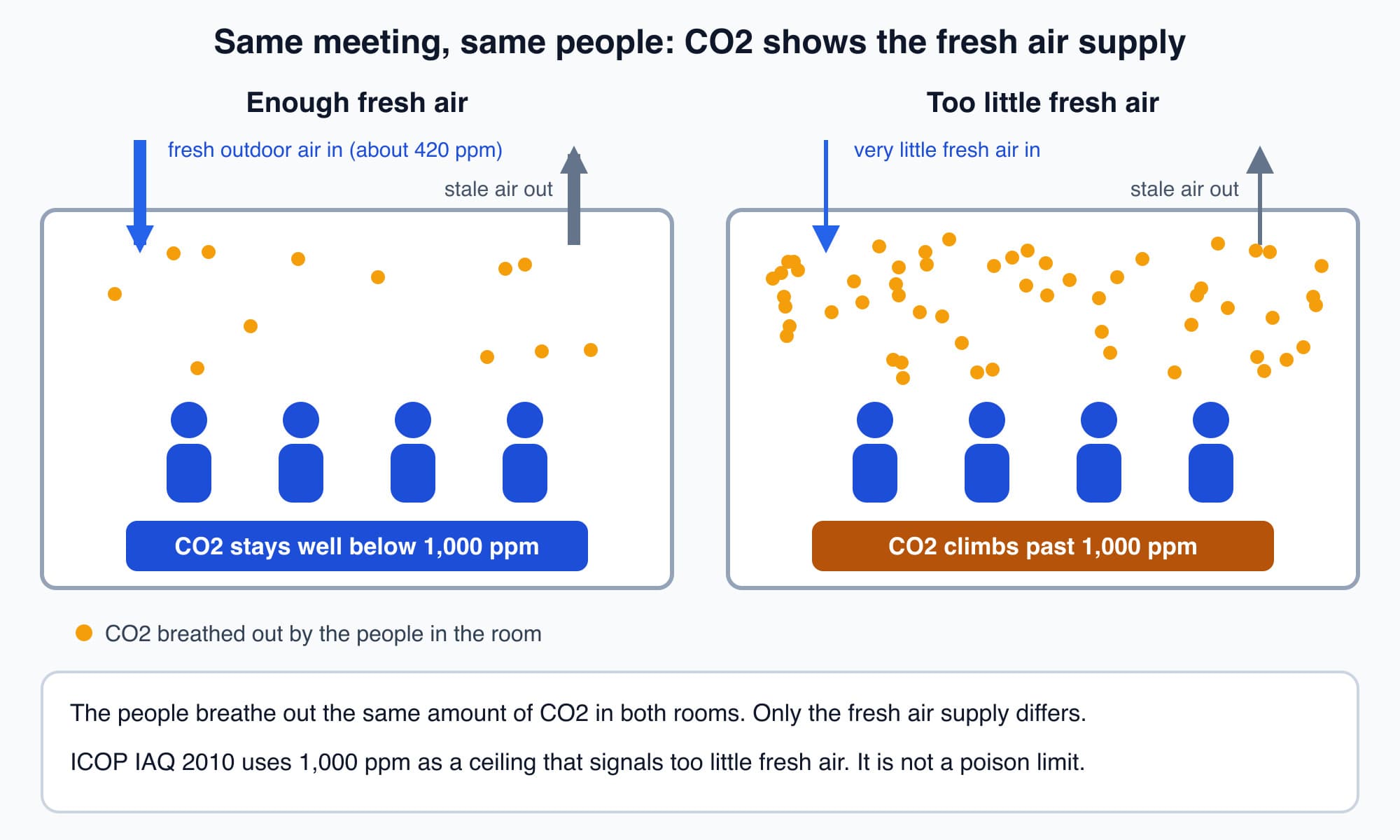
The same people breathe out the same CO2. How high the reading climbs depends on how much fresh air the room gets.
So CO2 is an indicator. You cannot see stale air, but you can measure CO2 cheaply. When the number of people in a room is steady, the CO2 level rises and falls with the amount of fresh air each person is getting. A high reading does not mean the CO2 itself is harmful. It means that everything else the occupants add, such as odours and moisture, is not being cleared either.
CO2 has limits as an indicator. It only tracks what people add. It tells you nothing about dust and haze particles, gases from furniture or cleaning products, or mould. A poorly ventilated room can also show a low reading when it is empty, simply because nobody is adding CO2. So a CO2 reading is a check on ventilation, not a complete test of air quality.
Malaysia's code of practice uses 1,000 ppm of CO2 as a ceiling
Malaysia's Industry Code of Practice on Indoor Air Quality 2010 (ICOP IAQ 2010), issued by the Department of Occupational Safety and Health (DOSH), sets out good practice for indoor air in workplaces. For CO2, it uses 1,000 ppm as a ceiling: a reading above it signals that the ventilation is not keeping up. It is a limit for judging ventilation, not a toxic limit.
The code also gives acceptable ranges for the physical conditions in a room. Together with the CO2 ceiling, these are the numbers most relevant to this course:
Measurement | ICOP IAQ 2010 acceptable range |
|---|---|
Air temperature | 23 to 26 °C |
Relative humidity | 40 to 70% |
Air movement | 0.15 to 0.50 m/s |
Carbon dioxide (CO2) | 1,000 ppm ceiling, as an indicator of ventilation |
The code also sets limits for a number of indoor pollutants. Those belong to indoor air quality investigations and are outside the scope of this course.
To put the CO2 numbers side by side: fresh outdoor air is about 420 ppm, and the ICOP ceiling is 1,000 ppm. A room that stays well below 1,000 ppm while it is full of people is getting enough fresh air. A room that keeps rising above 1,000 ppm needs more.
Why does this matter if CO2 at these levels is not toxic? Because stuffy, poorly ventilated rooms affect people. They are linked to drowsiness, headaches and slower thinking, so the mid-afternoon tiredness in a crowded meeting room is partly caused by the air.
In Malaysia, fresh air costs cooling energy, so it is balanced rather than maximised
Every cubic metre of fresh air brought into a Malaysian building arrives hot and humid. Before it reaches the people inside, the cooling system has to lower its temperature and remove much of its moisture: both the sensible and the latent heat from Part 3. That takes electricity, and the amount grows with the amount of fresh air. Double the fresh-air rate and you roughly double that part of the cooling load.
This is why ventilation is balanced, not maximised. If fresh air were free, you would fill every room with it. In the tropics it is one of the more expensive things a cooling system does. So the aim is to bring in enough fresh air to keep the air healthy and CO2 below 1,000 ppm, and not a great deal more.
CO2 sensors can help with this balance. A meeting room designed for twelve people is often empty or half full. Supplying the full design amount of fresh air all day would mean cooling and drying outdoor air for nobody. Demand-controlled ventilation uses CO2 sensors to adjust the fresh air to match the people actually present: less fresh air when the room is empty and the CO2 is low, more when the room fills up and the CO2 climbs. The same sensor that protects the occupants also saves cooling energy.
Measuring CO2 shows you when a room is short of fresh air. Changing the fresh-air supply in response is a job for the building's controls. We come back to how AHUs do this in Part 10, and to how a building management system (BMS) runs it in Part 19.
Worth knowing: A finer filter is harder to push air through, so the fan has to work harder, and use more electricity, to move the same amount of air. Choosing a filter means balancing cleaner air against a higher fan energy bill, not simply picking the finest one available.
Optional detail: A widely used international benchmark for fresh-air rates is ASHRAE Standard 62.1, published by ASHRAE (the American Society of Heating, Refrigerating and Air-Conditioning Engineers). It sets minimum outdoor-air rates for commercial buildings, and Malaysian consulting engineers commonly design to it. ICOP IAQ 2010 is an approved industry code of practice under the Occupational Safety and Health Act 1994. It is not a regulation in itself, but it sets the standard employers are expected to meet, and it can be used as evidence of what good practice requires. Some studies have tested people's decision-making in rooms with different CO2 levels and found that performance got worse as the air got staler, even when people did not notice anything wrong.
What comes next: how much cooling does a building need?
We have now seen what a building's cooling system has to remove: heat that comes into the rooms, moisture from the air, and the heat and moisture carried in with fresh outdoor air. The next part, What Is a Ton of Refrigeration?, explains the units used for cooling. It starts from the next natural question: how do engineers measure an amount of cooling, and why are large machines rated in "tons"?
Check your understanding
- A meeting room reads 1,200 ppm of CO2 in the afternoon. Is the CO2 poisoning the people in it? No. At office levels, CO2 is not toxic. The reading shows that the room is not getting enough fresh air for the number of people in it, so the other things people add to the air are building up too. The room needs more fresh air.
- Why doesn't a Malaysian office simply bring in as much fresh air as possible? Outdoor air here is hot and humid, so every extra cubic metre has to be cooled and dried before it reaches people, which uses electricity. The aim is enough fresh air to keep the air healthy and CO2 below 1,000 ppm, and not much more.
Recap: People change the air in a room by breathing out CO2 and moisture, and furniture, cleaning products and food add more. A sealed, efficient building has to bring in fresh air on purpose, through AHUs in a large building; wall-mounted split units only recirculate room air. Three ways keep indoor air clean: ventilation, filtration (rated by MERV) and source control. CO2 is not toxic at office levels, but it shows how much fresh air a room is getting. Malaysia's ICOP IAQ 2010 uses 1,000 ppm as a ceiling for ventilation, alongside 23 to 26 °C and 40 to 70% RH. Because fresh air in the tropics is hot and humid, it costs cooling energy, so ventilation is balanced rather than maximised.
Go deeper on video (optional)
This video shows how an air handling unit brings in fresh air, filters it and cools it. It is optional: Part 10 covers air handling units properly.
The Engineering Mindset walks through how an air-handling unit pulls in fresh outdoor air, filters it, and conditions it before it reaches the office.
This is Part 4 of 20 in Cobler's Cooling Fundamentals course. Previous: Why Is My Office Cool but Still Humid? Sensible Heat, Latent Heat and Dew Point. Next: What Is a Ton of Refrigeration? Tons, BTU and kW of Cooling Made Simple.
Cobler builds CobiNeural, a platform that shows a facility team its building's energy, water and indoor air data as live numbers across the whole site. To see how your building performs, talk to us.
FAQ
Frequently asked questions
Ask us about this topic
Something in this article you want to dig into — or a situation in your own building it doesn't quite cover? Send us your question. We don't run public comments; the team replies to you directly by email.