
Blog
Window, Split and VRF Air Conditioners: What's the Difference?
Window vs split vs VRF air conditioners explained simply: how each cools, why VRF's inverter compressor matches demand, and which suits your building.
 Tan Kok XinCooling Fundamentals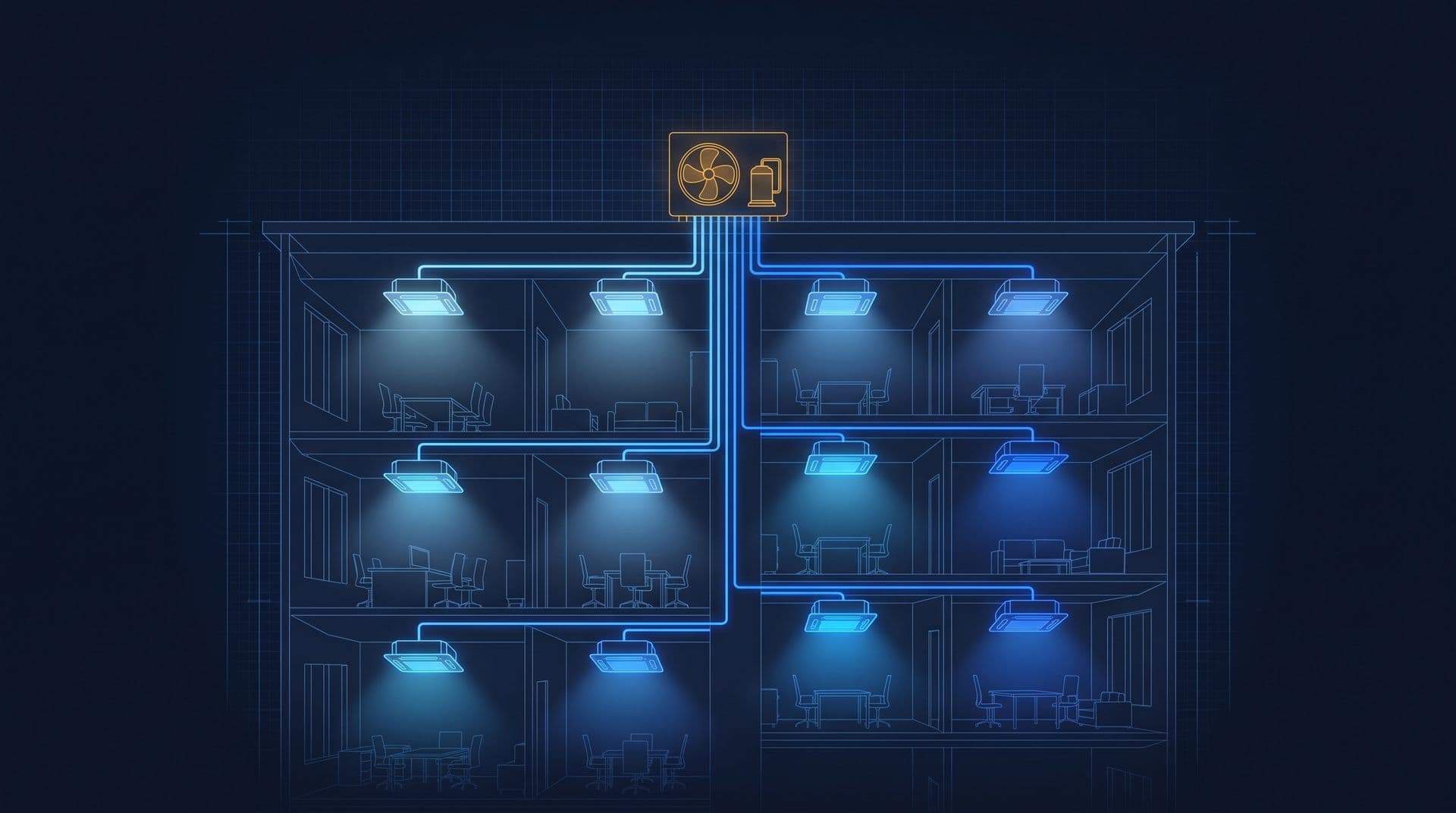
Part 7 of 20 in Cobler's Cooling Fundamentals course. New here? See the course page.
In Part 6 we worked out how much heat a space needs removed. The next question is which machine removes that heat, and which suits which building. Every machine in this part runs the refrigeration loop from Part 2; what changes is how the loop is packaged. At the end, there is a route through the rest of the course for buildings without a chiller plant.
Walk down a row of Malaysian shoplots and you will see small outdoor units bolted to the back walls, one or two for each shop. Look at a large office tower and you may see none at all. So what is the difference between window, split and VRF air conditioners, the systems you are most likely to meet in homes, shops and mid-size buildings? A window unit puts the whole cooling machine in one box; a split unit moves the noisy, hot half outdoors; and a VRF (variable refrigerant flow) system connects one outdoor unit to many indoor units, each controlled separately, with a variable-speed compressor. Large buildings go one step further and use a central chilled-water plant, which is the subject of the next part.
The window unit puts the whole cycle in one box
A window unit is the complete cooling cycle inside a single metal box that sits in a window or a hole in the wall. The cold half faces the room and the hot half faces the open air. It needs one box and one plug.
Inside, the box is divided into two sides:
- On the indoor side is the evaporator, the cold coil. A fan blows room air across it, the refrigerant inside takes in the heat, and cooler air comes out of the front grille.
- On the outdoor side are the compressor (the pump that squeezes the refrigerant) and the condenser, the hot coil, where the collected heat is blown away into the outdoor air.
Because everything is in one box, a window unit is cheap, simple and easy to install. The compressor is the noisy part, and in a window unit it sits in the wall about a metre from the room. That is the hum you hear from an old bedroom air conditioner when it starts. Window units also block a window, cool only the room they sit in, and switch fully on and off (the section on the inverter explains why that matters).
For a single small room, a window unit, at around RM1,000, is hard to beat on price. For anything bigger, its limits add up quickly.
The split unit moves the noisy half outside
A split air conditioner splits that single box into two parts and joins them with a pair of thin copper refrigerant pipes, plus a drain pipe and a power cable. It is the wall-mounted unit found in most Malaysian homes and shops.
- The indoor unit holds the evaporator: the cold coil and a quiet fan. It has no compressor, so it is much quieter. A ceiling cassette, common in shops and offices, is another type of indoor unit that works the same way.
- The outdoor unit, often called the condensing unit, holds the noisy, heat-producing parts: the compressor and the condenser coil with its large fan. It sits on an outside wall or a ledge, where its noise and hot air do not bother anyone.
Only the copper pipes and cable pass through the wall. Moving the compressor and condenser outdoors gives three advantages:
- It is much quieter indoors, because the loudest part is outside.
- It looks neater, because the indoor unit is slim and does not take up a window.
- It is more flexible, because the outdoor unit can sit several metres from the indoor unit, so a room without a suitable outside wall can still be cooled.
The trade-off is cost and installation. A split unit needs a trained installer to run the refrigerant pipes and charge them with refrigerant, while a window unit can almost be dropped in place. For a home or a small office, the split unit is the usual choice today.
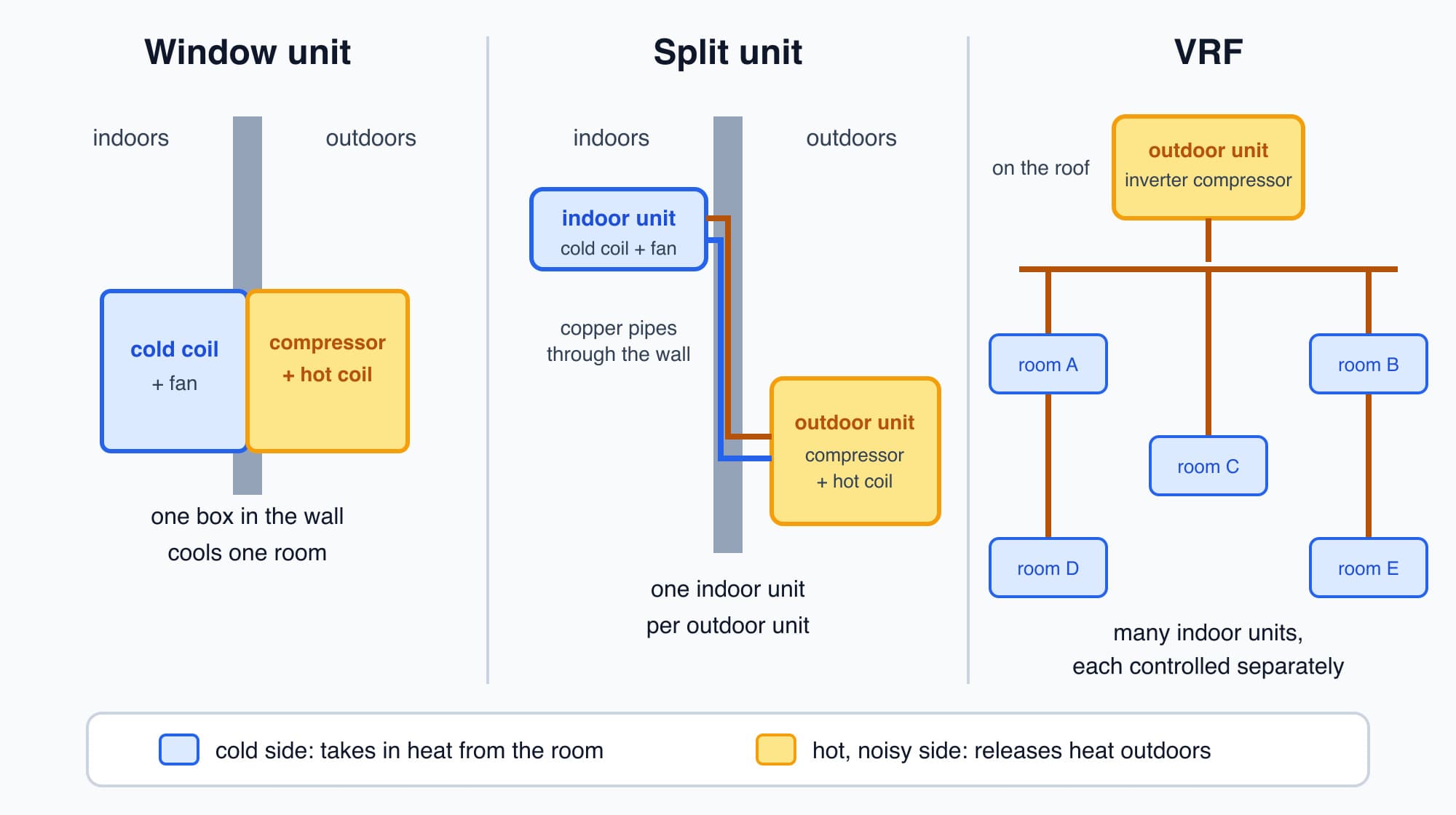
The same cooling loop packaged three ways. The compressor and hot condenser (amber) move further from the people being cooled.
The same pattern continues up the ladder: the hot, noisy work of releasing heat moves further away from the people being cooled. A window unit does it a metre away. A split unit does it outside the wall. VRF systems and chilled-water plants do it on the roof or in a plant room.
VRF connects one outdoor unit to many rooms
Now imagine a three-storey office where every room wants its own temperature. You could fit a separate split system for each room, but that means a wall crowded with a dozen outdoor units, each one making noise and needing its own maintenance.
VRF (Variable Refrigerant Flow) is the larger-scale answer. One outdoor unit, or a few, sends refrigerant through a shared network of pipes to many indoor units (ceiling cassettes, wall units and ducted units) across the building. Each indoor unit is controlled separately, so a meeting room can run cold while the empty office next door cools only lightly, all from the same outdoor unit on the roof.
The key word in the name is variable, and it points to the most important upgrade in this part: the inverter.
The inverter lets the compressor run at part speed
Older air conditioners have one speed. When the room gets warm, the compressor switches fully on at 100%. When the room reaches its setpoint, the compressor switches fully off. As the room warms again, it switches back on. This is called on/off cycling. A useful comparison is driving by pressing the accelerator to the floor, then coasting, then pressing it to the floor again. It works, but it is jerky and wasteful, and every hard restart puts strain on the machine.
An inverter solves this. It is an electronic drive that continuously varies the speed of the compressor motor, so the compressor can run at 30%, 55% or 80%, whatever the room needs at that moment. When the room is nearly at its setpoint, the compressor slows down and keeps running steadily instead of switching off and on. In the driving comparison, it is like easing the accelerator to hold a steady speed.
An inverter is the same idea as the variable-speed drives that run efficient pumps, fans and factory motors. Rectifiers and Inverters in our Electricity Fundamentals course explains the electronics. You do not need that detail for this course: a VRF's inverter compressor is that same variable-speed drive applied to the compressor motor. In a VRF system it does two jobs. It varies the total output of the outdoor unit, and, together with valves in the system, it sets how much refrigerant flows to each indoor unit. That is what "variable refrigerant flow" means.
(Many split units sold today, sometimes called inverter air conditioners, have an inverter compressor too. The benefit is the same.)
Why variable speed saves energy at part load
An air conditioner almost never works at its maximum load. The day it was sized for (Part 6), the hottest afternoon with every room full, happens only a few times a year. The rest of the time it meets a part load: a half-full building, a cooler morning, a cloudy day. Machines spend nearly all their running hours at part load.
An on/off machine has only one speed. At part load it matches the need by cycling: full output, off, full output, off. Each restart wastes energy, and each burst overcools before switching off. An inverter machine slows down and runs steadily at the lower output the room actually needs. Running a compressor steadily at 40% uses noticeably less energy than repeatedly running it at 100% and stopping it. This is why inverter and VRF systems have strong part-load efficiency: the savings come on the many ordinary days, not the hottest one.
In Malaysia you can read this on the label. The Suruhanjaya Tenaga (Energy Commission) star rating on a split unit is based on a seasonal figure called CSPF, which measures efficiency across a range of loads, not only at full output, which is where an inverter does well. More stars means more cooling for each unit of electricity. COP, EER and kW per Ton (Part 13) explains the label in full.
Which machine suits which building
The machines form a ladder, and each step suits a different size of building:
- Window unit: one small room. Cheapest and simplest, but the noisiest.
- Split unit: one room, or a small number of rooms each with its own unit. The usual choice for homes and small shops, roughly 1 to 5 zones.
- VRF / VRV: many separately controlled zones from shared outdoor units, up to dozens of indoor units across several floors. It suits mid-size commercial buildings such as small offices, clinics, hotels and retail floors.
- Central chilled-water plant: large buildings whose cooling load runs into the hundreds of refrigeration tons.
VRF's strengths match what a mixed-use commercial building needs: control of each zone (every tenant sets their own comfort), good part-load efficiency (from the inverter compressors, in a building that is rarely full), and room to grow, because more indoor units can be added when the fit-out changes.
The ladder has a top step. Once a building's total cooling load reaches the hundreds of refrigeration tons, as in a large office tower, a hospital or a shopping mall, filling the roof with more and more VRF outdoor units stops making sense. At that scale a central chilled-water plant takes over: a few large chillers in a plant room cool water, and pumps send it through the whole building. This is usually more efficient and easier to maintain than a large number of separate outdoor units.
In refrigeration tons (1 RT = 3.517 kW of cooling, from Part 5), the jump in scale is large. A home split unit delivers perhaps 2 to 4 kW, which is one ton or less. The shoplot is cooled by six wall-mounted split units and two ceiling cassettes, about 33 kW or 9 RT in total, with no chilled water and no cooling tower. The office tower needs about 900 RT at its peak and uses a chilled-water plant.
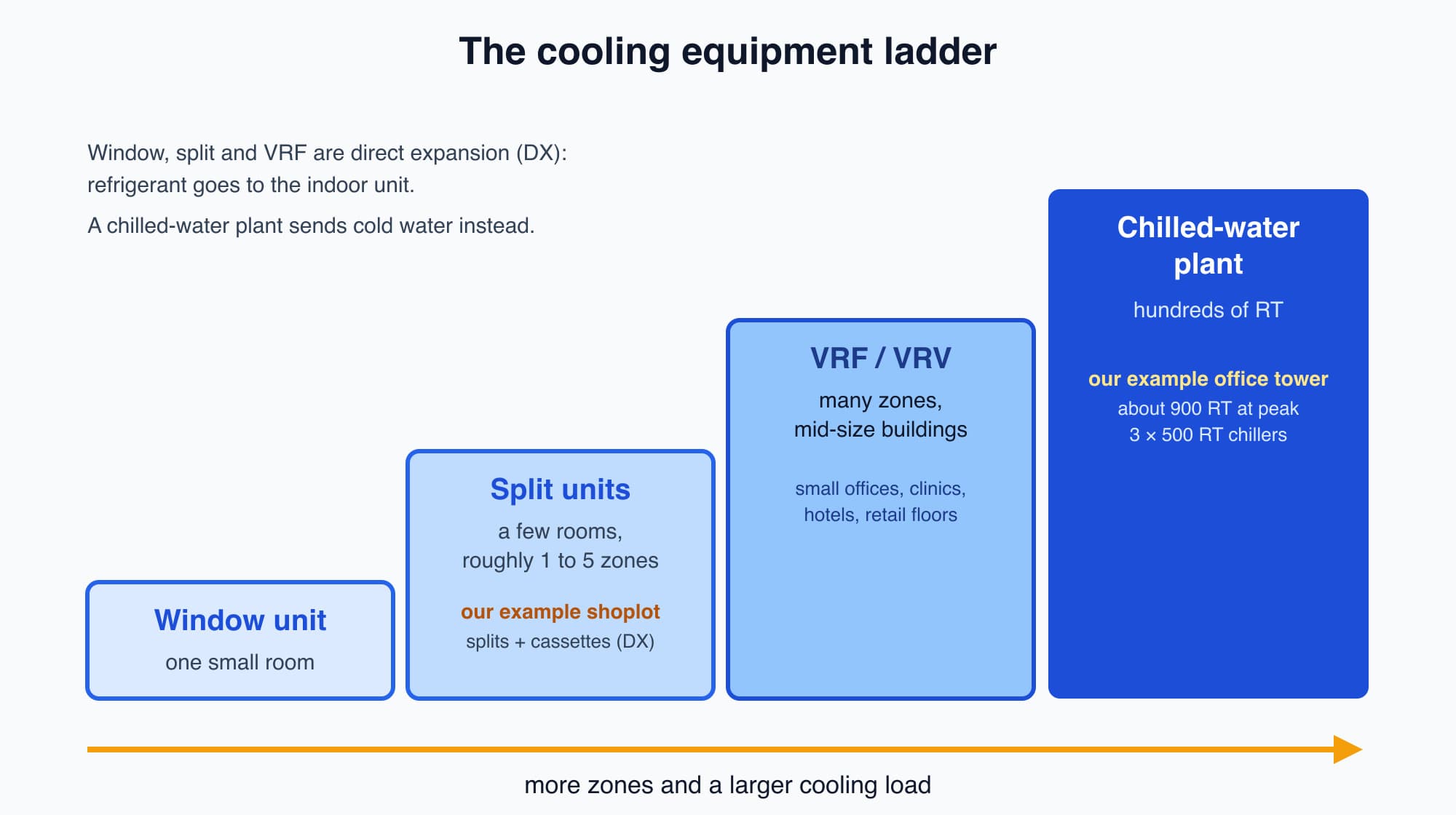
The equipment ladder: as the number of zones and the cooling load grow, the machinery changes.
If your building has no chiller plant, your route through this course
Window, split, cassette and VRF systems are all direct expansion (DX) systems: the refrigerant itself goes to the indoor unit and cools the room air directly. A chilled-water plant cools water first and sends the water to the rooms. Parts 1 to 6 apply to every building. Parts 8 to 12 and Part 17 are mainly about chilled-water plants. If your building is like the shoplot, here is what to read from here on:
- Read: Part 13, COP, EER and kW per Ton for star labels and CSPF; Part 14, Why Air Conditioning Is the Biggest Line on a Malaysian Building's Electricity Bill, noting that a Low Voltage shop is billed per kWh with no kW demand charge; Part 18, Oversized Chillers, Short-Cycling and Dirty Coils, whose short-cycling and dirty-coil sections apply directly to split units; and Task 7 of the final worked check, Part 20, which is the shoplot version.
- Optional: Part 8, How Does a Chilled-Water System Work?, to understand how large buildings do it; Part 10, AHU vs FCU, for its point that units which only recirculate room air bring in no fresh air; Part 15, Why Chiller Efficiency Is Measured at Part Load, which explains the same part-load idea as the variable-speed section above; Part 16 for measuring energy use, where a DX building sub-meters its air-conditioning circuits; and Part 19 for the control loop, setpoints and schedules, and its plant strategies if your building has a control system.
- Skip: Part 9 (pumps and valves), Part 11 (VAV systems), Part 12 (cooling towers) and Part 17 (low delta-T in chilled water). None of these apply to a building with split units only.
Worth knowing: You will also see the name VRV (Variable Refrigerant Volume). VRV is Daikin's trademark for the same technology. Daikin introduced it and kept the brand name, so other makers call theirs VRF. When someone says VRV, read it as VRF.
What comes next: the central chilled-water plant
At the top of the ladder, large buildings stop sending refrigerant to every room and send cold water instead. The next part, How Does a Chilled-Water System Work?, opens up the central plant: the chiller, the two water loops, and the cooling tower on the roof. If your building uses split units only, you can skim it (see the previous section). It answers the question: how does a chilled water system work?
Check your understanding
- Why is a split unit quieter indoors than a window unit? The compressor, the noisiest part, is in the outdoor unit. The indoor unit has only the cold coil and a quiet fan, joined to the outdoor unit by copper refrigerant pipes.
- An office is half empty on most days. Why does an inverter compressor save energy there compared with an on/off compressor? At part load, an on/off compressor cycles between full output and off, wasting energy at each restart and overcooling. An inverter compressor slows down and runs steadily at the lower output needed, which uses less energy. Most running hours are at part load, so the savings add up.
Recap: Window, split and VRF systems use the same refrigeration cycle packaged in different ways. A window unit puts everything in one box. A split unit moves the compressor and condenser outdoors for quiet and flexibility. VRF connects one outdoor unit to many separately controlled indoor units, and its inverter compressor varies its speed to match demand instead of cycling on and off, which saves energy at part load. CSPF star labels grade this part-load efficiency. Choose by the number of zones and the load: window or split for one or a few rooms, VRF for many, and a central chilled-water plant once the load reaches hundreds of RT. Buildings with DX systems only can follow the short route described above.
Go deeper on video (optional)
This video shows how a VRF system varies the refrigerant flow to each indoor unit, which puts the VRF and inverter sections into moving pictures. It is optional.
The Engineering Mindset walks through how a VRF system varies refrigerant flow to match each zone's cooling demand, the key idea that sets VRF apart from window and split units.
This is Part 7 of 20 in Cobler's Cooling Fundamentals course. Previous: How to Calculate a Building's Cooling Load: Where Heat Sneaks In. Next: How Does a Chilled-Water System Work? The Three Loops Explained.
Cobler builds CobiNeural, a platform that shows a facility team its building's energy, water and indoor air data as live numbers across the whole site. To see how your building performs, talk to us.
FAQ
Frequently asked questions
Ask us about this topic
Something in this article you want to dig into — or a situation in your own building it doesn't quite cover? Send us your question. We don't run public comments; the team replies to you directly by email.