Blog
How Does an Air Conditioner Work? It Moves Heat, It Doesn't Make Cold
An air conditioner does not create cold. It scoops heat out of your room and dumps it outside. This one reframe unlocks how all cooling actually works.
 Tan Kok XinCooling Fundamentals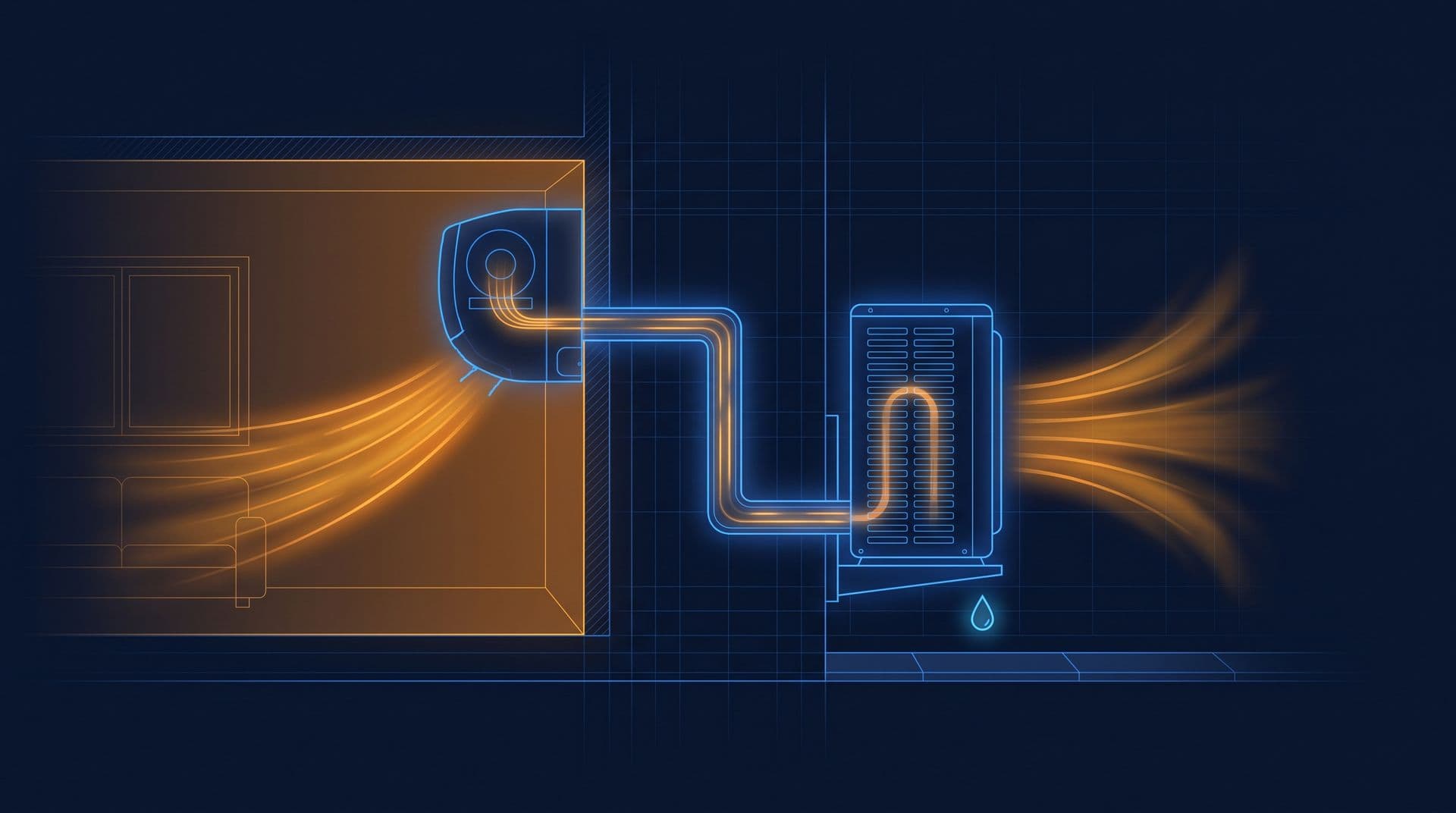
Part 1 of 20 in Cobler's Cooling Fundamentals course. New here? See the course page.
Cooling Fundamentals is a 20-part course for people who look after air-conditioned buildings in Malaysia, such as facility managers, building owners and office or shop staff, and who have no background in engineering. It starts with how one air conditioner works and builds up to a full chilled water plant, what it costs to run and how to check it. This first part answers the most basic question: what does an air conditioner actually do?
On a hot afternoon you switch on the air conditioner, and after a few minutes the room feels comfortable. Outside, the box on the wall blows out warm air, and a small pipe drips water onto the ground. How does an air conditioner work, and where do the heat and the water go?
The short answer is that an air conditioner does not make cold. It moves heat out of your room to the outdoors, and it uses electricity to do that. This part explains that idea one piece at a time. You do not need any background in science.
Two fictional buildings, with realistic numbers, run through the whole course. The shoplot is a three-storey shoplot in Petaling Jaya, cooled by wall-mounted split units and ceiling cassettes. The office tower is a 20-storey office building in Kuala Lumpur with a central chilled water plant. We will use both throughout the course, starting with the kind of air conditioner everyone knows: a split unit on a wall.
How does an air conditioner work? It moves heat out of the room
Heat is a form of energy. Everything around you, including the air in your room, holds some heat. A cool room is simply a room whose air holds less heat than a warm room.
Cold is not a substance. No machine can make it and blow it into a room. A useful comparison is darkness: you cannot switch on a lamp that sends out darkness. You can only take light away. In the same way, an air conditioner cools a room by taking heat away.
So an air conditioner does three things, in order:
- It takes heat out of the room air.
- It carries that heat through pipes to the outdoor unit.
- It releases the heat into the outdoor air.
The air left in the room holds less heat, and your skin feels it as cool.
Heat flows from warm to cool on its own, so moving it outdoors takes work
Left alone, heat always flows from something warmer to something cooler. A hot cup of coffee cools down to room temperature. A cold drink warms up. Neither ever goes the other way by itself.
Now look at what an air conditioner is asked to do. On a typical Malaysian afternoon it might be 33 degrees Celsius outside, and you want your room at 24 degrees Celsius. The air conditioner has to take heat out of the cooler room and push it into the hotter outdoor air. That is the opposite of the natural direction.
Heat will not do this by itself, so the machine has to force it. That is why an air conditioner has a compressor, a machine driven by an electric motor, and why it needs electricity. Part 2 explains what the compressor does. The electricity it uses appears on your bill in kilowatt-hours (kWh). Power vs Energy: The Difference Between kW and kWh, in our Electricity Fundamentals course, explains those units.
A ceiling fan is different. It only moves the air around. It takes no heat out of the room, and its motor even adds a small amount. It makes you feel cooler because moving air carries heat away from your skin and helps your sweat evaporate. The room itself does not get cooler.
A useful comparison: bailing water out of a leaking boat
Picture a small boat with a slow leak. Water keeps seeping in, so you scoop it out with a bucket and throw it over the side.
Bailing does not destroy any water. It moves the water from inside the boat to outside. It also takes continuous effort: stop bailing and the boat fills up again.
An air conditioner does the same with heat. Heat keeps entering a building through the walls and roof, through windows where the sun shines in, and from the people, computers and lights inside. The air conditioner carries that heat outdoors. When it stops, heat keeps coming in and the room warms up again.
The comparison stops working in one place. Water in a boat is a substance, while heat is energy, and the air conditioner adds some energy of its own as it works. The next section shows where that extra energy goes.
A machine that moves heat from one place to another is called a heat pump. Every air conditioner is a heat pump. In Malaysia we only ever ask it to pump heat out of buildings.
The outdoor unit blows hot air because it releases the room's heat plus the electricity
The warm air coming off a running outdoor unit is the heat that used to be in your room. The outdoor unit is where the heat is released. If it were not blowing warm air, it would not be getting rid of anything. A warm outdoor unit does not by itself mean it is faulty or wasting energy.
The outdoor unit releases more heat than the room lost. The electricity that runs the compressor does not disappear. It also ends up as heat, and that heat leaves through the outdoor unit too. So, for the machine as a whole:
Heat taken from the room + electricity used = heat released outdoors.
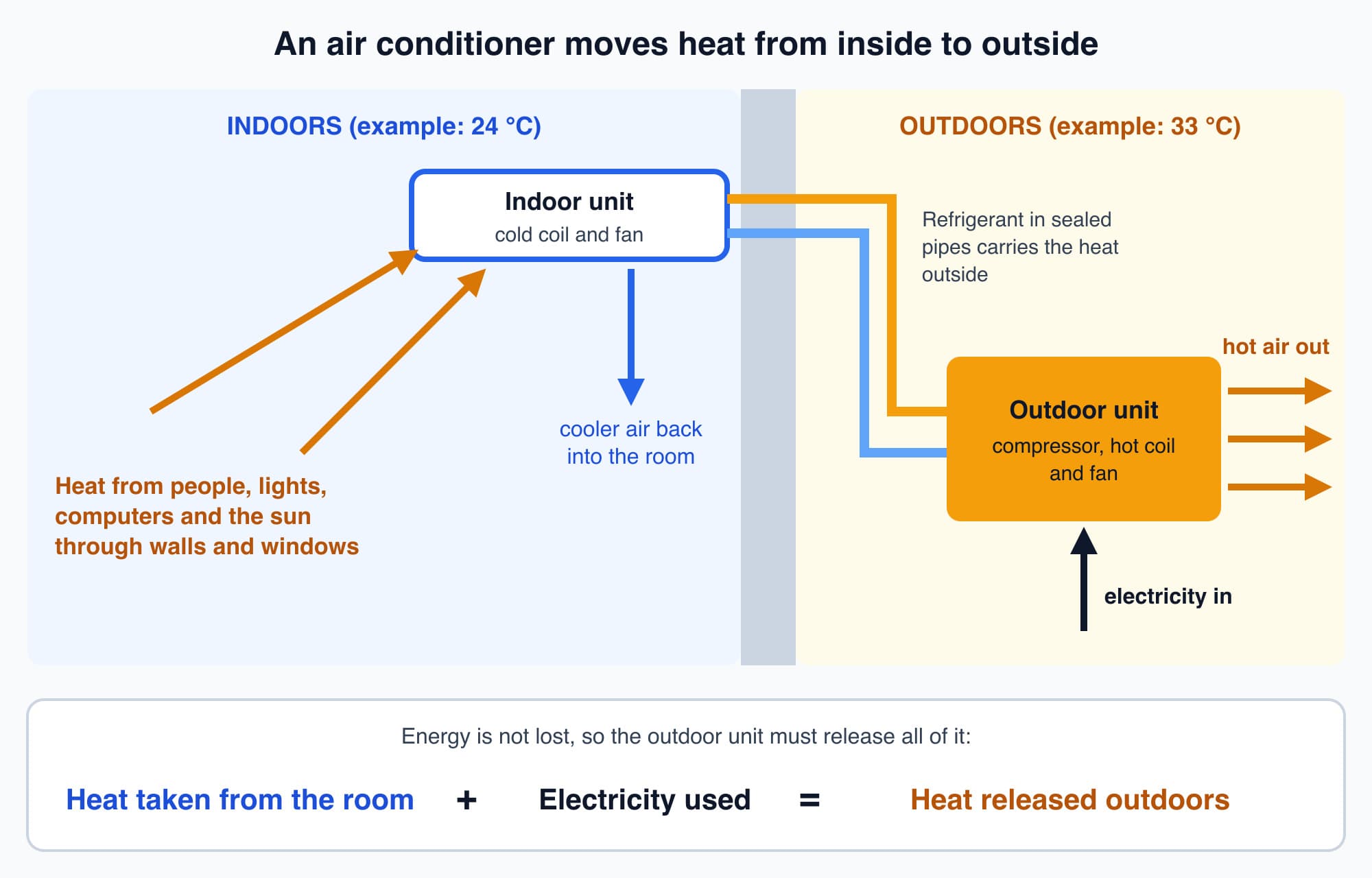
The outdoor unit releases the heat taken from the room plus the energy of the electricity used to move it.
This is simple bookkeeping: energy is never lost, so every bit of it has to end up somewhere, and here it ends up in the outdoor air.
The water dripping outside comes from the moisture in your room air
Air carries invisible water vapour. The amount is described as humidity. Malaysian outdoor air is very humid, often at 80% relative humidity or more. Relative humidity tells you how close the air is to holding as much water vapour as it can at its temperature. Part 3 explains it properly.
Inside the indoor unit is a coil: a block of thin metal pipes and fins that the machine keeps cold. A fan blows the room air across it. When the air touches the cold coil, it cools below its dew point, the temperature at which water vapour starts to turn back into liquid. Water forms on the coil, just as water forms on the outside of a glass of iced drink on a warm day. That water does not come through the glass. It comes from the air.
The water runs into a tray and leaves through a drain pipe. On a split unit, that is the drip you see outside. In a large building, it runs into a proper drain line.
Removing this moisture makes the room more comfortable, because damp air feels sticky even when it is cool. It is not free, though. Turning water vapour back into water releases heat onto the coil, and the machine has to carry that heat outdoors too, using more electricity. Part 3 explains this, and why a room can end up cool but still humid.
The same idea runs a fridge, a car and a building's chiller
The heat-moving idea is not special to the unit on your bedroom wall. A refrigerator, a car's air conditioner, a split unit and a building's chiller all move heat in the same basic way. What changes is where the heat comes from, where it goes, and the size of the machine.
System | Where it takes heat from | Where it releases the heat |
|---|---|---|
Refrigerator | The food compartment | The kitchen, through the warm grille or panel at the back |
Car air conditioner | The cabin | The passing air at the front of the car |
Home split unit | One room | The outdoor air |
Building chiller | Water that has been piped around the building to cool its air | The outdoor air, usually through cooling towers |
The size difference can be very large. In the shoplot, all eight indoor units together can move about 33 kW of heat. One chiller in the office tower can move about 1,760 kW, more than 50 times as much. (Here kW measures how fast heat is moved, not how much electricity is used. Part 5 explains the difference and the "refrigeration ton" used to rate chillers.)
The physics is the same at every size, so this course starts with a small machine and then builds up to a full chilled water plant. If your building is cooled only by split units and cassettes, like the shoplot, Part 7 shows which later parts you need and which you can skip.
In Malaysia, cooling runs all year, so it is a large part of the electricity bill
In many countries, a building needs heating in winter and cooling in summer. In lowland Malaysia, where most buildings are, it is never cold enough to need heating. The only job is to remove heat, every day of the year. There is no cool season in which the machines can rest.
That is why air conditioning is usually the largest single use of electricity in a Malaysian commercial building. In the office tower, air conditioning (the chiller plant plus the fans that move the air) uses about 45% of the building's electricity. In the shoplot, it also uses about 45%. The real share varies with the building, its opening hours and what else it runs. Part 14 looks at this share and at how cooling shows up on a TNB (Tenaga Nasional Berhad) bill.
Worth knowing: Every air conditioner releases more heat outdoors than it takes out of the room, because its electricity ends up as heat too. When thousands of buildings do this in the same area, the released heat adds to the warmth of the outdoor air. It is one of the reasons a dense, air-conditioned city centre can feel hotter than the countryside around it.
What comes next: the refrigeration cycle
In this part we said the air conditioner takes heat from the room and carries it outdoors, with the help of a compressor and some electricity. We have not yet said how. The next part, The Refrigeration Cycle Explained Simply, follows a fluid called a refrigerant round a sealed loop of pipes to answer one question: how can a machine pick up heat in a 24 °C room and release it into 33 °C outdoor air, when heat naturally flows the other way?
Check your understanding
- Why does the outdoor unit release more heat than the air conditioner takes out of the room? The electricity used to run the compressor also turns into heat. That heat has to leave too, so the outdoor unit releases the room's heat plus the energy of the electricity used.
- A ceiling fan makes you feel cooler. Does it cool the room? No. It only moves the air around and takes no heat out of the room. You feel cooler because moving air carries heat away from your skin and helps sweat evaporate.
Recap: An air conditioner does not make cold. It is a heat pump: it takes heat out of the room air, carries it outdoors and releases it there. Because heat naturally flows from warm to cool, moving it from a cool room to hot outdoor air takes work, which is why the machine needs a compressor and electricity. The outdoor unit releases the room's heat plus the energy of that electricity. The water that drips outside is moisture from the room air, condensed on the cold indoor coil. The same idea runs everything from a fridge to a building's chiller, and in Malaysia it runs all year.
Go deeper on video (optional)
This short animated video explains the same main idea as this part: an air conditioner is a heat pump that moves heat rather than making cold. It is optional.
TED-Ed's Anna Rothschild explains, for a general audience, that an air conditioner is a heat pump that moves heat rather than creating cold.
This is Part 1 of 20 in Cobler's Cooling Fundamentals course. Next: The Refrigeration Cycle Explained Simply: The Loop That Carries Heat Outside.
Cobler builds CobiNeural, a platform that shows a facility team its building's energy, water and indoor air data as live numbers across the whole site. To see how your building performs, talk to us.
FAQ
Frequently asked questions
Ask us about this topic
Something in this article you want to dig into — or a situation in your own building it doesn't quite cover? Send us your question. We don't run public comments; the team replies to you directly by email.