
Blog
Conway's Law: Your Building Is a Printout of Your Org Chart
In 1968 Melvin Conway showed that systems copy the org charts that build them. Your plant room is proof: mute chillers, three networks, and an OT/IT gap drawn in cable.
 Tan Kok XinThe Essay Series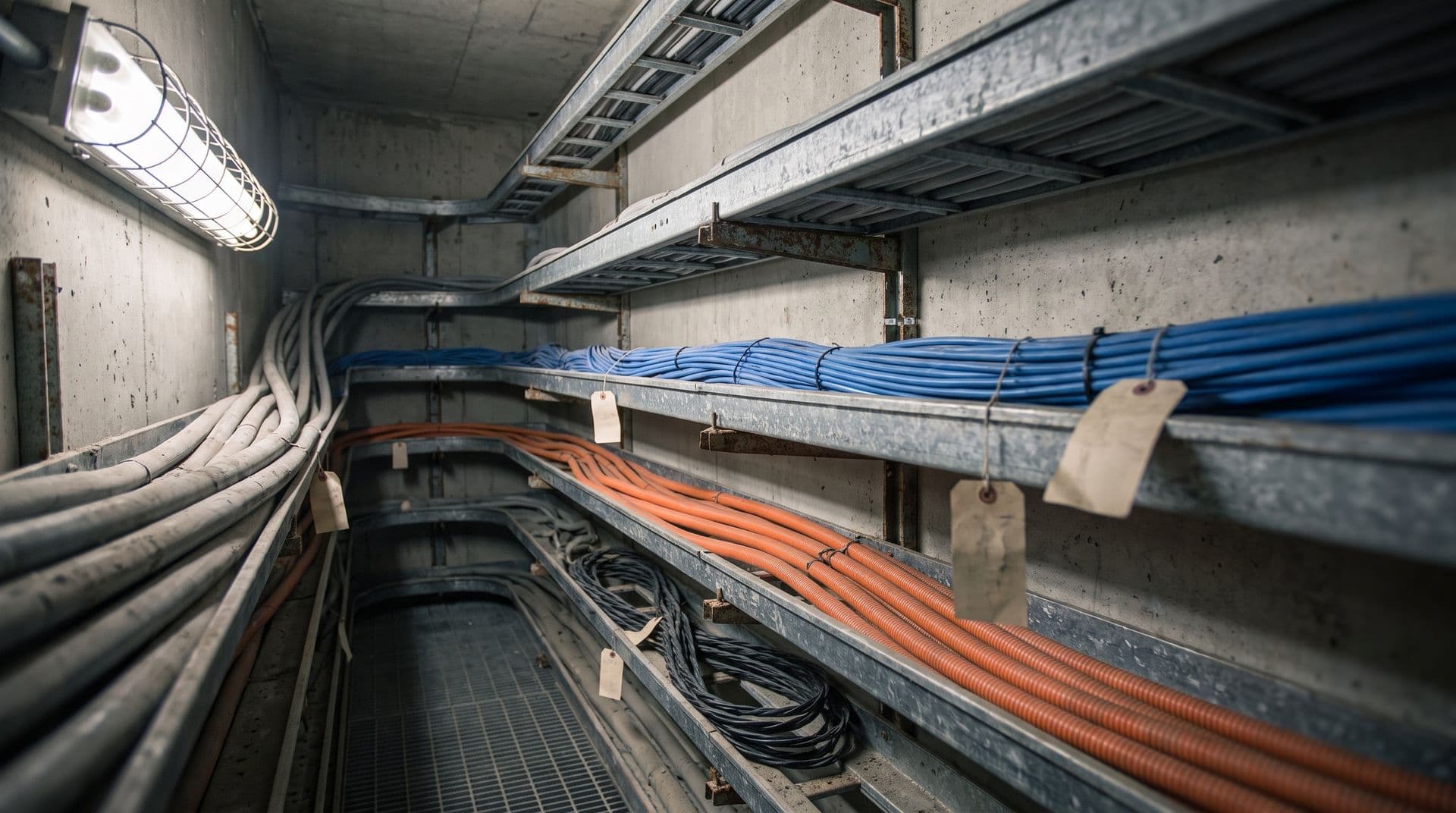
In 1967, a programmer named Melvin Conway sent a paper to the Harvard Business Review. The journal rejected it. A trade magazine called Datamation printed it in April 1968, and the idea inside became famous as Conway's Law.
The idea, in plain words: whatever a group of people builds will end up shaped like the way those people talk to each other.
Conway's actual sentence was stiffer. Organizations that design systems, he wrote, "are constrained to produce designs which are copies of the communication structures of these organizations."
His own example is a perfect miniature. One organization put five people on a COBOL compiler and three people on an ALGOL compiler. The COBOL compiler ran in five phases, and the ALGOL compiler ran in three. The software copied the org chart.
Fred Brooks gave the idea its name in The Mythical Man-Month in 1975, and it kept collecting proof. In 2008, Microsoft researchers studied all 3,404 binaries in Windows Vista. Org-chart metrics predicted which parts would fail better than code complexity or churn did.
Software people find this spooky. Building people should find it familiar.
Conway's Law, plant-room edition
Walk through almost any commercial building or factory in Malaysia and you are reading a fossil record of meetings that never happened.
There is the chiller that talks to nothing. Not because it can't. The port is right there. But the mechanical contractor and the controls contractor were on different contracts, and they never sat in the same room.
The BMS, the fire system and the access control run on three separate networks. Why three? Because three departments held three budgets in three different years. Nobody decided to build silos; three purchase orders decided it.
And the famous OT/IT air gap? Often that is just the boundary between the FM team and the IT team, drawn in cable. We wrote a whole piece on why those two teams clash. The short version: they have different first principles, and the network diagram shows it.
Every retrofit adds one more layer, shaped like whichever vendor sold it that budget year.
Here is the part I love. The building industry proved Conway right back in 1987. Machines from different vendors could not talk to each other, and the first fix was not technical. It was a meeting.
ASHRAE formed a committee in Nashville in June 1987, and that committee eventually gave us BACnet. To make the machines talk, the humans had to form an organization first.
Fix the meetings before the wiring
This is why integration projects fail organizationally before they fail technically. You can buy every gateway on the market. But if the chiller team and the electrical team never share a meeting, the gateways will not save you. Your "integrated" system will quietly split back into camps at the next retrofit.
Software people have a name for the fix: the inverse Conway maneuver, coined by Jonny LeRoy and Matt Simons of ThoughtWorks in 2010. If the system copies the communication structure, then change the communication structure first, and build second.
For a building, this looks boring and cheap. One operations meeting instead of four. One person who owns energy outcomes across HVAC, production and tenant areas. FM and IT in the same room before anyone pulls a cable.
Then pick the technology. This is honestly why we built CobiNeural as an overlay on existing BMS, PLC and SCADA systems. An overlay is the technical shape of a truce. Everyone keeps their own network, the whole organization gets one shared view, and nobody has to surrender first.
Where the metaphor breaks down
To be fair to buildings, they do not only copy org charts. Fire systems are kept separate partly because Bomba rules and certification demand independence. That is a silo you should keep. Some fragmentation also comes from the vendor market itself, which no internal reorg can fix.
Time matters too. A chiller lasts 30 years; an org chart lasts three. So a building is really a stack of printouts, one for every org chart it has ever had. A 2016 review of 142 studies (Colfer and Baldwin) found this mirroring common but not universal.
And Martin Fowler's caveat applies double to concrete: reorganizing the people will not instantly fix a rigid existing architecture. Changing who talks to whom changes the next retrofit, not the last one.
Still, the law holds where it matters. You cannot exempt your building from Conway's Law. But you can choose which communication structure it copies next.
If you want to see what one shared view of a many-vendor building looks like, book a demo. Bring the FM team and the IT team. Same room. That is most of the trick.
FAQ
Frequently asked questions
Ask us about this topic
Something in this article you want to dig into — or a situation in your own building it doesn't quite cover? Send us your question. We don't run public comments; the team replies to you directly by email.