Blog
LoRaWAN Explained: Long-Range Wireless for Energy Data
LoRaWAN gets energy data off scattered meters with no cabling and no per-device SIM fees. How it works - in plain analogies - and why it suits large-site energy monitoring.
 Tan Kok XinBMS & Building Technology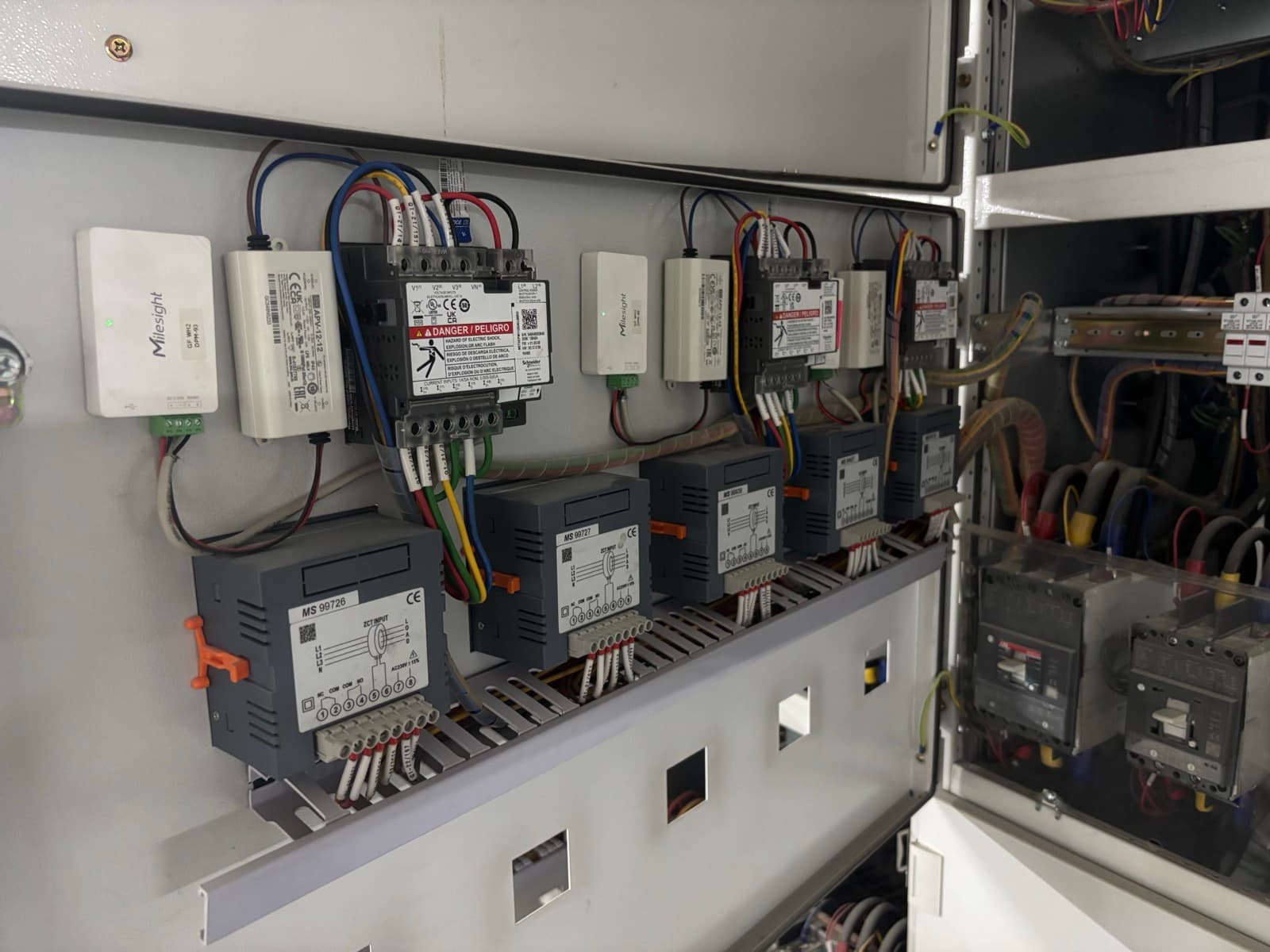
The problem LoRaWAN solves: getting data out of scattered meters
Picture a logistics facility, a factory, or a campus with power meters spread across switch rooms, sub-boards, and outbuildings hundreds of metres apart. You want every meter's energy data (kWh, demand, power factor) in one place, live. The old way is to trench and pull data cable to each one, or run it through occupied space at considerable cost and disruption. For a retrofit, that bill alone often kills the project.
LoRaWAN removes the cable. It is a long-range, low-power wireless protocol built exactly for sending small packets of data, like meter readings, across a large site on a tiny power budget. It is how you get energy data off equipment that was never wired for it, without opening up walls or paying for a SIM card on every device.
In short
- LoRaWAN solves the practical problem of getting data out of meters scattered across switch rooms and outbuildings without trenching cable.
- A LoRaWAN network has three parts: the meter-connected device, a gateway, and a server that collects the readings.
- Its long range and low power draw make it a strong fit for energy monitoring across a spread-out site.
- The result is live kWh, demand and power factor data from every meter in one place, without a wired retrofit.
What LoRaWAN is, in plain terms
LoRaWAN (Long Range Wide Area Network) is a type of LPWAN: a low-power, wide-area network. It trades speed for reach and battery life. You will never stream video over it, but you can send a meter reading several kilometres on a sliver of power.
An analogy: WiFi is a conversation across a room. It is fast and detailed, but it does not carry far and it drains your battery to keep shouting. LoRaWAN is a foghorn. It sends a short, low, distinctive note that carries for kilometres, even through rain and walls, precisely because it is slow and simple. You would not hold a chat with a foghorn, but to say "I am here, my reading is 412 kWh" once a minute, it is perfect.
It runs on unlicensed radio spectrum (the sub-GHz band around 920 MHz in Malaysia), so the airtime between your devices and the gateway is free and carrier-independent. Unlike cellular IoT, the individual meters and sensors do not each need a SIM or a data subscription. The gateway still needs one path back to the internet (ethernet, WiFi, or a cellular SIM at remote sites), but that is a single connection for the whole network, not one per device.
How it works: devices, gateway, server
A LoRaWAN network has a simple shape — a star, like a wheel with spokes:
- End devices are the sensors and controllers out in the field. They broadcast small messages.
- A gateway is the hub. It listens on the radio band and relays everything it hears up to the server over normal internet.
- The network and application server decrypt, de-duplicate, and hand the data to your software.
The gateway is best understood as a cell tower for your sensors, or a radio mast. Here is the part that surprises people: end devices are not "paired" to a gateway the way a Bluetooth earbud pairs to a phone. A device simply broadcasts into the air, and any gateway in range hears it and forwards it. Add a second gateway for a far corner of the site and your devices use it automatically. No reconfiguration, no handshake.
Each message also rides on a spreading factor, which is the dial between range and speed. Think of talking across a noisy hall: speak slowly and deliberately and someone far away catches every word; speak quickly and only those close by keep up. A device far from the gateway "speaks slowly" (high spreading factor) to be heard at distance; a close one "speaks quickly" and frees the airwaves for others. Cleverly, signals at different spreading factors do not interfere, which is how a single gateway can serve thousands of devices at once.
And because a device wakes, sends a tiny packet, and goes back to sleep, a battery sensor can run for years: the radio equivalent of mailing a postcard now and then rather than holding an open phone call.
What it looks like in the field
In a real Malaysian deployment, the two ends of the network are physically modest. The gateway is a small weatherproof box with a couple of antennas, mounted high on the building so it has a clear line of sight across the site.
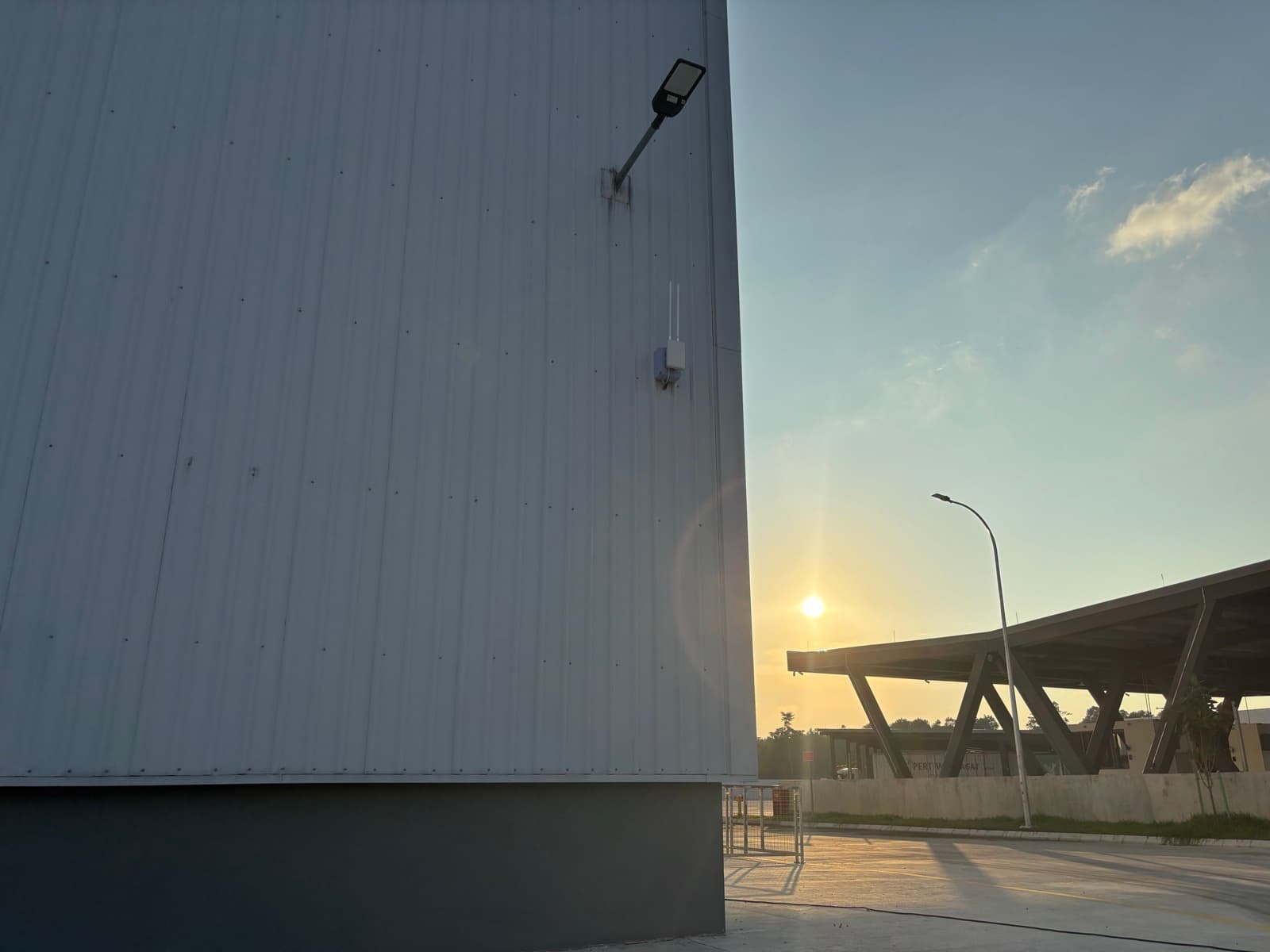
A LoRaWAN gateway on the building exterior - one hub hears every meter across the site.
At the data end sit the meters. Digital power meters measure each board's energy, demand, and power quality and publish those values over Modbus, the standard industrial data language, but a wired one. To get Modbus readings onto LoRaWAN, each meter is wired to a LoRaWAN Modbus controller: a small device that polls the meter over Modbus, packages the readings, and transmits them wirelessly to the gateway. One panel can hold several controllers reading a row of meters, turning a cabinet full of wired meters into a wireless feed of live energy data, with no long cable runs back to a server room.
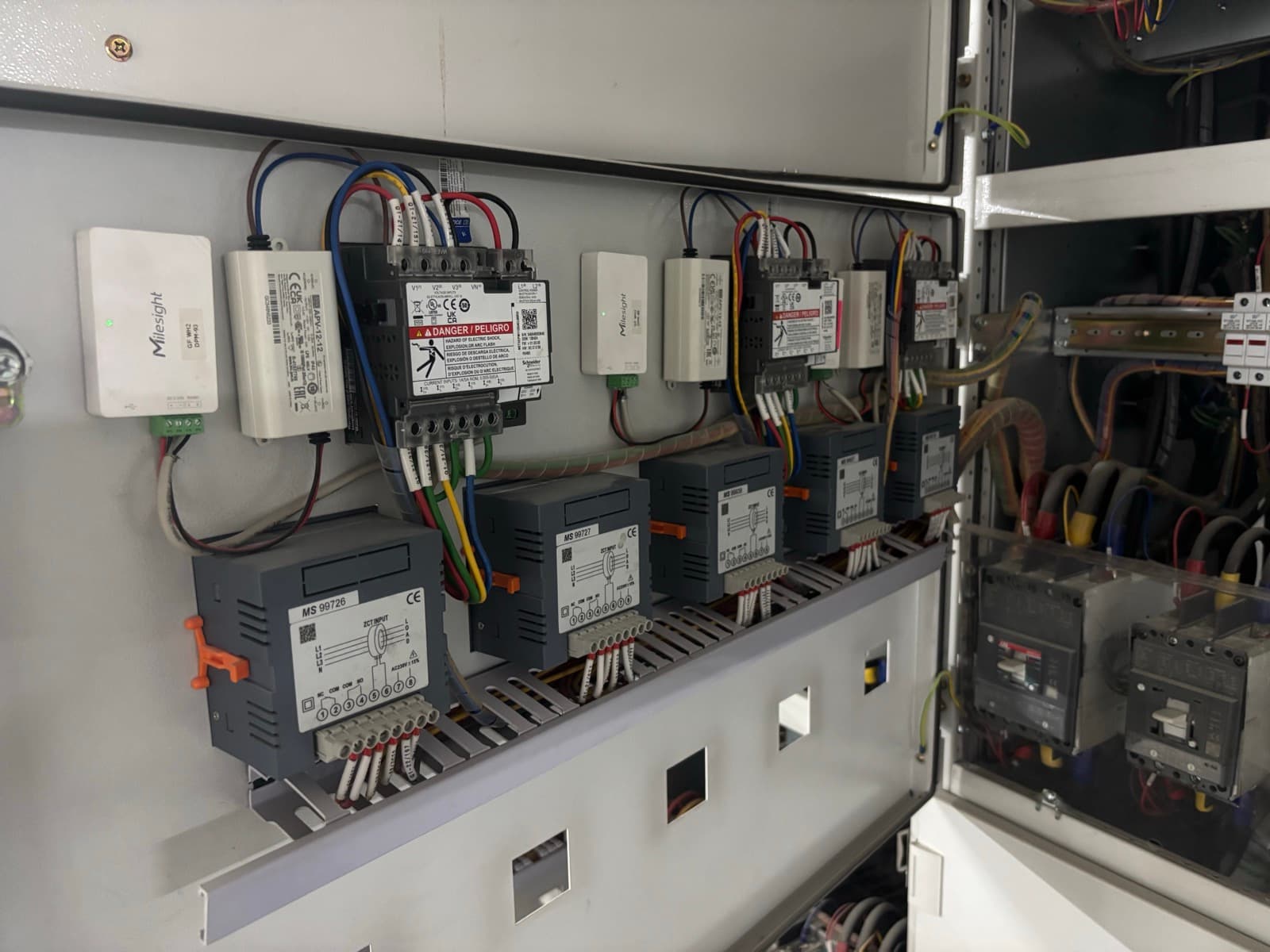
Digital power meters wired to LoRaWAN Modbus controllers - each controller reads a meter over Modbus and transmits the data wirelessly.
Why LoRaWAN is a strong fit for energy monitoring
The advantages stack up quickly for a building or industrial site:
- Long range. Two to five kilometres in a built environment, more in the open, so a single gateway usually blankets an entire facility or campus. One hub, whole site.
- Low power. Devices sip energy and battery sensors last years, so there is nothing to recharge and little to maintain.
- No cabling, no per-device subscriptions. The radio link is unlicensed, so there is no trenching and no SIM or data plan on each meter, unlike cellular IoT, where every sensor carries its own subscription. The gateway needs just one internet connection (ethernet, WiFi, or a single SIM at remote sites), so backhaul is one small cost, not a per-meter one. This is what makes retrofits affordable.
- It goes through buildings. Sub-GHz signals penetrate walls, floors, and switch rooms far better than WiFi, reaching meters in basements and plant rooms.
- It scales. One gateway handles thousands of devices, so adding meters later is trivial.
- It is secure. LoRaWAN encrypts every message end to end with AES-128, so readings are protected from device to server.
- It works with the meters you have. A Modbus controller bridges existing meters onto the network, so you are not ripping out instrumentation to go wireless.
That last point matters most in practice. You rarely start from scratch — you start with meters, controllers, and a building that already exists. LoRaWAN vs WiFi for buildings is not really a contest for this job; they do different things, and for low-power, long-range meter data, LoRaWAN wins.
From radio packet to energy decision
Getting the data off the meter is only step one. Those readings have to become something a facilities team acts on: a load profile, a maximum-demand alert, a sub-metering breakdown by tenant or system. That is where the data lands in CobiNeural, which ingests the LoRaWAN feed alongside everything else and turns it into energy, demand, and sub-metering insight, with building automation layered on top where control is needed. The radio is the plumbing; the value is in what the platform does with the water.
For how a BMS senses, decides and controls a building, see our free course Building Automation & BMS Fundamentals.
LoRaWAN is what makes that data affordable to collect in the first place, especially across older or sprawling sites where wiring every meter was never going to happen. See how it feeds real deployments in our case studies, or request a demo to scope wireless energy monitoring for your own facility.
FAQ
Frequently asked questions
Ask us about this topic
Something in this article you want to dig into — or a situation in your own building it doesn't quite cover? Send us your question. We don't run public comments; the team replies to you directly by email.