Blog
Malaysia Electricity Price Outlook 2027
The AFA has swung 12.7 sen/kWh in fourteen months. Here is what the fuel, carbon, regulatory and green-procurement evidence actually supports for 2027 C&I budgets, with confidence levels attached and fact separated from opinion.
 Tan Kok XinTNB Bills & Tariffs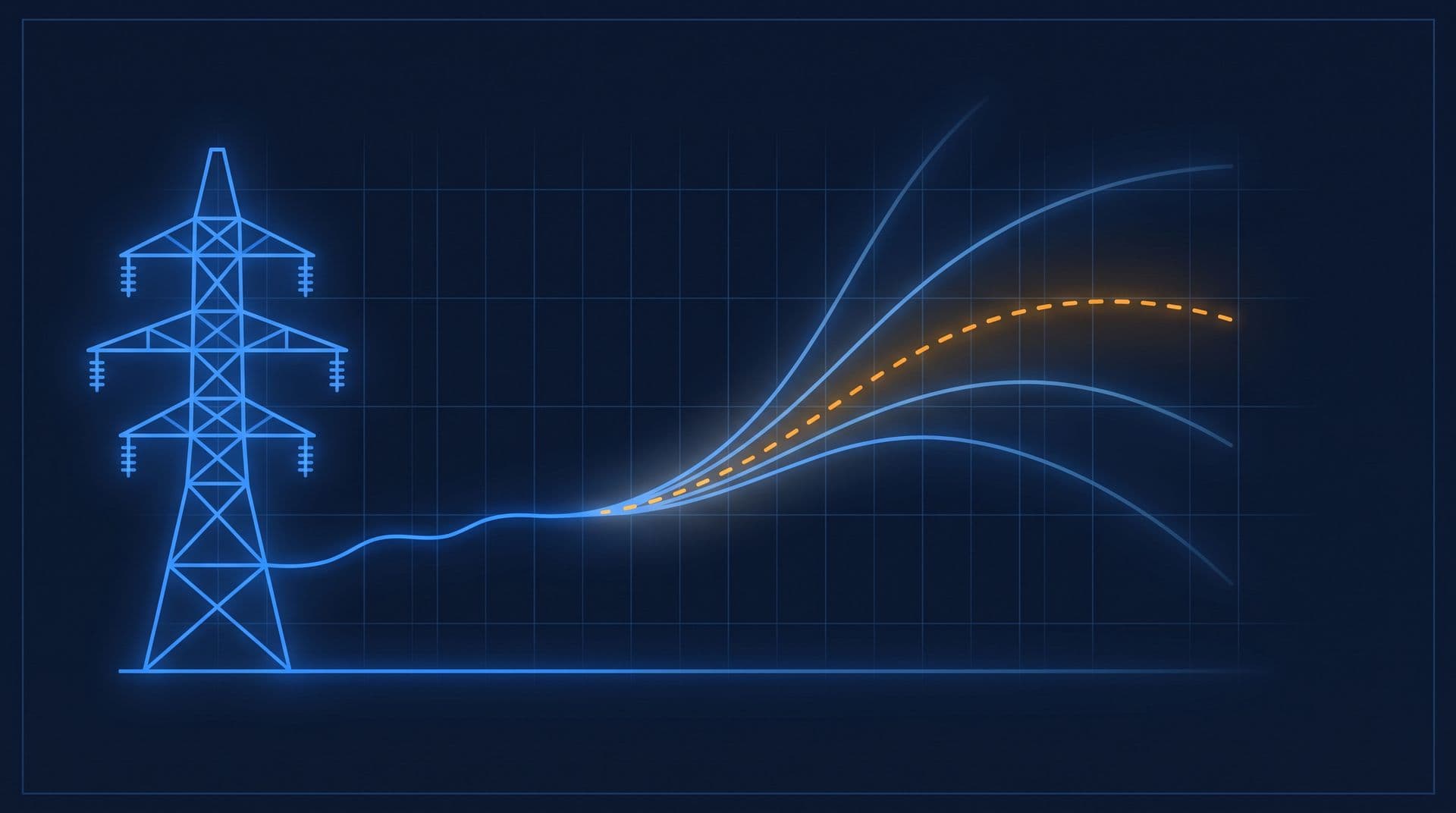
For a 2027 budget, plan the Malaysia electricity price as a range: the Peninsular Malaysia base tariff is fixed through the regulatory period, while the monthly Automatic Fuel Adjustment (AFA) can change. Our assessment is that three of the four pressures on bills can be estimated within a range; the carbon-tax impact remains too uncertain.
In November 2025, AFA was minus 8.91 sen/kWh. In October 2026, it is plus 3.61. That is a 12.52 sen swing on every kilowatt-hour (kWh) in under a year, against a base tariff of 45.62 sen. TNB's own projection puts January 2027 at plus 7.59, double today's rate. Your 2027 operating expenditure budget needs to allow for that uncertainty.
In short
- The Peninsular Malaysia base tariff is fixed through the regulatory period; the Automatic Fuel Adjustment (AFA) is the part that moves monthly.
- Four pressures will shape 2027 bills, and three of them can be estimated within a range; the carbon-tax impact remains too uncertain to size.
- AFA moved from minus 8.91 sen/kWh in November 2025 to plus 3.61 in October 2026, and TNB projects plus 7.59 for January 2027.
- For a 2027 budget, the practical levers are reducing demand, correcting power factor and reviewing load timing, since the base tariff itself is fixed for now.
Where the Malaysia electricity price sits in October 2026
The base tariff is fixed at 45.62 sen/kWh, but AFA changes each month. The Energy Commission approved that base for Regulatory Period 4 (RP4), the Tenaga Nasional Berhad (TNB) tariff structure in force since July 2025. It covers 2025 to 2027 and is up 14.2% from the previous regulatory period, RP3, at 39.95 sen (TNB Bursa announcement, 26 Dec 2024).
The published AFA figures show how the adjustment moved from a discount to a surcharge:
Month | AFA (sen/kWh) |
|---|---|
July 2025 | 0.00 |
November 2025 | -8.91 |
January 2026 | -4.99 |
March 2026 | -2.15 |
April 2026 | -0.47 |
May 2026 | +1.38 |
June 2026 | +2.59 |
July 2026 | +3.59 |
August 2026 | +3.80 |
September 2026 | +3.67 |
October 2026 | +3.61 |
Discounts widened through the second half of 2025, reached their largest point in November, then narrowed until AFA turned into a surcharge in May 2026. It peaked at +3.80 in August and has eased slightly since. The total spread is larger than a quarter of the base tariff (paultan.org, 1 Oct 2026). Our AFA explainer covers how the adjustment works.
August's headline rate included a subsidy. Before the subsidy, AFA was 4.28 sen/kWh. The Kumpulan Wang Industri Elektrik (KWIE) industry fund absorbed 11% of the cost increase, worth 0.48 sen/kWh, compared with 35% and 1.96 sen/kWh in July. The fund was covering a smaller share of the increase (paultan.org, 1 Aug 2026).
The plus or minus 3 sen band commonly called an AFA “cap” acts as a review threshold. Published rates have exceeded it in both directions. Movement beyond the band is understood to require cabinet approval, so do not treat it as a ceiling in your budget.
What four pressures will shape 2027 bills?
Fuel prices and exchange rates, carbon-tax policy, tariff reviews and green electricity procurement will shape the outlook. The confidence levels below reflect our assessment of each pressure, with our budget recommendations labelled separately.
Fuel and exchange rates: high confidence, with coal driving the surcharge
Coal and Tier 2 gas are driving the current surcharge. In the October 2026 calculation, Tier 2 gas is RM58.92/mmBTU against a base of RM46, while Tier 1 piped gas is RM32.68/mmBTU, below its RM35 base. The unit mmBTU means a million British thermal units.
Coal is USD 123.76/MT against a USD 97 base, where USD means US dollars and MT means metric tonnes. The ringgit, at 4.0834 to the dollar, is stronger than the 4.307 assumed in the base, which softens the coal cost gap slightly (paultan.org, 1 Oct 2026).
Our assessment: calm Tier 1 gas prices are not enough reason to assume the surcharge will fall. Coal and Tier 2 gas prices are carrying the surcharge, and Malaysian policy controls neither. The ringgit is helping for now; a weaker ringgit would add to the surcharge.
TNB publishes a rolling three-month projection alongside each monthly rate. On 1 October 2026 it projected +4.27 sen/kWh for November, +4.46 for December and +7.59 for January 2027 (paultan.org). These projections can change; they are assumptions for a budget, not confirmed future rates. The published series gives no basis for assuming discounts will return in 2027 without a fall in coal and gas prices.
Sites that also burn piped gas have a separate distribution tariff reset to consider. Gas Malaysia's base average distribution tariff is RM1.880/GJ/day for 2026 to 2028, rising to RM2.114 after the incentive-based regulation adjustment. Here, GJ means gigajoule, a unit of energy (The Edge Malaysia).
Carbon tax: low confidence of any 2027 bill impact
The effect of carbon tax on 2027 electricity bills remains uncertain because implementation is under review. The tax on iron, steel and energy was announced for 2026 and reaffirmed in the Budget 2026 speech in October 2025. In April 2026, the Minister for Environmental Sustainability and Natural Resources said implementation was under review “in light of current geopolitical circumstances”, with the near-term focus moved to verifying carbon credits (Eco-Business, 22 Apr 2026).
Our assessment: do not include a direct carbon-tax line in your 2027 electricity budget. Track developments alongside the National Climate Change Bill, because a carbon price on electricity generation would eventually reach commercial and industrial users through generation costs. Our Malaysia carbon tax article covers the scope and rate detail.
RP4 and the next tariff review: high confidence for 2027, watch 2028
RP4 runs to 31 December 2027, so the tariff structure is known for that year. The next regulatory determination, RP5, will be negotiated and decided during 2027.
Our assessment: 2027 is the most predictable year for the current structure, but the least predictable for guidance on what follows. If you prepare three-year budgets, the 2028 line carries the regulatory risk.
Green electricity procurement: medium confidence, with an indirect effect
Green electricity schemes affect who pays for grid capacity, rather than reducing the base tariff. The Green Electricity Tariff (GET) has had a single tier since 1 July 2025, with premiums based on commitment length:
- One year: 5 sen/kWh.
- Two years: 4 sen/kWh.
- Three years: 3 sen/kWh.
The programme quota is 6,600 GWh, or gigawatt-hours. For bilateral supply, the Corporate Renewable Energy Supply Scheme (CRESS) has an announced project pipeline of roughly 4 GW, or gigawatts. The Energy Commission revised the CRESS guidelines on 29 December 2025 (Baker McKenzie, on both schemes).
Our assessment: neither scheme lowers the base tariff for anyone. If you are comparing a CRESS power purchase agreement with buying electricity from the grid, watch the System Access Charge. Its future direction remains the main uncertainty in that comparison. Our GET 2026 hedge math compares the GET premium with AFA volatility.
What is not likely to change before 2028
The base tariff, RP4 structure, demand-charge components, renewable energy levy and power factor thresholds are fixed for the regulatory period. For budgeting, these are:
- Base tariff: 45.62 sen/kWh.
- Medium Voltage demand charges: Capacity plus Network, RM89.27/kW per month on the General tariff and RM97.06/kW on Time of Use (ToU).
- Renewable energy levy on non-domestic bills: the 1.6% KWTBB levy, for Kumpulan Wang Tenaga Boleh Baharu.
- Power factor surcharge thresholds: 0.85 below 132 kV (kilovolts), and 0.90 at or above it. Power factor measures how effectively the electrical supply delivers useful power.
Our budget recommendation is to hold these constant and put the uncertainty allowance against AFA alone.
How should a 2027 budget handle this?
Use low, base and high AFA cases to show how changes would affect your costs. At an illustrative site using 500,000 kWh per month, every RM0.01/kWh movement changes the bill by RM5,000 a month, or RM60,000 a year.
The published range since RP4 began, from -8.91 to +3.80 sen, produces a monthly difference of RM63,550 at that consumption level. This example shows the exposure between the lowest and highest published months; it is not a forecast. TNB's January 2027 projection of +7.59 sen sits 3.98 sen above October's rate, which is another RM19,900 a month at the same site. Scale it to your own kWh.
Our suggested cases are all assumptions:
Budget case | AFA assumption |
|---|---|
Low | Zero |
Base | Trailing twelve-month average of the published series |
High | Top of TNB's published forward projection |
Record which case each department approved. When you review a budget variance in Q3 2027, you can compare the actual rate with the agreed assumption.
Reduce demand, correct power factor and review load timing
Maximum demand reduction, power factor correction and load shifting can reduce costs while tariff forecasts remain uncertain. Maximum demand (MD) is the recorded power demand used to calculate demand charges. On the Medium Voltage General tariff, each kW (kilowatt) of MD costs RM89.27 a month, so each kW permanently removed saves RM1,071.24 a year (RM1,164.72 on ToU), independently of AFA. Our guide to cutting TNB maximum demand charges covers the methods.
For supplies below 132 kV, keeping power factor above 0.85 avoids a surcharge. You can calculate the payback period for correction hardware from the surcharge it avoids.
Load shifting means moving electricity use to a different time. It does not reduce AFA, which is charged at the same rate on every kWh at any hour. What it does reduce is demand: spreading loads out lowers the monthly peak that sets the capacity and network charges, and on a ToU tariff it moves kWh to the cheaper off-peak rate. Our ToU tariff guide shows how to test whether ToU pays.
If you want to see this on your own bill, our free maximum demand calculator estimates the charge from your kW and tariff. For the full mechanics of a TNB bill, see our free course Understanding Your Electricity Bill.
Before you finalise your 2027 budget, request a demo. We will walk through what your interval data shows about your site's maximum demand, power factor and load profile.
FAQ
Frequently asked questions
Ask us about this topic
Something in this article you want to dig into — or a situation in your own building it doesn't quite cover? Send us your question. We don't run public comments; the team replies to you directly by email.