Blog
Edge vs Cloud for Building & Energy Systems
Edge or cloud? For a building platform the answer is both - time-critical control at the edge, heavy analytics and the portfolio view in the cloud. Here's which job goes where.
 Tan Kok XinBMS & Building Technology
Edge vs cloud for building and energy systems: where should the computing happen?
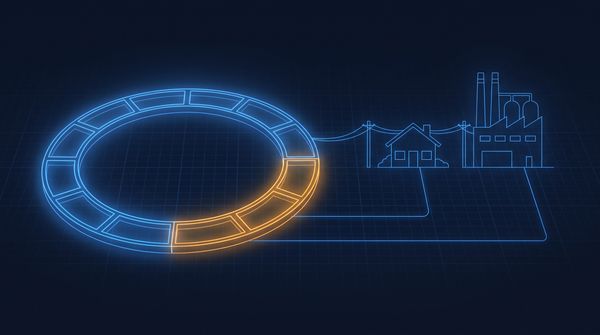
Edge means processing data on-site, near the equipment that produced it. Cloud means sending it to remote servers to be stored and analysed. For a building or energy platform the honest answer to "which is better" is both — the time-critical work belongs at the edge, the heavy analysis and the portfolio view belong in the cloud. The skill is knowing which job goes where. Putting the wrong job in the wrong place is how systems end up either fragile or slow.
What "edge" and "cloud" mean on a real site
On a building or industrial site, the edge is the layer of hardware physically present in the plant room and switch rooms: controllers, PLCs, gateways, local servers. They sit on the same network as the chillers, meters and motors, so they see data instantly and can act on it without leaving the building.
The cloud is remote infrastructure reached over the internet. It has effectively unlimited storage and compute, it's accessible from anywhere, and it's where data from many sites can be brought together. The trade-off is the trip: data has to travel there and back, and that depends on a working internet connection.
The numbers frame the decision. Edge processing responds in single-digit milliseconds, while a round trip to the cloud typically runs from tens to a couple of hundred milliseconds. For storing a year of energy history that difference is irrelevant. For a safety interlock or a fast control loop, it's the whole game.
What belongs at the edge
Anything where waiting for the cloud is unacceptable stays local:
- Real-time control. Staging a chiller, holding a setpoint, tripping an interlock: these are deterministic control jobs that must run in milliseconds and must never pause because the internet dropped. This is the BMS, PLC and SCADA layer, and it's correctly built at the edge.
- Operation through an outage. A building can't stop cooling because its broadband failed. Edge systems keep running with local autonomy when the connection drops, and sync up again once it's back. For critical industrial process, that resilience isn't optional.
- First-pass data handling. Buffering readings, basic filtering, and local alarms can happen on-site so nothing is lost during a network interruption.
The principle: control and safety never depend on a connection you don't control.
What belongs in the cloud
Anything that benefits from scale, history, or a view across sites goes up:
- Long-term storage and trends. Years of energy, demand and equipment data, far more than local hardware should hold.
- Heavy analytics. Building the baselines that anomaly detection compares against, correlating energy with weather, computing portfolio KPIs. See what anomaly detection does.
- The portfolio view. One screen across every building is only possible when each site's data lands in a common place. That's the multi-site management case.
- Reporting and access. EECA reports, ESG accounting, and dashboards a manager can open from anywhere, on any site, without being in the plant room.
The cloud is where data from a fragmented estate becomes a single, queryable picture — something no individual edge device can do alone.
Why the right answer is a hybrid
Framing it as edge or cloud is a false choice. A well-designed building platform is hybrid: fast, critical work runs at the edge for speed and resilience; storage, analytics and the cross-site view run in the cloud for scale and reach. The two are designed to work together, not to replace each other.
This maps cleanly onto how a Smart Operation Platform sits over your controls. The control layer (your existing BMS, PLC and SCADA) stays at the edge, doing real-time control reliably. CobiNeural reads from that layer and lifts the data into a cloud platform for analytics, anomaly detection, reporting and the portfolio dashboard, then pushes optimisations back down through the automation layer when action is needed. Control stays local; intelligence scales in the cloud.
The Malaysian practicalities: connectivity, cost and data
A few realities shape the design here:
- Connectivity isn't uniform. A KL office tower has solid fibre; a remote plant or a sprawling logistics site may not. Edge resilience matters more the less reliable the link, which is also why wireless backhaul like LoRaWAN pairs well with edge buffering at remote meters.
- Bandwidth and cost. Sending every raw reading to the cloud continuously is wasteful. Sensible designs process and summarise at the edge and send what matters, cutting both bandwidth and cost.
- Data control. Keeping operational and process data on-site, with only what's needed leaving the building, is often a security and governance preference as much as a technical one.
So which do you need?
For how a BMS senses, decides and controls a building, see our free course Building Automation & BMS Fundamentals.
You don't choose one. You need control and safety at the edge, and analytics, reporting and the portfolio view in the cloud — joined into one system. If a vendor pushes a pure-cloud design that makes control depend on the internet, or a pure-edge design with no central intelligence across sites, ask which jobs they've put where and why. The answer should match the work: milliseconds at the edge, scale in the cloud. To see how that split would look for your estate, book a walkthrough.
FAQ
Frequently asked questions
Ask us about this topic
Something in this article you want to dig into — or a situation in your own building it doesn't quite cover? Send us your question. We don't run public comments; the team replies to you directly by email.