
Blog
Shearing Layers: Why Buildings Outlive Their Brains
Frank Duffy insisted there is no such thing as a building, only layers aging at different speeds. The fastest-dying layer is the one that remembers, and that is why buildings fail to learn.
 Tan Kok XinThe Essay Series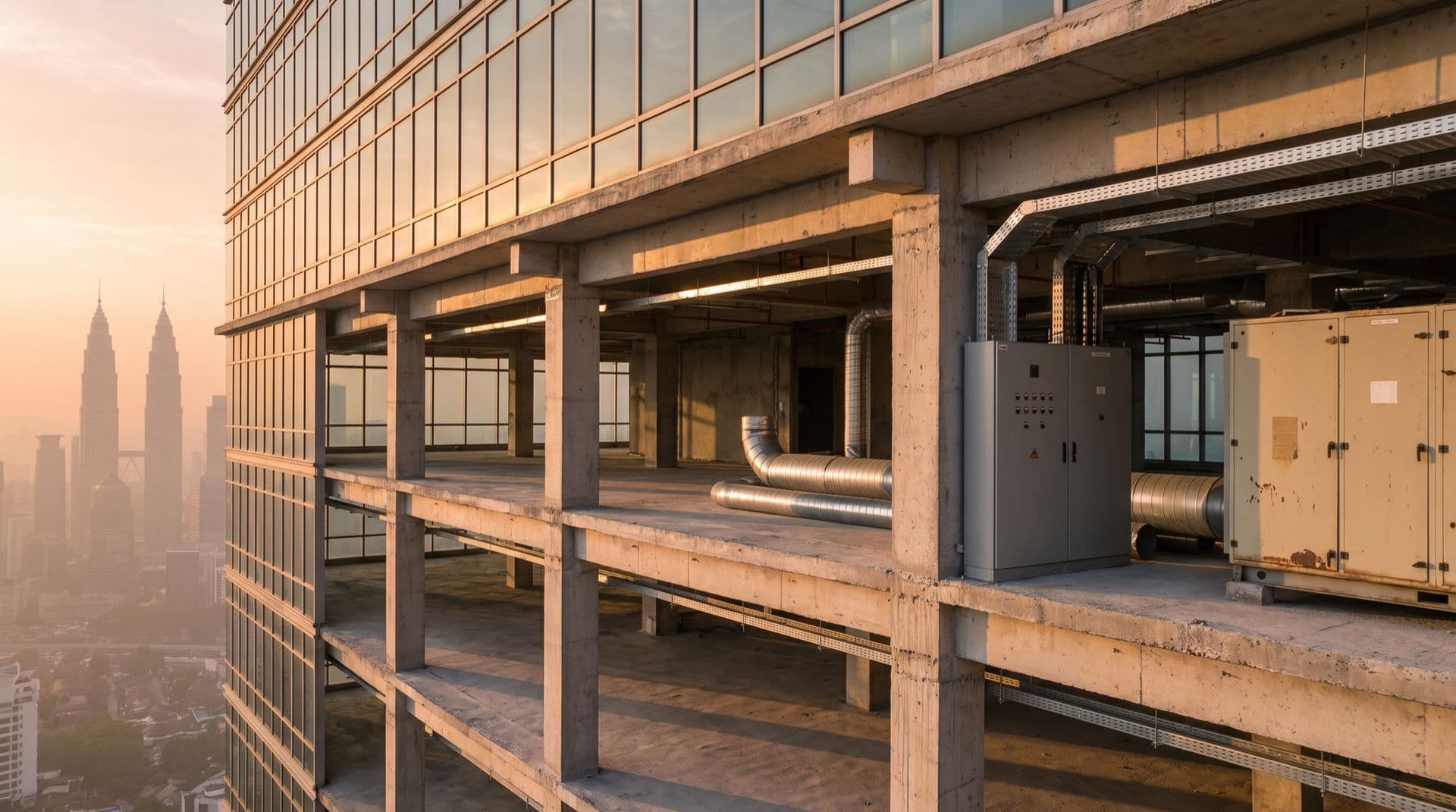
Frank Duffy died on 21 February 2026, at the age of 85. The obituaries listed the offices: president of the RIBA, co-founder of the workplace-design practice DEGW, one of the originators of facilities management. But his real legacy was an act of demolition performed entirely on paper. "Our basic argument is that there isn't any such thing as a building," he insisted. "A building properly conceived is several layers of longevity of built components." That idea became known as shearing layers, and Duffy spent fifty years arguing, in effect, that a building is not a noun but a verb. Not an object you finish, but a process you host.
Follow that idea into a Malaysian plant room and it explains why buildings outlive their own intelligence three or four times over, and why so few of them ever learn from it.
In short
- A building is made of layers that change at different speeds, from structure (decades) to space plan (a few years); shearing layers explains why buildings feel out of date faster than they age.
- Slow systems block the fast ones, and fast ones tear up the slow ones, when a building does not allow slippage between differently paced layers.
- Wiring intelligence permanently into slow-changing infrastructure is what causes a building to outlive its own brains.
- Keeping the intelligence layer separable from the physical layers is what lets a building's controls keep pace with how the building is actually used.
What are shearing layers?
Duffy's version came first. In Planning Office Space (1976), he and his DEGW colleagues cut the office building into four strata by lifespan: the Shell (structure, 30 to 50 years), the Services (cabling, plumbing, air conditioning, roughly 15), the Scenery (partitions and ceilings, about 5), and the Set (the furniture layout, which shuffles in months or weeks).
Stewart Brand took the idea and, in How Buildings Learn (1994), later a six-part BBC series scored by Brian Eno, stretched it into six S's: Site (effectively eternal), Structure (30 to 300 years), Skin (around 20), Services (7 to 15), Space plan (about 3 in a commercial building), and Stuff (daily to monthly). His diagram of nested layers slipping past each other came with two sentences that carry the whole idea. First, the design imperative: "An adaptive building has to allow slippage between the differently-paced systems... Otherwise the slow systems block the flow of the quick ones, and the quick ones tear up the slow ones with their constant change." Second, the bleaker corollary: "Because of the different rates of change of its components, a building is always tearing itself apart."
Brand borrowed the mechanism from hierarchy theory in ecology: the dynamics of a system are dominated by its slow components, with the rapid ones following along. Slow constrains quick. His beloved exemplar was MIT's Building 20, a "temporary" 1943 structure meant to last the duration of the war and six months. It stood for 55 years and hosted the Radiation Lab, Chomsky's linguistics, Bose's speaker research, and work by nine Nobel laureates. Nobody loved Building 20 because it was permanent. They loved it because its quick layers could be torn at without ceremony, so it could keep learning.
The plant-room ledger
Duffy and Brand wrote before IoT and cloud analytics, so their layers stop at Stuff. Add a seventh column to the ledger, and this is our extension, not theirs: the controls and data layer. Then run the arithmetic against ASHRAE's median equipment service lives. A centrifugal chiller: 23 years. Electronic controls: 15. Industry guidance puts a building management system at 10 to 15 years of useful life, and plenty of buildings are still running controllers installed 15 to 25 years ago on discontinued platforms and cannibalised spare parts.
Now take a KL office tower topped out in 1991. Its structure, at Brand's 30 to 300 years, has barely warmed up. Its chillers, at a 23-year median, mean it is on its second plant. Its controls, at 10 to 15 years, put it on its third generation and plausibly its fourth. That is arithmetic, not anecdote, and in the tropics the arithmetic runs hot: ASHRAE's medians come from temperate duty cycles, while a 24/7 cooling load in tropical humidity wears services out faster. And air conditioning accounts for around 58% of energy consumption in KL commercial buildings. The fastest-shearing layer sits directly under the largest line on the TNB bill.
Here is the part that matters. When a chiller is scrapped, the building loses a machine. When a controls generation dies, it loses a mind. The setpoints tuned over a decade of complaints, the schedules that encode which tenant works Saturdays, the trend logs, the alarm thresholds, the operator's accumulated sense of what normal looks like: all of it was welded to the hardware, so all of it went to the skip with the panel. The layer whose job is remembering is the layer that gets replaced most often. That, precisely, is why buildings fail to learn.
Never weld your intelligence to your infrastructure
Brand's slippage rule is usually read as architecture. Read it instead as procurement. If the fast layers must be free to churn without tearing the slow ones, then the reverse also holds: the things you want to keep must not be bolted to the things you expect to replace.
This is why ripping out a working BMS to get better analytics is a category error. It replaces a services-layer component to fix an intelligence-layer problem, like reroofing a building because you lost the filing cabinet. The alternative is overlay architecture, which is pace layering made literal: a platform like CobiNeural sits above the existing BMS, PLC and SCADA rather than inside them, so the baselines, the measurement-and-verification history, and the reporting record survive every equipment swap underneath. The record outlives the recorder.
Keep this distinct from the Ship of Theseus problem we've written about before. Theseus asks whether identity survives replacement. Shearing layers asks what happens when parts are replaced at different speeds, and what the friction between those rates destroys. One is a question about identity; this one is a question about rates.
Malaysia has quietly raised the stakes on getting this right. The Energy Efficiency and Conservation Act 2024 (Act 861), in force since 1 January 2025, requires large energy users to appoint a registered energy manager, run an energy management system, and submit reports, while offices of 8,000 m² and above face a BEI cap of 250 kWh/m²/year with annual energy-intensity labelling. That is a compliance clock ticking every year, faster than any equipment layer turns over. A BEI trend that resets to zero every time the controls generation dies is worthless to a regulator and worse than worthless to the owner. Only a data layer that slips free of the equipment beneath it can keep feeding those reports across chiller and controls generations.
Where the metaphor ends
Honesty about the seams. The seventh layer is ours, not Duffy's or Brand's; they wrote before the cloud existed, so it is an extension of the model, not a citation. Brand's lifespans are empirical averages from US and UK building stock, not physical law; Malaysian duty shifts the numbers even where the ordering holds. Nor do the layers separate cleanly in a real plant room: controls live physically inside services as actuators, sensor wiring and panel I/O, so a chiller replacement will always drag some of the controls layer out with it no matter how well you architect. The mechanisms differ too. Concrete and compressors shear under mechanical and thermal stress; software "wears out" through vendor obsolescence, discontinued protocols and unsupported platforms. That shearing is economic and institutional rather than material, even where the pattern rhymes.
And Brand's own rule can invert. Slow constrains quick, usually, but sometimes the fast layer should force change in the slow one: analytics revealing a chronically oversized chiller plant, or a power factor quietly taxing every bill, is the fast layer correctly instructing the slow one. Brand allowed for this himself: in his pace-layering account, the fast layers are where the learning happens, and what they learn accrues upward into the slow ones. The lesson is not never touch the slow layers. It is never let the fast layer's death erase what the building has learned. One more caveat: How Buildings Learn is partly an aesthetic and civic argument about loved, vernacular buildings; compressing it into a BMS procurement rule is legitimate, but it is a narrowing. Duffy, who thought buildings should be judged over decades of use rather than at the ribbon-cutting, would probably have forgiven us.
Brand later generalized shearing layers into pace layering and distilled it into an aphorism: "Fast learns, slow remembers." In the plant room, the assignments are exact. The structure remembers by standing. The overlay learns by watching. A building becomes intelligent only when the two are allowed to slip past each other without tearing, so that the third chiller plant and the fourth controls generation inherit everything the first ones knew.
If your building is older than its BMS, and it almost certainly is, it might be worth seeing what an overlay remembers on its behalf. Request a demo and we'll show you.
FAQ
Frequently asked questions
Ask us about this topic
Something in this article you want to dig into — or a situation in your own building it doesn't quite cover? Send us your question. We don't run public comments; the team replies to you directly by email.